MSE 280 Exam 2
True or false.
A flaw in the materials lowers the fatigue life.
True
True or false.
Failure by fatigue requires an applied stress greater than the yield stress/
False
True or false.
Fatigue failure occurs earlier with a higher positive (tensile) mean stress.
True
True or false.
The stress concentration is lower around a crack than around a hole.
False
True or false.
The stress concentration is higher around a large hole than a small hole.
True
True or false.
The stress concentrated more near an internal flaw than with near a surface flaw.
False
What polymer/condition would have the highest ductility?
Thermoplastic at T>Tg
What polymer/condition that would have the highest ductility?
Thermoplastic slowly loaded
True or false.
The strength of a metal increases with increased temperature
False
True or false.
A Rockwell hardness of 100 is the same as a Brinell hardness of 100
False
What is the metal with the highest stiffness?
Steel
What is the metal with the highest melting point?
Steel
What is the metal witht he highest yield strength?
Steel
What is the metal with highest ultimate tensile strength?
Steel
What is the metal with the highest ductility?
Aluminum
What happens to the creep rate at increased temperatures?
It increases exponetially
What happens to the creep rate at increased loads?
It increases
Typically as the strength of a metal increases what happens to the ductility?
Decreases
An 650 lb tensile force is applied to an 0.12 inch diameter nickel wire having a yield strength of 45,000 psi and a tensile strength of 55,000 psi. Will the wire plastically deform?
Yes
An 750 lb tensile force is applied to an 0.14 inch diameter nickel wire having a yield strength of 45,000 psi and a tensile strength of 50,000 psi. Will the wire experience necking?
No
Possible mechanical properties obtained from a bend test include (more than one answer is possible)
The modulus of rupture and the modulus of elasticity in bending (flexural modulus)
At room temperature, if you want to increase the strain in a steel, what has to happen to the applied stress?
it mus be increased
The following graph shows tensile test results for three metal alloys. The metal with the highest yield strength is
steel
Will a thermoplastic polymer be more brittle or more ductile above the glass transition temperature (versus below the glass transition temperature)?
it will be more ductile
The metallic crystal structure with a ductile to brittle transition temperature is
BCC
true or false.
In most materials when strength is increased, ductility also increases.
false
Which material has the higher ductility
metal
The two most common impact test types are
charpy and izod
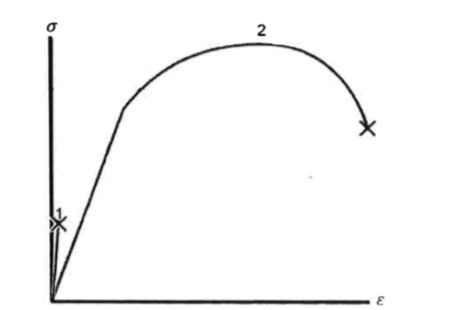
Which of the following curves is a typical tension test result for a ceramic?
curve 1
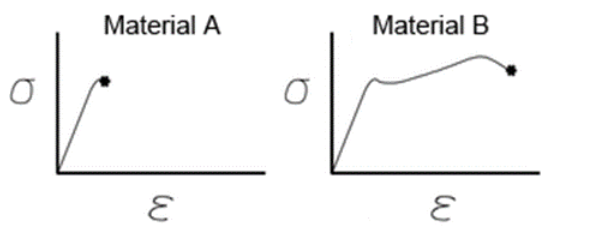
The tensile curve from the material with the lowest ductility is
curve A
What happens to the strengths of a metal when the temperature increases significantly?
decreases
How does the strain change with time for a viscoelastic material that is held at a constant applied stress?
increases
true or false.
There is a distinct change in density when a liquid transforms to an amorphous solid.
false
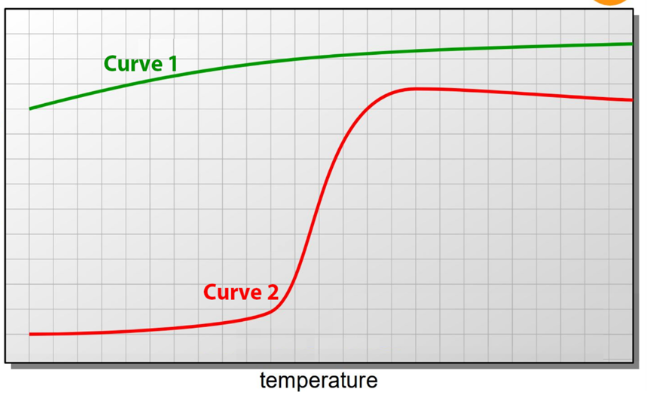
Match the curve in the following graph to the metal crystal structure.
1- FCC
2- BCC
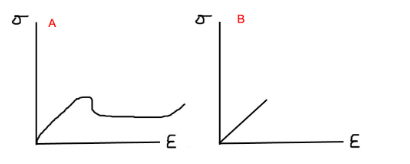
The tensile test for a slowly loaded thermoplastic and a rapidly loaded thermoplastic are shown below. Match the curve with the load rate.
A- slowly loaded
B- rapidly loaded
The tensile curves for a slowly loaded thermoplastic above the glass transition temperature and a slowly loaded thermoplastic below the glass transition temperature are shown below. Match the curve with the temperature of testing
A- above the glass
B- below the glass
Match the following hardness tests with their load range.
1. Brinell
2. Rockwell
3. microhardness
1. highest
2. medium
3. smallest
Elastic deformation is permanent deformation.
false
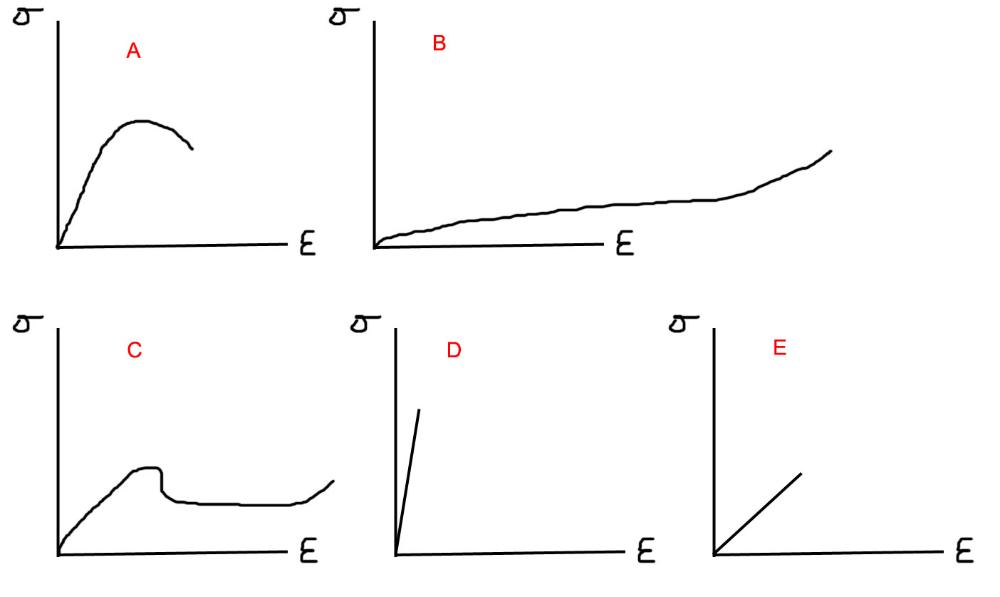
Match the curves
A Rockwell C hardness of 50 is the same as a Brinell hardness of 50.
false
A brinell hardness value of 100 BHN is the same as a Rockwell hardness value of 100 RB.
false
The boundary between plastic and elastic deformation on a tensile test is called
yield strength
Does a more ductile or a more brittle steel have a higher ductile to brittle transition temperature?
more brittle
Which material has a highest modulus?
cermaic
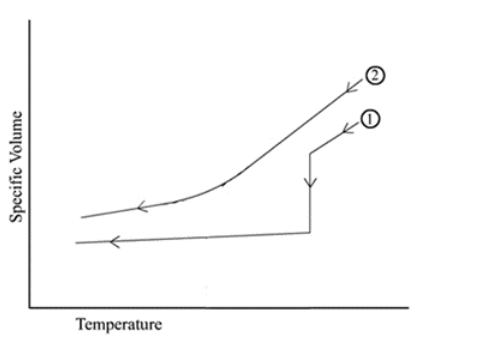
Which of the following curves represents the change in specific volume (1/density) of an amorphous material with temperature?
curve 2
A steel is to be used in Alaska where the temperature in winter can become extremely cold. The material will experience some impact loading. Would an fcc steel or a bcc steel be preferable? Why?
FCC
Which material has the higher ductility and yield point?
metal
The following shows two part, that are the same except for the size of the crack in the part. Which part would you expect would fail at a lower stress?
the one with the larger crack
What is "fracture toughness" a measure of?
The resistance to fracture with a pre-existing flaw
The following shows two parts that are the same except for the shape of the flaw in the part. The flaw is the same length in the two parts. Which part would you expect would fail at a lower stress?
The part with the sharper crack
The critical surface crack length for a magnesium part is 0.2 inches. The nondestructive evaluation (NDE) technique used to evaluate the part has a resolution of 0.1 inches. The technique will resolve the critical flaws for this application.
true
Would you expect a part that has been carefully machined to a smooth finish to fail before or after a similar part with a rough machined surface?
after
Circle all of the following that will give failure at a lower applied stress.
a bigger flaw vs a smaller flaw
The most common cause of failure is
fatigue
The following shows two possible options for a highly stressed corner in a part you are designing. Which would you expect to last longer?
The design with the rounded corner
Which would you expect to be more sensitive to a flaw on it's surface
cermaic
Which of the following WOULD NOT have a longer fatigue life?
An aircraft with windows with square corners
The following shows two parts that are the same except for the location of the crack in the part. The crack is the same size in the two parts. Which part would you expect would fail at a lower stress?
The part with the crack on the surface
Which of the following can cause failure at applied stresses below the yield stress?
Stress corrosion cracking, a defect in a part, creep, and fatigue
Which of the following is NOT a good description of a ductile failure.
it requires little energy
At room temperature, if stress applied to a steel is constant, will the strain change over time?
no
Which of the following is true for stress corrosion cracking.
Associated with a corrosive environment.