Chapter 1: Introduction to Medical Language
Chapter 1.1 The Purpose of Medical Language
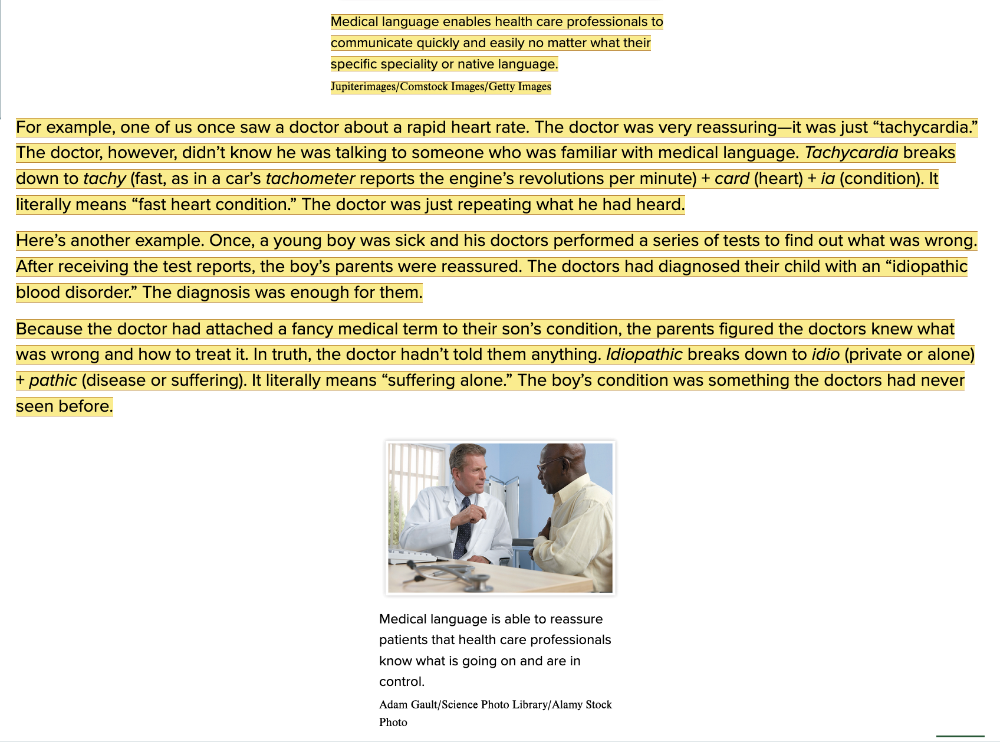
Chapter 1.1 The Purpose of Medical Language
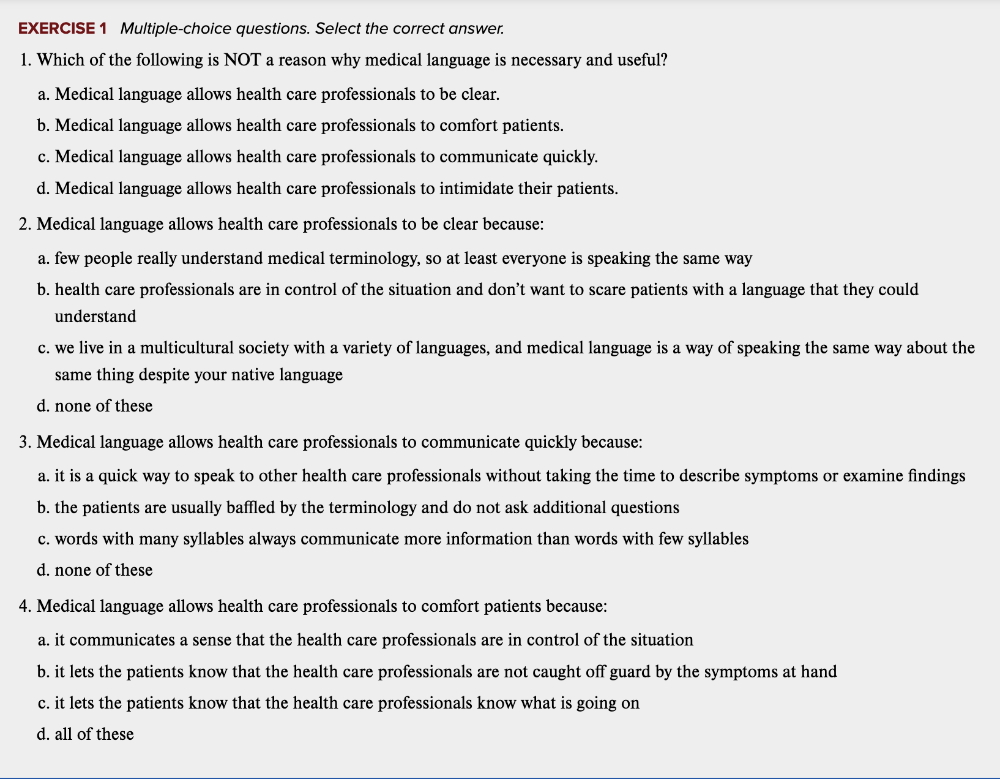
Learning Outcome 1.1 Exercises
1. d
2. c
3. a
4. d
Chapter 1.2 The Origins of Medical Language
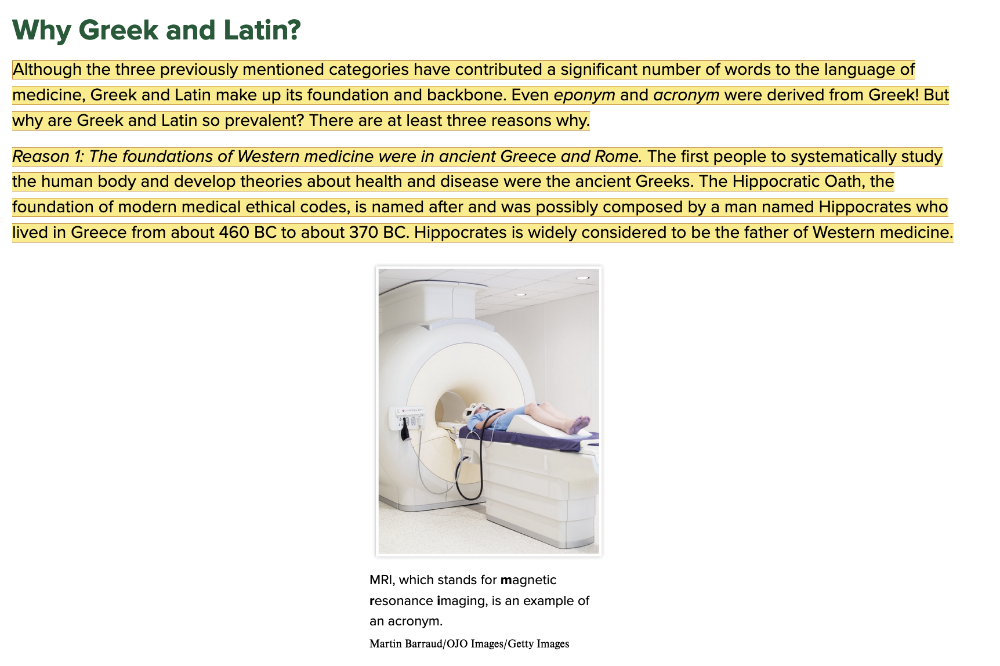
Chapter 1.2 The Origins of Medical Language
Chapter 1.2 The Origins of Medical Language
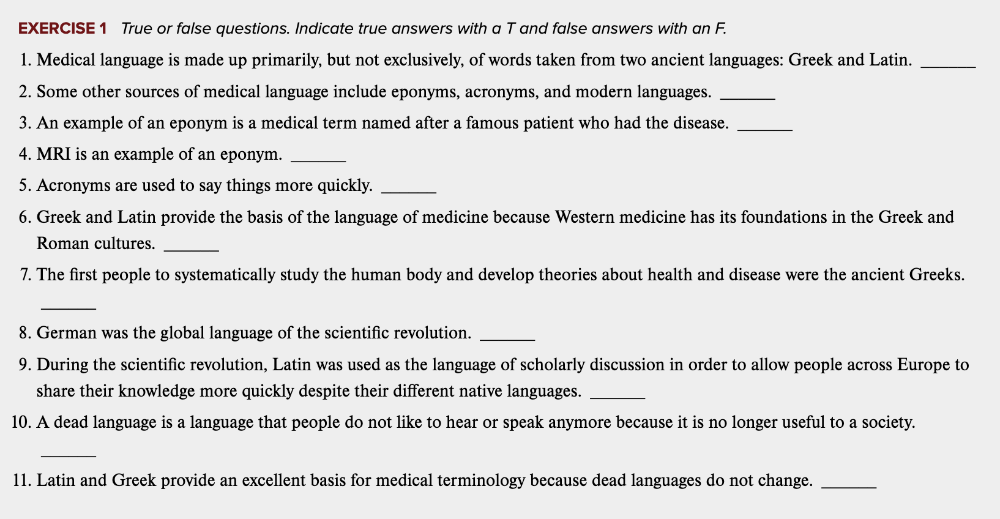
Learning Outcome 1.2 Exercises
1. True
2. True
3. True
4. False, it is an acronym.
5. True
6. True
7. True
8. False, Latin was.
9. True
10. False
11. True
Chapter 1.3 The Principles of Medical Language
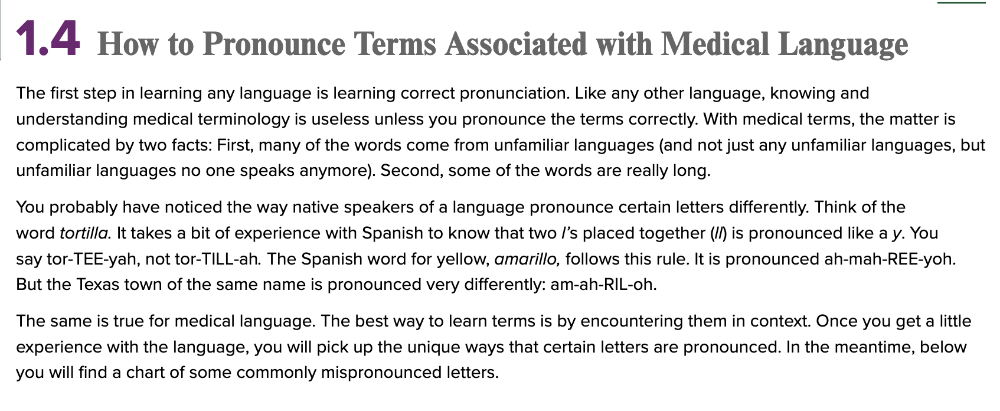
Chapter 1.4 How to Pronounce Words Associated with Medical Language
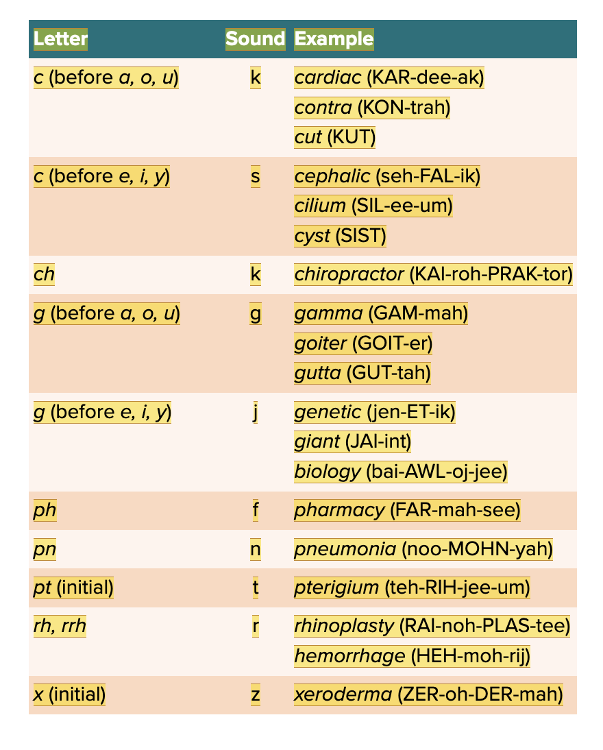
Chapter 1.4 How to Pronounce Words Associated with Medical Language
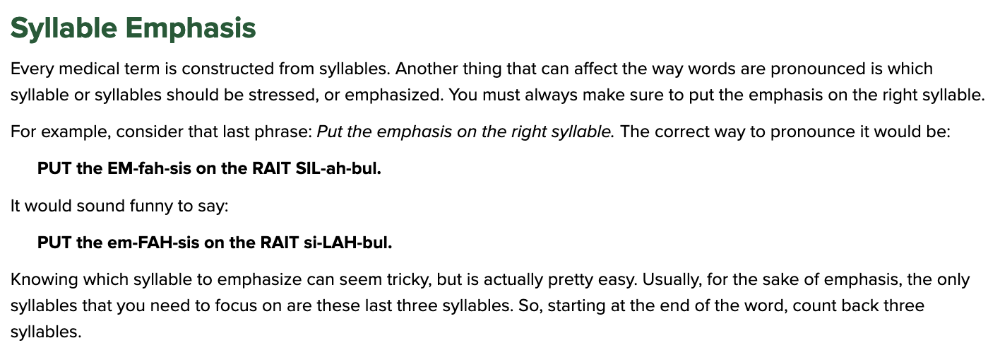
Chapter 1.4 How to Pronounce Words Associated with Medical Language
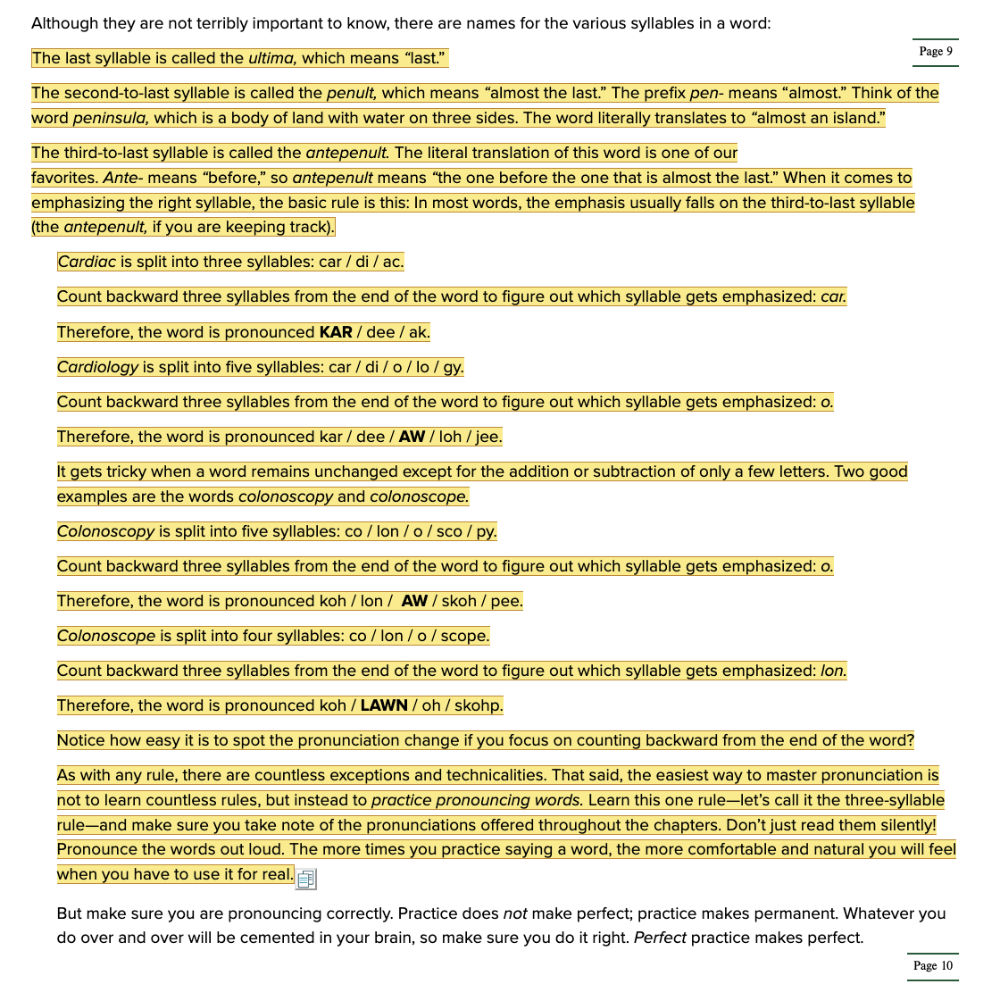
Chapter 1.4 How to Pronounce Words Associated with Medical Language
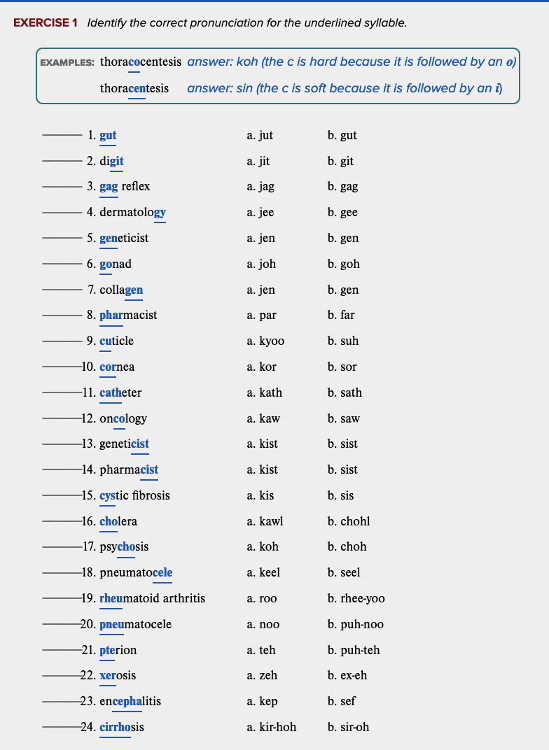
Learning Outcome 1.4 Exercises: Exercise 1
1. b. gut
2. a. jit
3. b. gag
4. a. jee
5. a. jen
6. b. goh
7. a. jen
8. b. far
9. a. kyoo
10. a. kor
11. a. kath
12. a. kaw
13. b. sist
14. b. sist
15. b. sis
16. a. kawl
17. a. koh
18. b. seel
19. a. roo
20. a. noo
21. a. teh
22. a. zeh
23. b. sef
24. b. sir-oh
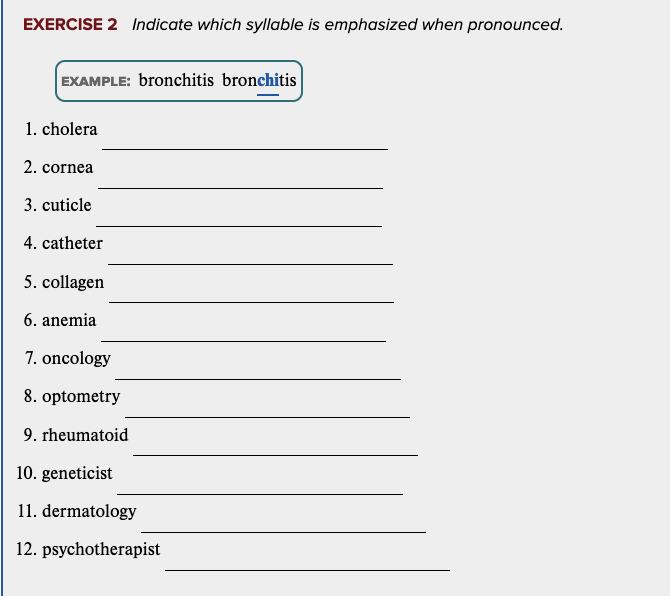
Learning Outcome 1.2 Exercises: Exercise 2
1. cholera
2. cornea
3. cuticle
4. catheter
5. collagen
6. anemia
7. oncology
8. optometry
9. rheumatoid
10. geneticist
11. dermatology
12. psychotherapist
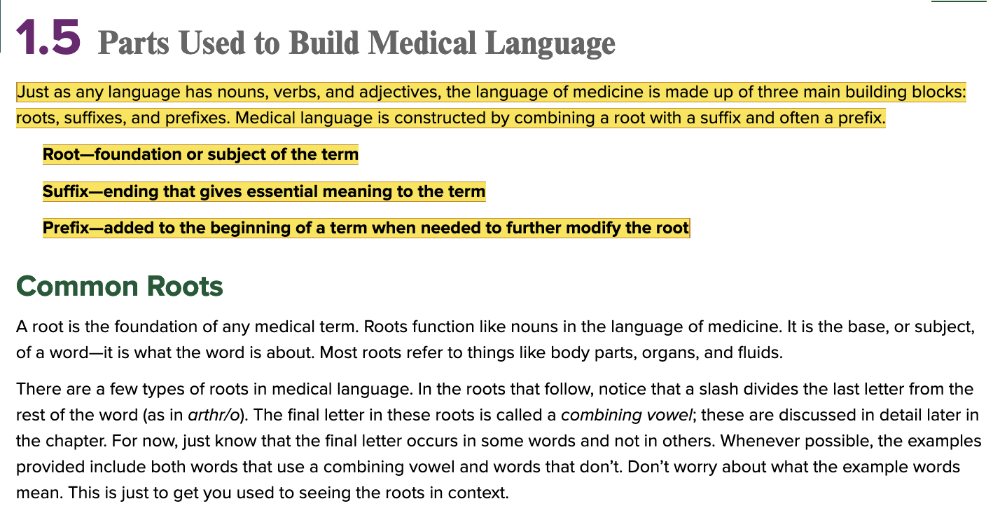
Chapter 1.5 Parts Used to Build Medical Language
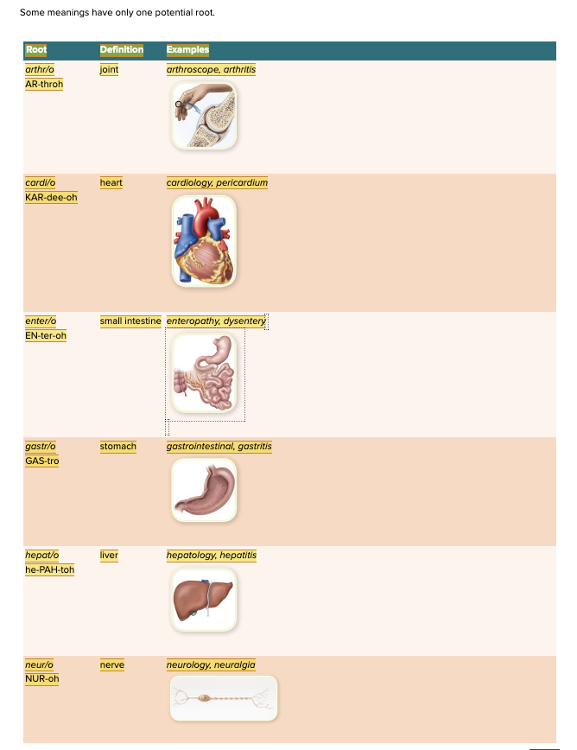
Chapter 1.5 Parts Used to Build Medical Language:
Common Roots - Some meanings have only one potential root.
Chapter 1.5 Parts Used to Build Medical Language:
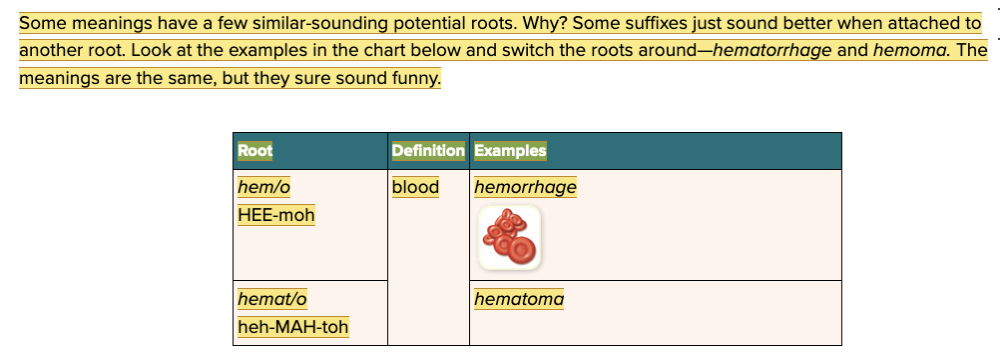
Common Roots - Some meanings have a few similar-sounding potential roots.
Chapter 1.5 Parts Used to Build Medical Language:
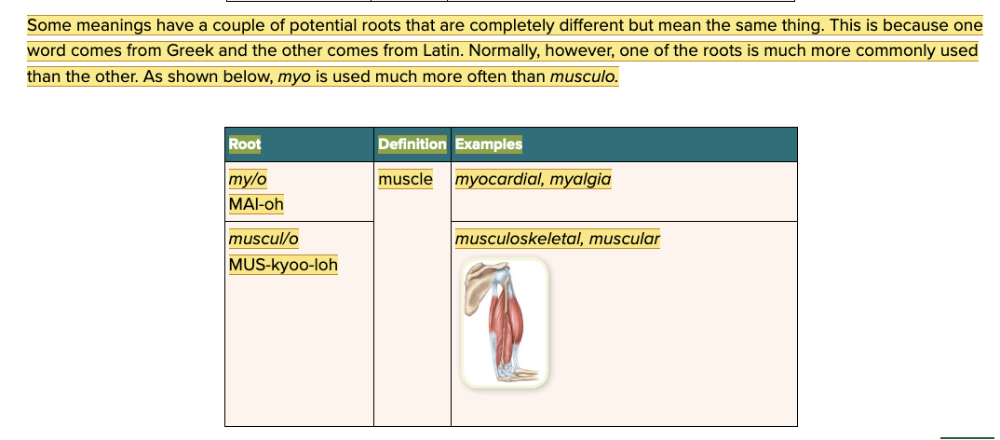
Common Roots - Some meanings have a couple of potential roots that are completely different but mean the same thing.
Chapter 1.5 Parts Used to Build Medical Language:
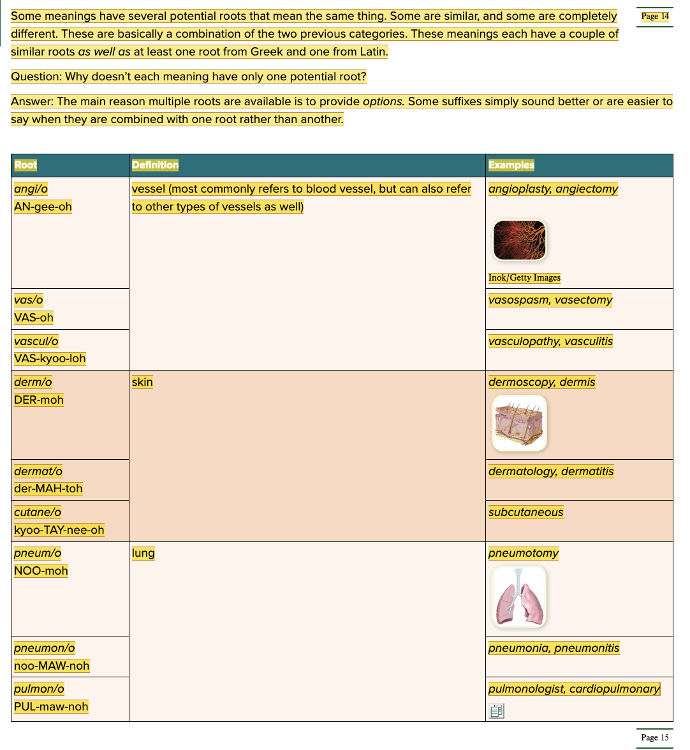
Common Roots - Some meanings have several potential roots that mean the same thing.
Chapter 1.5 Parts Used to Build Medical Language:
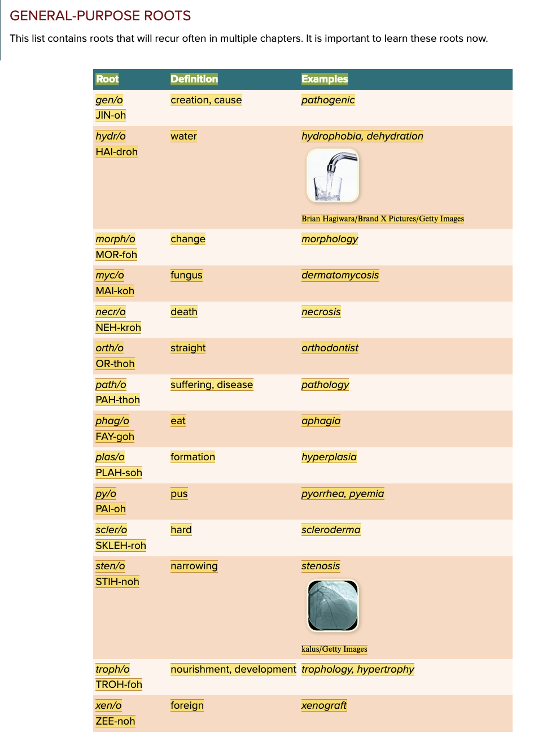
Common Roots -
- General-Purpose Roots: This list contains roots that will recur often in multiple chapters.
Chapter 1.5 Parts Used to Build Medical Language:
Common Suffixes -
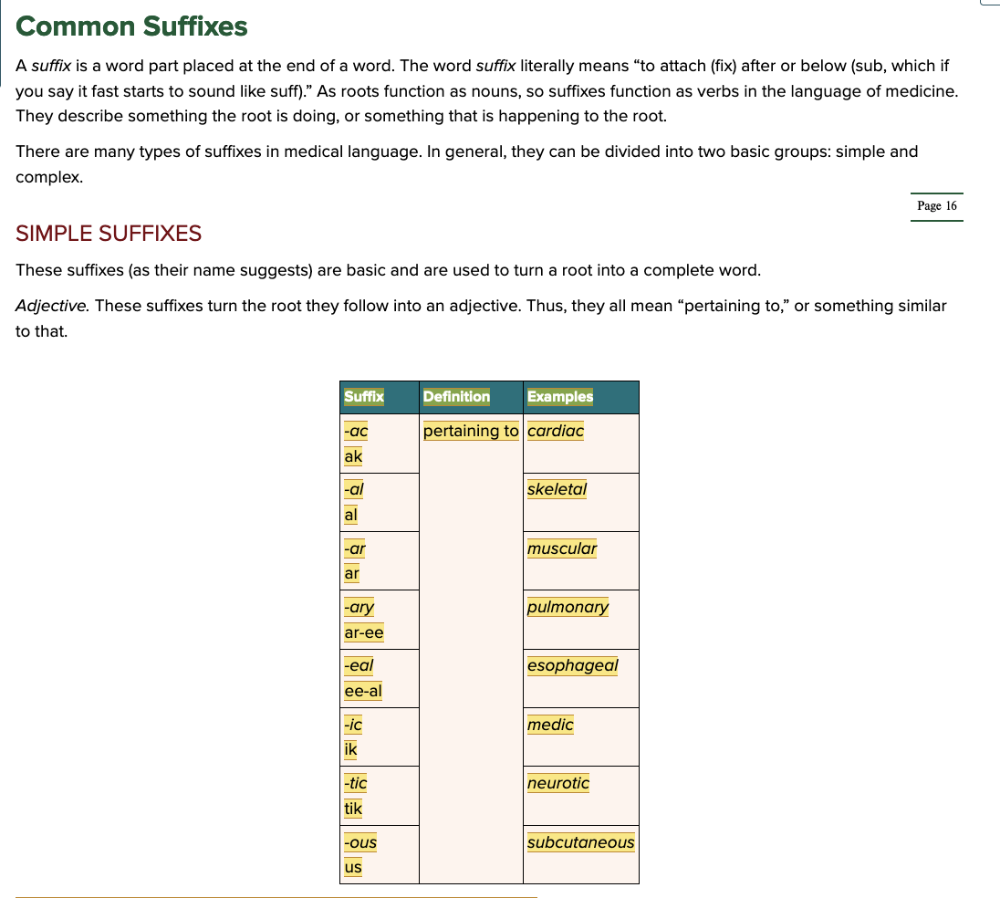
- Simple Suffixes: are used to turn a root into a complete word.
- Adjective. These suffixes turn the root they follow into an adjective. Thus, they all mean "pertaining to," or something similar to that.
Chapter 1.5 Parts Used to Build Medical Language:
Common Suffixes -
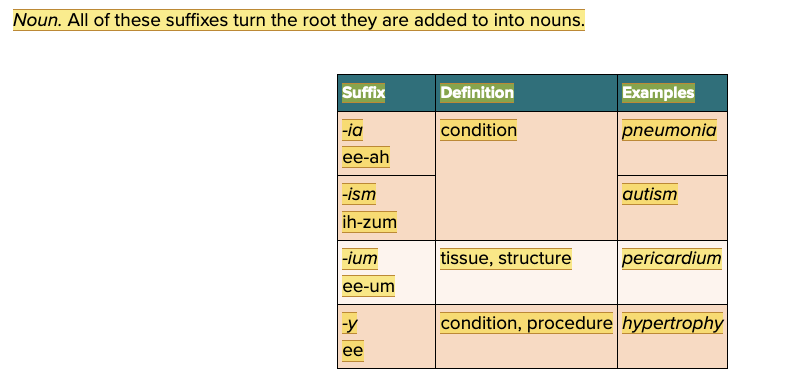
- Simple Suffixes: are used to turn a root into a complete word.
- Noun. All of these suffixes turn the root they are added to into nouns.
Chapter 1.5 Parts Used to Build Medical Language:
Common Suffixes -
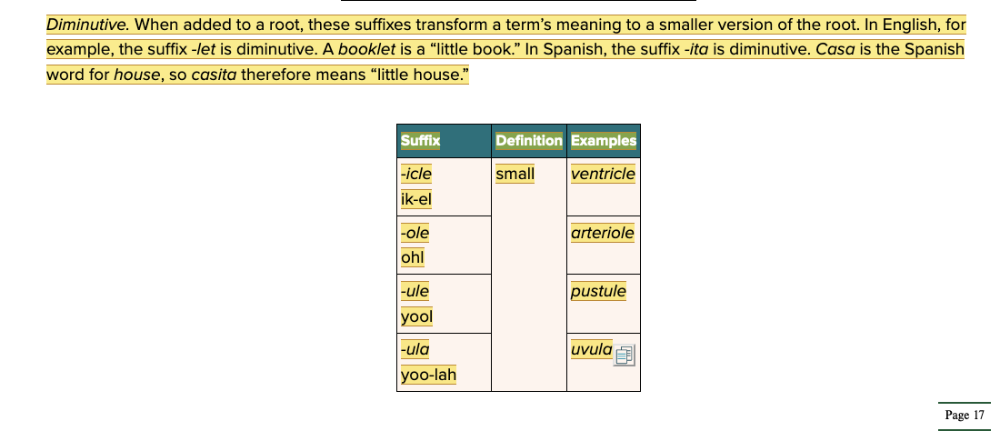
- Simple Suffixes: are used to turn a root into a complete word.
- Diminutive. When added to a root, these suffixes transform a term's meaning to a smaller version of the root.
Chapter 1.5 Parts Used to Build Medical Language:
Common Suffixes -
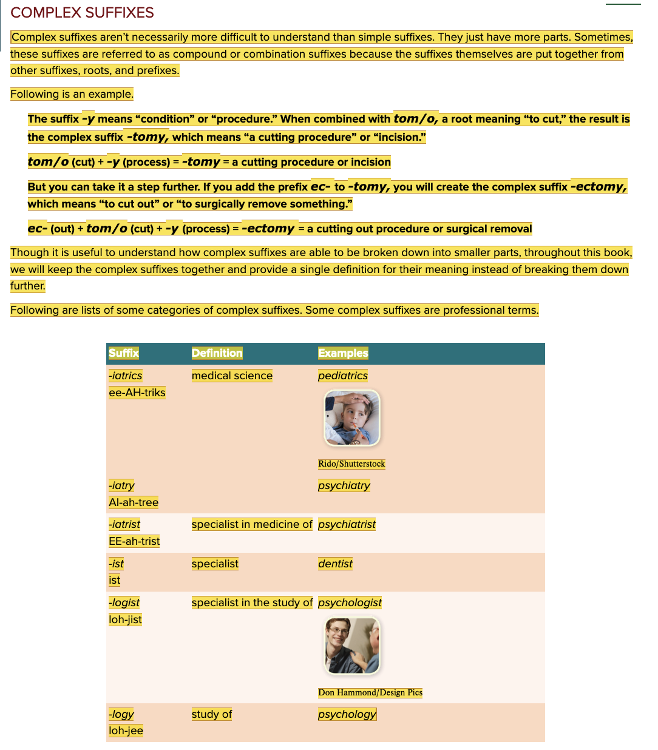
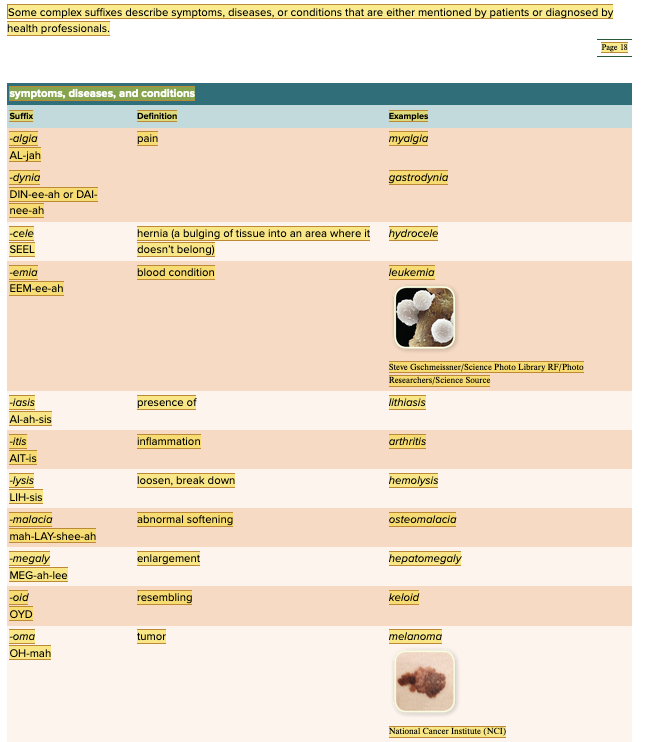
- Complex Suffixes: They have more parts than simple suffixes but that doesn't necessarily make them more difficult. Sometimes they are referred to as compound or combination suffixes because the suffixes themselves are put together from other suffixes, roots, and prefixes.
- Some complex suffixes are professional terms.
Chapter 1.5 Parts Used to Build Medical Language:
Common Suffixes -
- Complex Suffixes: They have more parts than simple suffixes but that doesn't necessarily make them more difficult. Sometimes they are referred to as compound or combination suffixes because the suffixes themselves are put together from other suffixes, roots, and prefixes.
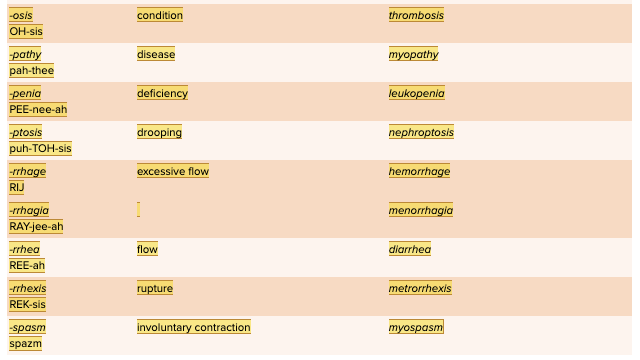
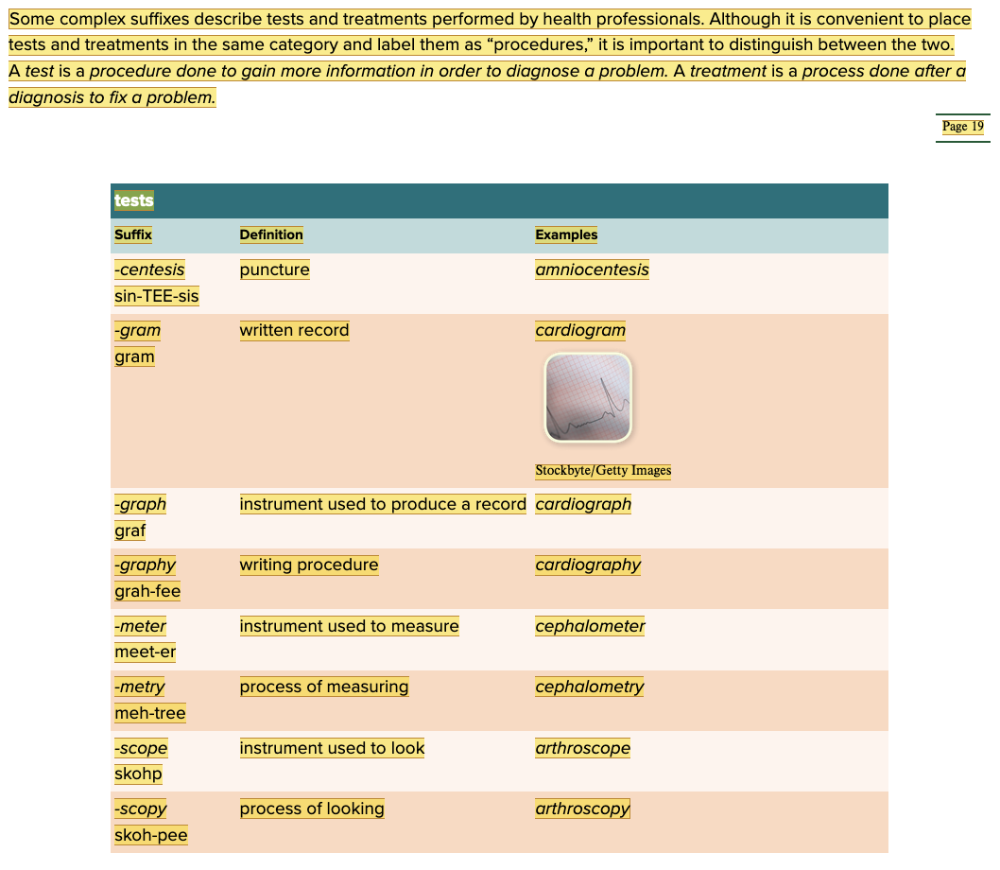
- Some complex suffixes describe symptoms, diseases, or conditions that are either mentioned by patients or diagnosed by health professionals.
Chapter 1.5 Parts Used to Build Medical Language:
Common Suffixes -
- Complex Suffixes: They have more parts than simple suffixes but that doesn't necessarily make them more difficult. Sometimes they are referred to as compound or combination suffixes because the suffixes themselves are put together from other suffixes, roots, and prefixes.
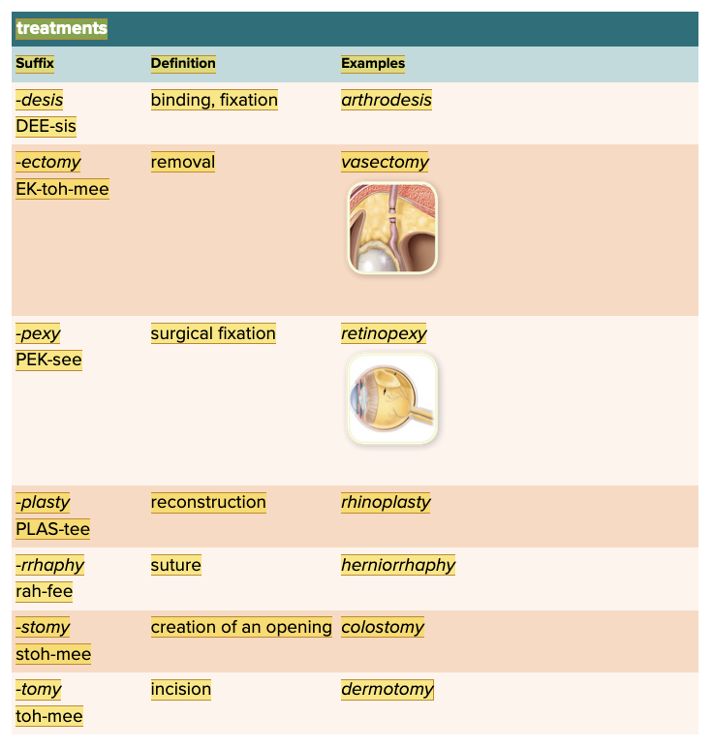
- Some complex suffixes describe tests and treatments performed by health professionals. A test is a procedure done to gain more information in order to diagnose a problem. A treatment is a process done after a diagnosis to fix a problem.
Chapter 1.5 Parts Used to Build Medical Language:
Common Suffixes -
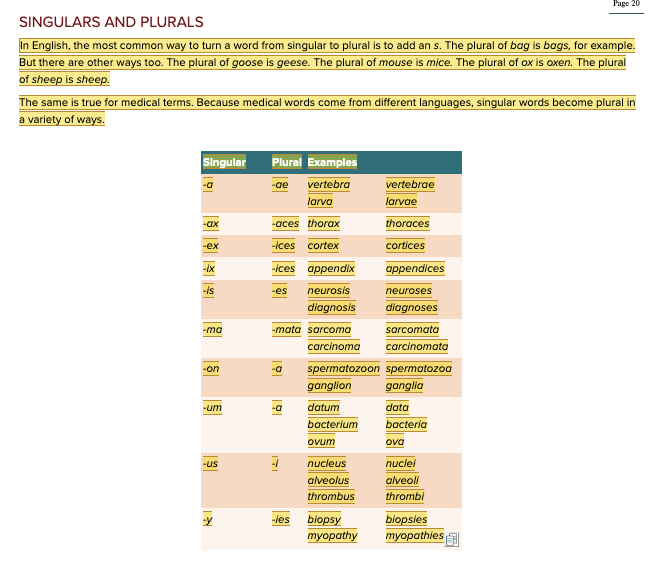
- Singulars and Plurals: In English, the most common way to turn a word from singular to plural is to add an s. However, there are other ways. Like from goose to geese. The same is true for medical terms.

Chapter 1.5 Parts Used to Build Medical Language:
Common Prefixes - a prefix is a word part placed at the beginning of a word. They function like adjectives in the language of medicine.
Chapter 1.5 Parts Used to Build Medical Language:
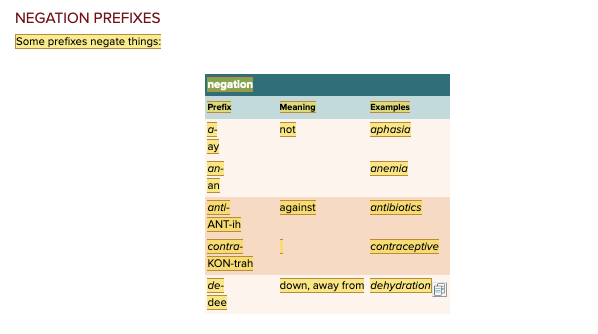
Common Prefixes - a prefix is a word part placed at the beginning of a word. They function like adjectives in the language of medicine.
- Negation Prefixes: Some prefixes negate things.
Chapter 1.5 Parts Used to Build Medical Language:
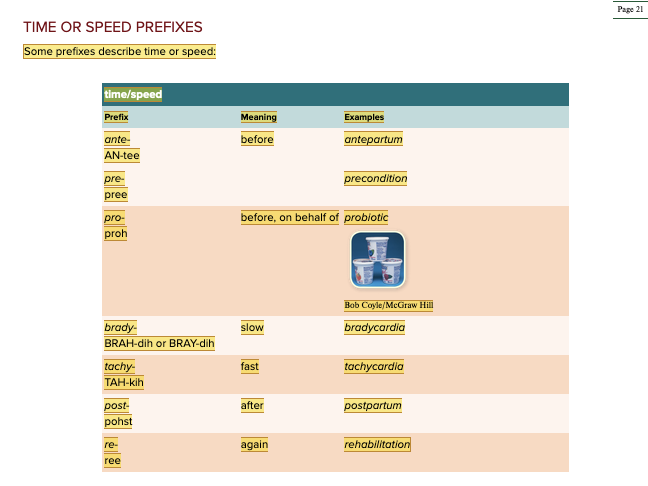
Common Prefixes - a prefix is a word part placed at the beginning of a word. They function like adjectives in the language of medicine.
- Time or Speed Prefixes: Some prefixes describe time or speed.
Chapter 1.5 Parts Used to Build Medical Language:
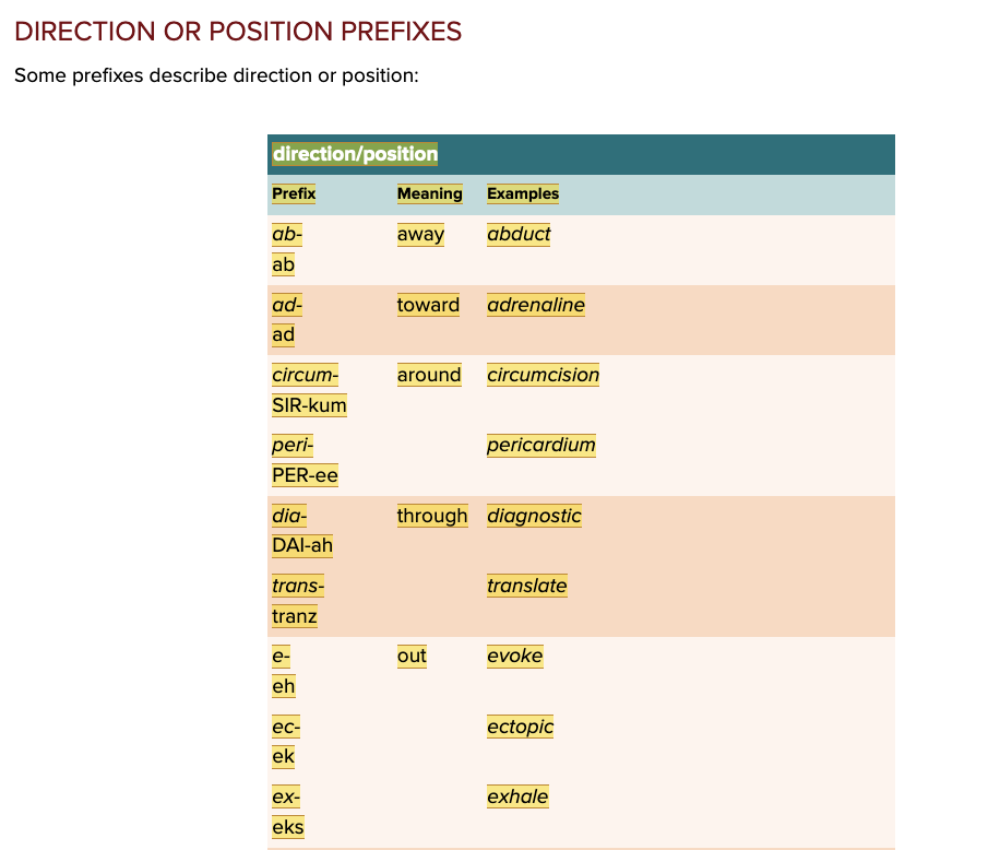
Common Prefixes - a prefix is a word part placed at the beginning of a word. They function like adjectives in the language of medicine.
- Direction or Position Prefixes: Some prefixes describe direction or position.
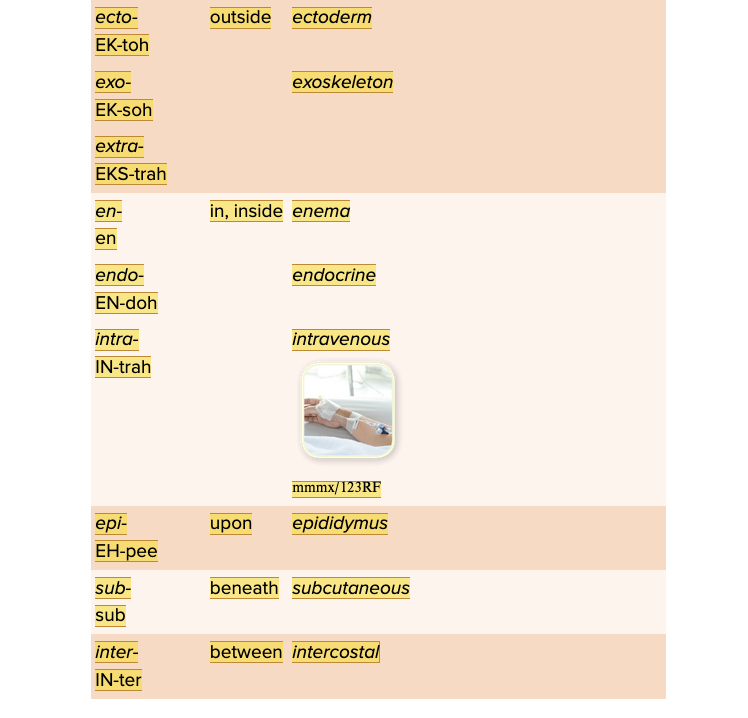
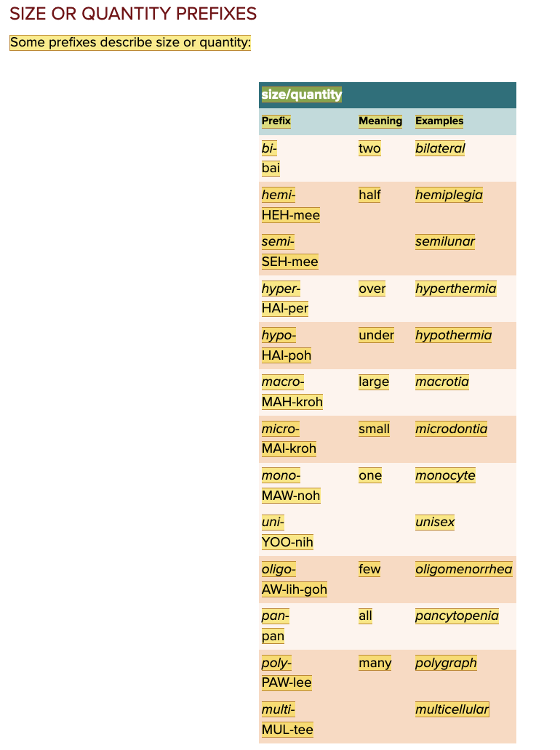
Chapter 1.5 Parts Used to Build Medical Language:
Common Prefixes - a prefix is a word part placed at the beginning of a word. They function like adjectives in the language of medicine.
- Size or Quantity Prefixes: Some prefixes describe size or quantity.
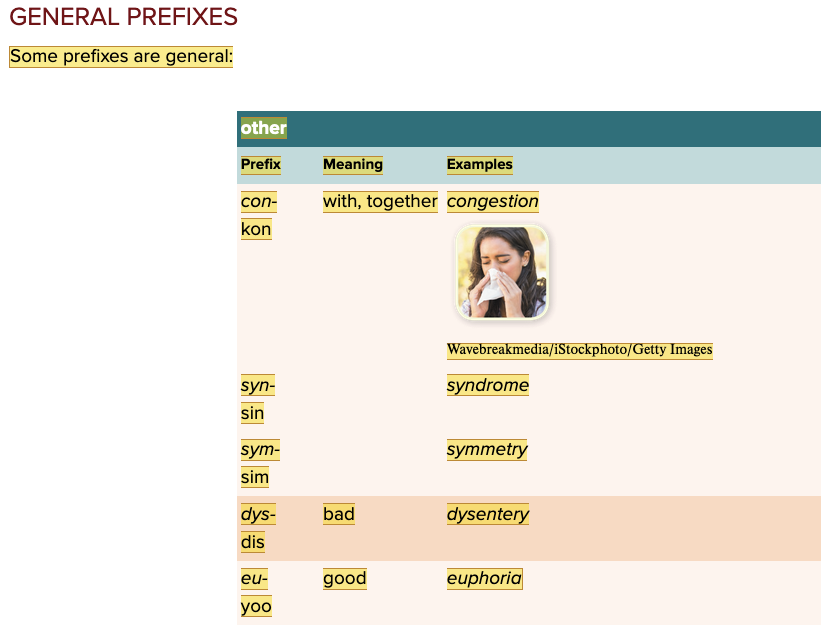
Chapter 1.5 Parts Used to Build Medical Language:
Common Prefixes - a prefix is a word part placed at the beginning of a word. They function like adjectives in the language of medicine.
- General Prefixes: Some prefixes are general.
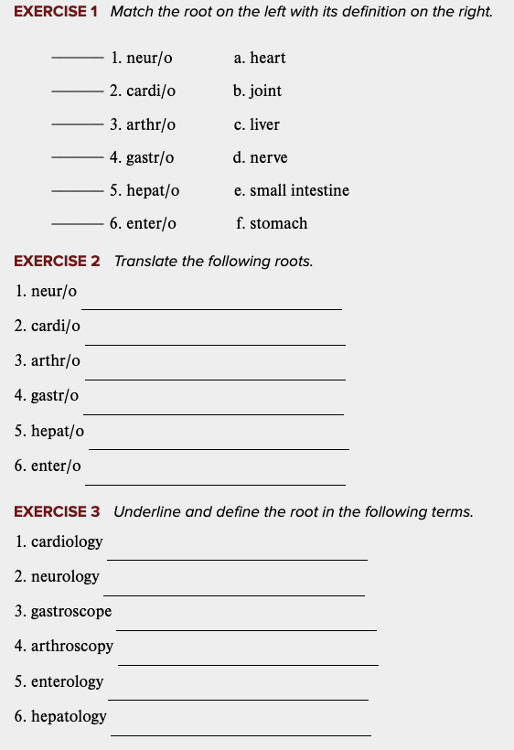
Learning Outcome 1.5 Exercises: Exercise 1, 2, 3.
Exercise 1
- h
- h
- h
- h
- h
Exercise 2
- h
- h
- h
- h
- h
Exercise 3
- h
- h
- h
- h
- h
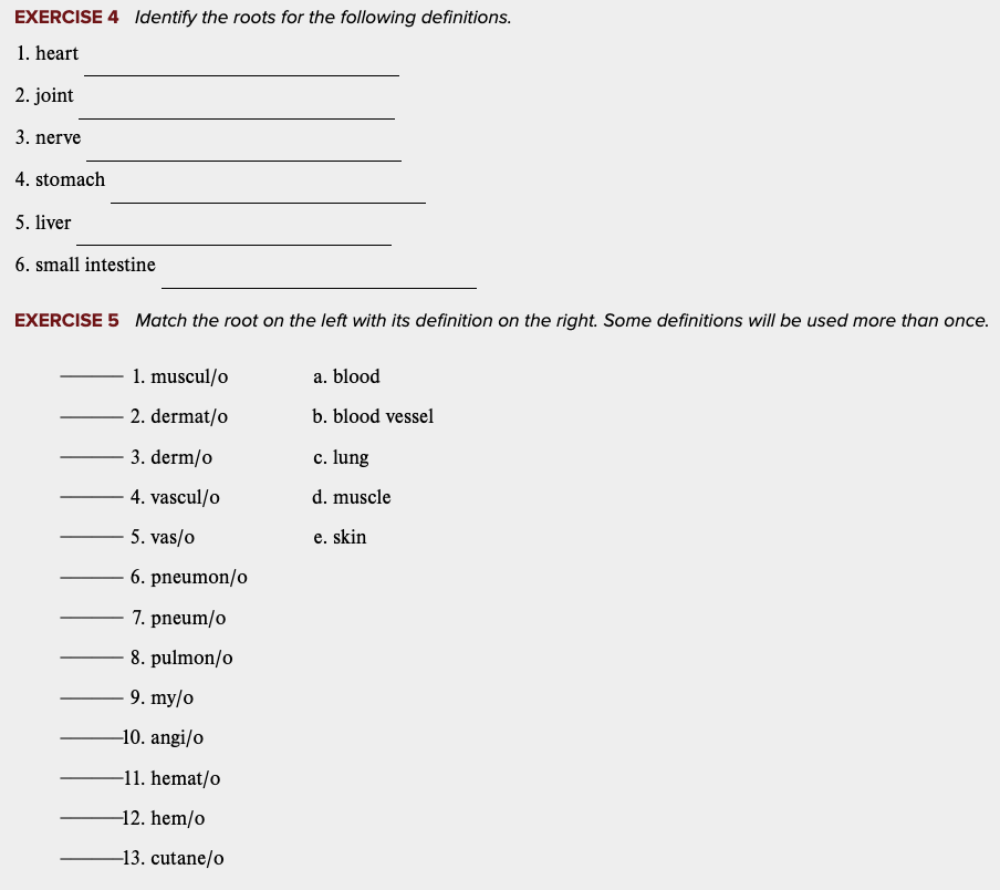
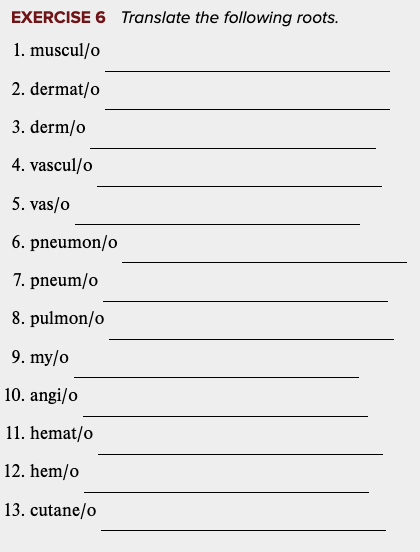
Learning Outcome 1.5 Exercises: Exercise 4, 5, 6.
Exercise 4
Exercise 5
Exercise 6
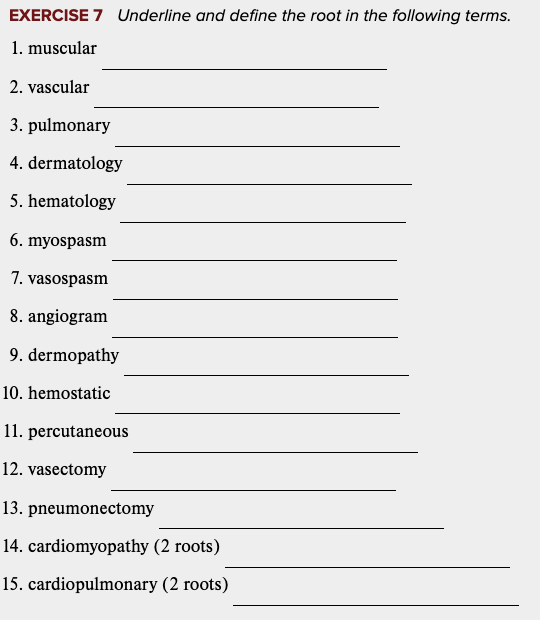
Learning Outcome 1.5 Exercises: Exercise 7, 8, 9.
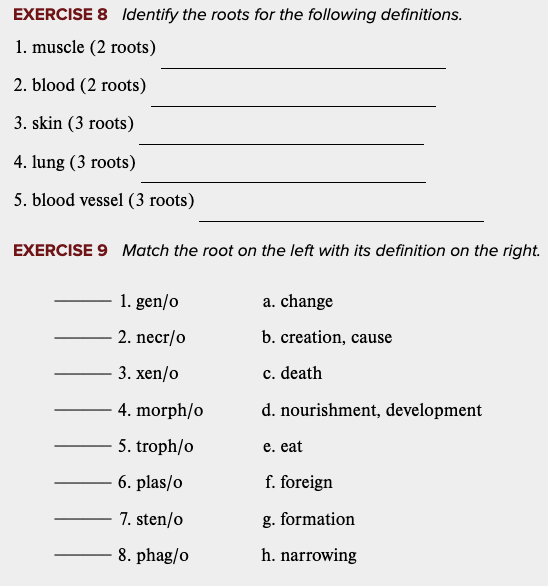
Exercise 7
Exercise 8
Exercise 9
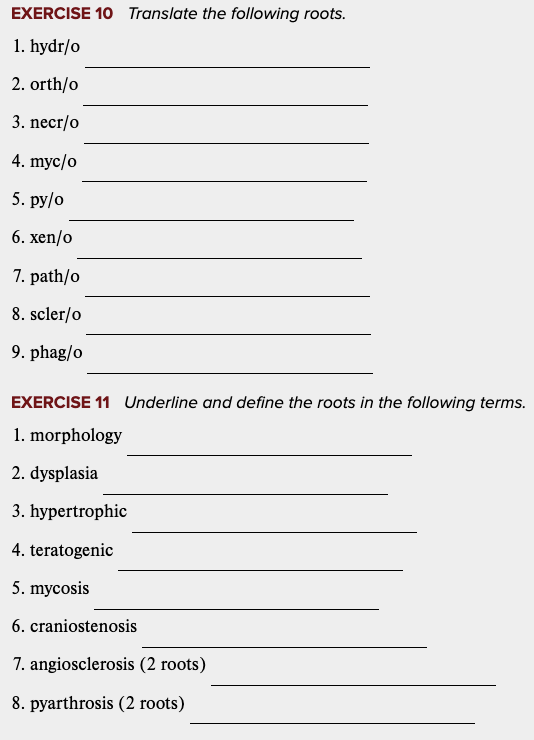
Learning Outcome 1.5 Exercises: Exercise 10, 11, 12.
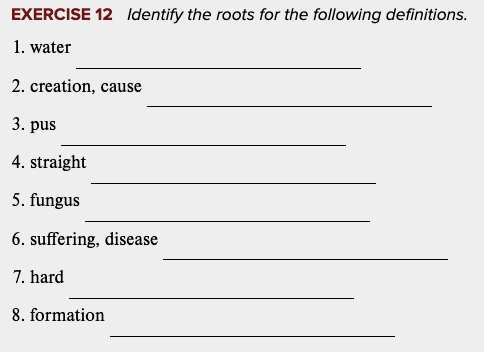
Exercise 10
Exercise 11
Exercise 12
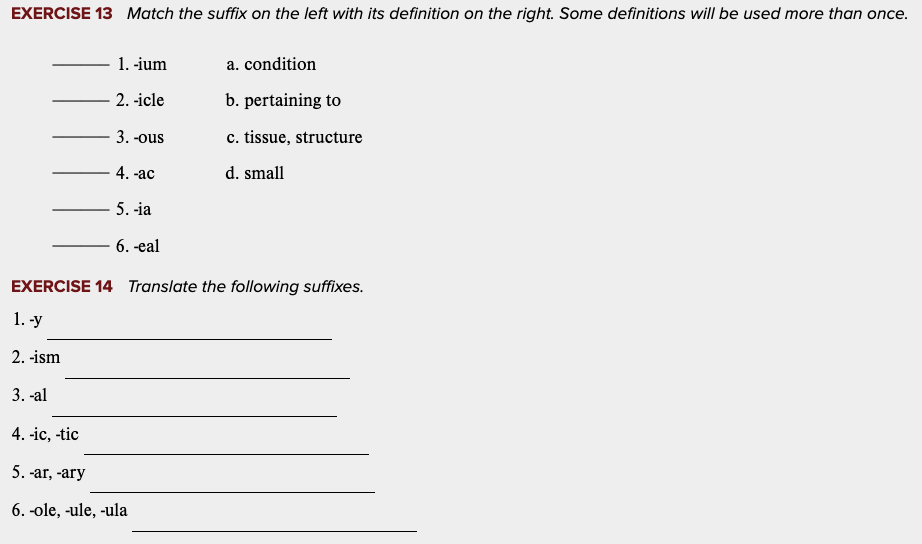
Learning Outcome 1.5 Exercises: Exercise 13, 14, 15.
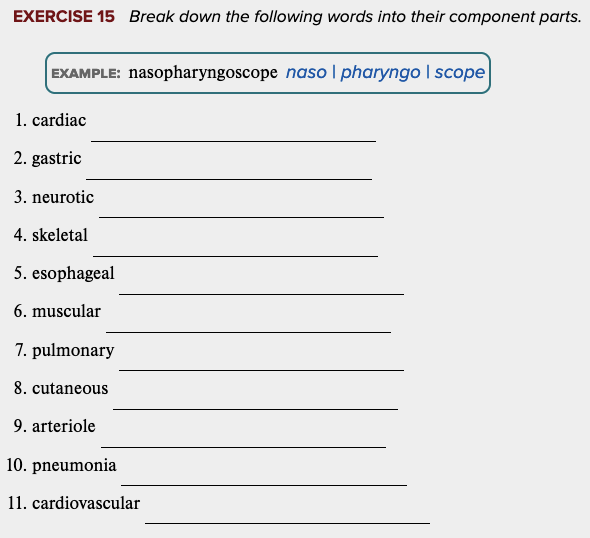
Exercise 13
Exercise 14
Exercise 15
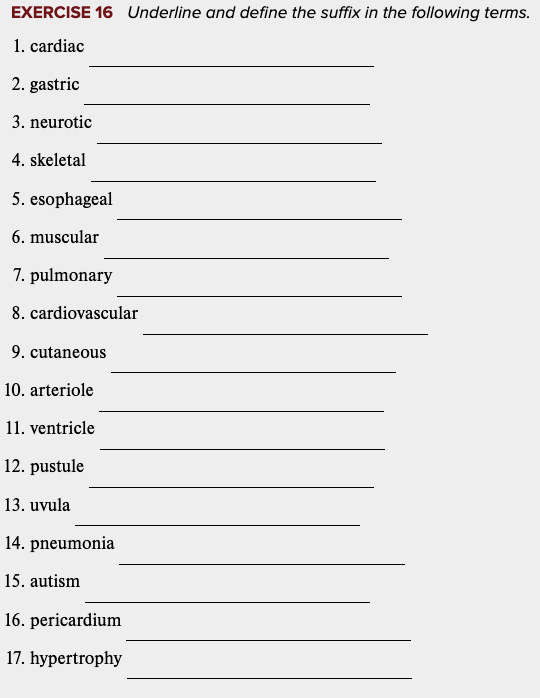
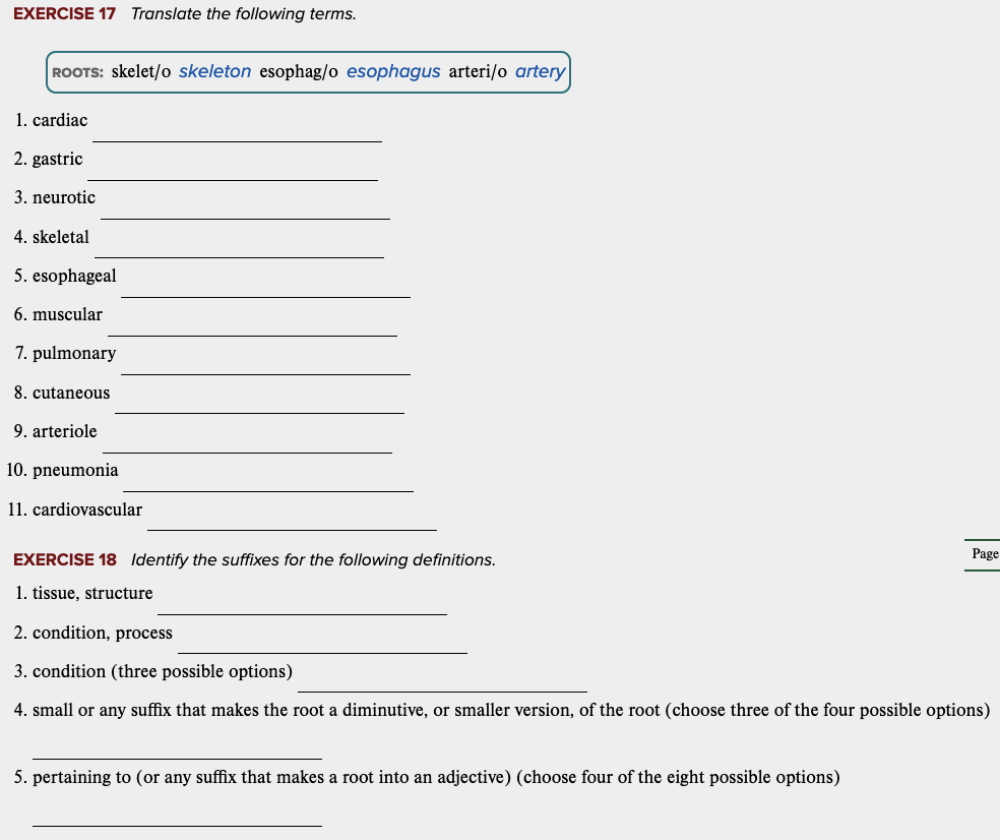
Learning Outcome 1.5 Exercises: Exercise 16, 17, 18.
Exercise 16
Exercise 17
Exercise 18
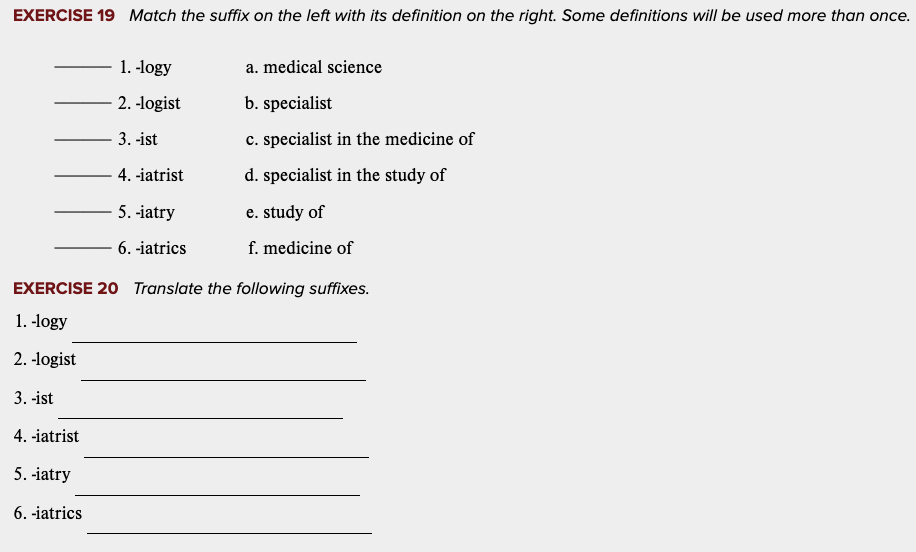
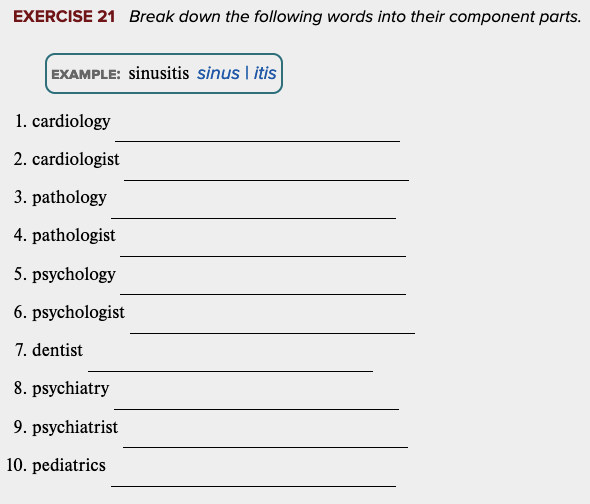
Learning Outcome 1.5 Exercises: Exercise 19, 20, 21.
Exercise 19
Exercise 20
Exercise 21
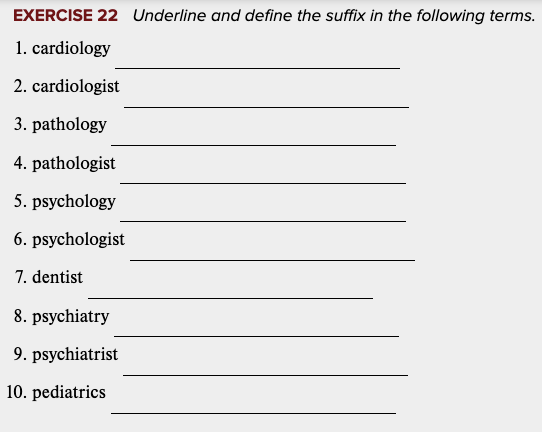
Learning Outcome 1.5 Exercises: Exercise 22, 23, 24.
Exercise 22
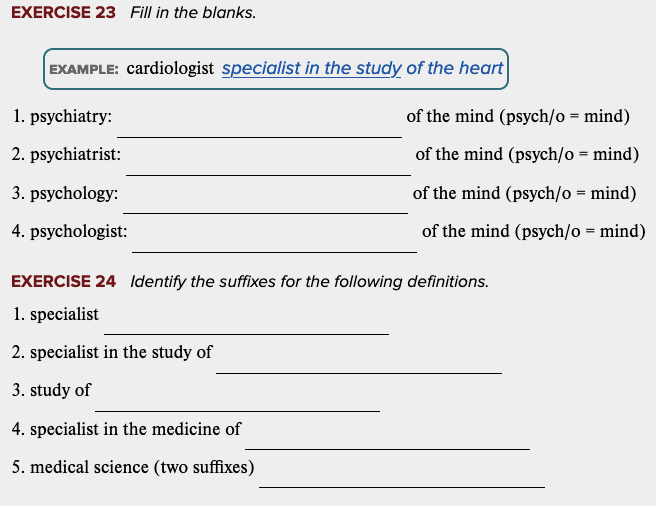
Exercise 23
Exercise 24
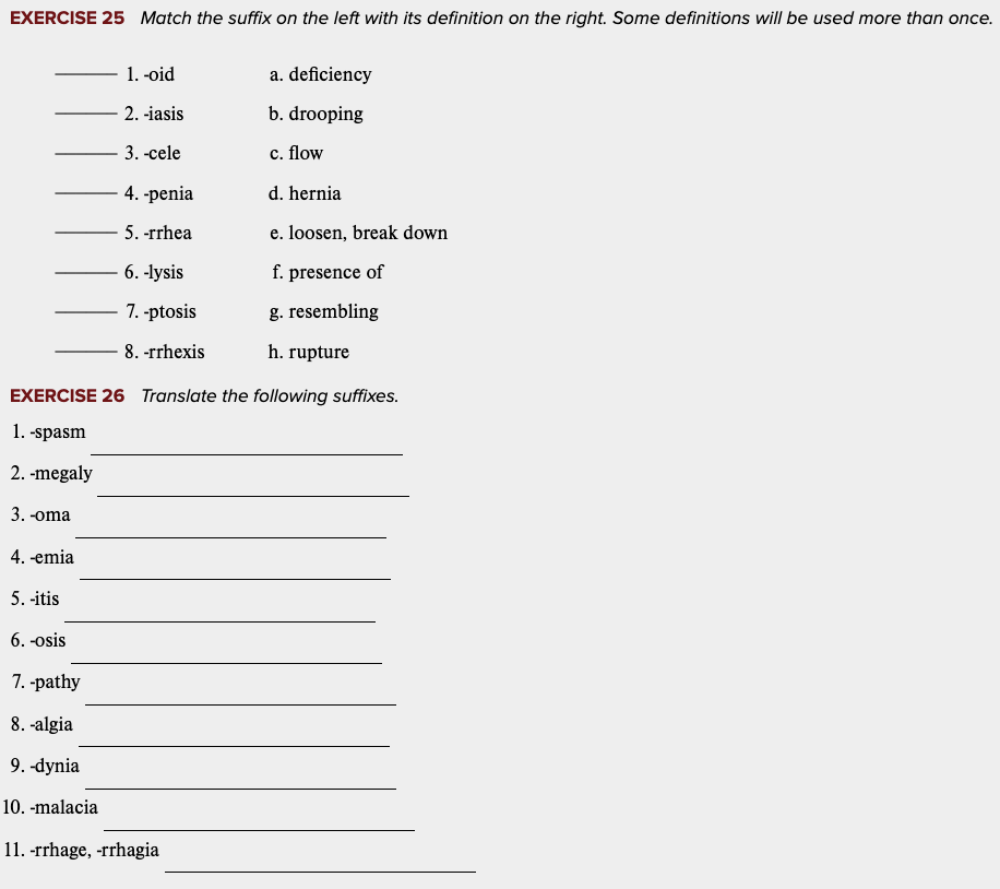
Learning Outcome 1.5 Exercises: Exercise 25, 26, 27.
Exercise 25
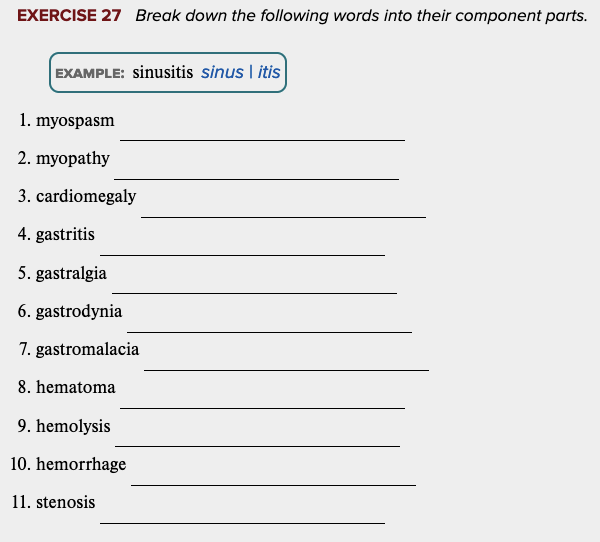
Exercise 26
Exercise 27
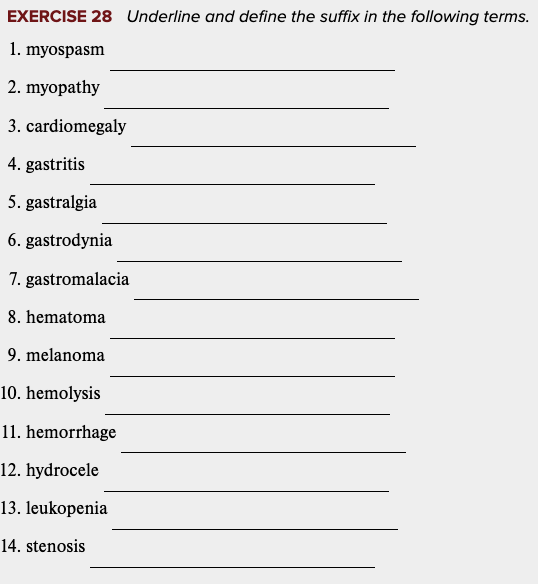
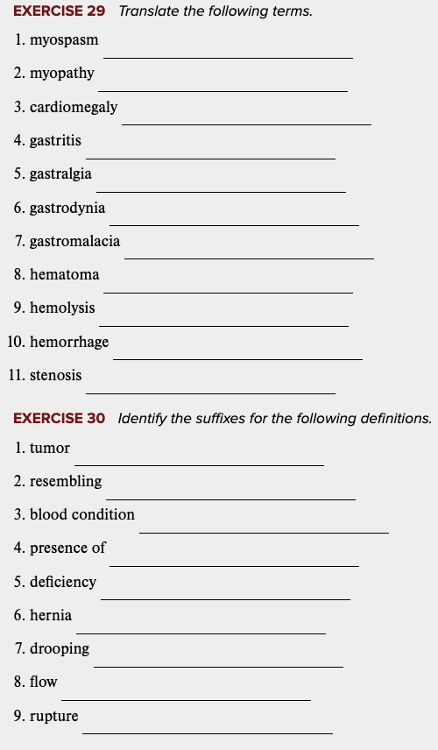
Learning Outcome 1.5 Exercises: Exercise 28, 29, 30.
Exercise 28
Exercise 29
Exercise 30
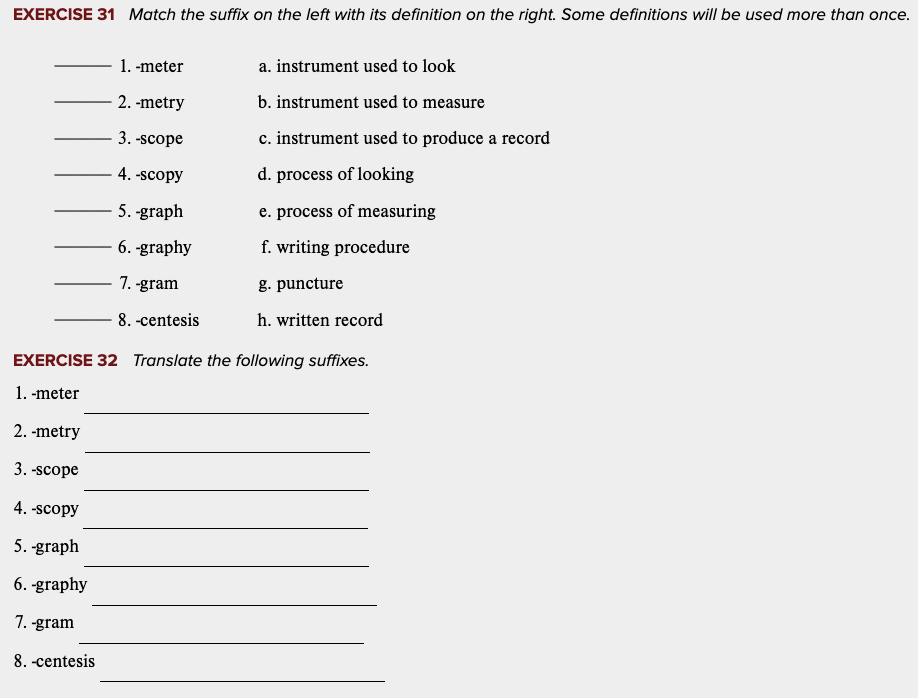
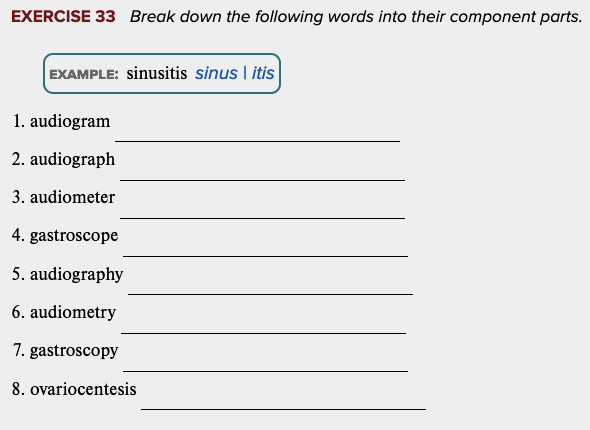
Learning Outcome 1.5 Exercises: Exercise 31, 32, 33.
Exercise 31
Exercise 32
Exercise 33
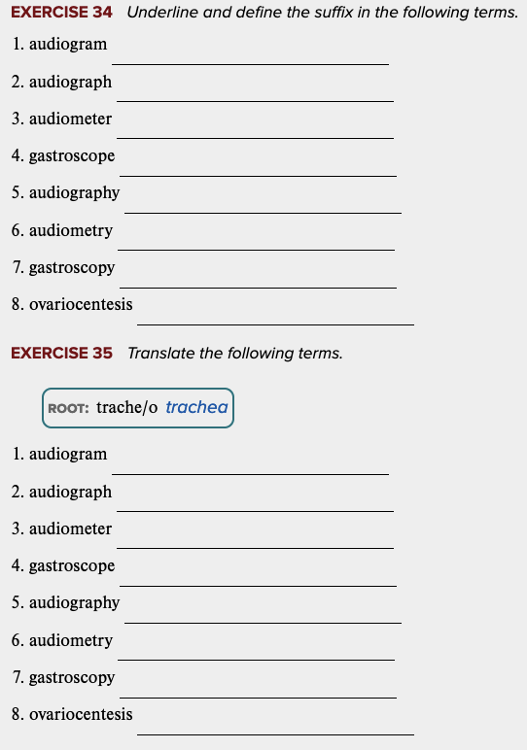
Learning Outcome 1.5 Exercises: Exercise 34, 35, 36.
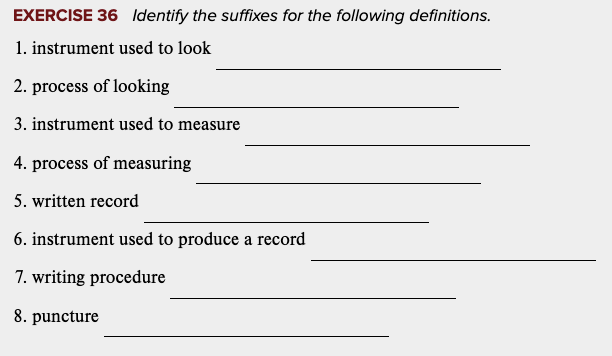
Exercise 34
Exercise 35
Exercise 36
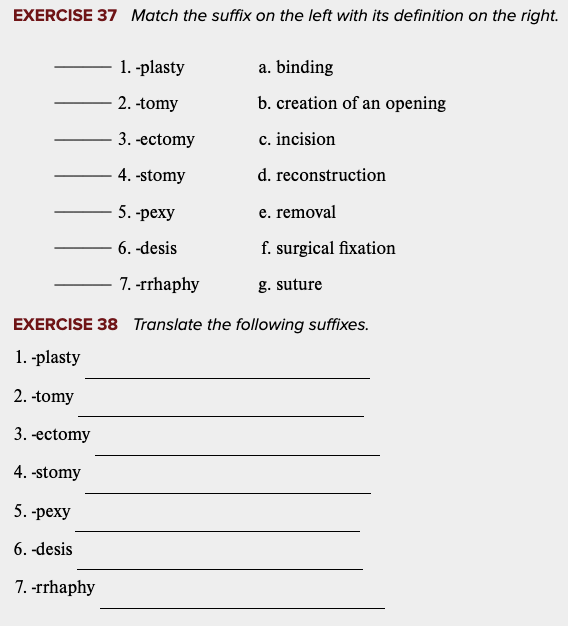
Learning Outcome 1.5 Exercises: Exercise 37, 38, 39.
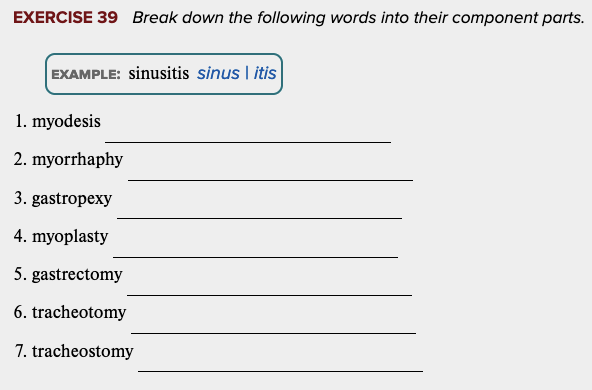
Exercise 37
Exercise 38
Exercise 39
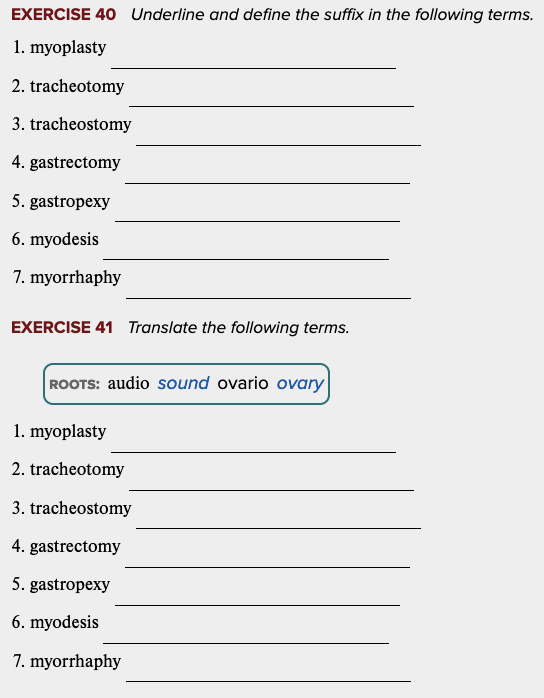
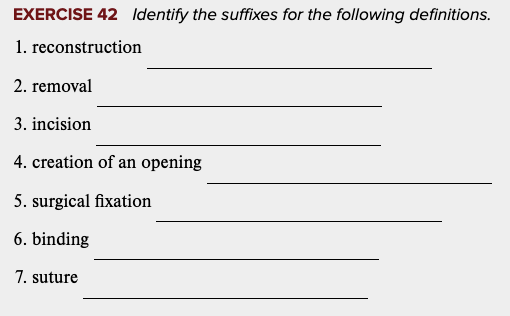
Learning Outcome 1.5 Exercises: Exercise 40, 41, 42.
Exercise 40
Exercise 41
Exercise 42
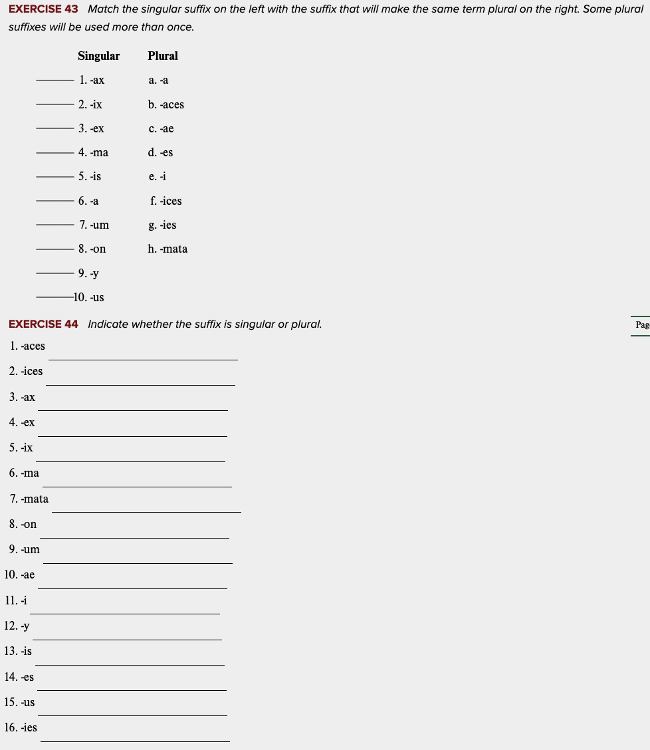
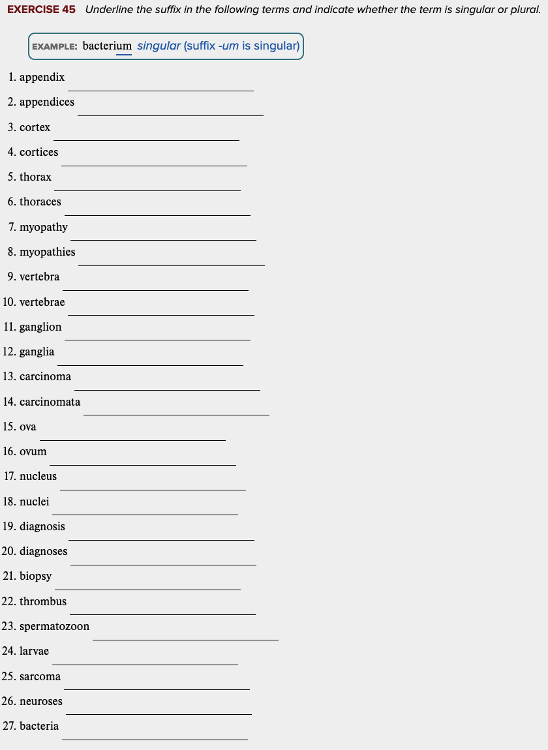
Learning Outcome 1.5 Exercises: Exercise 43, 44, 45.
Exercise 43
Exercise 44
Exercise 45
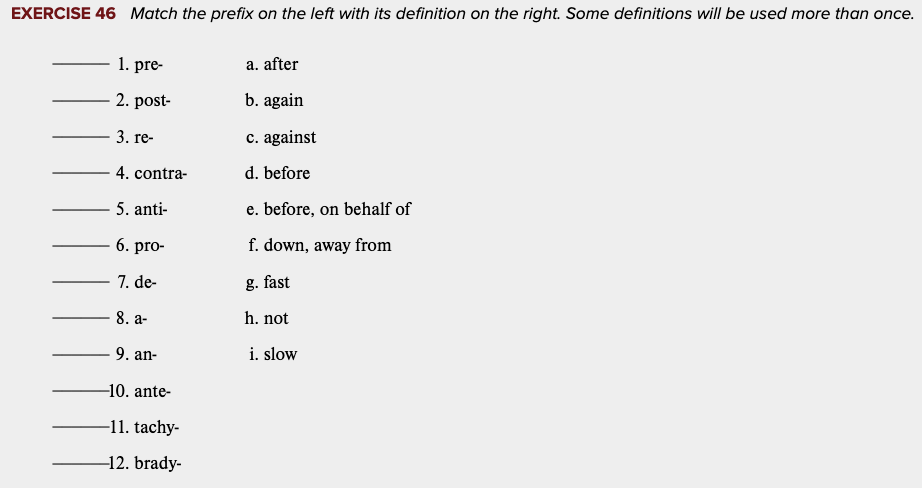
Learning Outcome 1.5 Exercises: Exercise 46, 47, 48.
Exercise 46
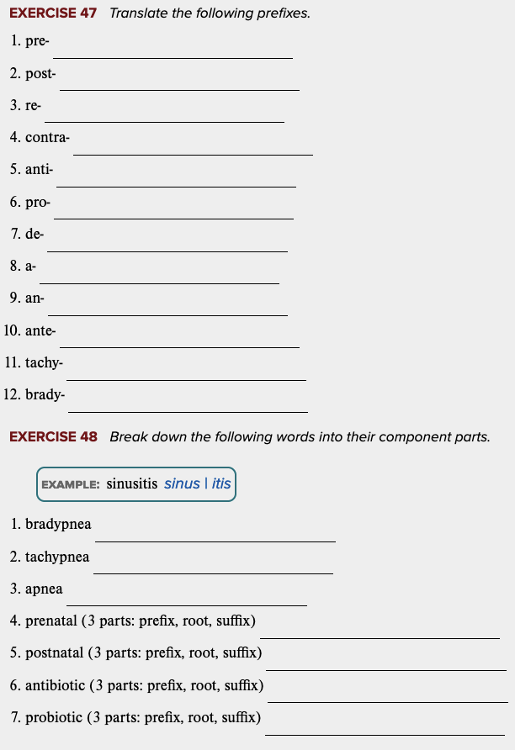
Exercise 47
Exercise 48
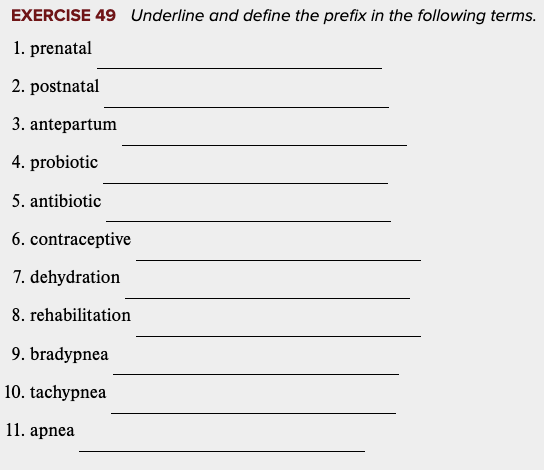
Learning Outcome 1.5 Exercises: Exercise 49, 50, 51.
Exercise 49
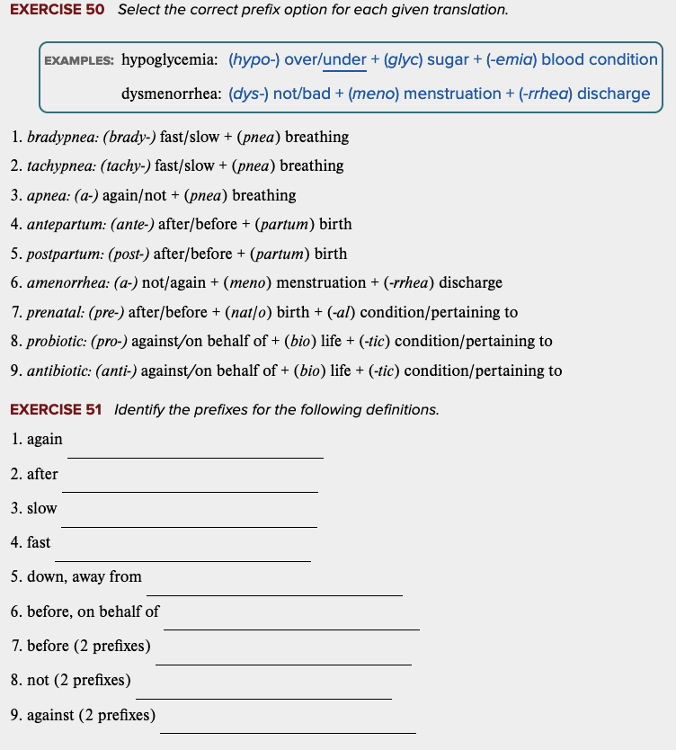
Exercise 50
Exercise 51
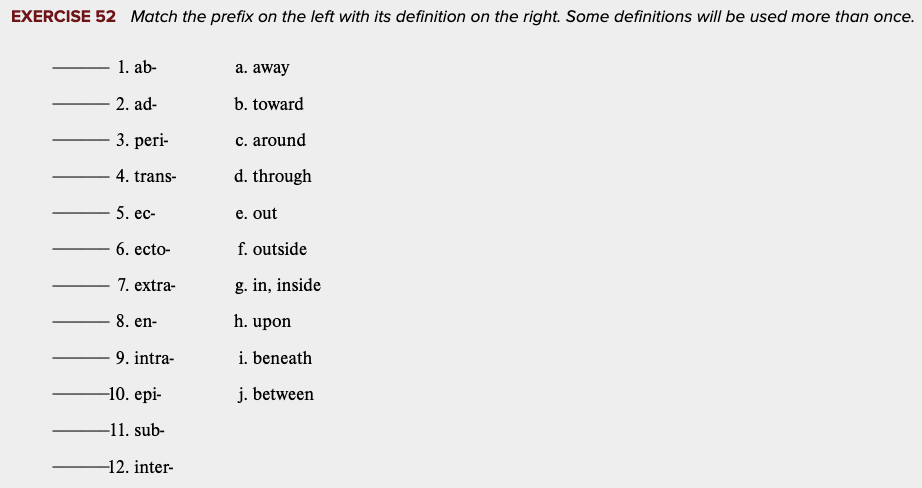
Learning Outcome 1.5 Exercises: Exercise 52, 53, 54.
Exercise 52
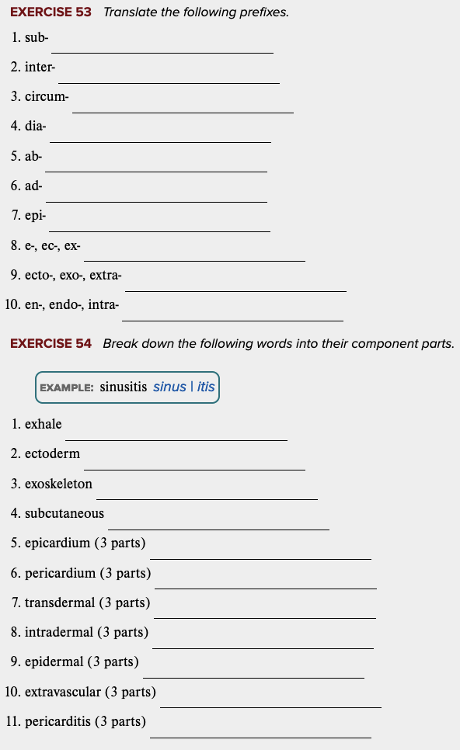
Exercise 53
Exercise 54
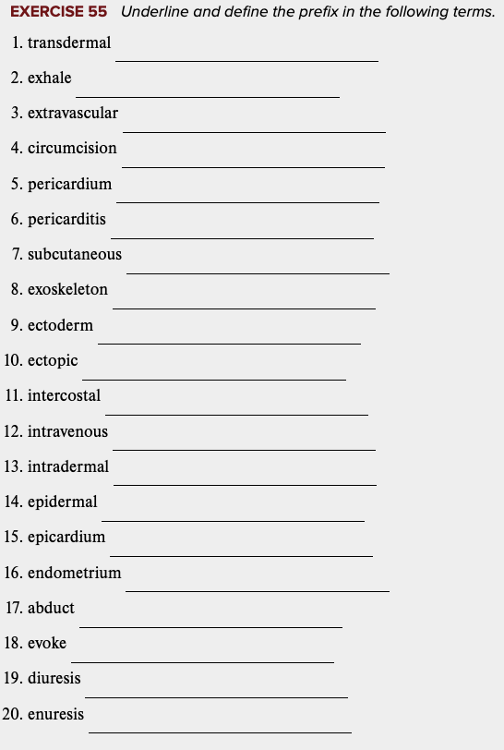
Learning Outcome 1.5 Exercises: Exercise 55, 56, 57.
Exercise 55
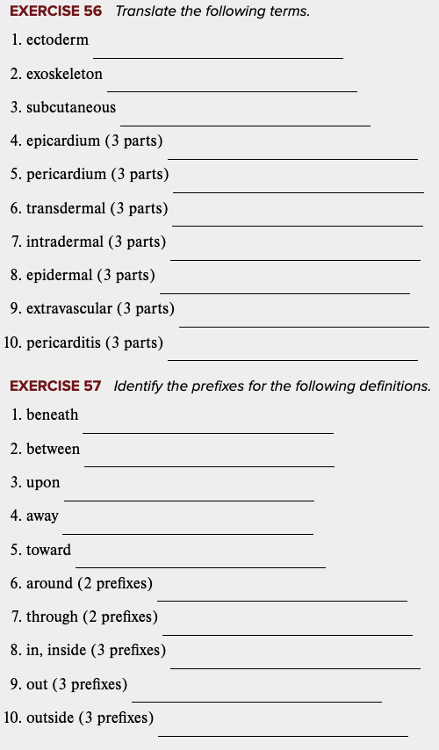
Exercise 56
Exercise 57
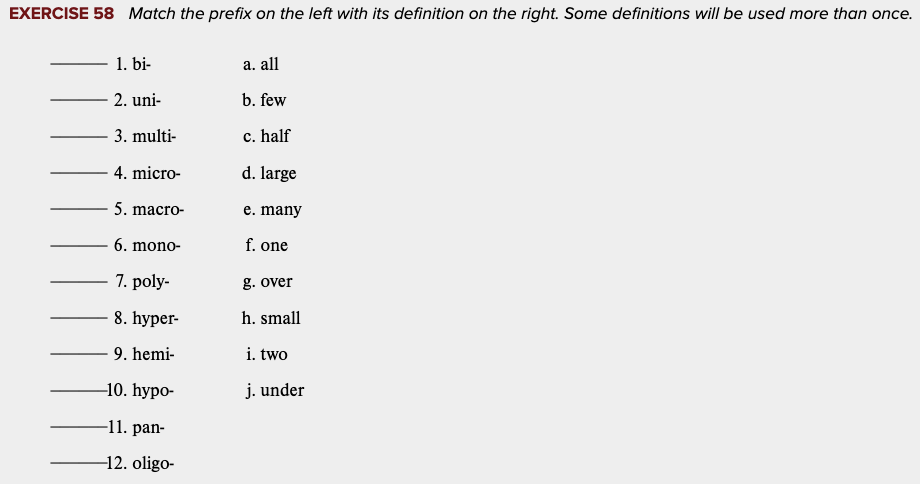
Learning Outcome 1.5 Exercises: Exercise 58, 59, 60.
Exercise 58
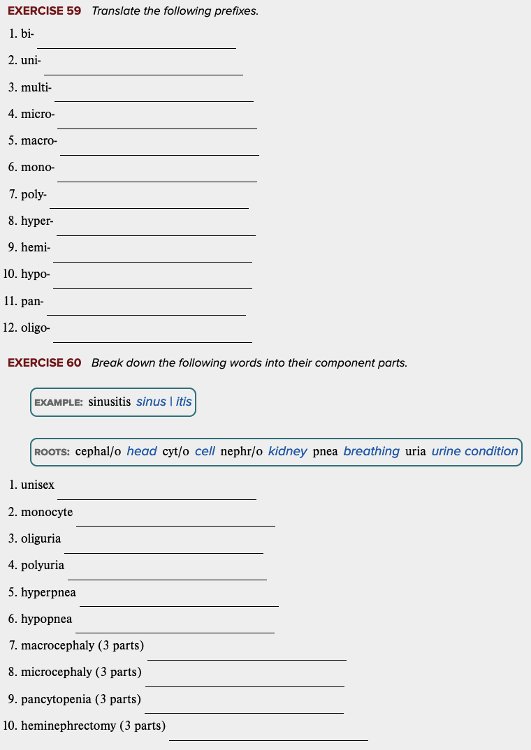
Exercise 59
Exercise 60
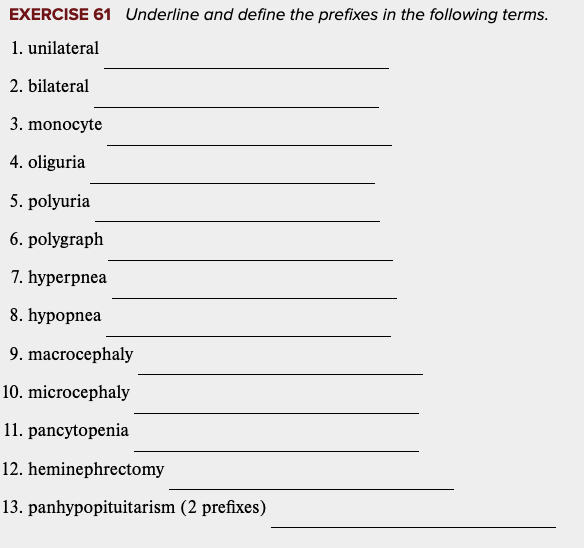
Learning Outcome 1.5 Exercises: Exercise 61, 62, 63.
Exercise 61
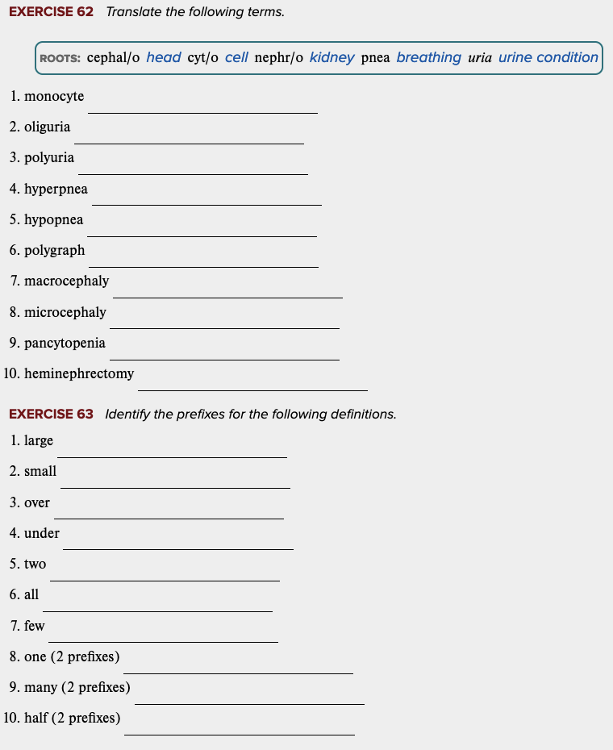
Exercise 62
Exercise 63
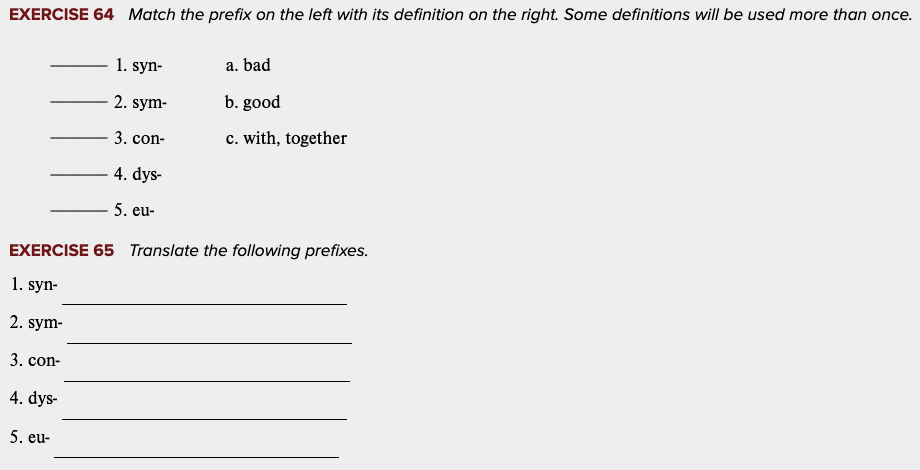
Learning Outcome 1.5 Exercises: Exercise 64, 65, 66.
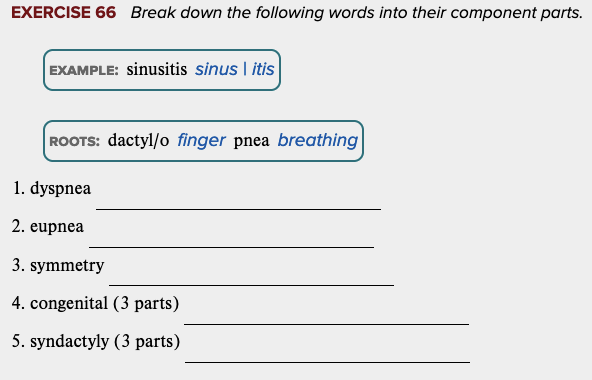
Exercise 64
Exercise 65
Exercise 66
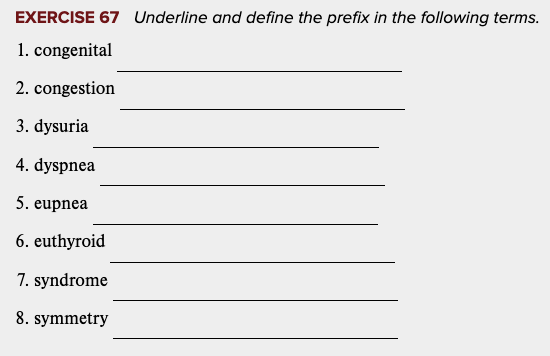
Learning Outcome 1.5 Exercises: Exercise 67, 68, 69.
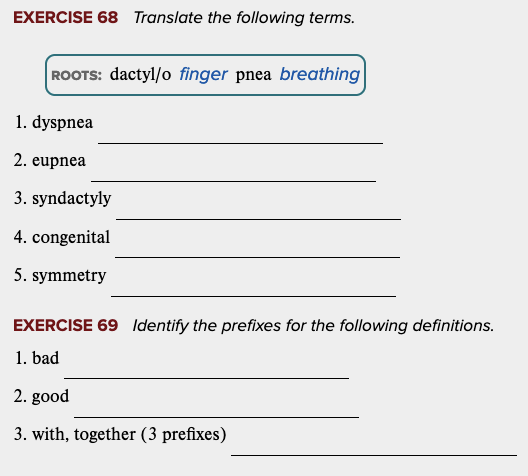
Exercise 67
Exercise 68
Exercise 69
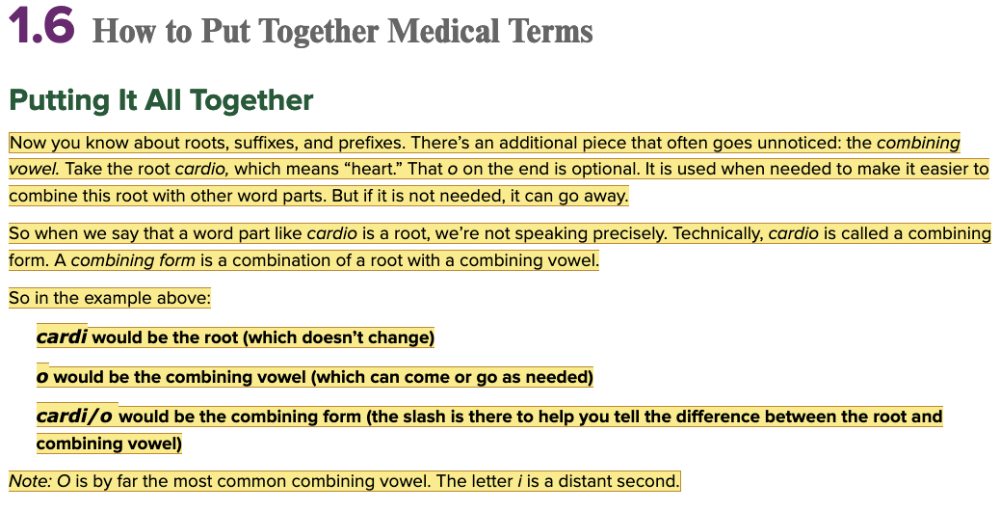
Chapter 1.6 How to Put Together Medical Terms:
Putting It All Together - There's an additional piece called the combining vowel.
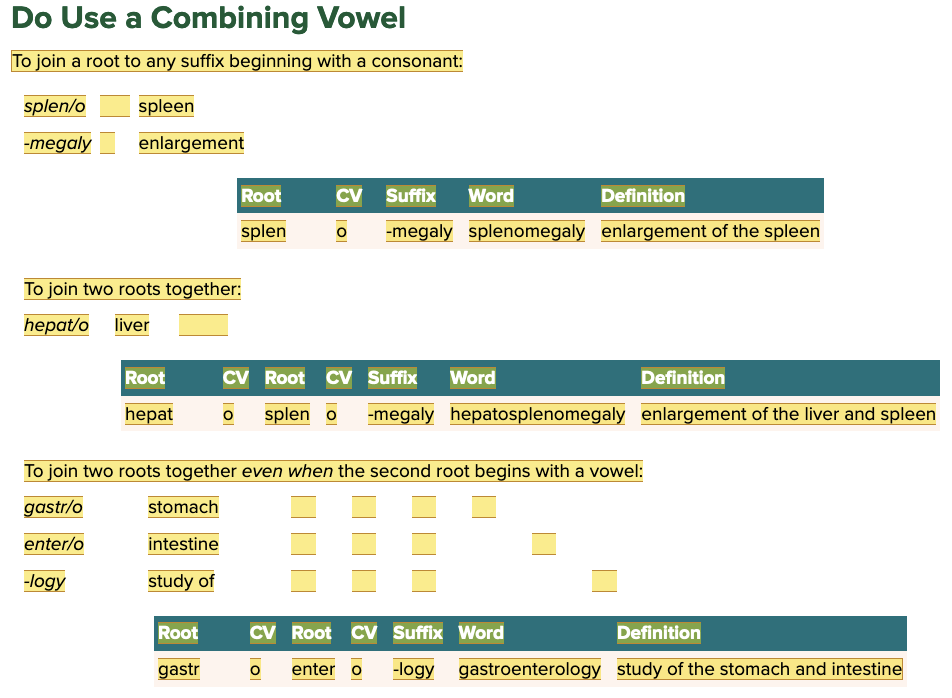
Chapter 1.6 How to Put Together Medical Terms:
Do Use a Combining Vowel - To join a root to any suffix beginning with a consonant.
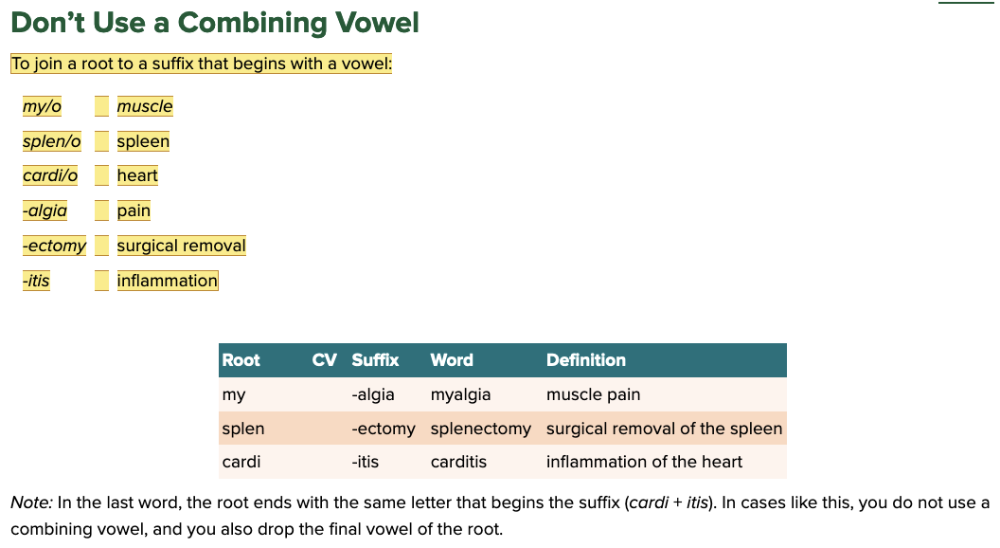
Chapter 1.6 How to Put Together Medical Terms:
Don't Use a Combining Vowel - To join a root to a suffix that begins with a vowel.
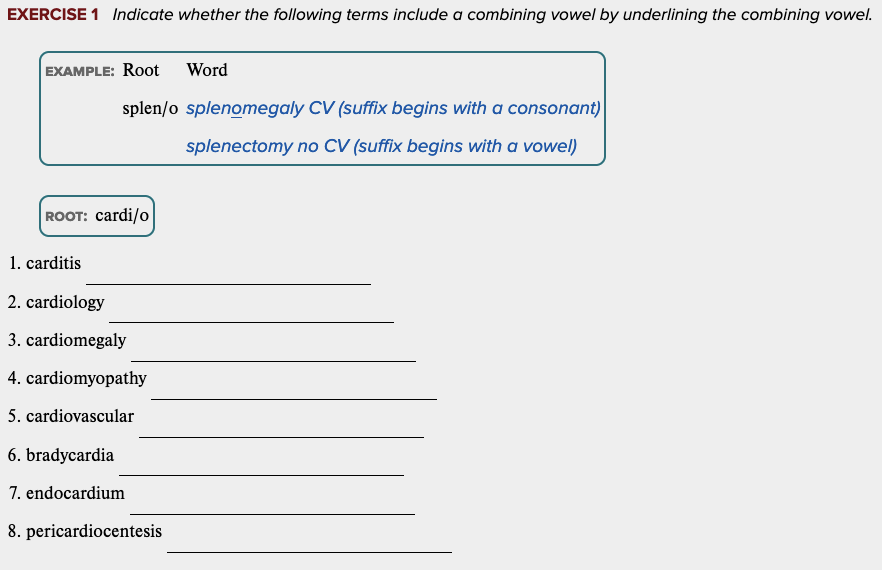
Learning Outcome 1.6 Exercises: Exercise 1
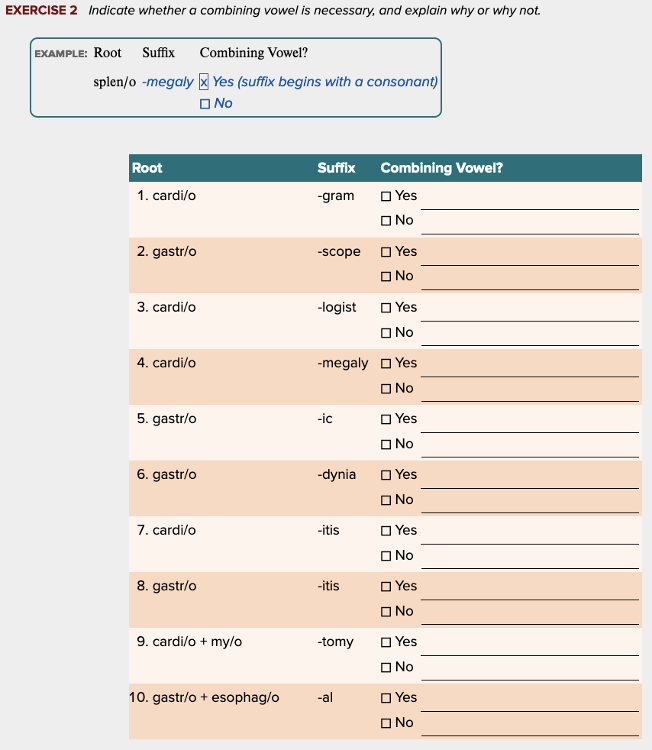
Learning Outcome 1.6 Exercises: Exercise 2
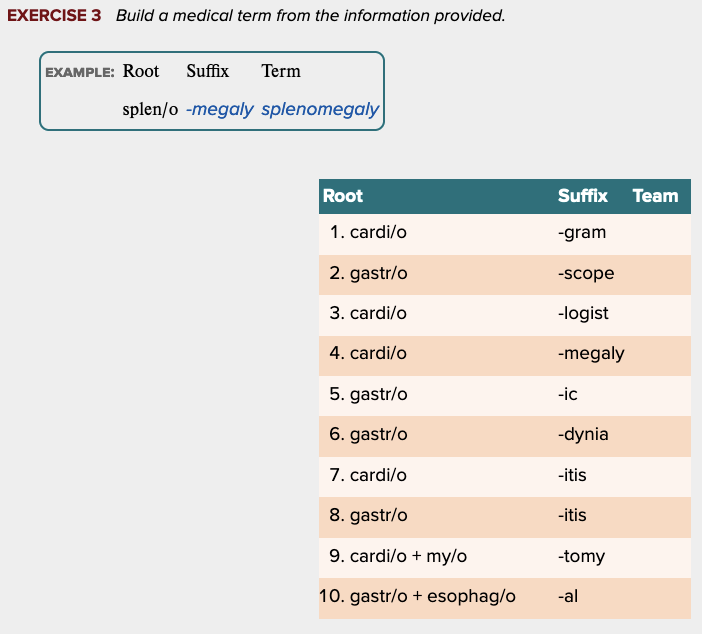
Learning Outcome 1.6 Exercises: Exercise 3
Chapter 1.7 How Medical Terms Are Translated:
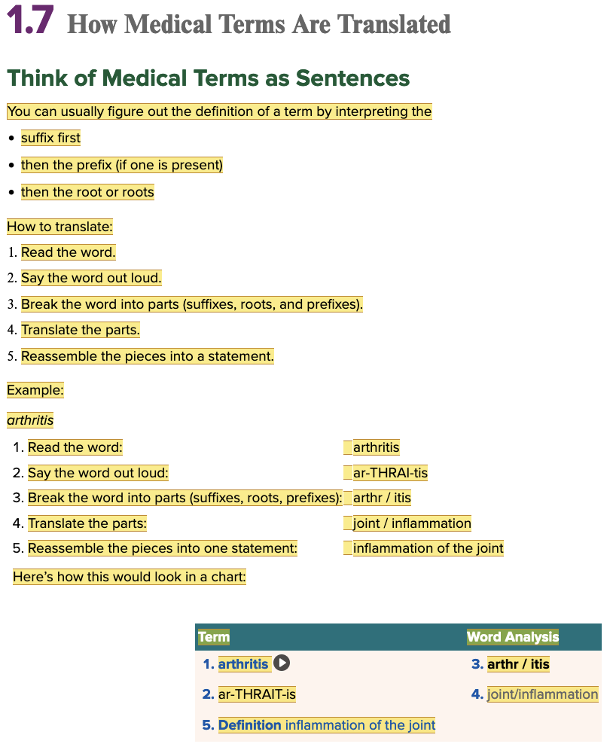
Think of Medical Terms as Sentences
Chapter 1.7 How Medical Terms Are Translated:
Think of Medical Terms as Sentences -
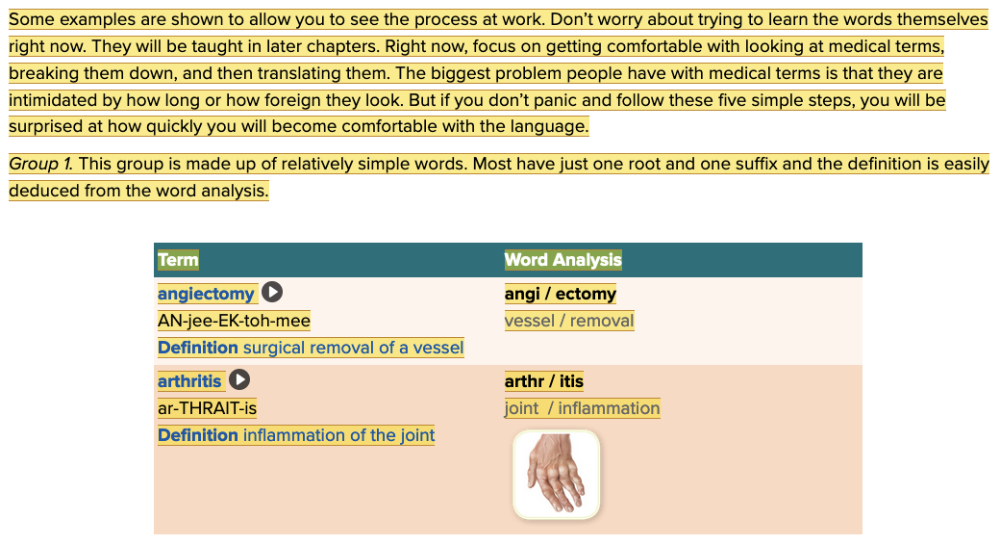
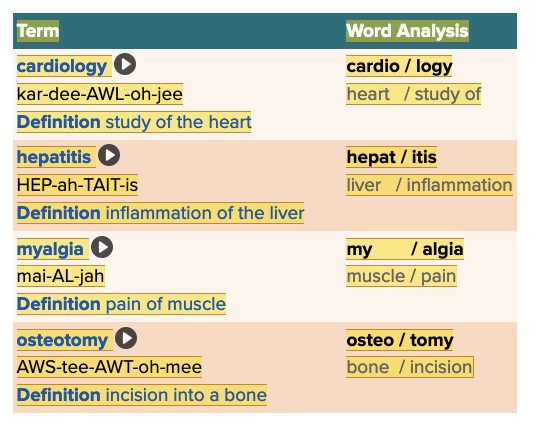
- Group 1. This group is made up of relatively simple words. Most have just one root and one suffix and the definition is easily deduced from the word analysis.
Chapter 1.7 How Medical Terms Are Translated:
Think of Medical Terms as Sentences -
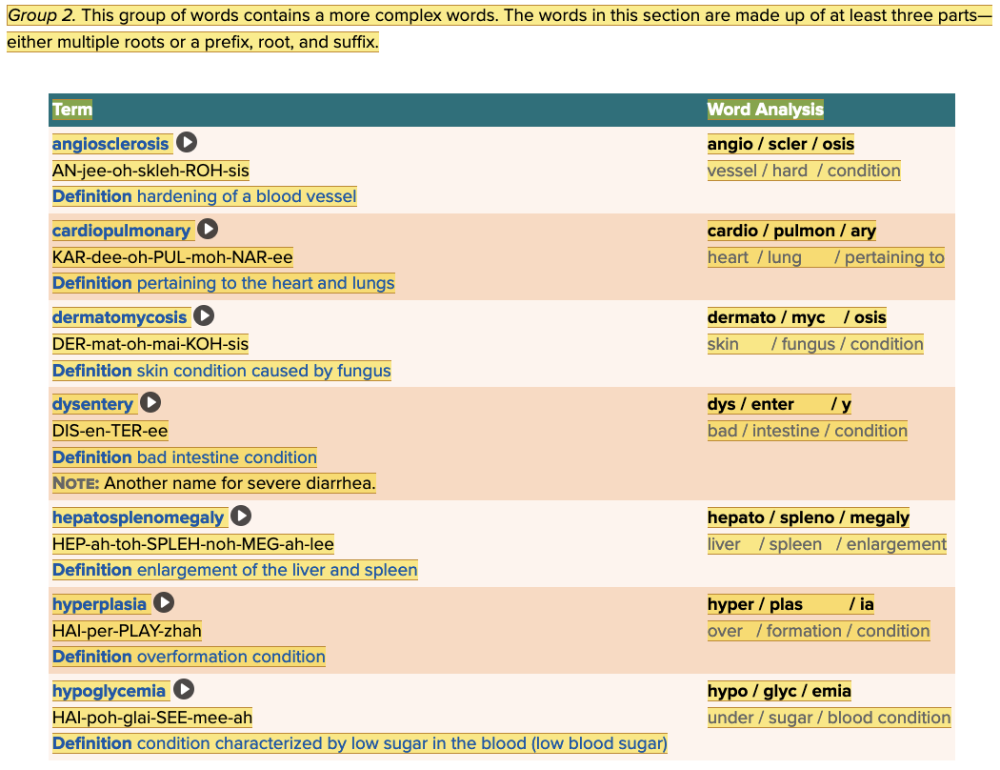
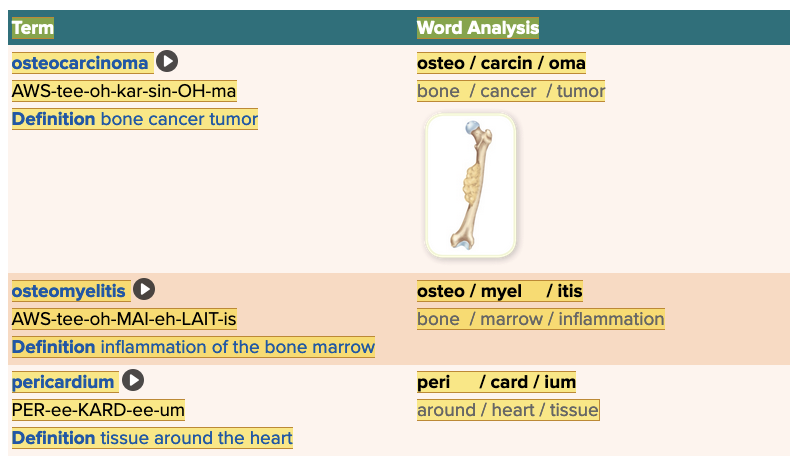
- Group 2. This group of words contains a more complex words. The words in this section are made up of at least three parts--either multiple roots or a prefix, root, and suffix.
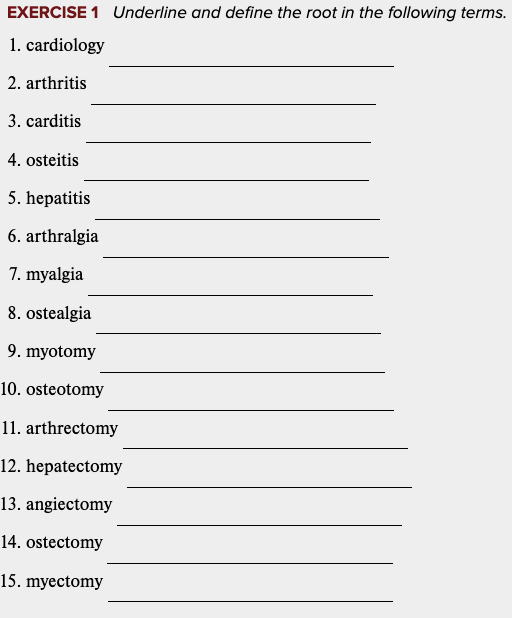
Learning Outcome 1.7 Exercises: Exercise 1
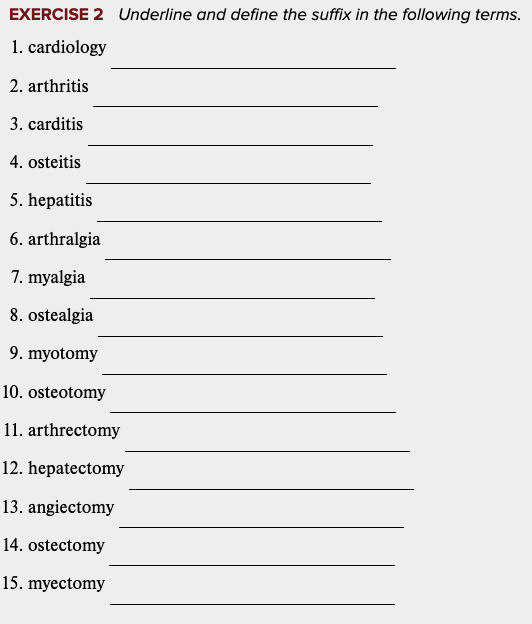
Learning Outcome 1.7 Exercises: Exercise 2
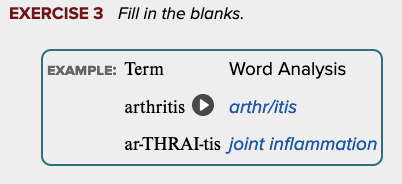
Learning Outcome 1.7 Exercises: Exercise 3
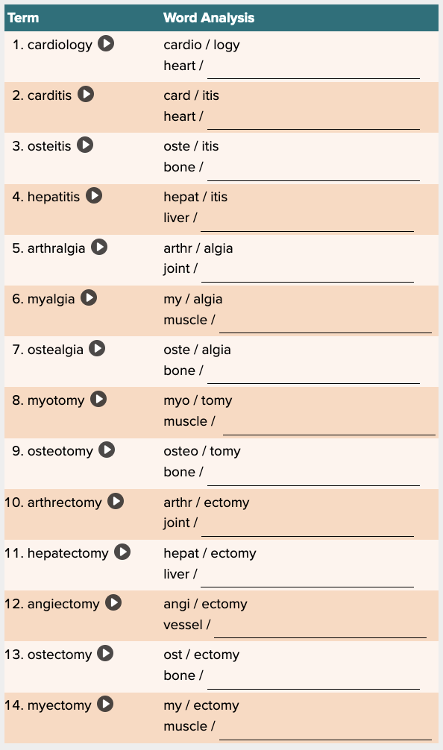
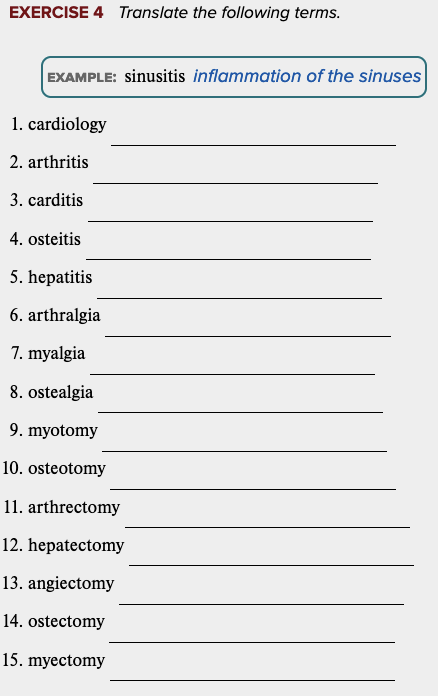
Learning Outcome 1.7 Exercises: Exercise 4
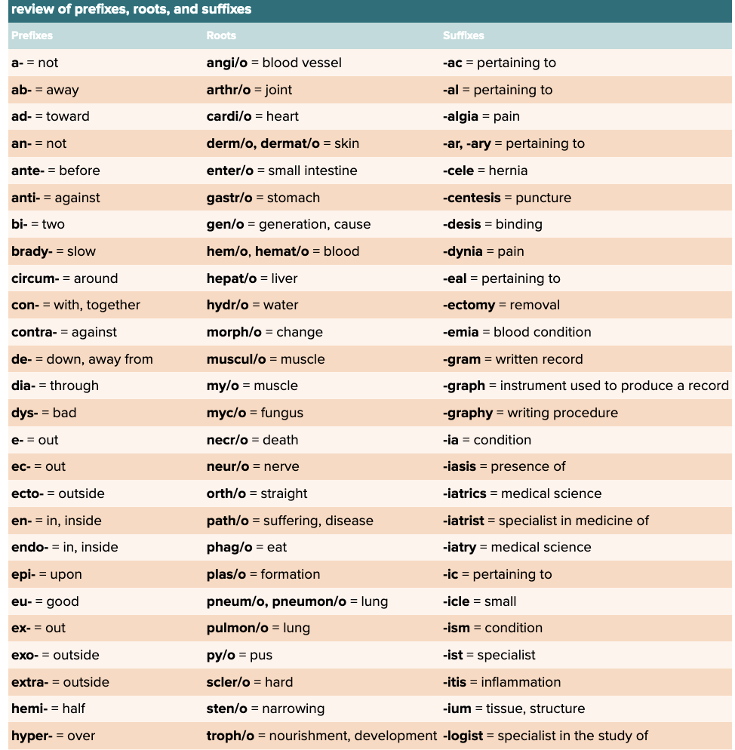
Chapter 1 Review of Prefixes, Roots, and Suffixes.
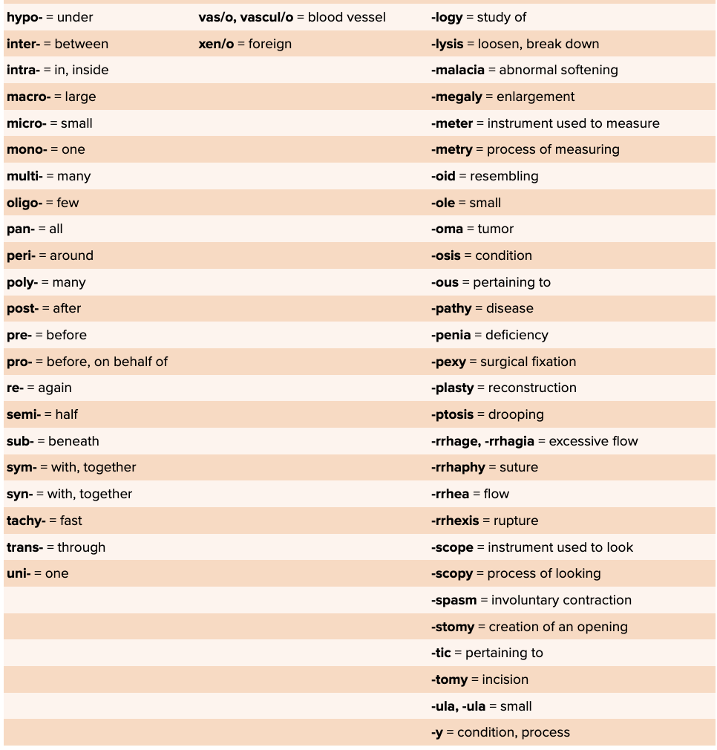
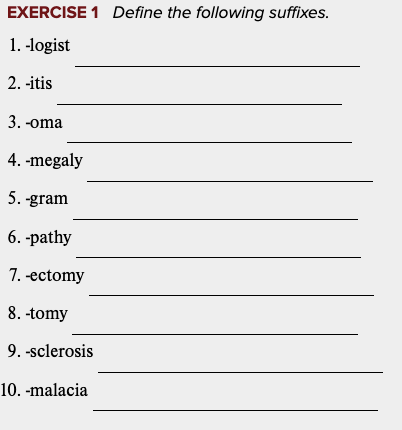
Chapter 1 Review Exercises: Exercise 1
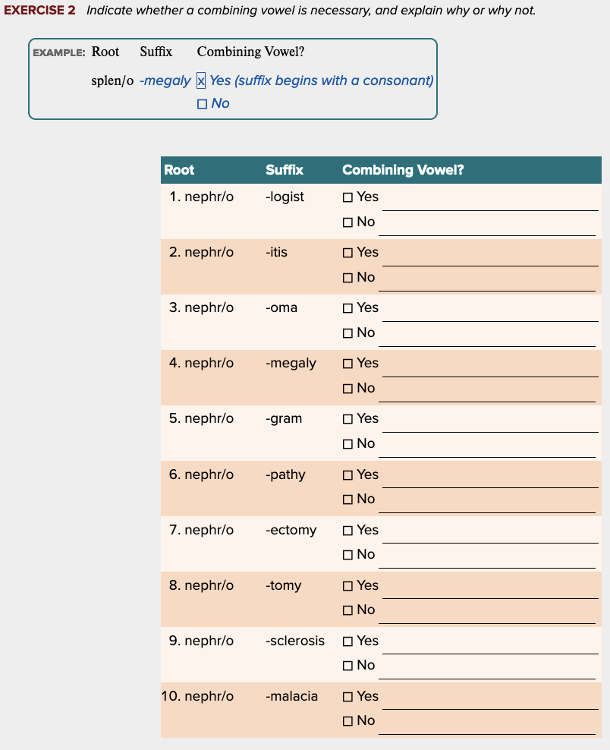
Chapter 1 Review Exercises: Exercise 2
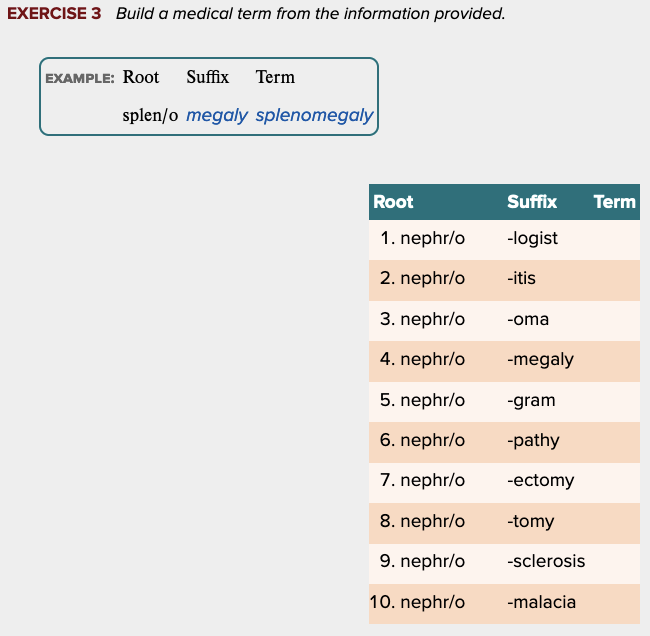
Chapter 1 Review Exercises: Exercise 3
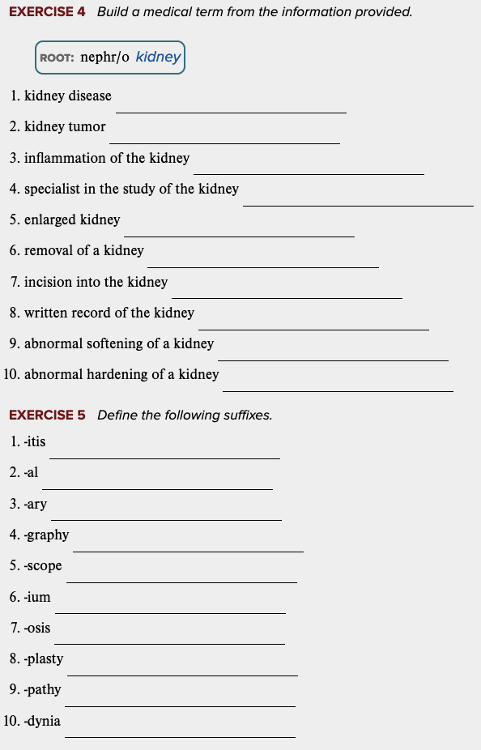
Chapter 1 Review Exercises: Exercise 4, 5
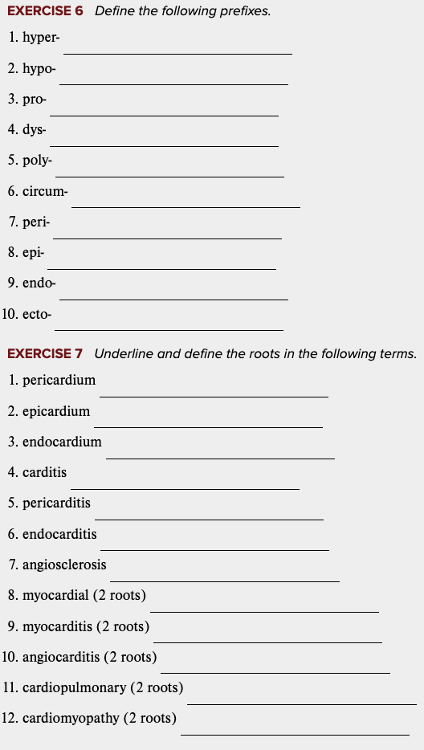
Chapter 1 Review Exercises: Exercise 6, 7
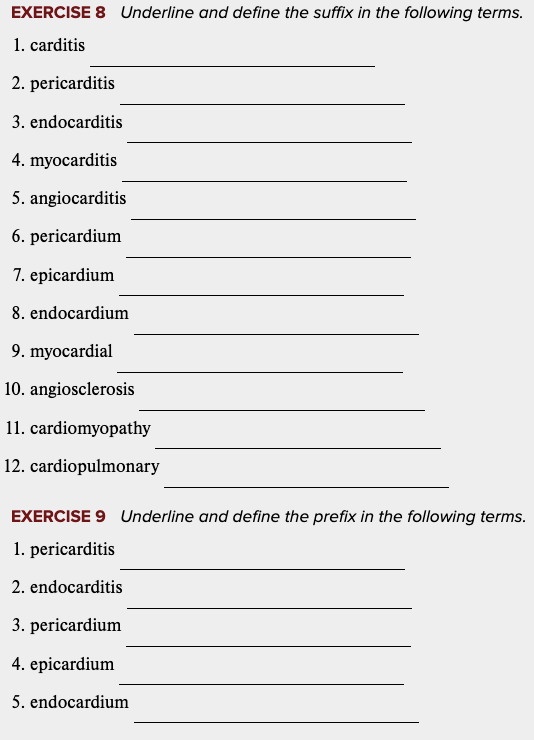
Chapter 1 Review Exercises: Exercise 8, 9
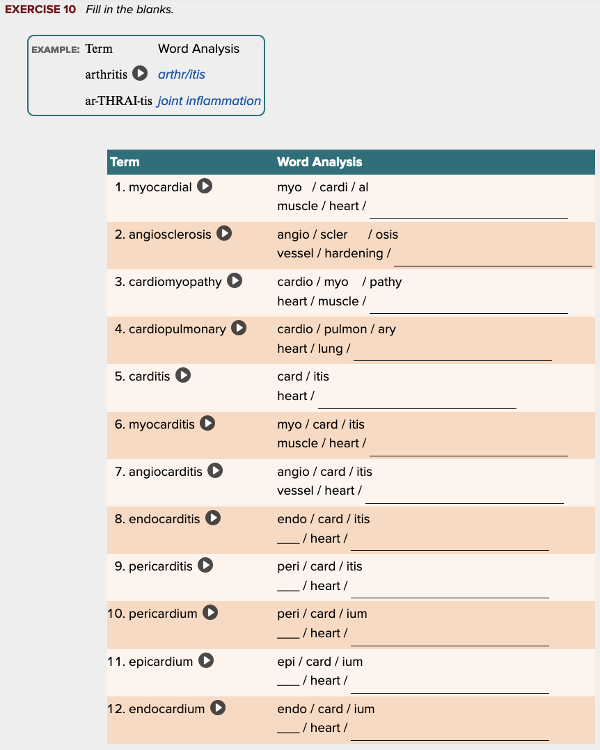
Chapter 1 Review Exercises: Exercise 10
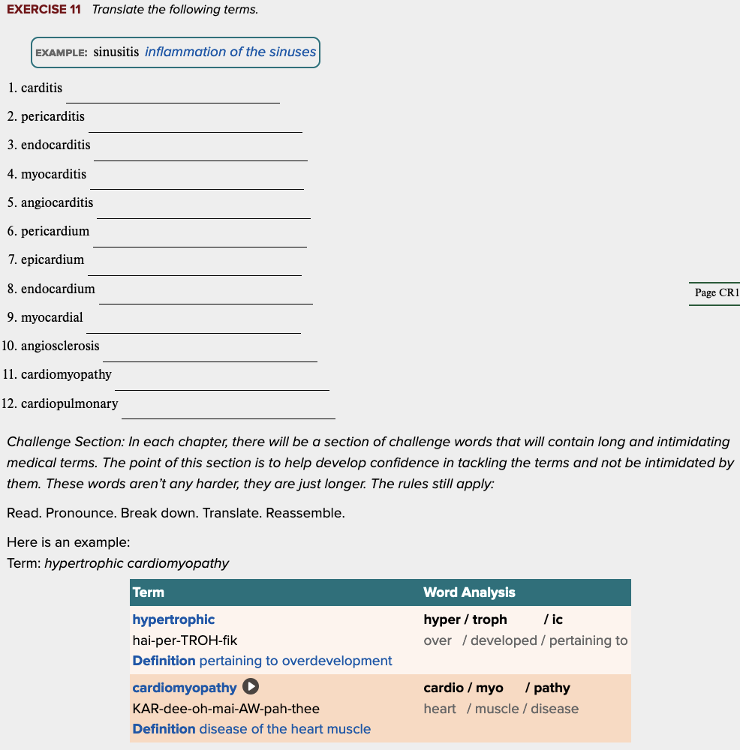
Chapter 1 Review Exercises: Exercise 11
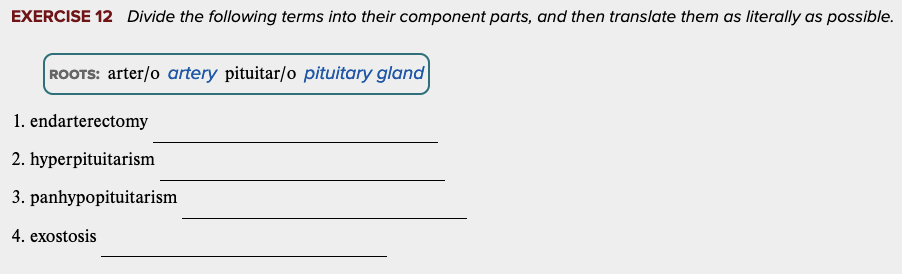
Chapter 1 Review Exercises: Exercise 12
Medical language allows health care professionals to communicate quickly because ______.
Multiple choice question.
- it uses a common understanding of the terms
- patients are less likely to ask questions when medical terms are used
- terms are not based on roots
- it saves time on documentation
it uses a common understanding of the terms
Medical language is comprised primarily of words from the Latin and ______ languages.
Fill in the Blank Question.
Greek
A word formed by using the name of the person who discovered or invented what is being described is a(n) ______.
Multiple choice question.
- acronym
- antonym
- synonym
- eponym
eponym
The word acronym is derived from the Greek words "acro-" meaning "high, end" and "onyma" meaning ______.
name
The first people to study the human body and develop theories about health and disease were the ancient ______.
Greeks
Which of the following is true of medical language?
Multiple select question.
- It allows professionals to communicate clearly.
- It provides abbreviations for all diseases.
- It allows professionals to communicate quickly.
- It can be comforting to the patient.
- It allows professionals to communicate clearly.
- It allows professionals to communicate quickly.
- It can be comforting to the patient.
Medical language is primarily made up of words taken from how many ancient languages?
Multiple choice question.
- Three
- Two
- Five
- Four
Two
In what centuries did the scientific revolution occur?
Multiple select question.
- Second
- First
- Sixteenth
- Nineteenth
- Seventeenth
- Sixteenth
- Seventeenth
Occurred through the sixteenth to eighteenth century.
An eponym is formed by using the inventor's or discoverer's
Multiple choice question.
- location.
- disease.
- nationality.
- name.
name.
You should not think of medical language as words to be memorized. Instead, think of it as sentences to be ______.
translated
A word made up of the first letters of each of the words that make up a phrase is a(n) ______.
Multiple choice question.
- acronym
- eponym
- antonym
- synonym
acronym
The letter "G" is pronounced like a "J" when followed by which vowels?
Multiple select question.
- O
- I
- A
- E
- I
- E
The foundations of western medicine were from which ancient areas?
Multiple select question.
- India
- China
- Greece
- Rome
- Greece
- Rome
The syllables in the word "colonoscopy" are co / lon/ o/ sco/ py. The syllable that is the ultima is ______.
py, last, or pee
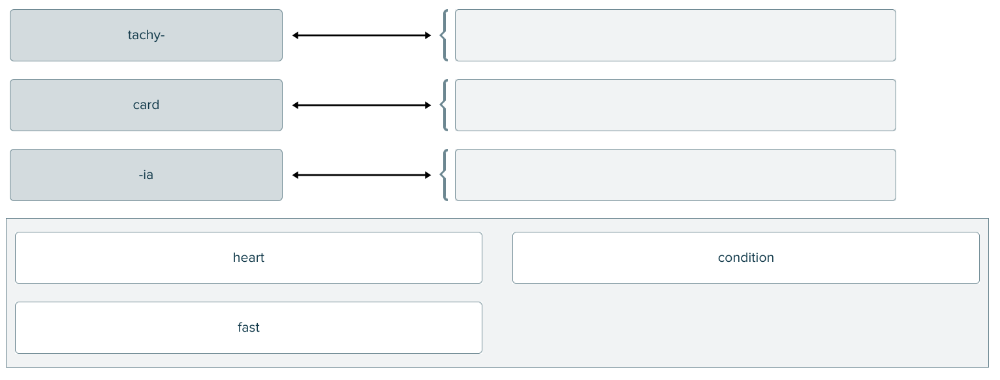
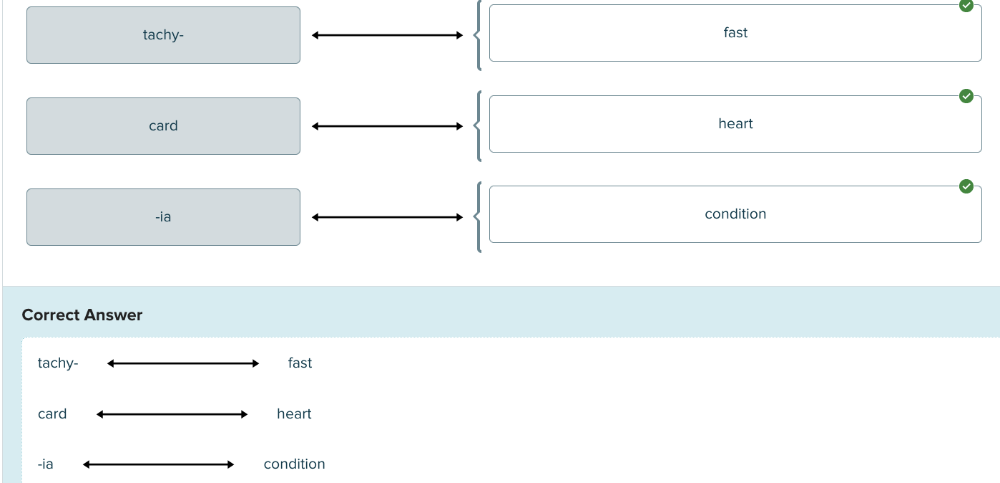
Match the word parts of the term "tachycardia" with their meanings.
The most important thing to do in order to master the pronunciation of medical words is Blank______.
Multiple choice question.
- write out the pronunciation
- write out the word
- count the syllables
- practice saying them out loud
practice saying them out loud
Which of the following was the global language of the scientific revolution?
Multiple choice question.
- Sanskrit
- Aramaic
- Akkadian
- Latin
Latin
The type of word part at the end of the word that gives essential meaning to the term is the ______.
suffix
Which of the following are true about understanding how medical language works?
Multiple select question.
- You can generate words from their word parts.
- You will learn the meaning of key words.
- You must be fluent in more than one language to master it.
- You will be able to break down and understand words you have never seen before.
- You can generate words from their word parts.
- You will learn the meaning of key words.
- You will be able to break down and understand words you have never seen before.
A prefix is found ______ of a word.
Multiple choice question.
- at the beginning
- at the end
- randomly, at any place
- in the middle
at the beginning
The letters "ph" are pronounced as the letter ______.
f
The roots that mean "vessel" are vascul/o or ______.
Multiple choice question.
- ven/o
- cutane/o
- angi/o
- pneum/o
angi/o
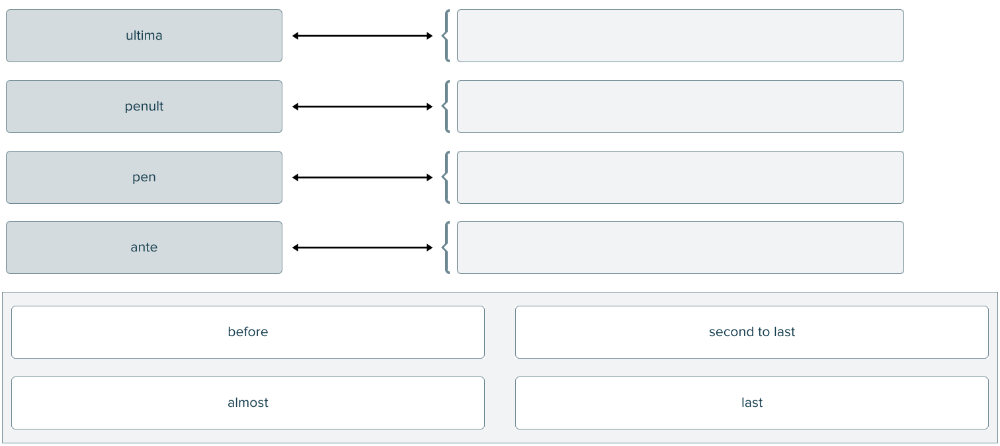
Match the terms related to syllables with their meanings.
The word "colonoscope" has four syllables. Deconstruct the word by separating the syllables with hyphens. ______.
co-lon-o-scope
The part added to the beginning of a term is the
Multiple choice question.
- suffix.
- combining form.
- prefix.
- root.
prefix.
The root in the term "dermatitis" means ______.
skin
Which of the following create the foundation or subject of medical terms?
Multiple select question.
- root
- combining form
- suffix
- prefix
- root
- combining form
Both of the combining forms "pneum/o-" and "pulmon/o-" refer to the ______.
lung or lungs
The root "orth/o-" means ______.
straight
When deciding how to pronounce a word, the emphasis usually falls on the ______.
Multiple choice question.
- postultima
- antepenult
- penult
- ultima
antepenult
Which of the following suffixes means "small"?
Multiple choice question.
- -ous
- -osis
- -itis
- -ole
- -ia
-ole
The word "cardiology" has five syllables. Deconstruct the word by separating the syllables with hyphens. ______-______-______-______-______-______-______-______-______.
Blank 1: car
Blank 2: - or /
Blank 3: di
Blank 4: - or /
Blank 5: o
Blank 6: - or /
Blank 7: lo
Blank 8: - or /
Blank 9: gy
The suffix "-iatrist" is an example of which type of suffix?
Multiple choice question.
- Positional
- Complex
- Simple
- Directional
Complex
Which is the root in the term "subcutaneous"?
Multiple choice question.
- Subcut
- Sub
- Cutane/o
- Ous
Cutane/o
The suffix "-logy" means
Multiple choice question.
- record.
- specialist.
- study of.
- medical science.
study of.
A ______ is the ending of a medical word that gives essential meaning to the term.
Blank 1: suffix
The suffix "-megaly" means
Multiple choice question.
- softening.
- pain.
- tumor.
- enlargement.
enlargement.
The root "myc/o-" means
Multiple choice question.
- fungus.
- tendon.
- muscle.
- disease.
fungus.
The suffix that means "instrument used to produce a record" is
Multiple choice question.
- -scope.
- -graph.
- -meter.
- -gram.
-graph.
Which of the following suffixes mean "pertaining to"?
Multiple select question.
- -ary
- -eal
- -ac
- -ous
- -ole
- -ia
- -ism
- -ary
- -eal
- -ac
- -ous
In the word "appendectomy", the suffix "-ectomy" means ______.
Blank 1: removal or cutout
Which of the following is true about complex suffixes?
Multiple choice question.
- They are more difficult to understand.
- They are never made up of more than one word part.
- They only begin with a consonant.
- They have more parts.
They have more parts.
Which of the following medical terms are singular?
Multiple select question.
- Thrombi
- Ova
- Biopsy
- Thrombus
- Diagnoses
- Ovum
- Diagnosis
- Biopsy
- Thrombus
- Ovum
- Diagnosis
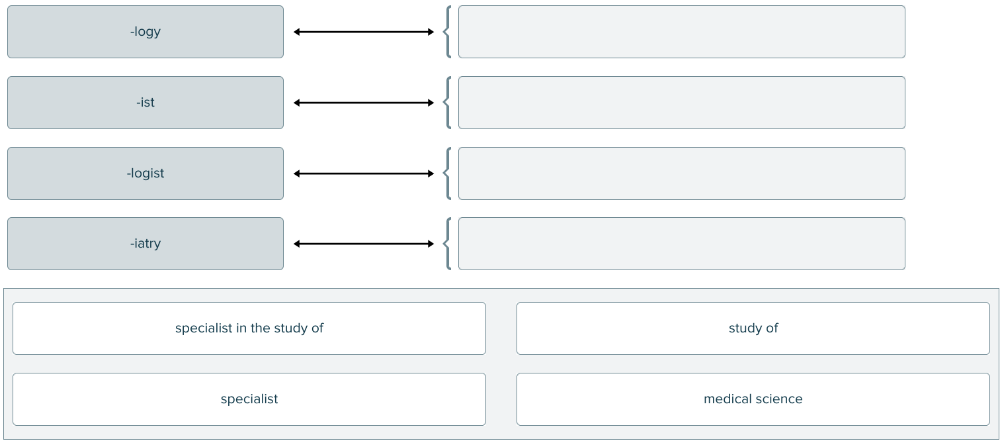
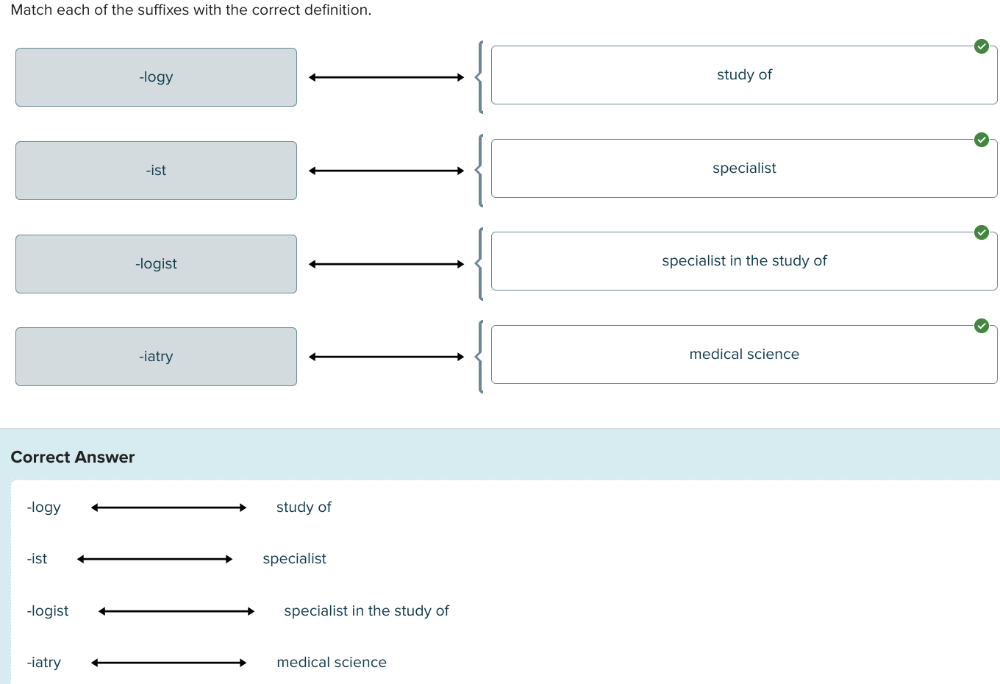
Match each of the suffixes with the correct definition.
The prefixes "anti-" and "contra-" mean ______.
Blank 1: against
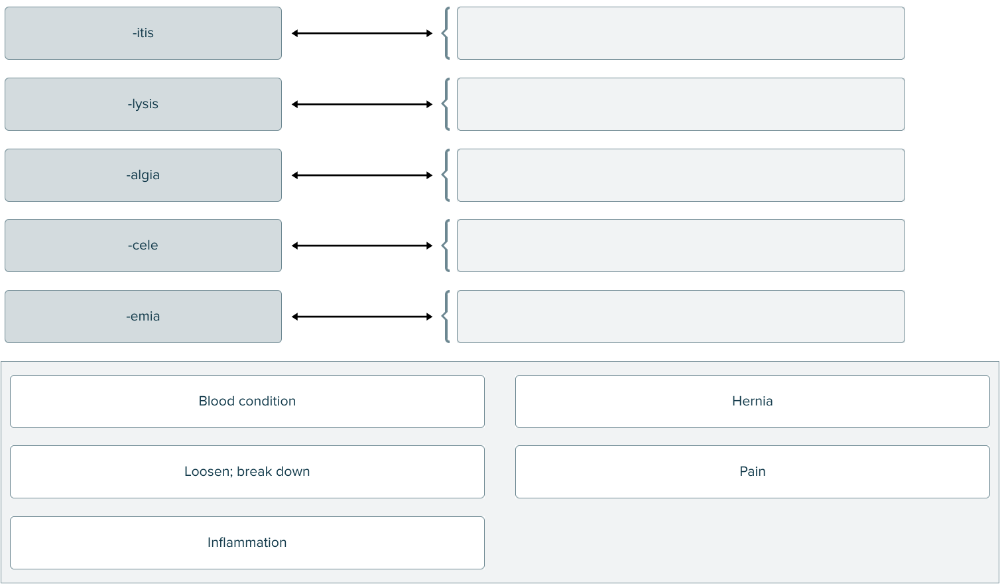
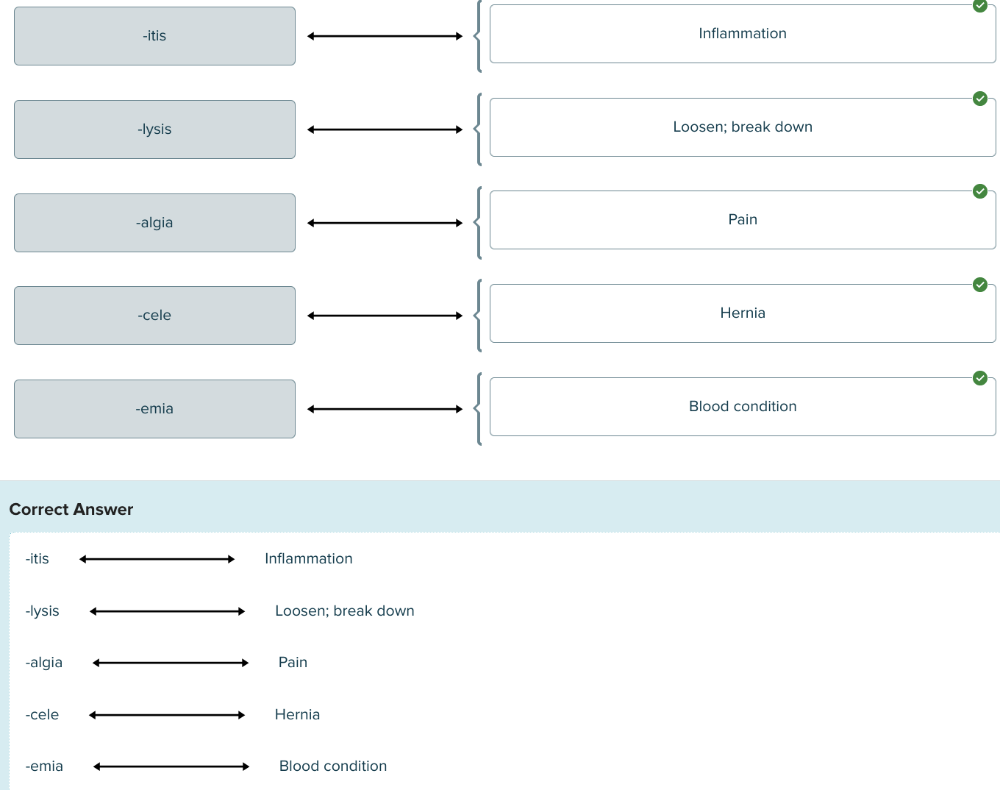
Match the suffix with the meaning.
A patient with bradycardia has a ______ heartbeat.
Multiple choice question.
- absent
- irregular
- slow
- fast
slow
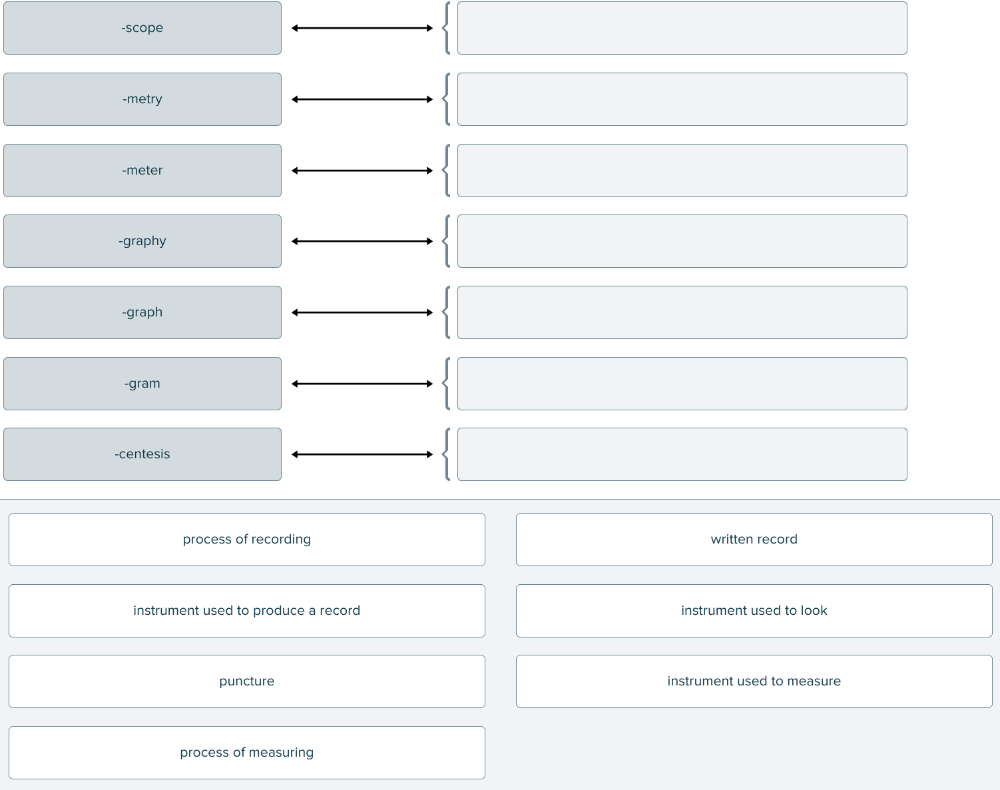
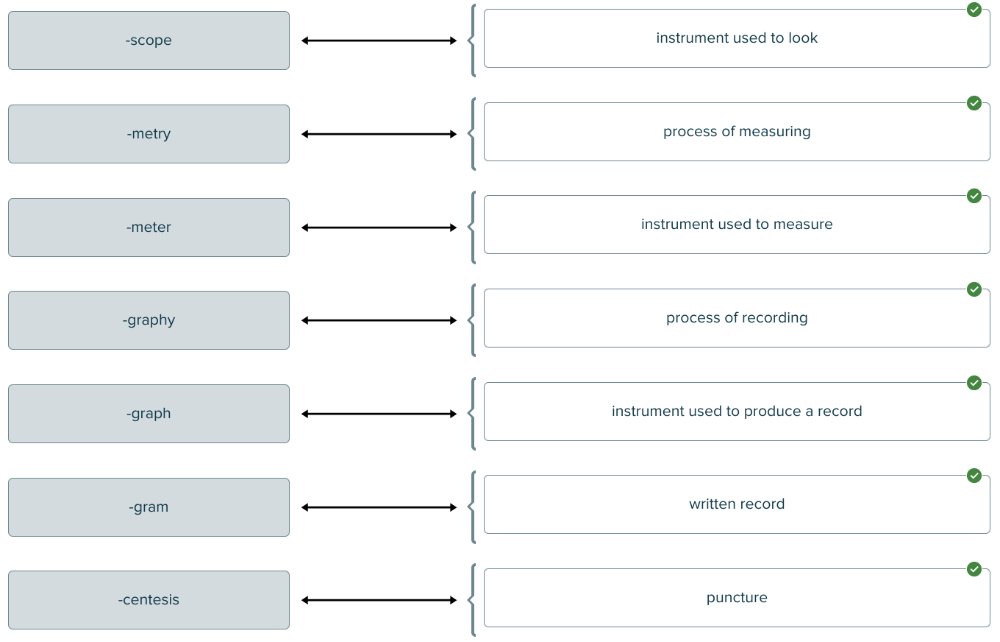
Match each test suffix with the correct definition.
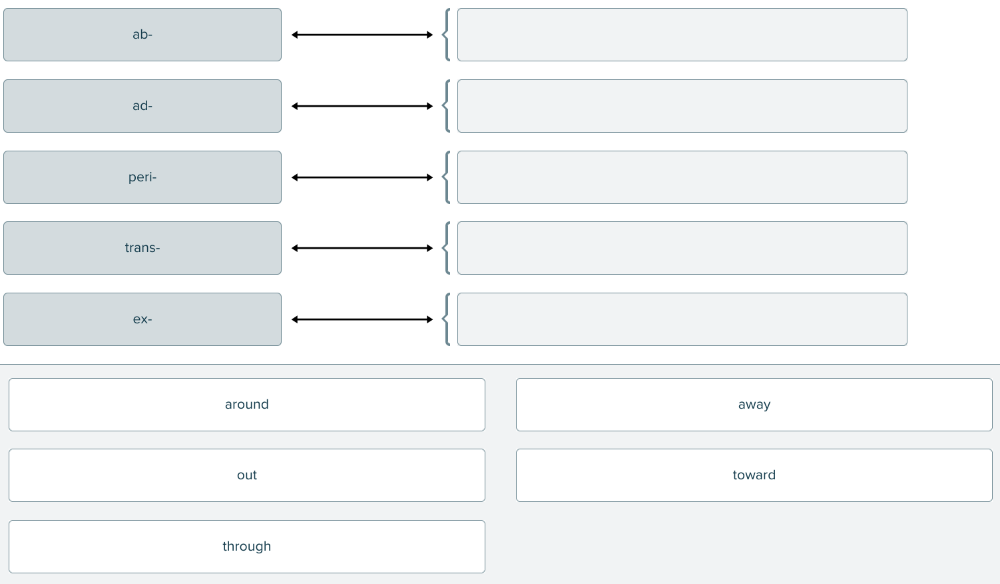
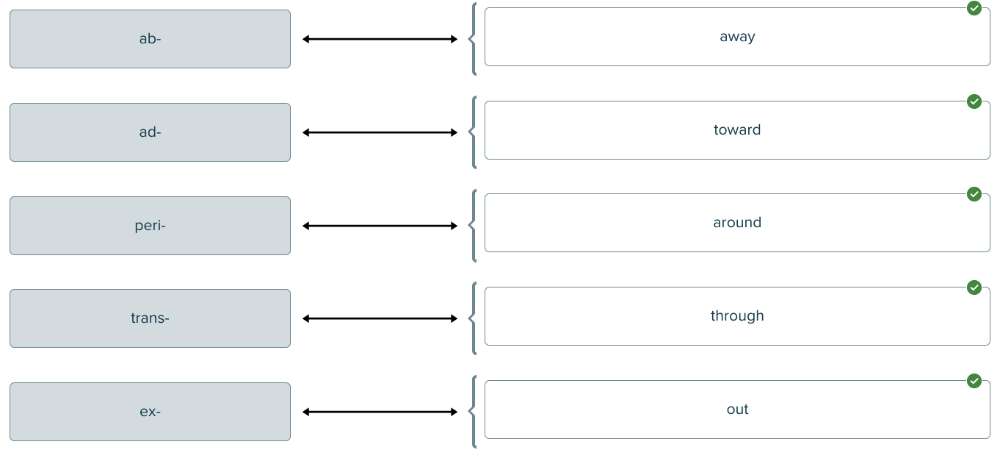
Match each prefix about direction or position with the correct definition.
Deconstruct the word "rhinoplasty" by separating the combining form and the suffix with a hyphen. ______.
Blank 1: rhino-plasty
The plural form of the word "ganglion" is
Multiple choice question.
- ganglias
- ganglia
- gangis.
- ganglius
ganglia
Which of the following prefixes means "not"?
Multiple select question.
- De-
- Pre-
- A-
- An-
- A-
- An-
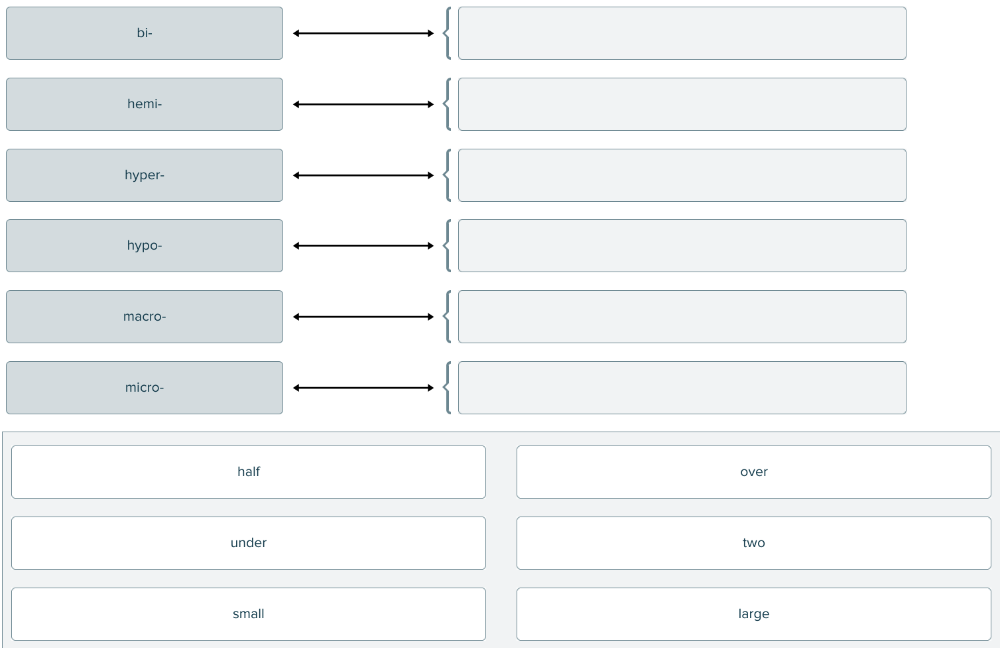
Match each size or quantity prefix with the correct definition.
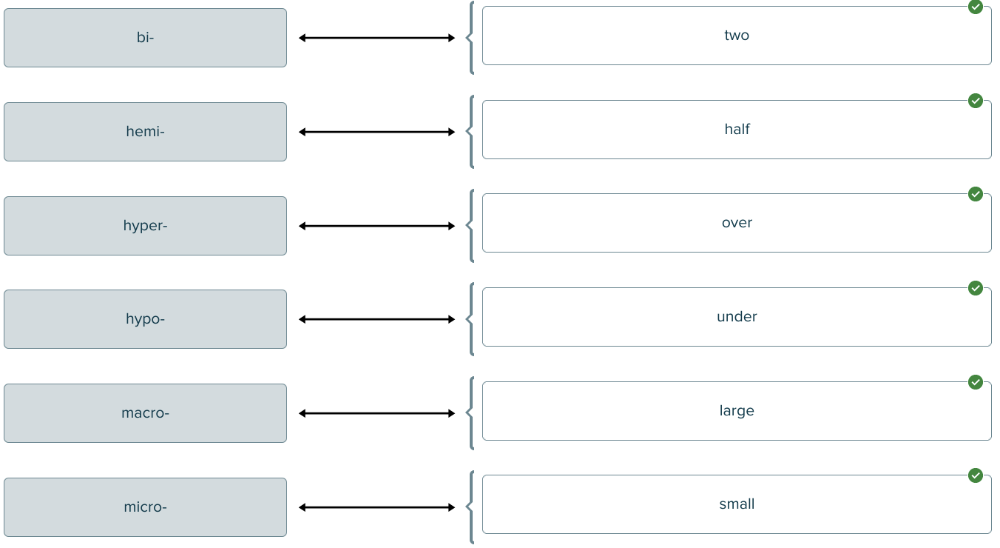
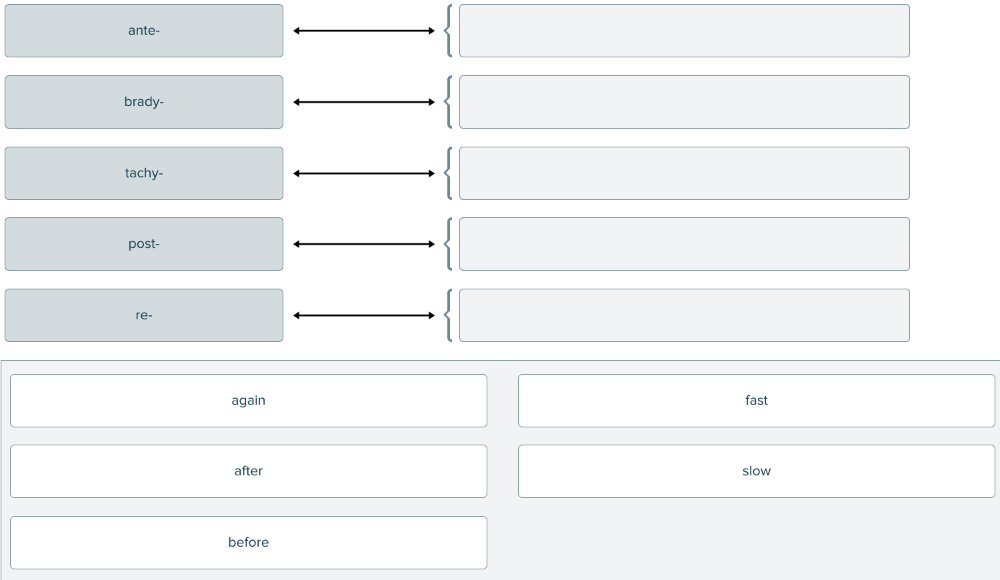
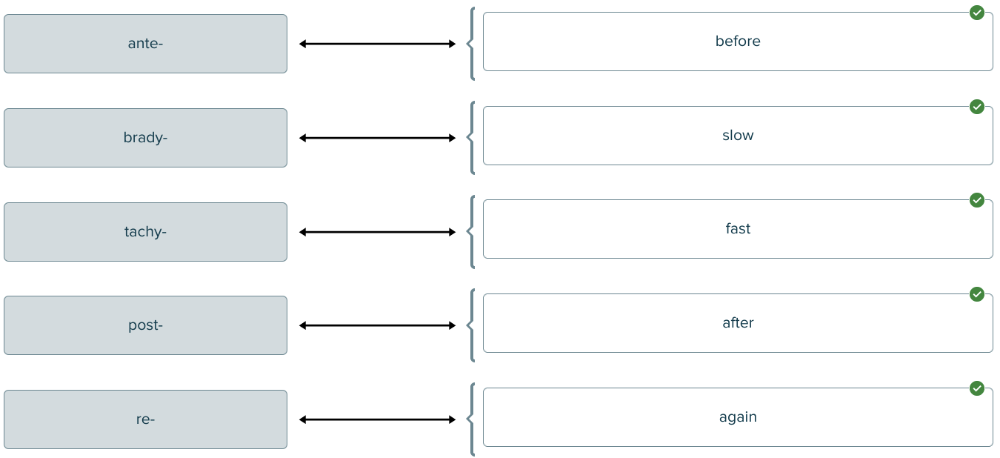
Match each prefix related to time or speed with the correct definition.
Which of the following prefixes mean "with" or "together"?
Multiple select question.
- Syn-
- Con-
- Eu-
- Sym-
- Syn-
- Con-
- Sym-
Which of the following prefixes mean "around"?
Multiple select question.
- Intra-
- Ecto-
- Circum-
- Peri-
- Circum-
- Peri-
The combining vowel is found at the end of the ______.
Multiple choice question.
- suffix
- root
- prefix
- verb
root
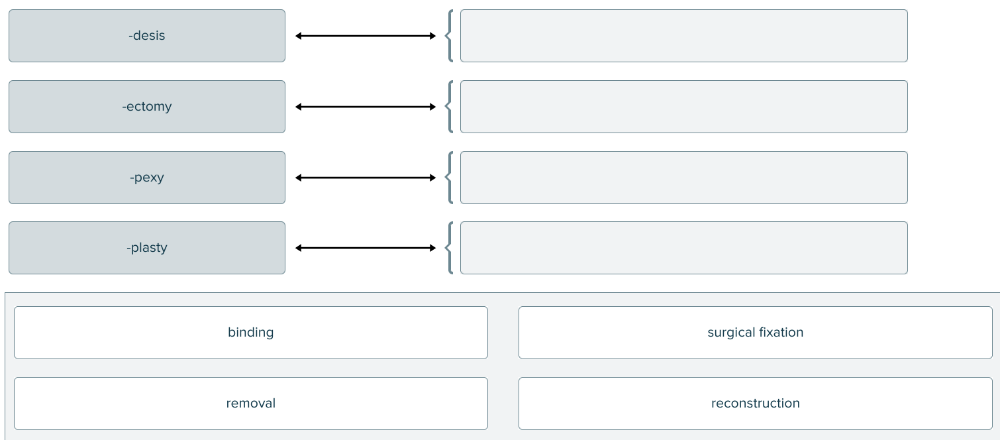
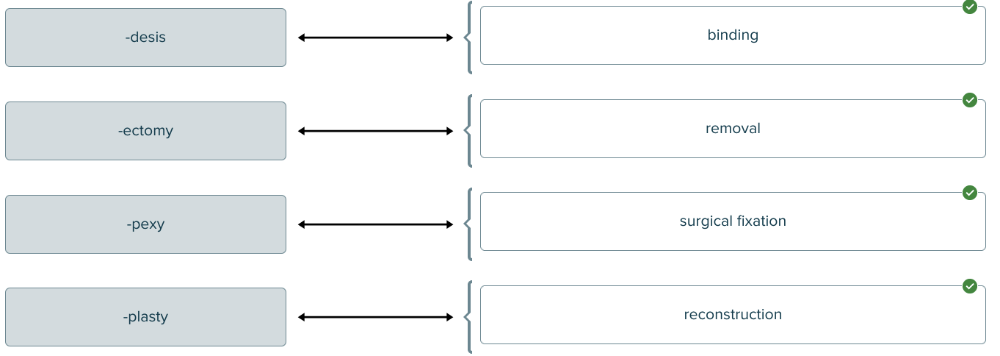
Match the treatment suffix with the correct definition.
Which of the following medical terms are plurals?
Multiple select question.
- Appendix
- Larva
- Ovum
- Diagnoses
- vertebrae
- Thoraces
- Ova
- Diagnoses
- vertebrae
- Thoraces
- Ova
The two word parts in the word "monocyte" mean "______" and "cell."
Blank 1: one or single
In the word gastroenterology, the two combining forms mean Blank______.
Multiple select question.
- intestine
- stomach
- kidneys
- heart
- liver
- intestine
- stomach
Which of the following prefixes mean "with" or "together"?
Multiple select question.
- Eu-
- Syn-
- Sym-
- Dys-
- Con-
- Syn-
- Sym-
- Con-
A combining vowel is NOT used when connecting a root to which of the following suffixes?
Multiple choice question.
- -graph
- -logy
- -pathy
- -ectomy
-ectomy
A combining form is a combination of a __ with a combining vowel.
Multiple choice question.
- hyphen
- suffix
- prefix
- root
root
In the word "arthritis," the suffix means ______.
Blank 1: inflammation
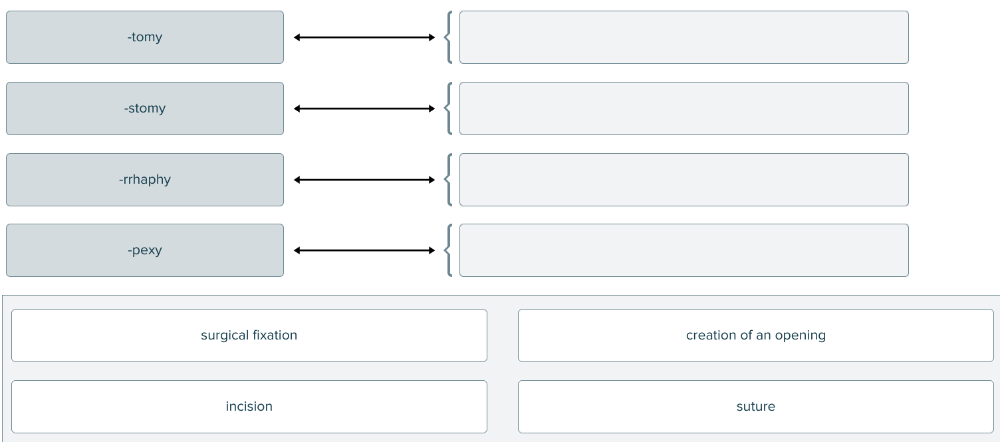
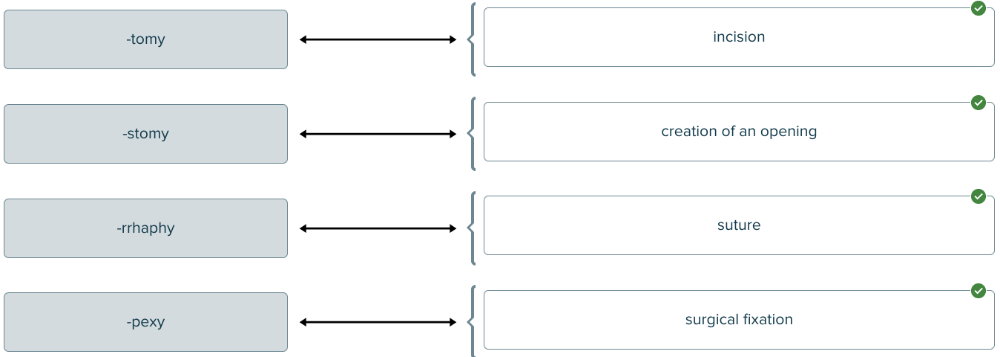
Match the correct definition to the suffix for treatments.
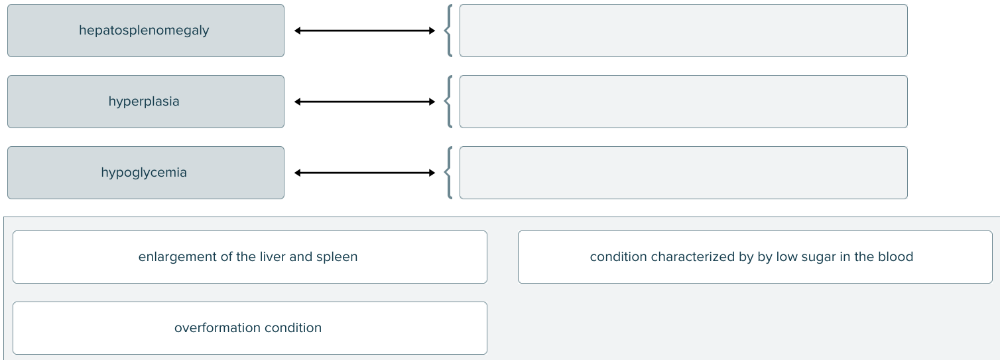
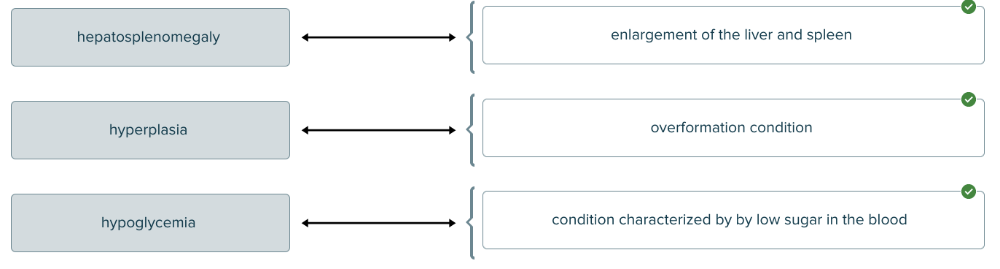
Match the medical term to the definition.
The plural form of the word "ganglion" is
Multiple choice question.
- ganglius
- gangis.
- ganglias
- ganglia
ganglia
When is a combining vowel used?
Multiple select question.
- To join a prefix to a root
- To join a root to a suffix that begins with a consonant
- To join a root to another root
- To join a root to a suffix that begins with a vowel
- To join a root to a suffix that begins with a consonant
- To join a root to another root
When is a combining vowel NOT used?
Multiple choice question.
- To join a root to another root.
- To join a root to a suffix that begins with a vowel.
- To join a root to a suffix that begins with a consonant.
- To join two roots together even when the second root begins with a vowel.
To join a root to a suffix that begins with a vowel.
Deconstruct the word "myalgia". Enter hyphens or slashes in the appropriate blanks. ______ ______ ______.
Blank 1: my
Blank 2: - or /
Blank 3: algia
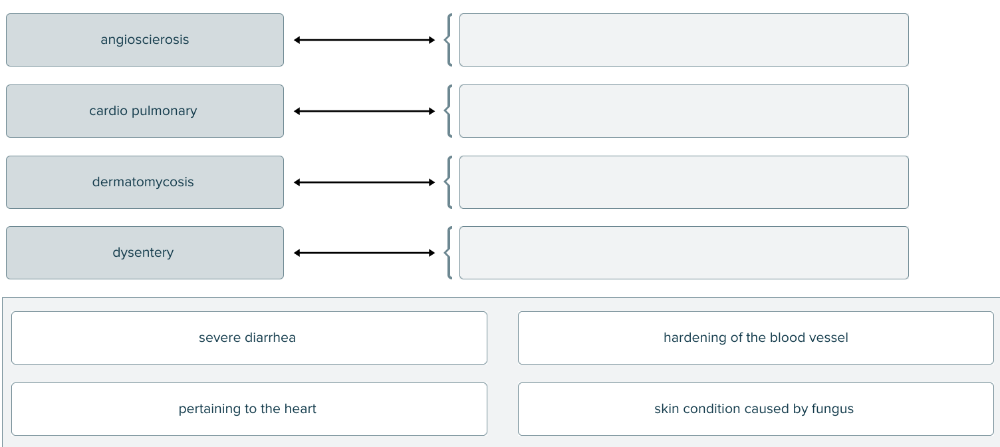
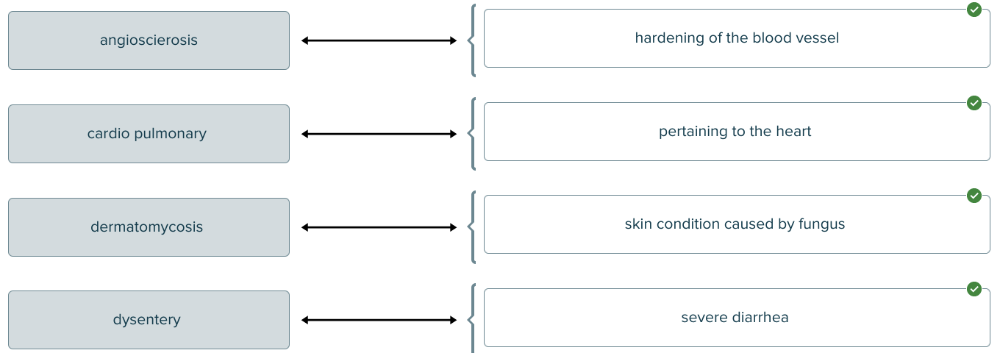
Match the general term condition to the definition.
The combining form in the word "hepatomegaly" means ______.
Blank 1: liver
A combining vowel is used when joining a root with which of the following suffixes?
Multiple choice question.
- -itis
- -ac
- -ule
- -megaly
-megaly