Autonomic Nervous System
Compared to the somatic nervous system, the autonomic nervous system secretes
acetylcholine or norepinephrine
Compared to the autonomic nervous system, receptors of the somatic nervous system include
nicotinic cholinergic receptors only
Compared to the somatic nervous system, which of the following describes the neuron arrangement from the central nervous system (CNS) to the effector in the autonomic nervous system?
two motor neurons in series
The sympathetic division is also referred to as the _______________ division.
thoracolumbar
The parasympathetic division is also referred to as the _______________ division.
craniosacral
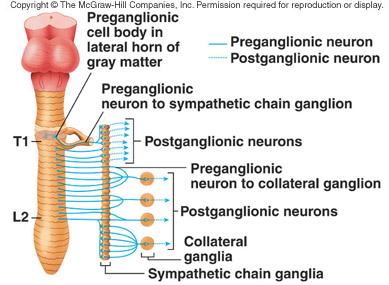
Nerve fibers of the sympathetic division of the autonomic nervous system originate in which of the following segments of the central nervous system?
thoracic and lumbar regions of the spinal cord
Nerve fibers of the parasympathetic division of the autonomic nervous system originate in which of the following segments of the central nervous system?
brainstem and sacral region of the spinal cord
In which of the following cranial nerves do the parasympathetic preganglionic nerve fibers that innervate organs of the thorax and upper abdomen occur?
vagus
In which of the following segments do the parasympathetic preganglionic nerve fibers that send signals to organs within the pelvic cavity originate?
sacral region of the spinal cord
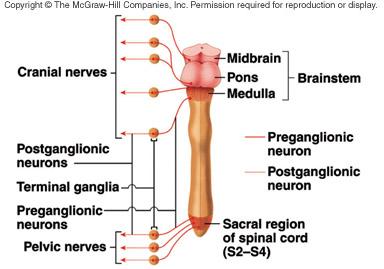
Which of the following ganglia are associated with the parasympathetic division of the autonomic nervous system?
terminal
Sympathetic preganglionic axons originate from neurons in the _______________ of the spinal cord.
lateral horns
After traveling a short distance in a spinal nerve sympathetic preganglionic axons exit the spinal nerve in a
white ramus communicans
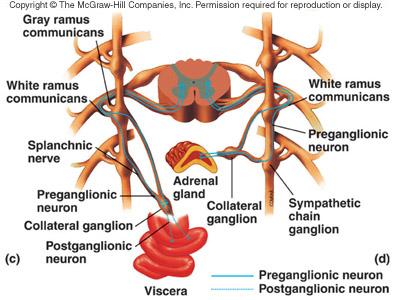
Which of the following indicates the correct path sympathetic nerve fibers take when leaving the spinal cord before returning to a spinal nerve on their way to stimulate arrector pili muscles and sweat glands in the skin?
1. white ramus
2. paravertebral ganglion
3. spinal nerve
4. ventral root
5. gray ramus
4-3-1-2-5
Parasympathetic preganglionic axons in pathways leading to visceral effectors in the head occur in each of the following cranial nerves EXCEPT the
vagus nerves.
Which of the following types of ganglia occur in chains on either side of the vertebral column?
paravertebral ganglia
Nerve fibers of the _______________ division of the autonomic nervous system arise from the brainstem and the sacral region of the spinal cord.
parasympathetic
Which of the following is true about the nerve fibers of sympathetic motor neurons?
Preganglionic fibers exit the spinal cord in the ventral roots of spinal nerves.
Preganglionic axons of this division of the autonomic nervous system originate in the brainstem and from the sacral region of the spinal cord.
parasympathetic
All of the following are true about autonomic sympathetic nerve fibers EXCEPT
preganglionic fibers begin in the brainstem and sacral region of the spinal cord.
The parasympathetic fibers that control the secretion of saliva, tears and nasal secretions are conveyed in the
facial nerves.
Parasympathetic fibers that innervate organs in the abdominopelvic cavity are conveyed in the _______________ nerve or arise from spinal nerves in the ______________ region.
vagus; sacral
Parasympathetic ganglia are located near the _______________ and are called ______________.
target organs; terminal ganglia.
The facial nerves include parasympathetic fibers that regulate
secretion of saliva, tears and nasal secretions.
Parasympathetic fibers of the vagus nerves form each of the following autonomic plexuses EXCEPT the
inferior hypogastric.
Which of the following autonomic plexuses is formed by parasympathetic fibers that arise from spinal nerves S2 to S4?
inferior hypogastric
Parasympathetic axons exit the brainstem in all of the following cranial nerves EXCEPT which of the following?
hypoglossal(XII)
Sympathetic splanchnic nerves
carry preganglionic sympathetic axons to collateral ganglia after they pass through the sympathetic chain ganglia without synapsing.
Sympathetic axons leave the sympathetic chain ganglia in all of the following EXCEPT
cranial nerves.
Which of the following is NOT a collateral ganglion of the sympathetic division?
submandibular ganglion
Which of the following is a terminal ganglion of the parasympathetic division?
ciliary ganglion
The axons of preganglionic neurons of the parasympathetic division synapse within _______________ ganglia.
terminal
Nicotinic receptors occur in the membranes of which of the following?
postganglionic parasympathetic and sympathetic neurons
Which of the following are NOT exclusively cholinergic neurons?
sympathetic postganglionic
Which of the following are usually adrenergic neurons?
sympathetic postganglionic
Nicotinic receptors in the autonomic nervous system are located in the membranes of
postganglionic neurons of the parasympathetic and sympathetic divisions.
Which of the following receptors occur in the membranes of target cells of sympathetic postganglionic neurons?
alpha or beta adrenergic or muscarinic cholinergic
Which of the following receptors occur in the membranes of target cells of parasympathetic postganglionic neurons?
muscarinic cholinergic
Which of these receptors occur in the membranes of sympathetic postganglionic neurons?
nicotinic cholinergic
Acetylcholine is always the neurotransmitter employed by each of the following EXCEPT
sympathetic postganglionic neurons.
Norepinephrine is usually the neurotransmitter employed by
sympathetic postganglionic neurons.
What type of receptors occur in the membranes of the adrenal medulla cells that respond to sympathetic stimulation by secreting the hormones epinephrine and norepinephrine?
nicotinic cholinergic
Nicotinic acetylcholine receptors occur in each of the following locations except the membranes of
parasympathetic effector cells.
The neurotransmitter acetylcholine binds to
nicotinic and muscarinic receptors.
Which effectors would be stimulated after consumption of nicotine?
both parasympathetic and sympathetic postganglionic neurons
Because it selectively activates beta receptors, which of the following drugs is used to dilate bronchioles in respiratory disorders such as asthma?
albuterol
Which of the following is a parasympathetic blocking agent used to dilate the pupils during an eye examination?
atropine
Which of the following types of neurons is least likely to be cholinergic?
sympathetic postganglionic
The binding of acetylcholine to muscarinic receptors results in
an increase in intestinal motility.
The two divisions of the autonomic nervous system have antagonistic effects on each of the following EXCEPT
the diameter of blood vessels in skeletal muscles.
The two divisions of the autonomic nervous system have antagonistic effects on which of the following?
gastrointestinal motility
_______________ stimulation leads to dilation of the pupils of the eyes and _______________ stimulation leads to constriction of the pupils.
Sympathetic; parasympathetic
The two divisions of the autonomic nervous system have antagonistic effects on each of the following EXCEPT
the diameter of blood vessels in skeletal muscles.
During stress the sympathetic division of the ANS would cause each of the following EXCEPT
contraction of the urinary bladder.
Which of the following is NOT a parasympathetic effect?
dilation of the bronchioles in the lungs
Which of the following is a sympathetic effect?
increased heart rate
The parasympathetic fibers that control the muscles involved in constriction of the pupils in response to a bright light shined in eyes are conveyed in the
oculomotor nerves.
The sympathetic division of the autonomic nervous system normally controls target cells with ____ receptors.
nicotinic and muscarinic
Which of the following brain areas is the most important integrating center for autonomic nervous system functions?
hypothalamus
Each of the following areas of the central nervous system serves as an integrating center for autonomic nervous system functions EXCEPT the
thalamus
All of the following are true about the parasympathetic division of the autonomic nervous system EXCEPT which one?
Each preganglionic neuron synapses with as many as 17 postganglionic neurons.
Which of the following is NOT true about the sympathetic division of the autonomic nervous system?
Effects on target organs are specific and local.
Which of the following is NOT true about the parasympathetic division of the autonomic nervous system?
Stimulation affects several organs at the same time resulting in generalized effects.
A decrease in blood pressure is detected by _______________ in the common carotid arteries and leads to a _______________ reflex that stimulates an increase in the heart rate and force of contraction.
baroreceptors; sympathetic