Structure and Function of Plants (Lab Practical #1)
What do all cells possess?
A cell wall and protoplast.
What is the main purpose of the cell wall?
It surrounds the plant cell and holds the contents of the cell together.
What other functions does the cell wall serve?
Facilitates communication and the transfer of substances between cells.
What makes up the cell wall of plants?
- Middle Lamella
- Primary Wall
- Secondary Wall
- Plasmodesmata
What does the middle lamella do?
Cements the primary walls of adjacent cells together.
What is the primary wall?
The outermost layer of the cell wall.
What is the secondary wall?
The innermost layer of the cell wall.
What is the plasmodesmata?
Cytoplasmic threads that extend through openings in cell walls and connect the protoplasts of adjacent living cells (for communication).
What is the protoplast?
All of the contents within the plant cell (includes nucleus and cytoplasm).
What is within the plant cell's cytoplasm?
- Nucleus
- Numerous Membrane Bound Organelles
What is a plastid?
An organelle within the cell that is in charge of food manufacture and storage.
What are some examples of plastids?
Chloroplast
Chromoplast
Leucoplast
What is the vacuole?
A space within the cytoplasm filled with watery fluid.
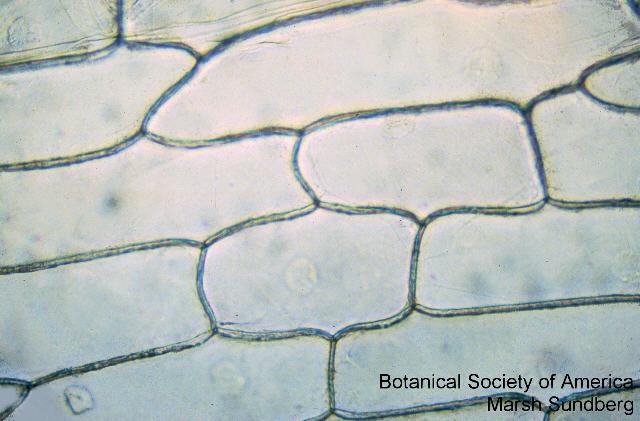
What are these cells from? Locate the cell wall, nucleus, and cytoplasm.
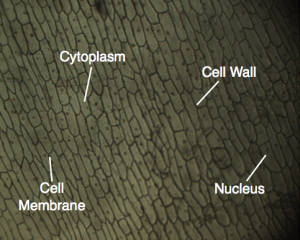
The epidermis of an onion.
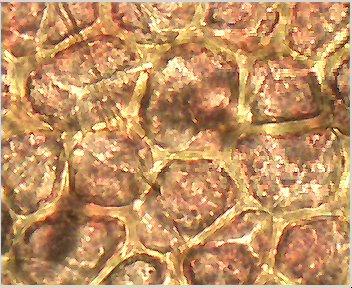
What lab specimen are these cells from? Locate the cell wall, cell lumen, middle lamella and plasmodesmata.
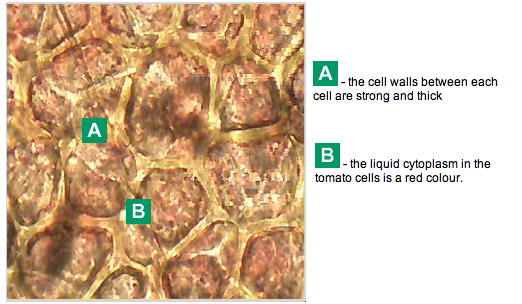
The epidermis of a tomato.
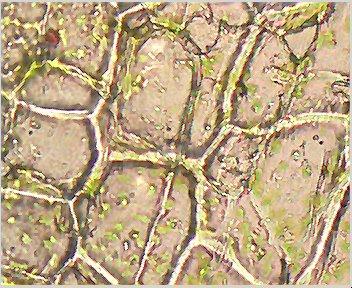
What lab specimen are these cells from? Locate the cell wall, plastids, and possibly stomata.
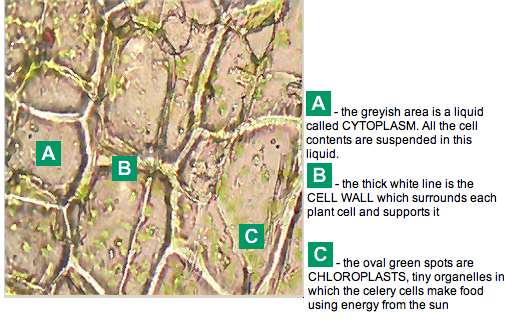
A Celery Stalk
What type of plastid would most likely be found in tomato tissue?
Chromoplasts
What kind of plastids are probably in celery tissue?
Chloroplasts
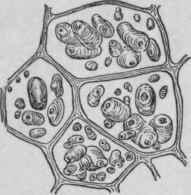
What lab specimen are these cells from? Locate the different structures.
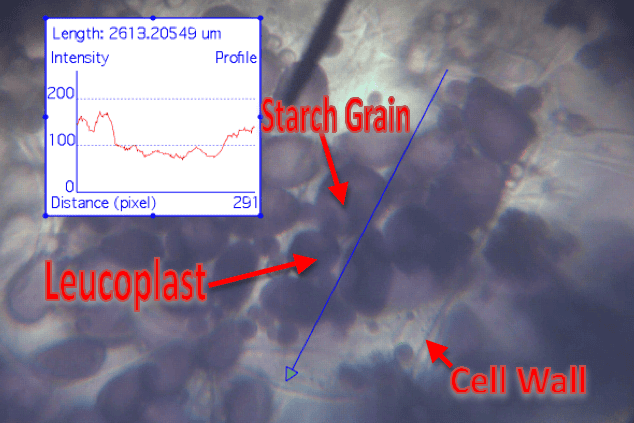
A potato.
What kind of plastids are probably in potato tissue?
Amyloplastids
What are the three characteristics that distinguish plant cells from animal cells?
1) Chloroplasts
2) Rigid Cell Wall
3) Plastids
What are the three principal types of plastids and what is the difference between them?
1) Chloroplast: forms in green plants
2) Chromoplast: forms in pigmented plants
3) Amyloplasts: forms in starch
What is the purpose of the plasmodesmata?
To connect the protoplasts of adjacent living cells.
Define a eukaryotic cell and give two examples of eukaryotic organisms.
DEF: A cell that has a membrane-bound nucleus, organelles, and chromosomes in which DNA is associated with proteins.
EX: reptiles, birds
Define a prokaryotic cell and give an example of a prokaryotic organism.
DEF: A cell lacking a membrane-bound nucleus and organelles.
EX: bacteria
What are the four main groups of eukaryotes?
1) Animals
2) Plants
3) Protists
4) Fungi
Briefly describe Cell Theory.
Cells create organisms.
Briefly describe Organismal Theory.
Organisms create cells.
T or F: Plants are eukaryotes.
True
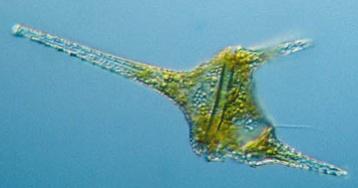
What kind of species of algae is this?
Dinophyta (dinoflagellates)
Why are dinoflagellates interesting biochemically?
- Their flagella beat within two grooves.
- Have permanently condensed chromosomes
- Bioluminescence
What kind of reproduction do dinoflagellates have?
Longitudinal Cell Division
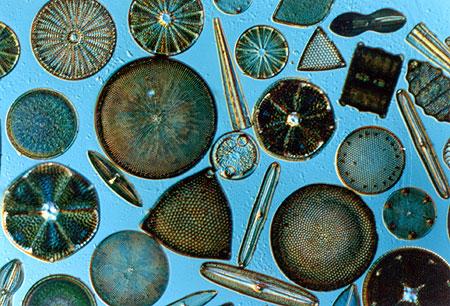
What kind of species is this?
Bacillariophyta (diatoms)
What substance makes up diatom walls?
Polymerized, opaline silica.
What kind of reproduction do diatoms have?
Asexual by cell division.
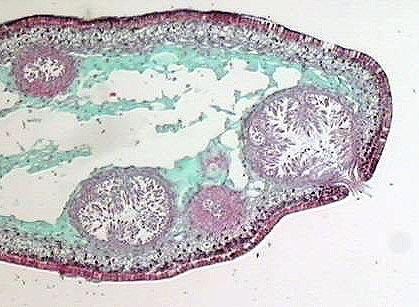
What kind of species is this, what is the name of the hollow chambers and what do they do?
Species: Phaeophyta (brown algae)
Hollow Chambers: Conceptacles
Produce: Gamete producing structures (gametangia)
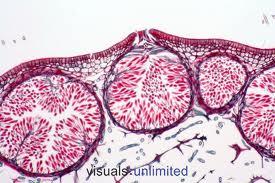
What gender is this Phaeophyta conceptacle and what does it produce?
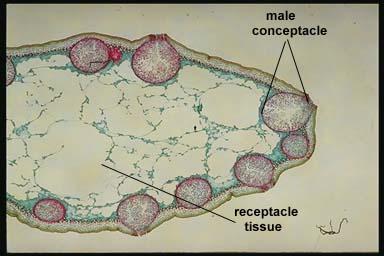
Male Conceptacle.
Produces: Antheridia --> sperm
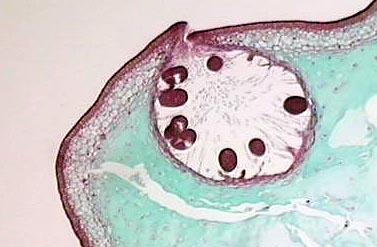
What gender is this Phaeophyta conceptacle and what does it produce?
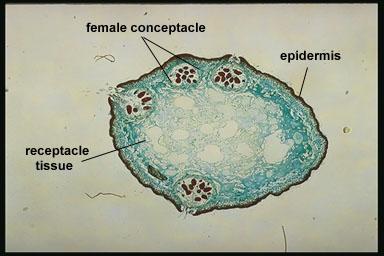
Female Conceptacle.
Produces: Oogonia (as opposed to archegonia) --> eggs
What kind of reproduction is present in "Fucus" (or Phaeophyta - brown algae)?
Zygotic Meiosis
Why are brown algae (usually) brown?
They contain xanthophyll fucoxanthin.
What is going to happen to the cells within oogonia and antheridia?
Antheridia produces sperm, Oogonia produces eggs through mitosis.
They are then released for fertilization.
What kind of reproduction does Rhodophyta (red algae) undergo?
Sporic Meiosis
What is unique about Rhodophyta (red algae)?
Energy is stored as Floridean starch in the cytoplasm.
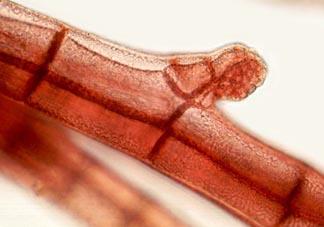
What kind of algal species is this and what are the clumped and individual structures?
Rhodophyta (red algae)
Clumped structure: spermatangia
Individual of clumped structure: spermatia
Why are red algae red?
They contain phycobilins.
Where do red algae tend to occur and what about their coloration is an adaptation to their habitat?
Red algae occur in deeper water, and their coloration is well suited to this habitat because it absorbs green and blue-green light that penetrates at that depth.
What is the second largest group of algae?
Chlorophyta (green algae)
What kind of grouping is Chlorophyta (green algae)?
Paraphyletic
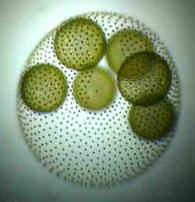
What is the name of this specimen and what type of algae is it? What ploidy level?
Volvox aureus
Chlorophyta (green algae)
1n
Is Volvox unicellular or colonial?
Colonial
Is Volvox motile or non-motile?
Motile
What are the smaller spheres inside the larger spheres in Volvox and how do they emerge from the larger sphere?
Juvenile spheroids that hatch from the larger sphere activated by heat or hormones depending upon if they're male or female.
What plant class are stoneworts a part of?
Class Charophyceae (charaphytes)
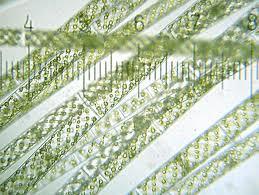
What specimen is this and what type of algae is it? Also label the cell walls and chloroplasts. What is the ploidy level?
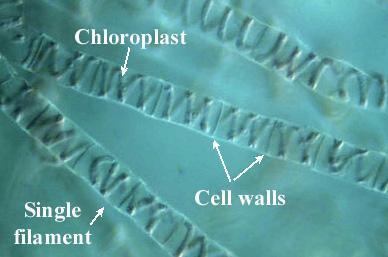
Spirogyra
Chlorophyta (green algae)
2n
What are the spiral-like structures in Spirogyra?
Chloroplasts
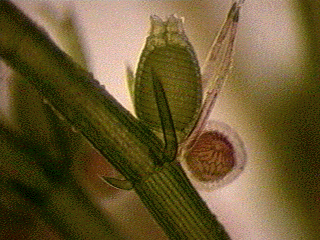
What specimen is this and what type of algae is it? Label the antheridium and ooganium.
Chara
Chlorphyta (green algae)
"Bulb" = Antheridium
Green outgrowth = Ooganium
What kind of reproduction is present in Chara?
Oogamous
What cells are released by antheridia, and by what kind of cell division (mitosis or meiosis) are they produced?
Sperm by mitosis.
What kinds of cells are produced by oogonia, and by what kind of cell division are they produced?
Eggs by mitosis.
What will happen in the oogonia after fertilization?
It becomes a zygote by meiosis and than goes through mitosis.
What are the two different kinds of reproductive means of fertilization?
Zygotic and Sporic Meiosis
What is another name for Sporic Meiosis?
Alternation of Generations
What phyla is called brown algae?
Phaeophyta
What indicates all the descendants of a common ancestor?
Monophyletic Group
Meiosis in which the dominant phase is haploid (some algae and fungi).
Zygotic
Meiosis also known as "alternation of generations".
Sporic Meiosis
fThe root of a phylogenetic tree represents a ____________ .
Common Ancestor
The first photosynthetic organisms that were also called "blue-green algae".
Cyanobacteria
This phyla is also called red algae.
Rhodophyta
Cells engulfed by heterotrophic eukaryotes but, rather than being digested, became symbiotes living within the cell.
Endosymbiosis
The photosynthetic pigment that is responsible for the red color in red algae.
Phycobilins
The photosynthetic pigment that is responsible for the brown color in brown algae.
Fucocanthin
Name the three phyla of non-vascular land plants.
1) Hepatophyta (liverworts)
2) Anthocerophyta (hornworts)
3) Brophyta (mosses)
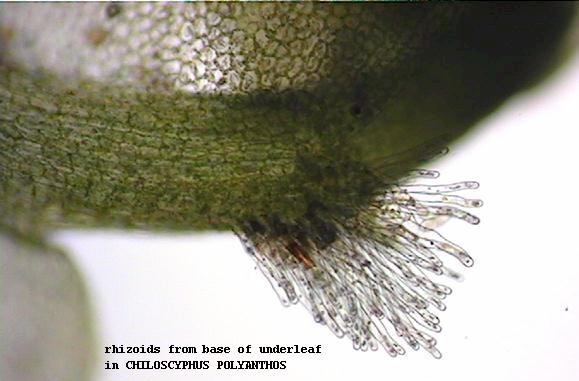
What is the main function of rhizoids?
To anchor the plants.
What is the difference between sporopollenin and cuticle?
Sporopollenin keeps plant spores from drying out while the cuticle accomplishes the same task for the adult plant.
What is another term for sporangium?
"Capsule"
What is the purpose of the sporangium?
To produce spores.
Why do we use quotation marks when referring to "leaf" and "stem" in mosses?
Both of these structures are haploid rather than diploid as in true leaves and stems.
How do the pores on liverwort gametophytes and the stomata on the sporophytes of hornworts, mosses and vascular plants differ? What is their function? What are they?
Sporophytes - spore producing (diploid phase)
Stomata - small openings within the epidermis of leaves and stems
- only found on sporophytes, not gametophytes
List and explain the innovations that occurred in Bryophytes that distinguish them from the Charophytes.
1) the presence of male and female gametangia
2) Retention of zygote and developing multicellular embryo within female gametophyte
3) presence of diploid multicellular sporohyte
4) Multicellular sporangia
5) Meiospores w/ sporopollenin walls
6) tissues that are produced by apical meristem
What major innovations do the green algae have that connects them to land plants?
- Cellulose
- Starch stored in plastids
- Chlorophylls a and b
etc.
Plants are also known as embryophytes. What does this term mean?
Means "plants"
Includes Bryophytes and vascular plants because both produce embryos
What is the function of gemmae cups in Hepatophyta (liverworts)?
Where the gemmae is produced.
What kind of reproduction (sexual or asexual) are gemmae involved in?
Asexual reproduction.
Why are gemmae found in little cup structures?
So that they may be dispersed by rainfall.
What is the difference between a thallus liverwort and a "leafy" liverwort?
Thallus liverworts: no leaf structures and are flat
"Leafy" liverworts: have leaf structure
Where does the antheridial head of a liverwort arise from?
Thallus of the gametophyte.
What is the ploidy level of the antheridial head of a liverwort?
Haploid (1n)
Once it has reached the archegoniophore in a liverwort, how does the sperm reach the egg?
Through raindrops splashing sperm onto the egg.
What is the ploidy level of the archegoniophore in a liverwort?
Haploid (1n)
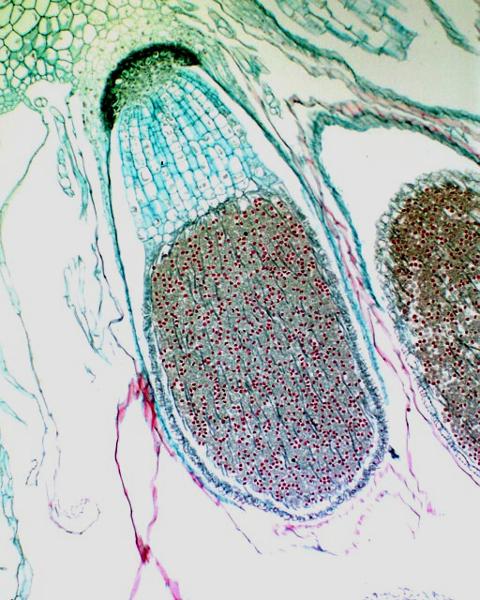
Label the spores, foot, seta, calyptra and sporangium in this liverwort sporophyte.
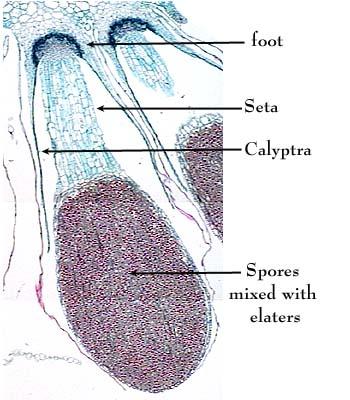
What is the ploidy level of a liverwort sporophyte?
Diploid (2n)
How do the spores leave the sporophyte in a liverwort?
The sporophyte matures and releases the spores.
What happens to liverwort spores once they leave the sporophyte? What will they become?
The spores germinate and become male or female gametophytes.
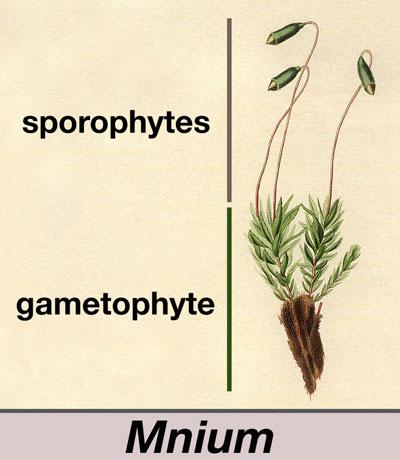
What is this a picture of?
Bryophyte (mosses)
What are the ploidy levels of these Bryophyte structures: gametophyte, sporophyte, seta, sporangium, calyptra.
Gametophyte (1n), Sporophyte (2n), Seta (1n), Sporangium (2n), Calyptra (2n)
Where would you find a stomata?
On the gametophytes.
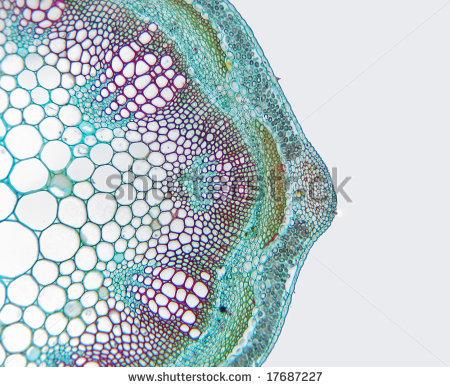
On this Medicago root, label the epidermis, xylem, phloem, cortex and pith.
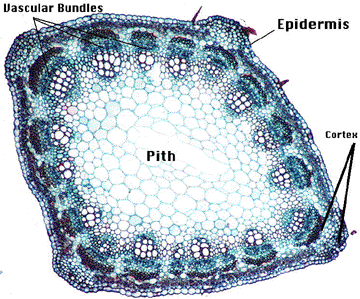
What kinds of meristemic tissue (procambium, protoderm, or ground meristem) do the vascular bundles, epidermis, and cortex come from?
- Procambium: Vascular Bundles
- Protoderm: epidermis
- Ground Meristem: Cortex
What is the function of the xylem?
Conducts most of the water and minerals.
What is the function of the phloem?
Conducts food.
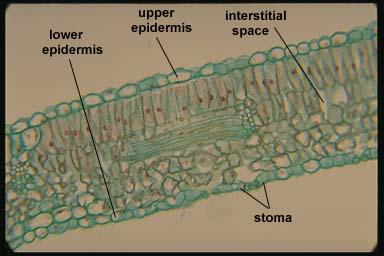
Label the upper epidermis, lower epidermis, xylem and phloem of the Medicago Leaf.