Anatomy and Physiology 2 Wiley Chapter 23
Which of the following is NOT part of the upper respiratory system?
Trachea
Which of the following is NOT a conducting zone action?
All of these are actions of the conducting zone
Which of the following is NOT a factor that determines the rate of pulmonary and systemic gas exchange?
all of these are factors that determine the rate of pulmonary and systemic gas exchange
Which of the following is a passageway for air, food and water?
pharynx
Which structure prevents food or water from entering the trachea?
epiglottis
The gas law that describes the pressure changes that occur during pulmonary ventilation is
Boyle's law
Which structure is located anterior to the esophagus and carries air to the bronchi?
trachea
Which of the following is the primary gas exchange site?
Alveolus
Which of the below tissues maintains open airways in the lower respiratory system?
hyaline cartilage
Which of the below tissues provides the functions of the inner layer of the conducting organs?
cilitated cuboidal epithelium with goblet cells
The point where the trachea divides into right and left primary bronchi is a ridge called
carina
Which of the below tissues forms the exchange surfaces of the alveolus?
simple squamous epithelium
Which of the following are cells of the alveoli that produce surfactant?
type II alveolar cells
Which of the following is NOT a factor that affects pulmonary ventilation?
all of these are factors that affect pulmonary ventilation
Which of the following indicates the diffusion of gases at the alveoli of the lungs?
oxygen in the blood, carbon dioxide out of the blood
Exhalation begins when
inspiratory muscles relax
Which of the following is the sum of the residual and the expiratory reserve volume?
functional residual capacity
Which of the following is NOT a factor that the rate of pulmonary and systemic gas exchange depends on?
force of contraction of diaphragm
Which of the following is the dominant method of carbon dioxide transport?
dissolved in plasma as bicarbonate ions
When blood pH drops, the amount of oxyhemoglobin ___ and oxygen delivery to the tissue cells ___.
decreases/increases
Which of the following is a factor that does NOT affect hemoglobin's affinity for oxygen?
respiratory rate
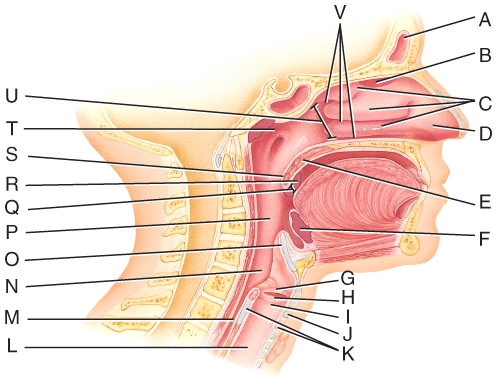
Where are the nasal conchae?
B) C
Which tonsils are found in the oropharynx?
B) R
Which structure is also referred to as the Adam's apple?
D) J
Where is the larynx?
A) I
Where is the uvula?
D) S
A white baby boy is born after 7 months of gestation. He develops difficulty breathing and looks slightly blue. He is most likely suffering from-
respiratory distress syndrome (RDS)
An individual is suffering from gangrene. This is a condition where circulation to tissues is interrupter causing a serious reduction in oxygenation to these tissues. Anaerobic bacteria invade the tissues and must be treated. If antibiotics don't work, an intelligent treatment may include-
hyberbaric oxygenation
A man is found lying unconscious on the floor of his apartment during a very cold period. A space heater is nearby. His lips appear to be cherry red in color. He might be suffering from-
carbon monoxide poisoning
An individual suffers a blood clot in an artery that delivers blood to his leg. The leg begins to take on a blue hue, becomes colder than the rest of his body and he experiences numbness in the leg. He is most likely experiencing-
ischemic hypoxia
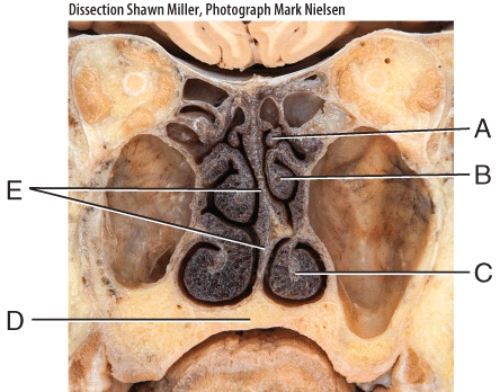
Where is the middle nasal concha?
B
Where is the inferior nasal concha?
C
What is E pointing to?
nasal septum
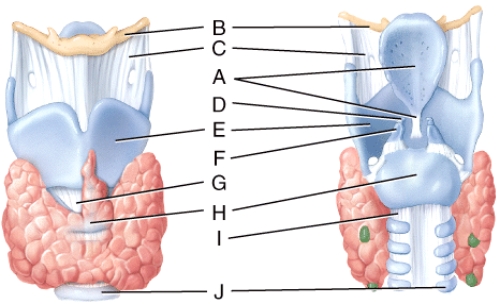
What is line D pointing to?
corniculate cartilage
Where is the cricoid cartilage?
E) H
An individual has an ideal weight of 125 pounds. Based on this fact, the estimated size of his anatomical (respiratory) dead space is-
125 milliliters
The most important factor that determines the percentage of oxygen saturation of hemoglobin is?
Po2
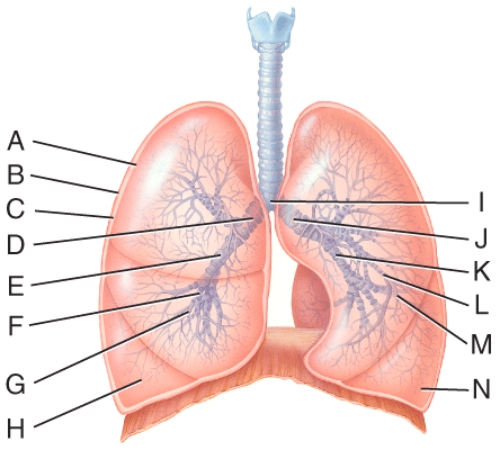
What is line J pointing to?
left primary bronchus
Where is the right bronchiole?
B) G
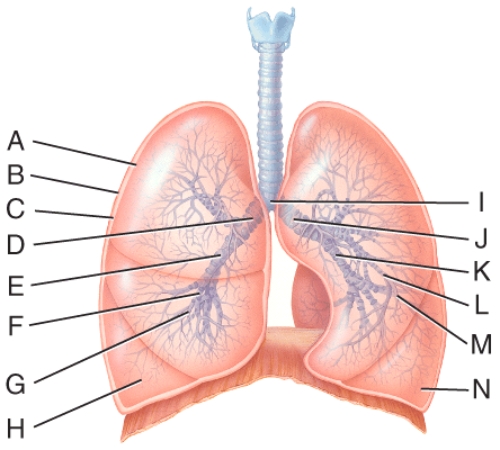
Which lines are pointing to tertiary bronchi?
F and L
What is line B pointing to?
parietal pleura
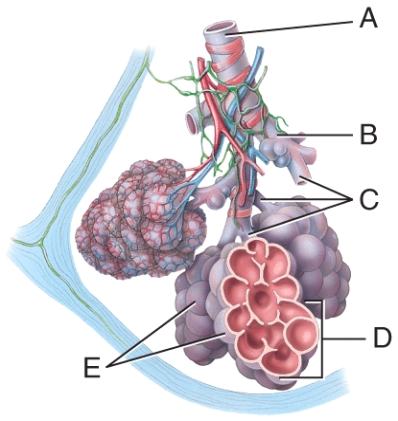
Which letter represents the primary gas exchange structure?
D) E
What are lines C pointing to?
Alveolar ducts
Where is the terminal bronchiole?
A
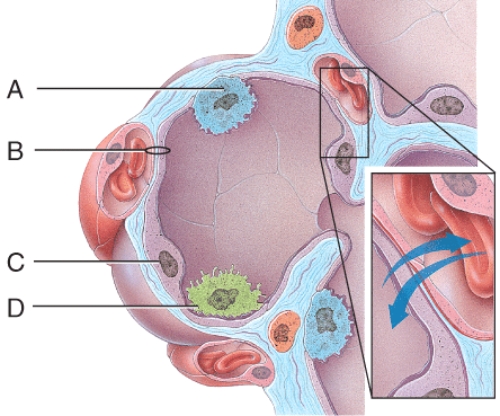
Which structure provides disease resistance within the lungs?
D
Which cells are the main sites of gas exchange?
C
Which cell secretes surfactant?
A
If an individual experiences a broken rib which is displayed sufficiently to puncture a lung, even though the outer skin is not punctured, he will most likely develop-
ABC
Normal quiet breathing is controlled by
all of these choices
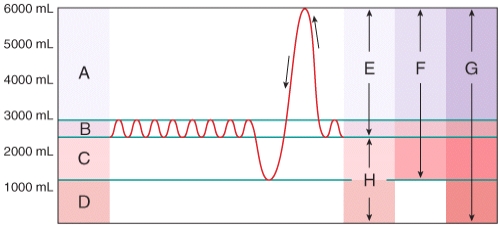
Which area in the figure is the sum of the tidal volume and the inspiratory reserve volume?
D) E
Which area in the figure is the sum of the tidal volume and the inspiratory reserve volume and expiratory reserve volume?
E) F
Which area in the figure is the sum of the vital capacity and residual volume?
C) G
Which area in the figure is the sum of the residual volume and the expiratory reserve volume?
A) H
Which area in the figure represents a very deep inhalation, much greater than the tidal volume?
B) A
Which area in the figure represents the volume of a normal breath?
A) B
Which area in the figure represents the volume of air remaining in the lungs after a deep exhalation?
C) D
Which area in the figure represents a very deep exhalation, much greater than the tidal volume?
A) C
Which of the following is a spasmodic contraction of the diaphragm followed by spasmodic closure of the rima glottidis, which produces a sharp sound on inhalation?
hiccuping
Which of the following is an inhalation followed by many short convulsive exhalations during which the rima glottidis remains open and the vocal folds vibrate, accompanied by characteristic facial expressions?
laughing/crying
Which of the following is a series of convulsive inhalations followed by a single prolonged exhalation where the rima glottidis closes earlier than normal after each inhalation so only a little air enters the lungs with each inhalation?
sobbing
Which of the following is a deep inhalation through a widely opened mouth producing an exaggerated depression of the mandible, the precise cause of which is unknown?
yawning
Which of the following is a long drawn and deep inhalation immediately followed by a shorter but forceful exhalation?
sighing
Which of the following is a spasmodic contraction of the muscles of exhalation that forcefully expels air through the nose and mouth?
sneezing
Which of the following is a long drawn and deep inhalation followed by a complete closure of the rima glottidis, which results in a strong exhalation, pushing the rima glottidis open and sending a blast of air through the upper respiratory passages?
coughing
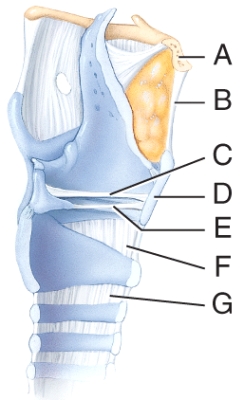
Which structure in the figure is the hyoid bone?
A
Which structure in the figure is the ventricular fold?
C
Which structure in the figure is the vocal fold?
D) E
Where is the rhythmicity center for respiration?
in the medulla
With which body system does the respiratory system work to regulate the pH of body fluids?
urinary
The branch of medicine that deals with the diagnosis and treatment of diseases of the ears, nose and throat is-
otolaryngology
The surgical procedure used to cosmetically reshape the nose or to correct a deviated septum or fracture of the nose is called
rhinoplasty
Coryza is the medical name for
the common cold
During quiet inhalation, which respiratory muscles contract?
diaphragm and external intercostals
The volume of one breath is called
tidal volume
The sum of the partial pressures of nitrogen, oxygen, argon, carbon dioxide, water vapor and other gases in our environment is called
atmospheric pressure
If each hemoglobin molecule has bound 3 oxygen molecules, the hemoglobin is considered to be saturated at what percentage?
75%
The neurons of the pontine respiratory group transmit nerve impulses to the
medulla
Exercise brings about an increase in
both a and b
the cartilages and muscles of the larynx develop from the
fourth and sixth pharyngeal arches
Which of the following is a forced exhalation against the closed rima glottidis as may occur during periods of straining while defecating?
valsalva maneuver