Central Science: Chapter 2
A molecule of water contains hydrogen and oxygen in a 1:8 ratio by
mass. This is a statement of ________.
A) the law of multiple
proportions
B) the law of constant composition
C) the law of
conservation of mass
D) the law of conservation of energy
E)
none of the above
B
Which one of the following is not one of the postulates
of Dalton's atomic theory?
A) Atoms are composed of protons,
neutrons, and electrons.
B) All atoms of a given element are
identical; the atoms of different elements are different and have
different properties.
C) Atoms of an element are not changed into
different types of atoms by chemical reactions: atoms are neither
created nor destroyed in chemical reactions.
D) Compounds are
formed when atoms of more than one element combine; a given compound
always has the same relative number and kind of atoms.
E) Each
element is composed of extremely small particles called atoms.
B
Consider the following selected postulates of Dalton's atomic
theory:
(i) Each element is composed of extremely small particles
called atoms.
(ii) Atoms are indivisible.
(iii) Atoms of a
given element are identical.
(iv) Atoms of different elements are
different and have different properties.
Which of the postulates is(are) no longer considered valid?
A)
(i) and (ii)
B) (ii) only
C) (ii) and (iii)
D) (iii)
only
E) (iii) and (iv)
C
Which pair of substances could be used to illustrate the law of
multiple proportions?
A) SO2, H2SO4
B) CO, CO2
C) H2O,
O2
D) CH4, C6H12O6
E) NaCl, KCl
B
Which statement below correctly describes the responses of alpha,
beta, and gamma radiation to an electric field?
A) Both beta and
gamma are deflected in the same direction, while alpha shows no
response.
B) Both alpha and gamma are deflected in the same
direction, while beta shows no response.
C) Both alpha and beta
are deflected in the same direction, while gamma shows no
response.
D) Alpha and beta are deflected in opposite directions,
while gamma shows no response.
E) Only alpha is deflected, while
beta and gamma show no response.
D
Which one of the following is not true concerning cathode
rays?
A) They originate from the negative electrode.
B) They
travel in straight lines in the absence of electric or magnetic
fields.
C) They impart a negative charge to metals exposed to
them.
D) They are made up of electrons.
E) The
characteristics of cathode rays depend on the material from which they
are emitted.
E
The charge on an electron was determined in the ________.
A)
cathode ray tube, by J. J. Thomson
B) Rutherford gold foil
experiment
C) Millikan oil drop experiment
D) Dalton atomic
theory
E) atomic theory of matter
C
________-rays consist of fast-moving electrons.
A) Alpha
B)
Beta
C) Gamma
D) X
E) none of the above
B
The gold foil experiment performed in Rutherford's lab
________.
A) confirmed the plum-pudding model of the atom
B)
led to the discovery of the atomic nucleus
C) was the basis for
Thomson's model of the atom
D) utilized the deflection of beta
particles by gold foil
E) proved the law of multiple proportions
B
In the Rutherford nuclear-atom model, ________.
A) the heavy
subatomic particles, protons and neutrons, reside in the
nucleus
B) the three principal subatomic particles (protons,
neutrons, and electrons) all have essentially the same mass
C)
the light subatomic particles, protons and neutrons, reside in the
nucleus
D) mass is spread essentially uniformly throughout the
atom
E) the three principal subatomic particles (protons,
neutrons, and electrons) all have essentially the same mass and mass is spread
essentially uniformly throughout the atom
A
Cathode rays are ________.
A) neutrons
B) X-rays
C)
electrons
D) protons
E) atoms
C
Cathode rays are deflected away from a negatively charged plate
because ________.
A) they are not particles
B) they are
positively charged particles
C) they are neutral
particles
D) they are negatively charged particles
E) they
are emitted by all matter
D
Cathode rays are deflected away from a negatively charged plate
because ________.
A) they are not particles
B) they are
positively charged particles
C) they are neutral
particles
D) they are negatively charged particles
E) they
are emitted by all matter
B
Of the three types of radioactivity characterized by Rutherford,
which is/are electrically charged?
A) β-rays
B) α-rays and
β-rays
C) α-rays, β-rays, and γ-rays
D) α-rays
E)
α-rays and γ-rays
B
Of the three types of radioactivity characterized by Rutherford,
which is/are not electrically charged?
A) α-rays
B) α-rays,
β-rays, and γ-rays
C) γ-rays
D) α-rays and β-rays
E)
α-rays and γ-rays
C
Of the three types of radioactivity characterized by Rutherford,
which are particles?
A) β-rays
B) α-rays, β-rays, and
γ-rays
C) γ-rays
D) α-rays and γ-rays
E) α-rays and β-rays
E
Of the three types of radioactivity characterized by Rutherford,
which type does not become deflected by a electric field?
A)
β-rays
B) α-rays and β-rays
C) α-rays
D) γ-rays
E)
α-rays, β-rays, and γ-rays
D
Of the following, the smallest and lightest subatomic particle is the
________.
A) neutron
B) proton
C) electron
D)
nucleus
E) alpha particle
C
All atoms of a given element have the same ________.
A)
mass
B) number of protons
C) number of neutrons
D)
number of electrons and neutrons
E) density
B
Which atom has the smallest number of neutrons?
A)
carbon-14
B) nitrogen-14
C) oxygen-16
D)
fluorine-19
E) neon-20
B
Which of the following atoms has the smallest number of
neutrons?
A) carbon-14
B) chlorine-35
C)
carbon-12
D) carbon-13
E) bromine-79
C
There are ________ electrons, ________ protons, and ________ neutrons
in an atom of 132 54Xe.
A) 132, 132,
54
B) 54, 54, 132
C) 78, 78, 54
D) 54, 54, 78
E)
78, 78, 132
D
An atom of the most common isotope of gold, 197Au, has
________ protons, ________ neutrons, and ________ electrons.
A)
197, 79, 118
B) 118, 79, 39
C) 79, 197, 197
D) 79, 118,
118
E) 79, 118, 79
E
Which combination of protons, neutrons, and electrons is correct for
the isotope of copper, 63
29Cu?
A) 29 p+, 34 n°, 29 e-
B) 29 p+, 29 n°, 63
e-
C) 63 p+, 29 n°, 63 e-
D) 34 p+, 29 n°, 34 e-
E) 34
p+, 34 n°, 29 e-
A
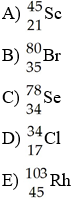
Which isotope has 45 neutrons?
B
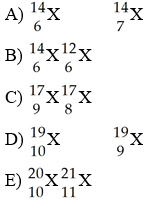
Which pair of atoms constitutes a pair of isotopes of the same element?
B
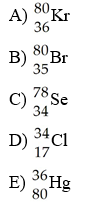
Which isotope has 36 electrons in an atom?
A
Isotopes are atoms that have the same ________ but differing
________.
A) atomic masses, charges
B) mass numbers, atomic
numbers
C) atomic numbers, mass numbers
D) charges, atomic
masses
E) mass numbers, charges
C
The nucleus of an atom does not contain ________.
A)
protons
B) protons or neutrons
C) neutrons
D) subatomic
particles
E) electrons
E
The subatomic particles located in the nucleus with no overall
charges are ________.
A) electrons
B) protons
C)
neutrons
D) protons and neutrons
E) protons, neutrons, and electrons
C
Different isotopes of a particular element contain the same number of
________.
A) protons
B) neutrons
C) protons and
neutrons
D) protons, neutrons, and electrons
E) subatomic particles
A
Different isotopes of a particular element contain different numbers
of ________.
A) protons
B) neutrons
C) protons and
neutrons
D) protons, neutrons, and electrons
E) None of the
above is correct.
B
In the symbol shown below, x = ________.
14
xC
A) 7
B) 13
C) 12
D) 6
E) not
enough information to determine
D
In the symbol below, X = ________.
13
6X
A) N
B) C
C) Al
D) K
E) not
enough information to determine
B
In the symbol below, x = ________.
x
8O
A) 17
B) 8
C) 6
D) 7
E) not
enough information to determine
E
In the symbol below, x is ________.
x
6C
A) the number of neutrons
B) the atomic
number
C) the mass number
D) the number of electrons
E)
the elemental symbol
C
Which one of the following basic forces is so small that it has no
chemical significance?
A) weak nuclear force
B) strong
nuclear force
C) electromagnetism
D) gravity
E)
Coulomb's law
D
Gravitational forces act between objects in proportion to their
________.
A) volumes
B) masses
C) charges
D)
polarizability
E) densities
B
The average atomic mass of silver is 107.8682 amu. The fractional
abundance of the lighter of the two isotopes is ________.
A)
0.24221
B) 0.48168
C) 0.51835
D) 0.75783
E) 0.90474
C
The atomic mass unit is presently based on assigning an exact
integral mass (in amu) to an isotope of ________.
A)
hydrogen
B) oxygen
C) sodium
D) carbon
E) helium
D
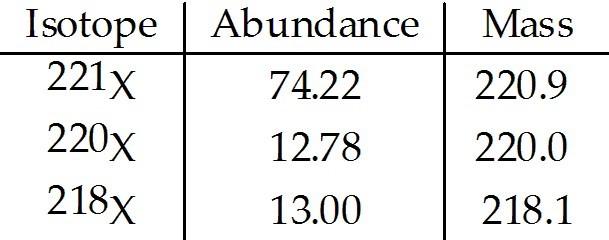
The element X has three naturally occurring isotopes. The masses (amu) and % abundances of the isotopes are given in the table below. The average atomic mass of the element is ________ amu.
A) 219.7
B) 220.4
C) 220.42
D) 218.5
E) 221.0
B
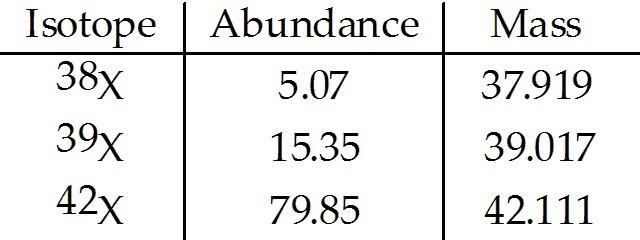
Element X has three naturally occurring isotopes. The masses (amu) and % abundances of the isotopes are given in the table below. The average atomic mass of the element is ________ amu.
A) 41.54
B) 39.68
C) 39.07
D) 38.64
E) 33.33
A
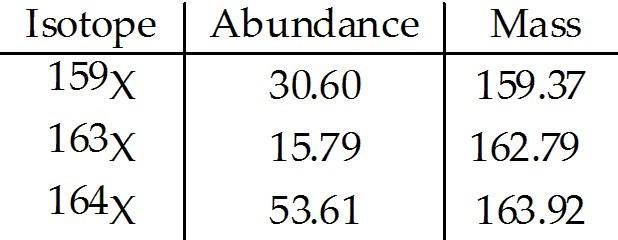
The element X has three naturally occurring isotopes. The isotopic masses (amu) and % abundances of the isotopes are given in the table below. The average atomic mass of the element is ________ amu.
A) 161.75
B) 162.03
C) 162.35
D) 163.15
E) 33.33
C
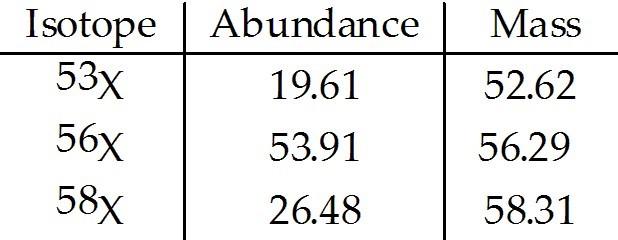
The element X has three naturally occurring isotopes. The isotopic masses (amu) and % abundances of the isotopes are given in the table below. The average atomic mass of the element is ________ amu.
A) 33.33
B) 55.74
C) 56.11
D) 57.23
E) 56.29
C
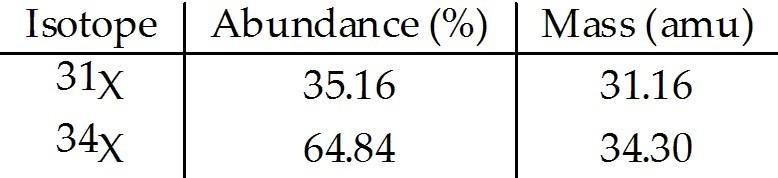
The element X has two naturally occurring isotopes. The masses (amu) and % abundances of the isotopes are given in the table below. The average atomic mass of the element is ________ amu.
A) 30.20
B) 33.20
C) 34.02
D) 35.22
E) 32.73
B
The average atomic weight of copper, which has two naturally
occurring isotopes, is 63.5. One of the isotopes has an atomic weight
of 62.9 amu and constitutes 69.1% of the copper isotopes. The other
isotope has an abundance of 30.9%. The atomic weight (amu) of the
second isotope is ________ amu.
A) 63.2
B) 63.8
C)
64.1
D) 64.8
E) 28.1
D
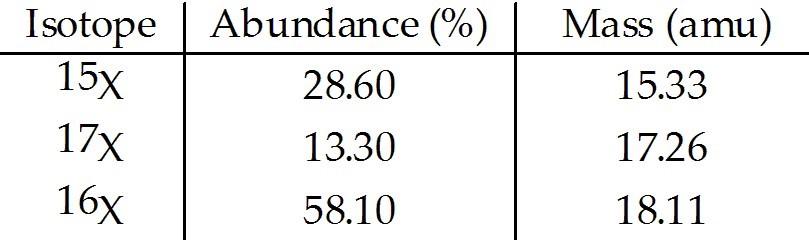
The element X has three naturally occurring isotopes. The masses (amu) and % abundances of the isotopes are given in the table below. The average atomic mass of the element is ________ amu.
A) 17.20
B) 16.90
C) 17.65
D) 17.11
E) 16.90
A
Vanadium has two naturally occurring isotopes, 50V with an
atomic mass of 49.9472 amu and 51V with an atomic mass of
50.9440. The atomic weight of vanadium is 50.9415. The percent
abundances of the vanadium isotopes are ________% 50V and
________% 51V.
A) 0.25, 99.75
B) 99.75,
0.25
C) 49, 51
D) 1.0, 99
E) 99, 1.0
A
An unknown element is found to have three naturally occurring
isotopes with atomic masses of 35.9675 (0.337%), 37.9627 (0.063%), and
39.9624 (99.600%). Which of the following is the unknown
element?
A) Ar
B) K
C) Cl
D) Ca
E) None of
the above could be the unknown element.
A
In the periodic table, the elements are arranged in ________.
A) alphabetical order
B) order of increasing atomic
number
C) order of increasing metallic properties
D) order
of increasing neutron content
E) increasing atomic mass
B
Elements ________ exhibit similar physical and chemical
properties.
A) with similar chemical symbols
B) with similar
atomic masses
C) in the same period of the periodic table
D)
on opposite sides of the periodic table
E) in the same group of
the periodic table
E
Which pair of elements would you expect to exhibit the greatest
similarity in their physical and chemical properties?
A) H,
Li
B) Cs, Ba
C) Ca, Sr
D) Ga, Ge
E) C, O
C
Which pair of elements would you expect to exhibit the greatest
similarity in their physical and chemical properties?
A) O,
S
B) C, N
C) K, Ca
D) H, He
E) Si, P
A
Which pair of elements would you expect to exhibit the greatest
similarity in their physical and chemical properties?
A) As,
Br
B) Mg, Al
C) I, Br
D) Br, Kr
E) N, O
C
The elements in groups 1A, 6A, and 7A are called ________,
respectively.
A) alkaline earth metals, halogens, and
chalcogens
B) alkali metals, chalcogens, and halogens
C)
alkali metals, halogens, and noble gases
D) alkaline earth
metals, transition metals, and halogens
E) halogens, transition
metals, and alkali metals
B
Which pair of elements below should be the most similar in chemical
properties?
A) C and O
B) B and As
C) I and Br
D)
K and Kr
E) Cs and He
C
An element in the upper right corner of the periodic table
________.
A) is either a metal or metalloid
B) is definitely
a metal
C) is either a metalloid or a nonmetal
D) is
definitely a nonmetal
E) is definitely a metalloid
D
An element that appears in the lower left corner of the periodic
table is ________.
A) either a metal or metalloid
B)
definitely a metal
C) either a metalloid or a nonmetal
D)
definitely a nonmetal
E) definitely a metalloid
B
Elements in the same group of the periodic table typically have
________.
A) similar mass numbers
B) similar physical
properties only
C) similar chemical properties only
D)
similar atomic masses
E) similar physical and chemical properties
E
Which one of the following molecular formulas is also an empirical
formula?
A) C6H6O2
B) C2H6SO
C) H2O2
D)
H2P4O6
E) C6H6
B
Which compounds do not have the same empirical formula?
A) C2H2,
C6H6
B) CO, CO2
C) C2H4, C3H6
D) C2H4O2,
C6H12O6
E) C2H5COOCH3, CH3CHO
B
Of the choices below, which one is not an ionic
compound?
A) PCl5
B) MoCl6
C) RbCl
D)
PbCl2
E) NaCl
A
Which type of formula provides the most information about a
compound?
A) empirical
B) molecular
C) simplest
D)
structural
E) chemical
D
A molecular formula always indicates ________.
A) how many of
each atom are in a molecule
B) the simplest whole-number ratio of
different atoms in a compound
C) which atoms are attached to
which in a molecule
D) the isotope of each element in a
compound
E) the geometry of a molecule
A
An empirical formula always indicates ________.
A) which atoms
are attached to which in a molecule
B) how many of each atom are
in a molecule
C) the simplest whole-number ratio of different
atoms in a compound
D) the isotope of each element in a
compound
E) the geometry of a molecule
C
The molecular formula of a compound is always ________ the empirical
formula.
A) more complex than
B) different from
C) an
integral multiple of
D) the same as
E) simpler than
C
Formulas that show how atoms are attached in a molecule are called
________.
A) molecular formulas
B) ionic formulas
C)
empirical formulas
D) diatomic formulas
E) structural formulas
E
Of the following, ________ contains the greatest number of
electrons.
A) P3+
B) P
C) P2-
D) P3-
E) P2+
D
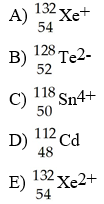
Which species has 54 electrons?
B
Which species has 16 protons?
A)
31P
B)34S2-
C)
36Cl
D) 80BR-
E) 16O
B
Which species has 18 electrons?
A) 39K
B)
32S2-
C) 35Cl
D)
27Al3+
E) 45Sc3+
B
Which of the following species contains 18 electrons?
A)
31P
B) 34S2-
C)
36Cl
D) 80Br-
E) 16O
B
Which of the following species is an isotope of 79Br?
A)
40Ar+
B) 34S2-
C)
79Br-
D) 80Br
E) 79Se
D
Which one of the following species has as many electrons as it has
neutrons?
A) 1H
B) 40Ca2+
C) 14C
D) 19F-
E) 14C2+
D
There are ________ protons, ________ neutrons, and ________ electrons
in 131I-.
A) 131, 53, 54
B) 131, 53,
52
C) 53, 78, 54
D) 53, 131, 52
E) 53, 78, 52
C
There are ________ protons, ________ neutrons, and ________ electrons
in 238U+5.
A) 146, 92, 92
B) 92, 146,
87
C) 92, 146, 92
D) 92, 92, 87
E) 146, 92, 97
B
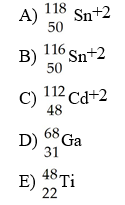
Which species contains 68 neutrons?
A
Which of the following compounds would you expect to be
ionic?
A) H2O
B) CO2
C) SrCl2
D) SO2
E) H2S
C
Which pair of elements is most apt to form an ionic compound with
each other?
A) barium, bromine
B) calcium, sodium
C)
oxygen, fluorine
D) sulfur, fluorine
E) nitrogen, hydrogen
A
Which pair of elements is most apt to form a molecular compound with
each other?
A) aluminum, oxygen
B) magnesium, iodine
C)
sulfur, fluorine
D) potassium, lithium
E) barium, bromine
C
Which species below is the nitride ion?
A) Na+
B)
NO3-
C) NO2-
D)
NH4+
E) N3-
E
Barium reacts with a polyatomic ion to form a compound with the
general formula Ba3(X)2. What would be the most likely formula for the
compound formed between sodium and the polyatomic ion X?
A)
NaX
B) Na2X
C) Na2X2
D) Na3X
E) Na3X2
D
Aluminum reacts with a certain nonmetallic element to form a compound
with the general formula Al2X3. Element X must be from Group ________
of the Periodic Table of Elements.
A) 3A
B) 4A
C)
5A
D) 6A
E) 7A
D
The formula for a salt is XBr. The X-ion in this salt has 46
electrons. The metal X is ________.
A) Ag
B) Pd
C)
Cd
D) Cu
E) Cs
A
Which formula/name pair is incorrect?
A) Mn(NO2)2
manganese(II) nitrite
B) Mg(NO3)2 magnesium nitrate
C)
Mn(NO3)2 manganese(II) nitrate
D) Mg3N2 magnesium nitrite
E)
Mg(MnO4)2 magnesium permanganate
D
Which formula/name pair is incorrect?
A) FeSO4
iron(II) sulfate
B) Fe2(SO3)3 iron(III) sulfite
C) FeS
iron(II) sulfide
D) FeSO3 iron(II) sulfite
E) Fe2(SO4)3
iron(III) sulfide
E
Which one of the following is the formula of hydrochloric
acid?
A) HClO3
B) HClO4
C) HClO
D) HCl
E) HClO2
D
The suffix -ide is used primarily ________.
A) for monatomic
anion names
B) for polyatomic cation names
C) for the name
of the first element in a molecular compound
D) to indicate
binary acids
E) for monoatomic cations
A
Which one of the following compounds is chromium(III) oxide?
A)
Cr2O3
B) CrO3
C) Cr3O2
D) Cr3O
E) Cr2O4
A
Which one of the following compounds is copper(I) chloride?
A)
CuCl
B) CuCl2
C) Cu2Cl
D) Cu2Cl3
E) Cu3Cl2
A
The correct name for MgF2 is ________.
A) monomagnesium
difluoride
B) magnesium difluoride
C) manganese
difluoride
D) manganese bifluoride
E) magnesium fluoride
E
The correct name for NaHCO3 is ________.
A) sodium
hydride
B) persodium carbonate
C) persodium
hydroxide
D) sodium bicarbonate
E) carbonic acid
D
A correct name for Fe(NO3)2 is ________.
A) iron nitrite
B)
ferrous nitrite
C) ferrous nitrate
D) ferric nitrite
E)
ferric nitrate
C
The correct name for HNO2 is ________.
A) nitrous acid
B)
nitric acid
C) hydrogen nitrate
D) hyponitrous acid
E)
pernitric acid
A
The proper formula for the hydronium ion is ________.
A)
H-
B) OH-
C) N3-
D) H3O+
E) NH4+
D
The charge on the ________ ion is -3.
A) sulfate
B)
acetate
C) permanganate
D) oxide
E) nitride
E
Which one of the following polyatomic ions has the same charge as the
hydroxide ion?
A) ammonium
B) carbonate
C)
nitrate
D) sulfate
E) phosphate
C
Which element forms an ion with the same charge as the ammonium
ion?
A) potassium
B) chlorine
C) calcium
D)
oxygen
E) nitrogen
A
The formula for the compound formed between aluminum ions and
phosphate ions is ________.
A) Al3(PO4)3
B) AlPO4
C)
Al(PO4)3
D) Al2(PO4)3
E) AlP
B
Which metal does not
form cations of differing charges?
A) Na
B) Cu
C)
Co
D) Fe
E) Sn
A
Which metal forms cations of differing charges?
A) K
B)
Cs
C) Ba
D) Al
E) Sn
E
The correct name for Ni(CN)2 is ________.
A) nickel (I)
cyanide
B) nickel cyanate
C) nickel carbonate
D) nickel
(II) cyanide
E) nickel (I) nitride
D
What is the molecular formula for 1-propanol?
A) CH4O
B)
C2H6O
C) C3H8O
D) C4H10O
E) C5H12O
C
Methane and ethane are both made up of carbon and hydrogen. In
methane, there are 12.0 g of carbon for every 4.00 g of hydrogen, a
ratio of 3:1 by mass. In ethane, there are 24.0 g of carbon for every
6.00 g of hydrogen, a ratio of 4:1 by mass. This is an illustration of
the law of ________.
A) constant composition
B) multiple
proportions
C) conservation of matter
D) conservation of
mass
E) octaves
B
________ and ________ reside in the atomic nucleus.
A) Protons,
electrons
B) Electrons, neutrons
C) Protons,
neutrons
D) Neutrons, only neutrons
E) none of the above
C
520 pm is the same as ________ Å.
A) 5200
B) 52
C)
520
D) 5.2
E) 0.00052
D
The atomic number indicates ________.
A) the number of neutrons
in a nucleus
B) the total number of neutrons and protons in a
nucleus
C) the number of protons or electrons in a neutral
atom
D) the number of atoms in 1 g of an element
E) the
number of different isotopes of an element
C
The nucleus of an atom contains ________.
A) electrons
B)
protons, neutrons, and electrons
C) protons and neutrons
D)
protons and electrons
E) protons
C
In the periodic table, the elements touching the steplike line are
known as ________.
A) transition elements
B) noble
gases
C) metalloids
D) nonmetals
E) metals
C
Which group in the periodic table contains only nonmetals?
A)
1A
B) 6A
C) 2B
D) 2A
E) 8A
E
Horizontal rows of the periodic table are known as ________.
A)
periods
B) groups
C) metalloids
D) metals
E) nonmetals
A
Vertical columns of the periodic table are known as ________.
A)
metals
B) periods
C) nonmetals
D) groups
E) metalloids
D
Elements in Group 1A are known as the ________.
A)
chalcogens
B) alkaline earth metals
C) alkali metals
D)
halogens
E) noble gases
C
Elements in Group 2A are known as the ________.
A) alkaline
earth metals
B) alkali metals
C) chalcogens
D)
halogens
E) noble gases
A
Elements in Group 6A are known as the ________.
A) alkali
metals
B) chalcogens
C) alkaline earth metals
D)
halogens
E) noble gases
B
Elements in Group 7A are known as the ________.
A)
chalcogens
B) alkali metals
C) alkaline earth metals
D)
halogens
E) noble gases
D
Elements in Group 8A are known as the ________.
A)
halogens
B) alkali metals
C) alkaline earth metals
D)
chalcogens
E) noble gases
E
Potassium is a ________ and chlorine is a ________.
A) metal,
nonmetal
B) metal, metal
C) metal, metalloid
D)
metalloid, nonmetal
E) nonmetal, metal
A
Lithium is a ________ and magnesium is a ________.
A) nonmetal,
metal
B) nonmetal, nonmetal
C) metal, metal
D) metal,
metalloid
E) metalloid, metalloid
C
Oxygen is a ________ and nitrogen is a ________.
A) metal,
metalloid
B) nonmetal, metal
C) metalloid, metalloid
D)
nonmetal, nonmetal
E) nonmetal, metalloid
D
Calcium is a ________ and silver is a ________.
A) nonmetal,
metal
B) metal, metal
C) metalloid, metal
D) metal,
metalloid
E) nonmetal, metalloid
B
________ are found uncombined, as monatomic species in
nature.
A) Noble gases
B) Chalcogens
C) Alkali
metals
D) Alkaline earth metals
E) Halogens
A
When a metal and a nonmetal react, the ________ tends to lose
electrons and the ________ tends to gain electrons.
A) metal,
metal
B) nonmetal, nonmetal
C) metal, nonmetal
D)
nonmetal, metal
E) None of the above; these elements share electrons.
C
The empirical formula of a compound with molecules containing 12
carbon atoms, 14 hydrogen atoms, and 6 oxygen atoms is
________.
A) C12H14O6
B) CHO
C) CH2O
D)
C6H7O3
E) C2H4O
D
________ only form ions with a 2+ charge.
A) Alkaline earth
metals
B) Halogens
C) Chalcogens
D) Alkali
metals
E) Transition metals
A
What is the formula of the compound formed between strontium ions and
nitrogen ions?
A) SrN
B) Sr3N2
C) Sr2N3
D)
SrN2
E) SrN3
B
Magnesium reacts with a certain element to form a compound with the
general formula MgX. What would the most likely formula be for the
compound formed between potassium and element X?
A) K2X
B)
KX2
C) K2X3
D) K2X2
E) KX
A
The charge on the manganese in the salt MnF3 is ________.
A)
1+
B) 1-
C) 2+
D) 2-
E) 3+
E
Aluminum reacts with a certain nonmetallic element to form a compound
with the general formula AlX. Element X is a diatomic gas at room
temperature. Element X must be ________.
A) oxygen
B)
fluorine
C) chlorine
D) nitrogen
E) sulfur
D
Sodium forms an ion with a charge of ________.
A) 1+
B)
1-
C) 2+
D) 2-
E) 0
A
Potassium forms an ion with a charge of ________.
A) 2+
B)
1-
C) 1+
D) 2-
E) 0
C
Calcium forms an ion with a charge of ________.
A) 1-
B)
2-
C) 1+
D) 2+
E) 0
D
Barium forms an ion with a charge of ________.
A) 1+
B)
2-
C) 3+
D) 3-
E) 2+
E
Aluminum forms an ion with a charge of ________.
A) 2+
B)
3-
C) 1+
D) 3+
E) 1-
D
Fluorine forms an ion with a charge of ________.
A) 1-
B)
1+
C) 2+
D) 3+
E) 3-
A
Iodine forms an ion with a charge of ________.
A) 7-
B)
1+
C) 2-
D) 2+
E) 1-
E
Oxygen forms an ion with a charge of ________.
A) 2-
B)
2+
C) 3-
D) 3+
E) 6+
A
Sulfur forms an ion with a charge of ________.
A) 2+
B)
2-
C) 3+
D) 6-
E) 6+
B
Predict the empirical formula of the ionic compound that forms from
sodium and fluorine.
A) NaF
B) Na2F
C) NaF2
D)
Na2F3
E) Na3F2
A
Predict the empirical formula of the ionic compound that forms from
magnesium and fluorine.
A) Mg2F3
B) MgF
C) Mg2F
D)
Mg3F2
E) MgF2
E
Predict the empirical formula of the ionic compound that forms from
magnesium and oxygen.
A) Mg2O
B) MgO
C) MgO2
D)
Mg2O2
E) Mg3O2
B
Predict the empirical formula of the ionic compound that forms from
aluminum and oxygen.
A) AlO
B) Al3O2
C) Al2O3
D)
AlO2
E) Al2O
C
The correct name for K2S is ________.
A) potassium
sulfate
B) potassium disulfide
C) potassium
bisulfide
D) potassium sulfide
E) dipotassium sulfate
D
The correct name for Al2O3 is ________.
A) aluminum
oxide
B) dialuminum oxide
C) dialuminum trioxide
D)
aluminum hydroxide
E) aluminum trioxide
A
The correct name for CaH2 is ________.
A) hydrocalcium
B)
calcium dihydride
C) calcium hydroxide
D) calcium
dihydroxide
E) calcium hydride
E
The correct name for SO is ________.
A) sulfur oxide
B)
sulfur monoxide
C) sulfoxide
D) sulfate
E) sulfite
B
The correct name for CCl4 is ________.
A) carbon
chloride
B) carbon tetrachlorate
C) carbon
perchlorate
D) carbon tetrachloride
E) carbon chlorate
D
The correct name for N2O5 is ________.
A) nitrous oxide
B)
nitrogen pentoxide
C) dinitrogen pentoxide
D) nitric
oxide
E) nitrogen oxide
C
The correct name for H2CO3 is ________.
A) carbonous
acid
B) hydrocarbonate
C) carbonic acid
D)
carbohydrate
E) carbohydric acid
C
The correct name for H2SO3 is ________.
A) sulfuric acid
B)
sulfurous acid
C) hydrosulfuric acid
D) hydrosulfic
acid
E) sulfur hydroxide
B
The correct name for H2SO4 is ________.
A) sulfuric acid
B)
sulfurous acid
C) hydrosulfuric acid
D) hydrosulfic
acid
E) sulfur hydroxide
A
The correct name for HNO3 is ________.
A) nitrous acid
B)
nitric acid
C) hydronitroxide acid
D) nitroxide acid
E)
nitrogen hydroxide
B
The correct name for HClO3 is ________.
A) hydrochloric
acid
B) perchloric acid
C) chloric acid
D) chlorous
acid
E) hydrochlorous acid
C
The correct name for HClO is ________.
A) hydrochloric
acid
B) perchloric acid
C) chloric acid
D) chlorous
acid
E) hypochlorous acid
E
The correct name for HBrO4 is ________.
A) hydrobromic
acid
B) perbromic acid
C) bromic acid
D) bromous
acid
E) hydrobromous acid
B
The correct name for HBrO is ________.
A) hydrobromic
acid
B) perbromic acid
C) bromic acid
D) bromous
acid
E) hypobromous acid
E
The correct name for HBrO2 is ________.
A) hydrobromic
acid
B) perbromic acid
C) bromic acid
D) bromous
acid
E) hydrobromous acid
D
The correct name for HClO2 is ________.
A) perchloric
acid
B) chloric acid
C) hypochlorous acid
D)
hypychloric acid
E) chlorous acid
E
The correct name of the compound Na3N is ________.
A) sodium
nitride
B) sodium azide
C) sodium trinitride
D)
sodium(III) nitride
E) trisodium nitride
A
The formula of bromic acid is ________.
A) HBr
B)
HBrO4
C) HBrO
D) HBrO3
E) HBrO2
D
The correct formula for molybdenum (IV) hypochlorite is
________.
A) Mo(ClO3)4
B) Mo(ClO)4
C) Mo(ClO2)4
D)
Mo(ClO4)4
E) MoCl4
B
The name of PCl3 is ________.
A) potassium chloride
B)
phosphorus trichloride
C) phosphorous(III) chloride
D)
monophosphorous trichloride
E) trichloro potassium
B
The ions Ca2+ and PO43- form a salt with the
formula ________.
A) CaPO4
B) Ca2(PO4)3
C)
Ca2PO4
D) Ca(PO4)2
E) Ca3(PO4)2
E
The correct formula of iron (III) bromide is ________.
A)
FeBr2
B) FeBr3
C) FeBr
D) Fe3Br3
E) Fe3Br
B
Magnesium and sulfur form an ionic compound with the formula
________.
A) MgS
B) Mg2S
C) MgS2
D) Mg2S2
E) Mg2S3
A
The formula of ammonium carbonate is ________.
A)
(NH4)2CO3
B) NH4CO2
C) (NH3)2CO4
D) (NH3)2CO3
E) N2(CO3)3
A
The formula of the chromate ion is ________.
A) CrO4
2-
B) CrO2 3-
C)
CrO-
D) CrO32-
E) CrO2-
A
The formula of the carbonate ion is ________.
A)
CrO22-
B) CrO32-
C)
CrO33-
D) CO2 -
E) CO-
B
The correct name for Mg(ClO3)2 is ________.
A) magnesium
chlorate
B) manganese chlorate
C) magnesium
chloroxide
D) magnesium perchlorate
E) manganese perchlorate
A
What is the correct formula for ammonium sulfide?
A)
NH4SO3
B) (NH4)2SO4
C) (NH4)2S
D) NH3S
E) N2S3
C
When calcium reacts with sulfur the compound formed is
________.
A) Ca2S2
B) Ca3S2
C) CaS
D) CaS2
E) Ca2S3
C
Chromium and chlorine form an ionic compound whose formula is CrCl3.
The name of this compound is ________.
A) chromium
chlorine
B) chromium (III) chloride
C) monochromium
trichloride
D) chromium (III) trichloride
E) chromic trichloride
B
Iron and chlorine form an ionic compound whose formula is FeCl3. The
name of this compound is ________.
A) iron chlorine
B) iron
(III) chloride
C) moniron trichloride
D) iron (III)
trichloride
E) ferric trichloride
B
Copper and chlorine form an ionic compound whose formula is CuCl2.
The name of this compound is ________.
A) copper chlorine
B)
copper (III) dichloride
C) monocopper dichloride
D) copper
(II) dichloride
E) cupric chloride
E
The name of the binary compound N2O4 is ________.
A) nitrogen
oxide
B) nitrous oxide
C) nitrogen (IV) oxide
D)
dinitrogen tetroxide
E) oxygen nitride
D
The formula for zinc phosphate is Zn3(PO4)2. What is the formula for
cadmium arsenate?
A) Cd4(AsO2)3
B) Cd3(AsO4)2
C)
Cd3(AsO3)4
D) Cd2(AsO4)3
E) Cd2(AsO4)4
B
The formula for aluminum hydroxide is ________.
A) AlOH
B)
Al3OH
C) Al2(OH)3
D) Al(OH)3
E) Al2O3
D
The name of the ionic compound V2O3 is ________.
A) vanadium
(III) oxide
B) vanadium oxide
C) vanadium (II) oxide
D)
vanadium (III) trioxide
E) divanadium trioxide
A
The name of the ionic compound NH4CN is ________.
A) nitrogen
hydrogen cyanate
B) ammonium carbonitride
C) ammonium
cyanide
D) ammonium hydrogen cyanate
E) cyanonitride
C
The name of the ionic compound (NH4)3PO4 is ________.
A)
ammonium phosphate
B) nitrogen hydrogen phosphate
C)
tetrammonium phosphate
D) ammonia phosphide
E) triammonium phosphate
A
What is the formula for perchloric acid?
A) HClO
B)
HClO3
C) HClO4
D) HClO2
E) HCl
C
The correct name for HIO2 is ________.
A) hypoiodic acid
B)
hydriodic acid
C) periodous acid
D) iodous acid
E)
periodic acid
D
What is the molecular formula for propane?
A) C2H8
B)
C3H6
C) C3H8
D) C4H8
E) C4H10
C
What is the molecular formula for butane?
A) C2H8
B)
C3H6
C) C3H8
D) C4H8
E) C4H10
E
What are the primary atoms found in alkanes?
A) carbon,
hydrogen, and oxygen
B) carbon and nitrogen
C) oxygen and
hydrogen
D) carbon and oxygen
E) carbon and hydrogen
E
What is the correct name for the following alkane, C5H12?
A)
heptane
B) propane
C) hexane
D) pentane
E) butane
D
How many carbon and hydrogen atoms are found in decane?
A) 10
carbons and 22 hydrogens
B) 9 carbons and 20 hydrogens
C)
10 carbons and 20 hydrogens
D) 9 carbons and 18 hydrogens
E) 10 carbons and 24 hydrogens
A
What is the molecular formula for heptane?
A) C6H12
B)
C6H14
C) C7H14
D) C7H16
E) C7H18
D
What is the molecular formula for 1-hexanol?
A) C6H13O
B)
C6H14O
C) C6H15O
D) C7H14O
E) C7H15O
B
A certain mass of carbon reacts with 128 g of oxygen to form carbon
monoxide. ________ grams of oxygen would react with that same mass of
carbon to form carbon dioxide, according to the law of multiple
proportions.
A) 25.6
B) 64.0
C) 128
D)
1280
E) 256
E
An atom of 13C contains ________ protons.
A)
6
B) 19
C) 7
D) 9
E) 13
A
Of the following, the subatomic particle with the smallest mass is
the ________.
A) proton
B) neutron
C) electron
D)
alpha particle
E) isotope
C
An atom of 118Xe contains ________ neutrons.
A)
54
B) 172
C) 64
D) 110
E) 118
C
There are ________ protons, ________ electrons, and ________ neutrons
in an atom of Xe.
A) 129, 129, 129
B) 129, 129, 75
C)
54, 75, 129
D) 54, 54, 75
E) 54, 54, 129
D
An atom of 14C contains ________ electrons.
A)
14
B) 20
C) 8
D) 10
E) 6
E
87 pm is the same as ________ Angstroms.
A) 870
B)
8.7
C) 87
D) .87
E) .087
D
200 pm is the same as ________ Å.
A) 2000
B) 20
C)
200
D) 2
E) 0.0002
D
In the symbol below, X = ________.
40
19X
A) Zr
B) K
C) Sc
D) Br
E) not
enough information to determine
B
In the symbol below, x = ________.
X
17Cl
A) 17
B) 34
C) 16
D) 36
E)
not enough information to determine
E
The mass number of an atom of 14C is ________.
A)
6
B) 20
C) 8
D) 14
E) 10
D
Which atom has the largest number of neutrons?
A)
silicon-30
B) sulfur-36
C) argon-38
D)
calcium-44
E) magnesium-24
D
How many neutrons are there in one atom of 184W?
A)
74
B) 112
C) 258
D) 110
E) 184
D
How many protons are there in one atom of 71Ga?
A)
40
B) 70
C) 71
D) 31
E) 13
D
How many electrons are there in one atom of 71Ga?
A)
40
B) 70
C) 71
D) 31
E) 13
D
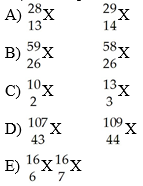
Which pair of atoms constitutes a pair of isotopes of the same element?
B
The atomic number of an atom of 80Br is ________.
A)
115
B) 35
C) 45
D) 73
E) 80
B
How many total electrons are in the Li+ ion?
A) 2
B)
3
C) 4
D) 7
E) 8
A
How many total electrons are in the O2- ion?
A)
10
B) 8
C) 6
D) 16
E) 4
A
If a iron atom loses 2 electrons to make an ion, what is the charge
on that ion?
A) 2+
B) 1+
C) 3+
D) 2-
E) 1-
A
If an atom gains 3 electrons to make an ion, what is the charge on
that ion?
A) 3+
B) 1+
C) 2+
D) 1-
E) 3-
E
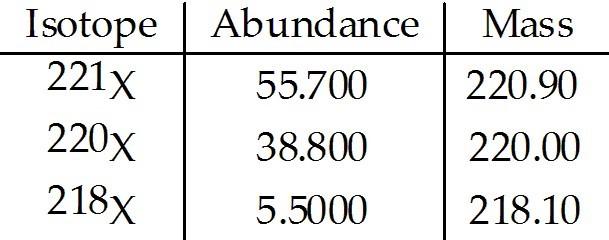
The element X has three naturally occurring isotopes. The masses (amu) and % abundances of the isotopes are given in the table below. The average atomic mass of the element is ________ amu.
A) 33.333
B) 220.40
C) 220.24
D) 219.00
E) 219.67
B
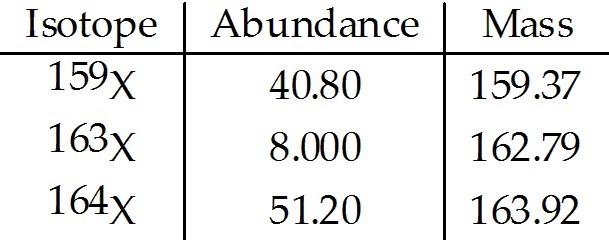
The element X has three naturally occurring isotopes. The masses (amu) and % abundances of the isotopes are given in the table below. The average atomic mass of the element is ________ amu.
A) 159.4
B) 162.0
C) 163.1
D) 161.5
E) 163.0
B
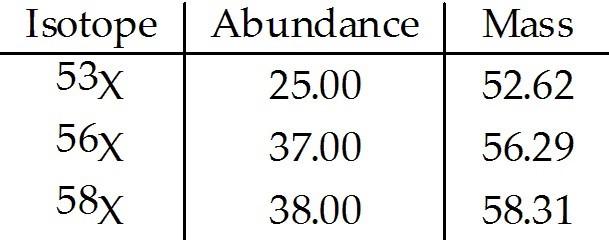
The element X has three naturally occurring isotopes. The masses (amu) and % abundances of the isotopes are given in the table below. The average atomic mass of the element is ________ amu.
A) 52.62
B) 56.14
C) 55.70
D) 55.40
E) 55.74
B
The element ________ is the most similar to helium in chemical and
physical properties.
A) O
B) Mg
C) Be
D)
Ar
E) Sr
D
Which pair of elements would you expect to exhibit the greatest
similarity in their physical and chemical properties?
A) Li,
F
B) Sr, Te
C) O, S
D) In, Sb
E) Ti, Ne
C
Which one of the following is a metalloid?
A) Se
B)
Hf
C) Zr
D) Xe
E) Si
E
The element lithium is in a group known as the ________.
A)
transition metals
B) alkaline earth metals
C) noble
gases
D) halogens
E) alkali metals
E
The element chlorine is in a group known as the ________.
A)
transition metals
B) noble gases
C) alkali metals
D)
alkaline earth metals
E) halogens
E
The element calcium is in a group known as the ________.
A)
transition metals
B) alkali metals
C) halogens
D) noble
gases
E) alkaline earth metals
E
Of the following, only ________ is not a metalloid.
A) B
B)
Po
C) Si
D) Ge
E) As
B
Which of the following elements is a nonmetal?
A) At
B)
Rh
C) Tc
D) Mo
E) Zr
A
Which one of the following will occur as diatomic molecules in
elemental form?
A) helium
B) argon
C) chlorine
D)
phosphorous
E) sodium
C
How many electrons does the Al3+ ion possess?
A)
16
B) 10
C) 6
D) 0
E) 13
B
How many protons does the Br- ion possess?
A) 34
B)
36
C) 6
D) 8
E) 35
E
Which one of the following is most likely to gain electrons when
forming an ion?
A) Mn
B) Zn
C) F
D) Li
E) Al
C
The formula of a salt is XCl2 . The X-ion in this salt has 24
electrons. The metal X is ________.
A) Ni
B) Fe
C)
Zn
D) Cr
E) Ti
B
Predict the charge of the most stable ion of bromine.
A)
2+
B) 1+
C) 3+
D) 1-
E) 2-
D
Predict the charge of the most stable ion of aluminum.
A)
3-
B) 1+
C) 2+
D) 1-
E) 3+
E
Which of the following compounds would you expect to be
ionic?
A) C2H6
B) NH3
C) H2O2
D) LiBr
E)
None of the above.
D
Which species below is the sulfate ion?
A) CN-
B) SO4
2-
C) OH-
D) SO3
2-
E) None of the above
B
Which species below is the nitrate ion?
A) NO2-
B) NO3-
C) ClO3-
D) ClO4-
E) MnO4-
B
Which species below is the chromate ion?
A) Cr2O7
2-
B) CrO4
2-
C) CH3COO-
D) CO3
2-
E) None of the above
B
The correct name for CaO is ________.
A) calcium oxide
B)
calcium hydroxide
C) calcium peroxide
D) calcium
monoxide
E) calcium dioxide
A
Element M reacts with fluorine to form an ionic compound with the
formula M . The M-ion has 21 electrons. Element M is ________.
A)
Al
B) Cr
C) Mn
D) Fe
E) Sc
B
The charge on the copper ion in the salt CuO is ________.
A)
+1
B) +2
C) +4
D) +3
E) +5
B
The charge on the silver ion in the salt AgCl is ________.
A)
+2
B) +1
C) +3
D) +4
E) +5
B
The name of the ionic compound NaBrO4 is ________.
A) sodium
perbromate
B) sodium bromate
C) sodium hypobromate
D)
sodium perbromite
E) sodium bromide
A
When a bromine atom forms the bromide ion, it has the same charge as
the ________ ion.
A) sulfide
B) ammonium
C)
nitrate
D) phosphate
E) sulfite
C
Which element forms an ion with the same charge as the sulfate
ion?
A) magnesium
B) sodium
C) fluorine
D)
vanadium
E) sulfur
E
The correct name for Na2O2 is ________.
A) sodium oxide
B)
sodium dioxide
C) disodium dioxide
D) sodium
peroxide
E) disodium oxide
D
Which metal is not required to have its charge specified in the names
of ionic compounds it forms?
A) Cr
B) Ni
C) Zr
D)
Na
E) Mo
D
The following hypothetical element : x : can be found in which group on the periodic table?
VIA
Which element is found in Period 2 and Group VIIA?
fluorine
The formula for potassium sulfide is ________.
K2S
What is the name of an alcohol derived from hexane?
hexanol
The possible oxidation numbers for iron are +1 and +2.
false
The formula for chromium (II) iodide is CrI2.
true
H2SeO4 is called selenic acid.
true
The correct name for Na3N is sodium azide.
false