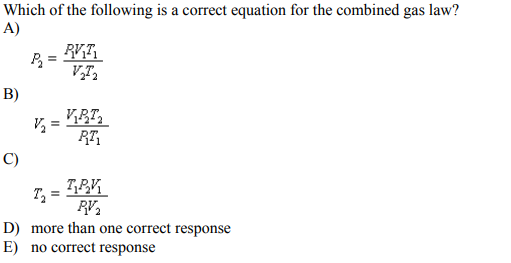
front 1 Which of the following statements is not a part of kinetic molecular theory?
Matter is composed of particles that are in constant motion.
B)
Particle velocity increases as the temperature increases.
C)
Particles in a system cannot transfer energy to each other.
D)
Particle interactions involve electrostatic attractions and repulsions. | back 1 C) Particles in a system cannot transfer energy to each other. |
front 2 In which of the following groupings of terms are the three terms
closely related?
A) kinetic energy, energy of motion, cohesive
forces
B) potential energy, energy of attraction, disruptive
forces
C) kinetic energy, electrostatic interactions, disruptive
forces
D) potential energy, electrostatic interactions, cohesive forces | back 2 D) potential energy, electrostatic interactions, cohesive forces |
front 3 In the liquid state, disruptive forces are
A) roughly of the
same magnitude as cohesive forces.
B) very weak compared to
cohesive forces.
C) dominant over cohesive forces.
D) unimportant. | back 3 A) roughly of the same magnitude as cohesive forces. |
front 4 The phrases “particles close together and held in fixed positions”
and “completely fills
the container” apply, respectively,
to
A) liquids and solids.
B) solids and gases.
C) gases
and liquids.
D) liquids and gases. | |
front 5 How many times larger in size is the atmosphere pressure unit than
the mm Hg pressure
unit?
A) 100
B) 325
C)
760
D) 1000 | |
front 6 Boyle's law involves which of the following?
A) a direct
proportion
B) a constant volume
C) a constant
pressure
D) a constant temperature | back 6 D) a constant temperature |
front 7 Indicate what the missing words are in the following statement of
Charles' law: At
constant pressure, the volume of a gas sample is
_______ proportional to its _______
temperature.
A)
directly; Celsius
B) directly; Kelvin
C) inversely;
Celsius
D) inversely; Kelvin | |
front 8 A gas has a volume of 4.70 liters at a temperature of 47ºC and
pressure of 2.60 atm.
What is the volume of the gas, in liters,
at a temperature of 277ºC and a pressure of
3.10?
A) 0.15
L
B) 6.78 L
C) 2.29 L
D) 5 1.03 10 × L | |
front 9 The correct form of the equation for the ideal gas law is
A) PV
= nRT.
B) PT = nRV.
C) P/V = nRT.
D) PV = n/RT. | |
front 10 What is the volume, in liters, occupied by 1.68 moles of N2 gas at
0.754 atm pressure
and a temperature of 96ºC?
A) 38.4
L
B) –2 1.5 10 × L
C) 67.5 L
D) 17.6 L | |
front 11 The partial pressure of neon in a gaseous mixture of neon and boron
trifluoride is
A) the pressure that the neon would exert in the
absence of the boron trifluoride
B) the percentage of the total
pressure of the mixture that is contributed by neon
C) equal to
the total pressure divided by neon's molar mass
D) equal to the
total pressure divided by the number of neon atoms present | back 11 A) the pressure that the neon would exert in the absence of the boron trifluoride |
front 12 In which of the following pairs of physical changes are both changes
exothermic?
A) sublimation, evaporation
B) freezing,
melting
C) freezing, condensation
D) melting, sublimation | back 12 C) freezing, condensation |
front 13 Which of the following statements concerning evaporation is
incorrect?
A) Molecules with energies considerably above average
are those which escape from
the liquid.
B) Increasing the
surface area of the liquid decreases the rate of evaporation.
C)
Increasing the temperature of the liquid increases the rate of
evaporation.
D) Evaporation causes the liquid temperature to decrease. | back 13 B) Increasing the surface area of the liquid decreases the rate of evaporation. |
front 14 Which of the following is not a factor in determining the magnitude
of the vapor
pressure of a liquid?
A) the temperature of the
liquid
B) the strength of the attractive forces between molecules
of the liquid
C) the size of the container for the liquid
D)
the type of forces between molecules within the liquid | back 14 C) the size of the container for the liquid |
front 15 The boiling point of a liquid is
A) the temperature at which the
rate of evaporation and sublimation are equal
B) always 32.0ºC or
greater
C) the temperature at which the pressure over the liquid
equals the vapor pressure of
the liquid
D) the temperature
at which liquid-vapor equilibrium is reached | back 15 C) the temperature at which the pressure over the liquid equals the
vapor pressure of |
front 16 A liquid is placed in a closed container. Equilibrium is reached
when
A) all of the liquid evaporates
B) when the rate of
condensation equals the rate of evaporation
C) when the rate of
condensation exceeds the rate of evaporation
D) when molecules
cease to pass from the liquid state to the vapor state | back 16 B) when the rate of condensation equals the rate of evaporation |
front 17 Liquids will boil at lower temperatures at higher elevations
because
A) the intermolecular attractions are weaker.
B)
atmospheric pressure increases.
C) it is harder to transfer heat
to the liquid.
D) the vapor pressure at which boiling occurs is lower | back 17 D) the vapor pressure at which boiling occurs is lower |
front 18 Which of the following statements about intermolecular forces is
incorrect?
A) They must be overcome in order for molecules to
escape from the liquid state into
the vapor state.
B) They
are much weaker than intramolecular forces.
C) They are
electrostatic in origin.
D) They occur within molecules rather
than between molecules. | back 18 D) They occur within molecules rather than between molecules. |
front 19 Which of the following statements is correct?
A) Dipole-dipole
interactions occur only between nonpolar molecules.
B) A hydrogen
bond is an extremely weak dipole-dipole interaction.
C) London
forces are “instantaneous” dipole-dipole interactions.
D)
Hydrogen bonding occurs anytime a hydrogen-containing molecule is
present in a
liquid | back 19 C) London forces are “instantaneous” dipole-dipole interactions. |
front 20 In which of the following liquids would London forces be the
predominant
intermolecular force?
A) HF
B) Br2
C)
H2Te
D) BrCl | |
front 21 Which of the following descriptions apply to matter in the solid
state?
A) definite shape and high density
B) cohesive forces
dominate over disruptive forces
C) kinetic energy dominates over
potential energy
D) more than one correct response
E) no
correct response | back 21 D) more than one correct response |
front 22 Which of the following descriptions apply to matter in the liquid
state?
A) Temperature change significantly influences the
volume.
B) Particles are less free to move about than in the
solid state.
C) Particles transfer energy from one to another
through collisions.
D) more than one correct response
E) no
correct response | back 22 C) Particles transfer energy from one to another through collisions. |
front 23 Which of the following descriptions apply to matter in the gaseous
state?
A) definite shape and definite volume
B) disruptive
and cohesive forces are about equal
C) pressure change
significantly influences the volume
D) more than one correct
response
E) no correct response | back 23 C) pressure change significantly influences the volume |
front 24 Which of the following pressure relationships is correct?
A) 760
torr = 760 mm Hg
B) 1 atm = 15.8 psi
C) 650 torr = 1
atm
D) more than one correct response
E) no correct response | |
front 25 Charles's law involves which of the following?
A) an indirect
proportion
B) a fixed quantity of gas
C) constant
temperature
D) more than one correct response
E) no correct response | back 25 D) more than one correct response |
front 26 Which of the following samples of gas would have a new volume of 3.00
liters if the
pressure is decreased from 3.00 atm to 1.00 atm at
constant temperature?
A) 1.00 L He
B) 5.00 L CO2
C)
9.00 L H2S
D) more than one correct response
E) no correct response | |
| |
front 28 A 1.00 mole sample of a gas would have a volume of 0.821 L at which
of the following
temperature and pressure conditions?
A) 300
K and 30.0 atm
B) –123º C and 15.0 atm
C) 300º C and 10.0
atm
D) more than one correct response
E) no correct response | back 28 D) more than one correct response |
front 29 A gaseous mixture at a total pressure of 1.50 atm contains equal
molar amounts of He,
Ne, and Ar. At constant temperature CO2 gas
is added to the mixture until the total
pressure is 3.00 atm.
Which of the following is a correct statement concerning
partial
pressures after the CO2 addition?
A) The partial
pressure of Ar has doubled.
B) The partial pressure of CO2 is
three times that of Ne.
C) All four gases have equal partial
pressures.
D) more than one correct response
E) no correct response | back 29 B) The partial pressure of CO2 is three times that of Ne. |
front 30 In which of the following pairs of state changes is the final state
(solid, liquid, gas) the
same for both members of the
pair?
A) sublimation and evaporation
B) condensation and
freezing
C) deposition and melting
D) more than one correct
response
E) no correct response | back 30 A) sublimation and evaporation |
front 31 If some of the vapor is allowed to escape from a sample where liquid
and vapor are in
equilibrium, the immediate result is
A) an
increase in intermolecular force strength.
B) a decrease in
condensation rate.
C) a decrease in evaporation rate.
D)
more than one correct response
E) no correct response | back 31 B) a decrease in condensation rate. |
front 32 When the vapor pressure of a liquid equals atmospheric pressure, the
temperature of the
liquid equals
A) 100º C if the liquid is
at sea level.
B) the boiling point of the liquid.
C) the
normal boiling point of the liquid.
D) more than one correct
response
E) no correct response | back 32 B) the boiling point of the liquid. |
front 33 A volatile liquid would
A) have weak attractive forces between
molecules.
B) evaporate “slowly” at room temperature.
C)
have a low vapor pressure at room temperature.
D) more than one
correct response
E) no correct response | |
front 34 Intermolecular forces differ from intramolecular forces in
that
A) they occur only in liquids.
B) they are much
stronger.
C) they occur only when hydrogen atoms are
present.
D) more than one correct response
E) no correct response | |
front 35 In which of the following pairs of molecules would the first listed
member of the pair
have a higher boiling point than the second
listed member of the pair?
A) HF and HBr
B) F2 and
Cl2
C) O2 and NO
D) more than one correct response
E)
no correct response | |
front 36 Use the following to answer questions 36-45:
In each of the
following multiple-choice questions, characterize EACH of the three
given
statements as being TRUE or FALSE and then indicate the
collective true-false status of the
statements using the
choices
a) All three statements are true.
b) Two of the
three statements are true.
c) Only one of the statements is
true.
d) None of the statements is true. | back 36 c) Only one of the statements is true. |
front 37 (1) For molecules of similar molecular mass, nonpolar molecules have
higher vapor
pressures than polar molecules.
(2) Temperature
values must be expressed on the Kelvin scale when using all gas
laws
except the ideal gas law.
(3) The average kinetic
energy of a system of molecules decreases as
temperature
increases.
A) All three statements are
true.
B) Two of the three statements are true.
C) Only one
of the statements is true.
D) None of the statements is true. | back 37 C) Only one of the statements is true. |
front 38 Statements:
(1) Sublimation and deposition are “opposite”
changes of state.
(2) A pressure of 1 atmosphere is greater in
magnitude than a pressure of 720 torr.
(3) The boiling point of a
liquid can be increased by heating the liquid to a
higher
temperature.
A) All three statements are
true.
B) Two of the three statements are true.
C) Only one
of the statements is true.
D) None of the statements is true. | back 38 C) Only one of the statements is true. |
front 39 Statements:
(1) Associated with Charles's law is the concept
that if the temperature of a gas
increases the volume of the gas
also increases.
(2) Liquids show little change in volume with
changes in temperature.
(3) Dipole-dipole interactions are
examples of intramolecular forces and hydrogen
bonds are examples
of intermolecular forces.
A) All three statements are
true.
B) Two of the three statements are true.
C) Only one
of the statements is true.
D) None of the statements is true. | back 39 C) Only one of the statements is true. |
front 40 Statements:
(1) Macroscopic properties of the liquid state
include a definite shape and a definite
volume.
(2) A
condition of physical equilibrium is associated with the measurement
of vapor
pressure.
(3) Boyle's law involves a direct
proportionality relationship between pressure and
volume.
A)
All three statements are true.
B) Two of the three statements are
true.
C) Only one of the statements is true.
D) None of the
statements is true. | back 40 C) Only one of the statements is true. |
front 41 Statements:
(1) Both dipole-dipole interactions and hydrogen
bonds are stronger than most single
covalent bonds.
(2) The
value of the ideal gas constant is the same for all gases under
ordinary
conditions of P, V, and T.
(3) Both condensation
and freezing are endothermic changes of state.
A) All three
statements are true.
B) Two of the three statements are
true.
C) Only one of the statements is true.
D) None of the
statements is true. | back 41 A) All three statements are true. |
front 42 Statements:
(1) The potential energy of greatest importance when
considering the states of matter is
that associated with
electrostatic interactions between particles.
(2) The pressure
exerted by each gas in a mixture of gases is the same as it would be
if
the gas were alone under the same conditions.
(3) London
forces are instantaneous dipole-dipole interactions whose strength
depends
on the ease with which molecular electron distributions
can be distorted.
A) All three statements are true.
B) Two
of the three statements are true.
C) Only one of the statements
is true.
D) None of the statements is true | back 42 B) Two of the three statements are true. |
front 43 Statements:
(1) The process of breathing is readily explained
using Charles's law.
(2) In a molecular system, kinetic energy is
considered to be a disruptive force.
(3) A pressure of 200 mm Hg
and a pressure of 200 torr are equal.
A) All three statements are
true.
B) Two of the three statements are true.
C) Only one
of the statements is true.
D) None of the statements is true. | back 43 D) None of the statements is true. |
front 44 Statements:
(1) The ideal gas law involves the variables P, V,
T, and R, and the constant n.
(2) Boiling is a special form of
evaporation which occurs when atmospheric pressure
exceeds the
vapor pressure of the hot liquid.
(3) The two requirements for
hydrogen bond formation are molecular polarity and the
presence
of covalently-bonded hydrogen atoms.
A) All three statements are
true.
B) Two of the three statements are true.
C) Only one
of the statements is true.
D) None of the statements is true. | back 44 D) None of the statements is true. |
front 45 Statements:
(1) Water's boiling point is much lower than
expected, based on comparison with other
substances, because of
hydrogen bonding.
(2) In the gaseous state, disruptive forces and
cohesive forces are of about the same
magnitude.
(3) As
liquid surface area increases, the rate of evaporation of a liquid
increases because
molecules encounter less external
pressure.
A) All three statements are true.
B) Two of the
three statements are true.
C) Only one of the statements is
true.
D) None of the statements is true. | back 45 A) All three statements are true. |
front 46 For each of the physical state characterizations, select from the
response list the physical state or
states to which the
characterizations apply. Responses may be used more than once or need
not
be used at all.
a) liquid state only
b) solid state
only
c) both liquid and solid states
d) both gaseous and
liquid states
46. Indefinite shape
47. Definite volume
48. Cohesive forces dominate over disruptive forces.
49. Potential energy dominates over kinetic energy.
50. Particles are relatively close together. | back 46 46-D: both gaseous and liquid states
47- C: both liquid and solid states
48- B: solid state only
49- B: solid state only
50- C: both liquid and solid states |
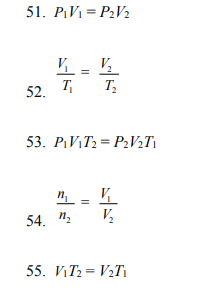
front 47 For each of the mathematical expressions for gas laws listed, select
the correct name for the law
from the response . Responses on the
right may be used more than once or need not be used
at
all.
a) Avogadro's law
b) Boyle's law
c)
Charles's law
d) combined gas law | back 47 51- B: Boyle's law
52- C: Charles's law
53- D: combined gas law
54- A: Avogadro's law
55- C: Charles's law |
front 48 For each of the change of state descriptions, select the name of the
change of state fro
m the response . Responses on the right may
be used more than once or need not be used at all.
a)
sublimation
b) condensation
c) deposition
d)
freezing
56. An endothermic change
57. Opposite of
evaporation
58. Energy is absorbed
59. Involves both the
liquid and solid state
60. Involves both the liquid and gaseous state | back 48 56-a) sublimation
57-b) condensation
58-a) sublimation
59-d) freezing
60-b) condensation |