Instructions for Side by Side Printing
- Print the notecards
- Fold each page in half along the solid vertical line
- Cut out the notecards by cutting along each horizontal dotted line
- Optional: Glue, tape or staple the ends of each notecard together
APUSH Review Folder Flashcards
front 1 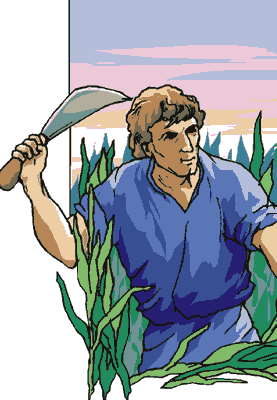 Indentured Servants | back 1 Unskilled laborer contracted to work for an employer for a fixed period of time, typically 3-7 years, in exchange for transportation, food, clothing, lodging, & other necessities. Led a hard life in the early days of the Chesapeake settlements Looks forward to becoming free & acquiring land of their own after completing their term of servitude. |
front 2 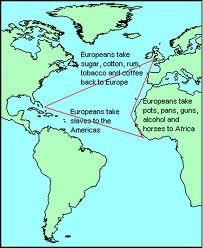 Triangle Trade | back 2 England->Coast of Africa->West Indies->back to England. Infamously profitable, though small in relation to colonial commerce. |
front 3 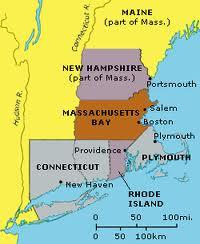 Dominion of New England | back 3 Created in 1686 by royal authority. Designed to promote efficiency in the administrations of the English Navigation Laws. Failed because the area it encompassed (Delaware River->Penobscot Bay) was too large for a single governor, Sir Edmund Andros, to manage |
front 4 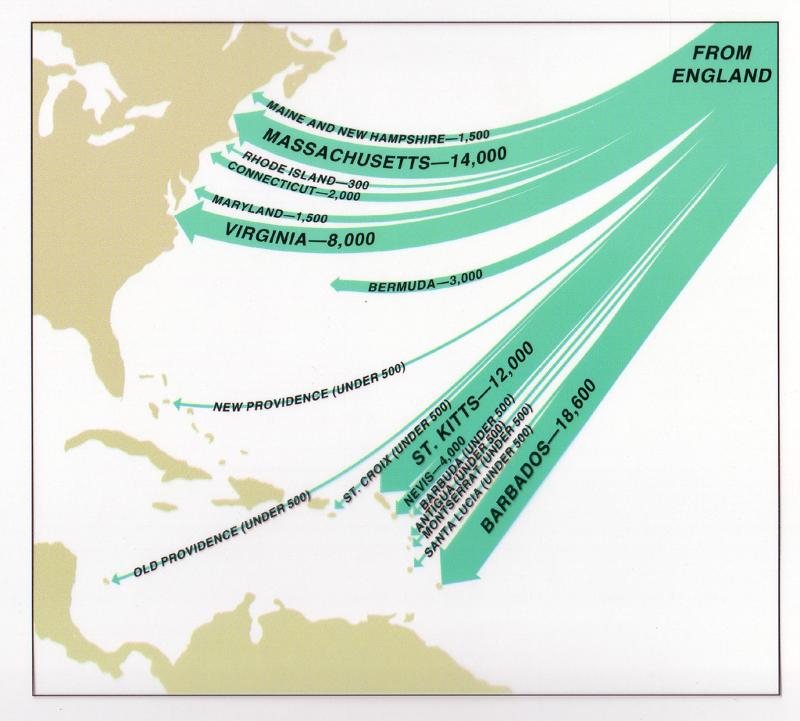 Great Migration | back 4 1630s, About 70,000 refugees left England, mostly Puritans (about 20,000). Attracted to the warm & fertile West Indies |
front 5  Jamestown | back 5 1607, The 1st permanent English colony in America where England's King James I charted the Virginia Company |
front 6  Fundamental Orders | back 6 1693, Established a democratic government controlled by substantial citizens. Like modern Constitution. Many essential features adopted by Connecticut & other states for their constitutions |
front 7 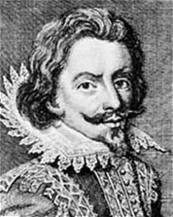 Nathaniel Bacon | back 7 Led Bacon's Rebellion. Died after burning Jamestown. |
front 8 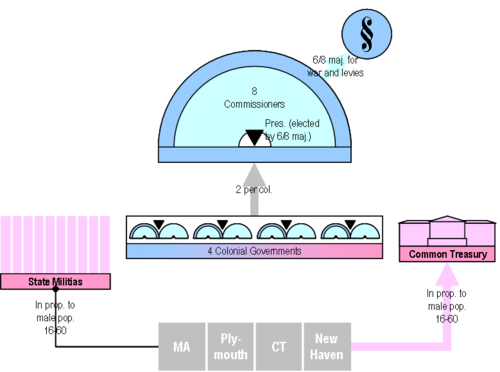 New England Confederation | back 8 Meeting held in Boston in 1643 where delegates from Connecticut, New Haven, Massachusetts Bay, & Plymouth Colony met & formed the United Colonies of New England (New England Confederation). Soon fell apart due to disagreement, but was a step toward formal cooperation among the colonies |
front 9 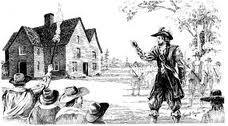 Bacon's Rebellion | back 9 1676, Rebellion of farmers to protest the royal governor's (Sir William Berkeley) lenient, let's-be-nice-to-the-Natives policy. Suppressed after Bacon's death. Led to limited power of the royal governor. |
front 10 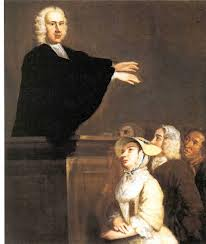 Great Awakening | back 10 A religious revival that swept through the colonies from the 1720s-1740s. Preachers challenged "cold" message of churches & stirred congregations w/ powerful, emotive sermons. Encouraged a sense of social equality & a questions of authority |
front 11 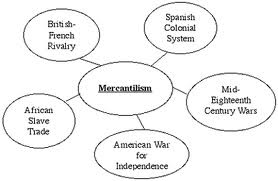 Mercantilism | back 11 Economic policy practice by most European countries in the 17th century. Based off the belief that wealth=power. Minimized trade w/ outsiders & maximized trade w/in their colonies. America supplied Britain w/ raw goods, Britain manufactured it & sent it back for Americans to buy |
front 12  Enlightenment | back 12 Influenced by the Scientific Revolution of the 17th century, took scientific reasoning & applied it to human nature, society, & religion. Emphasis upon liberty, democracy, republicanism, & religious tolerance. Culmination of drafting the US Declaration of Independence |
front 13 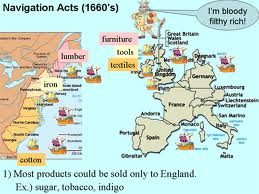 Navigation Acts | back 13 1712, A series of laws that restricted the use of foreign shipping for trade b/w England & its colonies. The goal was to force colonial development into lines favorable to England & stop colonial trade w/ Netherlands, France, & other European countries |
front 14  Salutary Neglect | back 14 Undocumented, though long-standing, British policy of avoiding strict enforcement of parliamentary laws, meant to keep American colonies obedient to Great Britain. 1067-1763, allowed the enforcement of trade relations laws to be lenient |
front 15 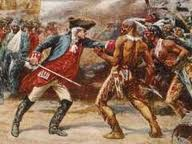 French & Indian War | back 15 1754-1763, War b/w Great Britain & France in North America. World-wide conflict 1756, known as the Seven Years' War. The beginning of open hostilities b/w America & Great Britain. |
front 16 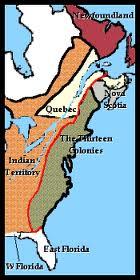 Proclamation Line of 1763 | back 16 Closed off the frontier to colonial expansion. |
front 17 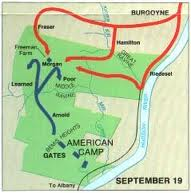 Saratoga | back 17 American victory. Turning point in the war. Convinced France to enter as ally to US. |
front 18 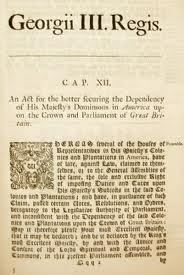 Declaratory Act | back 18 1766, A declaration by British Parliament. Stated that Parliament's authority was the SAME in the Americas as in Great Britain. Asserted Parliament's authority to make binding laws on the American colonies. |
front 19 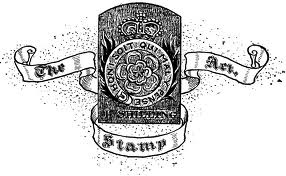 Stamp Act | back 19 1765, A direct tax impose by the British Parliament that required many printed materials in the colonies be produced on stamped paper produced in London and carry an embossed revenue stamp. |
front 20 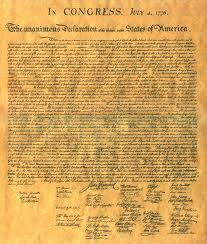 Declaration of Independence | back 20 Document that officially declared the 13 colonies as free from England's control. Came from 2nd Continental Congress |
front 21 First Continental Congress | back 21 1774, Meeting of colonial representatives in response to the Intolerable Acts. Known for the Declaration of Rights |
front 22 **Second Continental Congress | back 22 Reconvening of delegates after the Revolution came into full swing that adopted the Declaration of Independence and managed the colonial war effort. |
front 23 Land Ordinance of 1785 | back 23 Law that divided up land in the old northwest to be sold to pay off the national debt and set aside area of each township for public education. |
front 24 Northwest Ordinance of 1787 | back 24 Stated how territories would become states and admitted to the Union as well as forbidding slavery in the Old Northwest. |
front 25 Shays's Rebellion | back 25 Uprising led by Daniel Shays of backcoutry farmers who demanded lower taxes and a more efficient currency. Showed the weakness of the Articles of Confederation and the need for a stronger central government. |
front 26 Sons of Liberty | back 26 Rebellious group headed by Samuel Adams that orchestrated the Boston Tea Party and spread anti-British propaganda. |
front 27 Committees of Correspondence | back 27 Organizations established by Samuel Adams of Massachusetts that spread anti-British sentiment and openly endorsed rebellion. |
front 28 Election of 1800 | back 28 Also called the Revolution of 1800, the peaceful transfer of power from the federalists to Thomas Jefferson and the Democratic-Republicans. |
front 29 Strict & Loose Constructionism | back 29 Strict or loose interpretation of the Constitution, the former favored by Anti-federalists and Democratic Republicans while the latter favored by the federalists. |
front 30 Federalists | back 30 1787-1816, Formed by Hamilton. Was committed to being fiscally sound & nationalistic. Called for good relations w/ England, a national bank, and tariffs. Began the 2-party system. Vanished because they were too committed to the upper classes to win votes of ordinary citizens |
front 31 Anti-Federalists | back 31 Opposed the creations of a stronger federal government. Opposed ratification of the constitution. Worried that the position of President might evolve into a monarch. Wanted state government to have more power. |
front 32 Hamilton's Financial Program | back 32 Secretary of Treasury Hamilton's creation of a financial plan that would create a national bank, pay off war debts, & put a tariff on exported goods that would hopefully encourage industrialization in America. |
front 33 Jay's Treaty | back 33 A treaty b/w the US & Great Britain that is credited for averting war, resolving issues remaining from the Treaty of Paris, & allowing ten or more years of mostly peaceful trade b/w the US& Britain during the French Revolutionary Wars of 1793. |
front 34 Pinckney's Treaty | back 34 Established intentions of friendship b/w the US & Spain. Defined the boundaries of the US w/ the Spanish colonies. Guaranteed the US navigation rights on the Mississippi River. |
front 35 Whiskey Rebellion | back 35 1794, Pennsylvania, A citizen revolt against a 1791 tax on whiskey. The reaction demonstrated the determination of the US to enforce Federal Laws. Militias of several states were used to end the insurrection. |
front 36 XYZ Affair | back 36 A diplomatic event that strained relations b/w France & the US. Led to an undeclared naval war called the Quasi-War |
front 37 Alien & Sedition Acts | back 37 1798, Four bills passed by the Federalists. Signed into law by President John Adams. Designed to protect the US from enemy aliens & prevent seditious attacks from weakening government. Denounced as being unconstitutional & designed to stifle criticism of the administration, & infringing on the right of the states to act in these areas. Became a major political issue in the elections of 1798 & 1800 |
front 38 Virginia & Kentucky Resolutions | back 38 Drafted in response to the Alien & Sedition Acts. Stated that if Congress passed a law that was seen unconstitutional, states would not follow or abide by it. |
front 39 1793 Proclamation of Neutrality | back 39 A proclamation in which the US declared itself to be neutral b/w war & disputes of Britain & France. |
front 40 Louisiana Purchase | back 40 1803, Land bought from Napoleon for $15 million. Doubled the size of the US & made the westward movement possible. |
front 41 Missouri Compromise of 1820 | back 41 Admitted Maine as free and Missouri as slave state. Stated that any part of the Louisiana Territory north of 36 degree and 30 minutes would be non slave territory. |
front 42 Monroe Doctrine | back 42 1823, James Monroe's speech to Congress where he said that the America's were no longer open to colonization by European powers. |
front 43 1824 Election | back 43 All candidates were Republicans, marking the official demise of the Federalists. William Crawford,Andrew Jackson, Henry Clay, & John Q Adams. Jackson received more votes that the others. None won the majority. House of Rep chose John Q Adams |
front 44 Corrupt Bargain | back 44 Clay was named Secretary of State under President Adams after influencing the House of Rep to choose Adams. |
front 45 Tariff of Abominations | back 45 1828, Record-high tariff. Aimed to protect American industries. Hated by the agricultural South. Led to the Nullification Crisis. |
front 46 Nullification Crisis | back 46 1832, South Carolina's nullification of the Tariff of Abominations. Influenced by John Calhoun's "South Carolinas Exposition". Exposed states' rights issues. |
front 47 The American System | back 47 Clay's proposed legislative program calling for internal improvements, a protective tariff, & a national bank. The goal was economic prosperity & national unity. |
front 48 Marshall Court | back 48 1801-1835, Time period of Supreme Court where John Marshall was Chief Justice & made landmark decisions. The Supreme Court established judicial review & federal supremacy over states' power. |
front 49 Denmark Vesey | back 49 An ex-slave who led a failed slave rebellion consisting of 9,000 freed & enslaved blacks in Charleston, SC. Was scheduled for July 1822, but word spread & Denmark & other leaders were executed. |
front 50 Nat Turner | back 50 "The Prophet", August 21, 1831; A slave who led a rebellion against slave owners. Resulted in the deaths of 55 white men, women, & children to spread terror & alarm among whites. On Nov 5, 1831 he was tried, convicted, & sentenced to death. |
front 51 Gabriel Prosser | back 51 A slave who planned to lead a large slave rebellion in Richmond, Virginia on August 30, 1800. Failed when his plan was let out when two slaves told their masters of the plan. Prosser & 25 other slaves were hanged. |
front 52 Spoils System | back 52 Created under Andrew Jackson. Reward to political supporters w/ public office. An important element of the emerging 2-party order. |
front 53 Webster-Hayne Debate | back 53 Responded to the resolution to temporarily suspend surveying of public lands in the West. Widened to cover a variety of national issues including tariffs, slavery, internal improvements, & the nature of the Union. |
front 54 Tariff Act of 1832 | back 54 Pared away the worst "abominations" of 1828. Was still frankly protective & fell short of meeting Southern demands. Needed to get 2/3 vote to nullify. Made SC hopeful. |
front 55 Whigs | back 55 1834, A reaction to the authoritarian policies of Andrew Jackson. Were supporters of the American System & descendants of the old Federalist Party. Efforts to unify were slow & unsuccessful. Split when the issue of slavery was brought up. |
front 56 National Republican | back 56 Party during administration of John Q Adams. Anti-Jackson. Led by Clay. Platform was Clay's American System of nationally financed improvements to help the economy. Intended to promote unity & harmony. Dissolved in 1834 by Jackson's presidential victory |
front 57 Democratic | back 57 One of the few national political parties that favored strong state's rights and consisted mainly of southern separatists during the Antebellum period. |
front 58 Compromise Tariff of 1833 | back 58 Proposed by Clay as a resolution to the Nullification Crisis. Adopted to gradually reduce the rates after Southerners objected to the protectionism found in the Tariff of 1832 and the Tariff of Abominations. Import taxes would gradually be cut over the next decade until, by 1842, they matched the levels set in the Tariff of 1816—an average of 20%. |
front 59 Force Bill | back 59 1833, Gave the president the power to use the army and the navy to collect federal tariff duties. Passed in response to the events following the Compromise of 1832 in order to ensure that tariffs were collected. |
front 60 Gag Rule | back 60 1836, Required that all antislavery appeals to be tabled w/out debate. Caused controversy over the rights of free speech & petition. Repealed by John Q Adams 8 years later. |
front 61 South Carolina Exposition and Protest | back 61 Published by Calhoun. Denounced the Tariff of Abominations. Stated outright that the South should nullify the Tariff. SC failed to get the 2/3 majority. |
front 62 Transcendentalism | back 62 The belief that everyone possesses an inner light that can illuminate the highest truth & put him in touch w/ God, or the "Oversoul". Stubborn individualism in religious & social matters. Commitment to self-reliance, self-culture, & self- discipline. Bred hostility to authority & conventional wisdom. |
front 63 Second Great Awakening | back 63 1800, Swept America in a flood of spiritual fervor. Church attendance greatly increased & religion became much more emotional. Methodist & Baptist sects reaped the greatest reward. More women attended church & heard messages directed at them. Women were given roles of converting their families. |
front 64 Abolitionist Movement | back 64 The goal was the immediate emancipation of all slaves & the end of racial discrimination & segregation. Partly fueled by the religious fervor of the Second Great Awakening. Became increasingly prominent in Northern churches and politics, which contributed to the regional animosity between North and South leading up to the Civil War. |
front 65 Seneca Falls Convention | back 65 Women's rights convention of 1848. Declaration of Sentiments proclaimed "all men & women are created equal". Launched the modern women's rights movement. |
front 66 Hudson River School | back 66 Focus on romantic images of local landscapes, which promoted protection & settlement of the West & the creation of national parks. |
front 67 Romanticism | back 67 An artistic, musical, & philosophical movement that emphasized strong emotion as a source of the aesthetic experience. Showed majestic, turbulent, &/or wild scenes. |
front 68 Election of 1844 | back 68 Still in the Jacksonian era, Polk (Democrat) barely defeated Clay (Whig) w/ an expansionist platform. Polk went on to annex Texas & Oregon & provoke/win the Mexican-American War. |
front 69 Mexican-American War | back 69 Texas border dispute into a highly successful war that won US all the land from Texas to California for %15 million. Manifest Destiny spirit & free/slave territory disputes surged afterward. |
front 70 Manifest Destiny | back 70 The American belief that the US was destined to spread from the Atlantic to the Pacific. Was the core of American expansionism. |
front 71 Wilmot Provisio | back 71 Stipulated that slavery would not be allowed to exist in any territory gained from Mexico. Passed the House, not the Senate (Southerners refused to lose prospective slave states). Began the series of free/slave legal battles that ended w/ the Civil War. |
front 72 Free Soil Party | back 72 An antislavery party that pointed to the later Republican Party. Included industrialists who wanted higher tariffs, Northern Democrats who wanted Oregon, racists who wanted blacks out of new territories, & moral abolitionists. Generally agreed that the cheap labor of slavery kept poor whites from earning enough to advance in society. |
front 73 Compromise of 1850 | back 73 Allowed California to enter as a free state. Gave money to Texas in return for land. Created a stricter fugitive slave law. |
front 74 Cherokee Nation vs Georgia | back 74 Supreme court case where the Cherokee Indians filed suit against the state of Georgia for infringement of rights and despite being ruled in favor of, were denied recompense by Andrew Jackson. |
front 75 Worcester vs Georgia | back 75 Supreme court case ruling that declared Native tribes to be "distinct communities" and that state laws have no say in their affairs, an outcome again ignored by Andrew Jackson. |
front 76 Texas Issue | back 76 Mexican land settled by slave-supporting southerners and delayed admittance to the Union due to their potential disturbance to the delicate equilibrium in senate. |
front 77 Mexican Cession | back 77 Large tract of land bought by the United States for 18 million dollars after their victory in the Mexican-American War containing the much desired California. |
front 78 John C. Calhoun | back 78 A political sparring partner to Adams, Jackson, Webster, & Clay. Best remembered for the rallying cries to states' rights & nullification, used to support his steadfast opposition to tariffs on manufactures & his defense of slavery. |
front 79 Election of 1860 | back 79 Lincoln, Douglas, Breckinridge, & Bell. Lincoln won w/out a single Southern state. Almost immediately, Southern states began withdrawing from the Union, setting stage for a Civil War & the creation of a new state. |
front 80 Uncle Tom's Cabin | back 80 Written by Harriet Beecher Stowe. Depicts the reality of slavery, while also asserting that Christian love can overcome something as destructive as enslavement of fellow human beings. Helped fuel that abolitionist cause in the 1850s. "So this is the little lady who started this Great War." -Lincoln |
front 81 Gadsden Purchase | back 81 1853, Agreement to buy a strip if land in the South to build a railroad line to the Gulf of California. James Gadsden payed $10 million for territory about the size of Pennsylvania. |
front 82 Ostend Manifesto | back 82 1854, A document that described the rationale for the US to purchase Cuba from Spain. Implied the US should declare war if Spain refused. Proposed a shift in foreign policy, justifying the use of force to seize Cuba in the name of national security. |
front 83 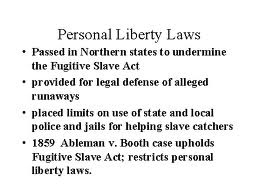 Personal Liberty Laws | back 83 A series of laws passed in the North in response to the Fugitive Slave Act of 1793 & 1850. Designed to protect free blacks, freedmen, & fugitive slaves by nullifying the Fugitive Slave Law w/out actually invoking controversial doctrine of nullification. |
front 84 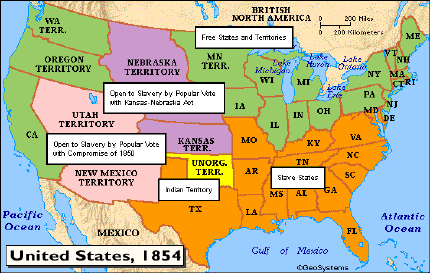 Kansas-Nebraska Act | back 84 1854,Allowed people in Kansas & Nebraska to decide whether or not to allow slavery. Served to repeal the Missouri Compromise of 1820. Infuriated many in the North who considered the Missouri Compromise to be a long-standing binding agreement. Pro-slavery South strongly supported. |
front 85 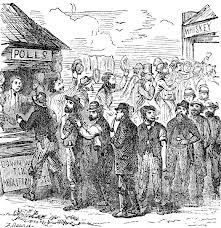 Bleeding Kansas | back 85 Described the violent hostilities between pro- & antislavery forces in Kansas Set by the Kansas-Nebraska Act. Exploded into a bloody civil war. |
front 86 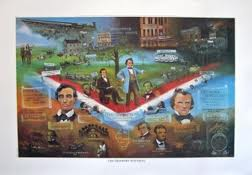 Freeport Doctrine | back 86 2nd of the Lincoln debates. Douglas supported the practice of popular sovereignty in the states where slavery was an issue, only if a state's majority chooses to bar slavery from its territories can slavery be legally abolished. Douglas won. Democratic party was split & Douglas lost support from the South. |
front 87  Lincoln-Douglas Debates | back 87 A series of public debates prior to the Civil War. Purpose was to display each candidate's views on different topics. Douglas won the senate seat. Lincoln received public notice, which helped him win the presidential election of 1861. |
front 88  Dred Scott vs Sanford | back 88 Scott sued for his freedom following the death of his owner. Lost because no one of African ancestry could claim US citizenship. Catalyzed Lincoln's Emancipation Proclamation. |
front 89 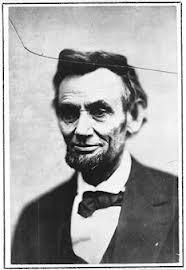 Abraham Lincoln | back 89 16th President. Became the leading force in rejoining the North & South during the Civil War. Helped abolish slavery & bring the Civil War to a close. Assassinated 1865 by Booth, bringing the nation even closer. |
front 90 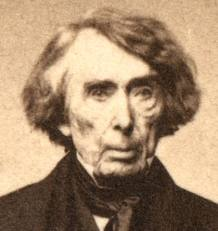 Roger Taney | back 90 5h chief of justice of the Supreme Court. Best known for his ruling during the Dred Scott case. Felt that African Americans could not be considered citizens of the US because they were inferior. Helped the Emancipation Proclamation soar across the nation. |
front 91  Popular Sovereignty | back 91 The concept of allowing the majority to decide whether or not the territory they live in should enter the Union as a free or slave state. Led to many problems, such as Bleeding Kansas, & was eventually dropped. |
front 92  Ex Parte Milligan | back 92 A Supreme Court decision stating that civilians could not be tried in military courts if there are civil courts available. Helped to define the power of the military over civilians in wartime. |
front 93  Ex Parte Merryman | back 93 1861, a US Federal court case which arose out of the Civil War. Against the presidents ability to suspend habeas corpus (the ability to take legal action as a prisoner to become free due to unlawful detention). Ruled that the president could not suspend habeas courpus, but this was ignored. |
front 94 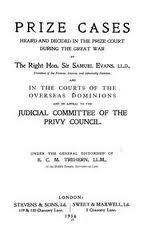 Prize Cases | back 94 1862, Judicial cases argued before the Supreme Court during the Civil War. Declared the blockade of the Southern ports unconstitutional. |
front 95 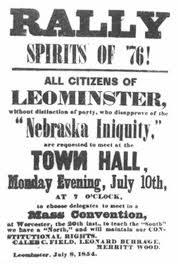 Ableman vs. Booth | back 95 1859, the Supreme Court stated that state courts could not issue rulings that contradict federal court decisions. Created to overturn a decision by the Supreme Court of Wisconsin. Ableman emphasized the dual form of American government & the independence of state & federal courts from one another. |
front 96 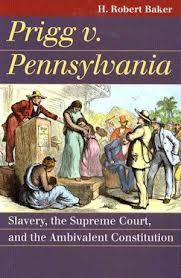 Prigg vs. Pennsylvania | back 96 1842, The Supreme Court decided that Federal law is superior to state law. Overturned the conviction of Edward Prigg as a result due to the questions of Federal law & state law being brought up by the Federal court stating the state's decision was unconstitutional. |
front 97  Young America | back 97 1845, An American political & cultural attitude about freedom. Formed as a political organization that advocated free trade, social reform, expansion southward into the territories, & support for republican, anti-aristocratic movements abroad. |
front 98 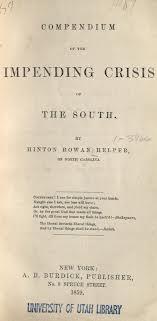 Hinton Helper | back 98 1850s, A Southern critic of slavery. Published "The Impending Crisis of the South", which argued that slavery hurt the economic prospects of non-slaveholders. Was an impediment to the growth of the entire region of the South. Believed to be acting as an agent of the North attempting to split Southern whites along class line. |
front 99 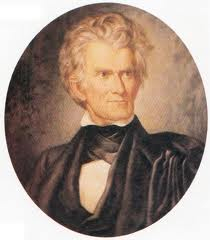 George Fitzhugh | back 99 An American social theorist who published racial & slavery-based sociological theories in the Antebellum Era. Argued that "the negro is but a grown up child" who needs the economic & social protections of slavery. Contended that slavery ensured that blacks would be economically secure & morally civilized. Was a leading pro-slavery intellectual. spoke for many of the Southern plantation owners. |
front 100 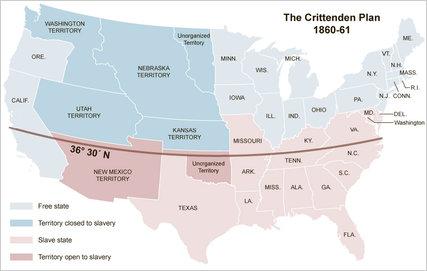 Crittenden Compromise | back 100 An unsuccessful proposal to resolve the US secession crisis by addressing the concerns that led the states in the Deep South to contemplate secession. Most of the laws conceded to the wants of the South, not the North. Led to the compromise being dismissed, causing an uproar in the South over the North not accepting it. |
front 101 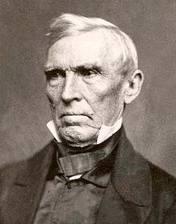 Crittenden Resolution | back 101 1861, Congress declared that the Civil War was being waged for the reunion of the states & not to interfere w/ the institutions of the South, mostly slavery. |
front 102 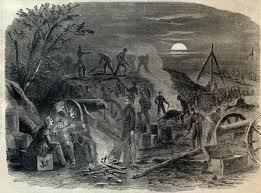 Manassas Juntion-Bull Run | back 102 1861, Intended to demonstrate the superiority of the Union arms, which could lead to the capture of the Confederate capital. |
front 103 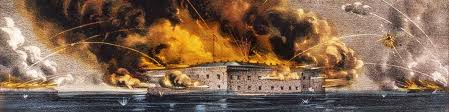 Fort Sumter | back 103 1861, The most important fort to start the Civil War. Opened the momentous bombardment was fired from a mortar located at Fort Johnson on James Island. |
front 104 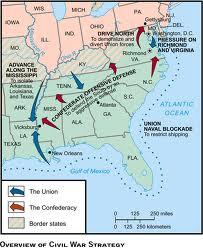 Northern Strategy | back 104 Meant attacking everywhere, encircling the enemy. Emulated the way constrictors attack (hence the name "Anaconda Plan"). |
front 105 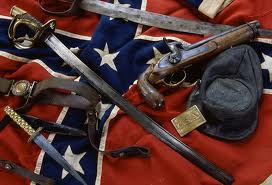 Southern Strategy | back 105 The concept was to remain on the defensive until an opportunity presented itself to laugh offensive operations. Ensured that all Northern thrusts would be met, assuring Confederate citizens that their homes would be defended, at least initially. |
front 106 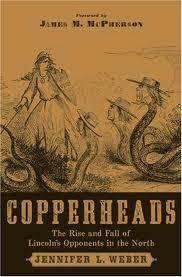 Copperheads | back 106 Northerners who opposed the Civil War. Considered traitors by others in the North. Favored immediate peace w/ the Confederacy. |
front 107 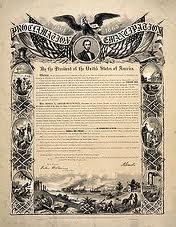 Emancipation Proclamation | back 107 An executive order issued by Lincoln during the Civil War. Proclaimed the freedom of 3.1 million of the nation's 4 million slaves. 50,000 freed immediately, the rest freed as the Union armies advanced. |
front 108 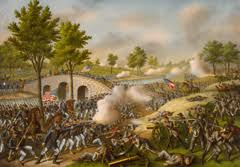 Antietam | back 108 1862, The first major battle in the Civil War in the North. Also the bloodiest single-day battle in American history (23,000 casualties). The Emancipation Proclamation was later announced. |
front 109 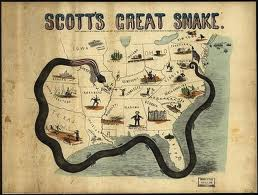 Anaconda Plan | back 109 Called for the capture of the Mississippi River to strangle the Confederacy economically & strategically. The essential part of the Union plan to win the Civil War. |
front 110  Confiscation Acts of 1861 | back 110 An act of Congress during the early months of the Civil War permitting the confiscation of any property, including slaves, being used to support the confederate insurrection. |
front 111 Presidential Reconstruction | back 111 Lincoln 1863, A state could rejoin the Union when 10% of voters had taken oath of allegiance to the US & emancipation.
|
front 112 Congressional Reconstruction | back 112 The creation of five military districts in the seceded states to be readmitted to the Union. Required Congressional approval for new state conventions. Ratified the 13th & 14th amendments. |
front 113 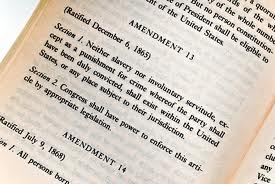 13th Amendment | back 113 1865, Abolished & continued to prohibit slavery. |
front 114 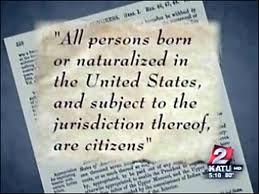 14th Amendment | back 114 1868, Reversed the Dred Scott decision & allowed newly freed slaves the right to gain a citizenship. Prohibited the government from depriving a person of their unalienable rights. Required the government to provide equal protection to everybody in their jurisdiction. |
front 115 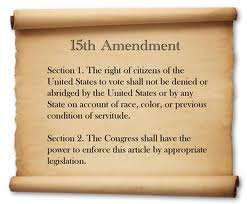 15th Amendment | back 115 1870, Allowed black men to vote. Forbade any government in the US from denying someone the right to vote based on race, color, or previous servitude. |
front 116 Tenure of Office Act | back 116 Took away the current president's power to remove an executive officer appointed by a past president w/out the advice & consent of the Senate. |
front 117 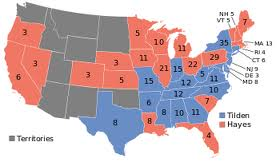 1876 Election | back 117 Hayes vs. Tilden. One of the most controversial elections in history. 20 electoral votes unaccounted for from Florida, Louisiana, & SC, later given to Hayes. Rumored that a deal was made, giving Hayes the presidency in return for the end of Reconstruction. 1st Democratic win of the popular vote in 24 years. |
front 118 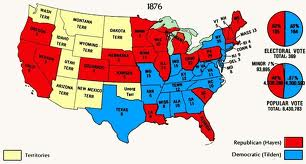 Compromise of 1877 | back 118 Informal deal that gave Rutherford B. Hayes the presidency on the terms that he remove federal troops from former Confederate states, construct a southern transcontinental railroad, and accept laws that would help industrialize the post-war south. |
front 119 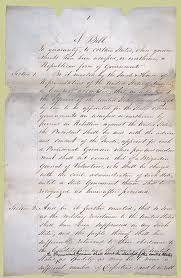 Wade-Davis Bill | back 119 A stricter plan for reconstruction. Stated that re-admittance into the Union would depend on a majority of the former Confederate states taking the oath that completely renounced their ties to the Confederacy. Passed by both houses, but was vetoed by Lincoln. |