Instructions for Side by Side Printing
- Print the notecards
- Fold each page in half along the solid vertical line
- Cut out the notecards by cutting along each horizontal dotted line
- Optional: Glue, tape or staple the ends of each notecard together
A First Course in Probability - Chapter 2 Problems
front 1 A box contains 3 marbles: 1 red, 1 green, and 1 blue. Consider an experiment that consists of taking 1 marble from the box and then replacing it in the box and drawing a second marble from the box. Describe the sample space. Repeat when the second marble is drawn without replacing the first marble. | back 1 (a) S = {(r,r), (r, g), (r,b), (g, r), (g, g), (g, b), (b, r), (b, g), (b, b)} (b) S = {(r, g), (r, b), (g, r), (g, b), (b, r), (b, g)} |
front 2 In an experiment, die is rolled continually until a 6 appears, at which point the experiment stops. What is the sample space of this experiment? Let En denote the event that n rolls are necessary to complete the experiment. What points of the sample spare are contained in En? What is (inf(U) 1 En)? | back 2 S = {(n, x 1 , …, x n−1 ), n ≥ 1, x i ≠ 6, i = 1, …, n − 1}, with the interpretation that the outcome is (n, x 1 , …, x n−1 ) if the first 6 appears on roll n, and x i appears on roll, i, i = 1, …, n − 1. The event c n n E ) ( 1 ∞ = ∪ is the event that 6 never appears. |
front 3 Two dice are thrown. Let E be the event that the sum of the dice is odd, let F be the event that at least one of the dice lands on 1, and let G be the event that the sum is 5. Describe the events EF, E ∪ F, FG, EF^c, and EFG. | back 3 EF = {(1, 2), (1, 4), (1, 6), (2, 1), (4, 1), (6, 1)}. |
front 4 A, B, and C take turns flipping a coin. The first one (a) Interpret the sample space. | back 4 A = {1,0001,0000001, …} B = {01, 00001, 00000001, …} |
front 5 A system is comprised of 5 components, each of which is either working or failed. Consider an experiment that consists of observing the status of each component, and let the outcome of the exper-iment be given by the vector ( x1, x2, x3, x4, x5 ) , where xi is equal to 1 if component i is working and is equal to 0 if component i is failed. (a) How many outcomes are in the sample space of this
experiment? | back 5 (a) 25 = 32 |
front 6 A hospital administrator codes incoming patients suffering gunshot wounds according to whether they have insurance (coding 1 if they do and 0 if they do not) and according to their condition, which is rated as good (g), fair (f), or serious (s). Consider an experiment that consists of the coding of such a patient. (a) Give the sample space of this experiment. | back 6 (a) S = {(1, g), (0, g), (1, f), (0, f), (1, s), (0, s)} |
front 7 Consider an experiment that consists of determin-ing the type of
job—either blue-collar or white-collar—and the political
affiliation—Republican, | back 7 (a) 6 15 |
front 8 Suppose that A and B are mutually exclusive events for which P (A) =
. 3 and P (B) = . 5. What is the probability that | back 8 (a) .8 |
front 9 A retail establishment accepts either the American Express or the VISA credit card. A total of 24 per-cent of its customers carry an American Express card, 61 percent carry a VISA card, and 11 per-cent carry both cards. What percentage of its cus-tomers carry a credit card that the establishment will accept? | back 9 Choose a customer at random. Let A denote the event that this
customer carries an American Express card and V the event that he or
she carries a VISA card. |
front 10 Sixty percent of the students at a certain school wear neither a ring
nor a necklace. Twenty per-cent wear a ring and 30 percent wear a
necklace. If one of the students is chosen randomly, what is the
probability that this student is wearing | back 10 Let R and N denote the events, respectively, that the student wears a ring and wears a necklace. (a) P(R ∪ N) = 1 − .6 = .4 |
front 11 A total of 28 percent of American males smoke cigarettes, 7 percent
smoke cigars, and 5 percent | back 11 Let A be the event that a randomly chosen person is a cigarette
smoker and let B be the event that she or he is a cigar smoker. |
front 12 An elementary school is offering 3 language classes: one in Spanish, one in French, and one in German. The classes are open to any of the 100 students in the school. There are 28 students in the Spanish class, 26 in the French class, and 16 in the German class. There are 12 students that are in both Spanish and French, 4 that are in both Span-ish and German, and 6 that are in both French and German. In addition, there are 2 students taking all 3 classes. (a) If a student is chosen randomly, what is the probability that he
or she is not in any of the language classes? | back 12 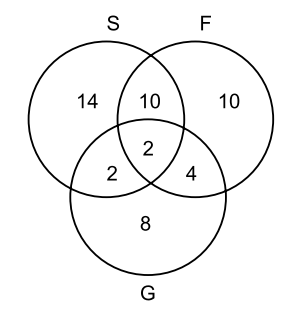 (a) P(S ∪ F ∪ G) = (28 + 26 + 16 − 12 − 4 − 6 + 2)/100 = 1/2 (attached image) (c) since 50 students are not taking any of the courses, the probability that neither one is taking a course is (50 2)/ (100 2) = 49/198 and so the probability that at least one is taking a course is 149/198. |
front 13 A certain town with a population of 100,000 has (The list tells us, for instance, that 8000 people read newspapers I
and II.) | back 13 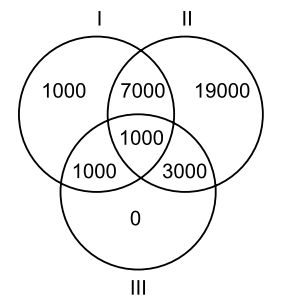 (a) 20,000 (b) 12,000 (c) 11,000 (d) 68,000 (e) 10,000 |
front 14 The following data were given in a study of a group of 1000 subscribers to a certain magazine: In ref-erence to job, marital status, and education, there were 312 professionals, 470 married persons, 525 college graduates, 42 professional college gradu-ates, 147 married college graduates, 86 married professionals, and 25 married professional college graduates. Show that the numbers reported in the study must be incorrect. Hint: Let M, W, and G denote, respectively, the set of
professionals, married persons, and college graduates. Assume that one
of the 1000 persons is chosen at random, and use Proposition 4.4 to
show that if the given numbers are correct, then | back 14 P(M) + P(W) + P(G) − P(MW) − P(MG) − P(WG) + P(MWG) = .312 + .470 + .525 − .086 − .042 − .147 + .025 = 1.057 |
front 15 If it is assumed that all (52 c 5) poker hands are equally likely, what is the probability of being dealt (a) a flush? (A hand is said to be a flush if all 5 cards are of the
same suit.) | back 15 (a) 4*(13 c 5)/(52 c 5) (b) 13*(4 c 2)*(12 c 3)*(4 c 1)(4 c 1)*(4 c 1)/(52 c 5) (c) (13 c 2)*(4 c 2)*(4 c 2)(44 c 1)/(52 c 5) (d) 13*(4 c 3)*(12 c 2)*(4 c 1)*(4 c 1)/(52 c 5) (e) 13*(4 c 4)*(48 c 1)/(52 c 5) |
front 16 Poker dice is played by simultaneously rolling 5 dice. Show that (a) P { no two alike } = . 0926; | back 16 (a) 6*5*4*3*2/6^5 (b) 6*(5 c 2)5*4*3/6^5 (c) (6 c 2)*4*(5 c 2)*(3 c 2)/6^5 (d) 6*5*4(5 c 3)/21 (e) 6*5(5 c 3)/6^5 (f) 6*5*(5 c 4)/6^5 |
front 17 If 8 rooks (castles) are randomly placed on a | back 17 ∏8 i=1 i^2/64*63**68 |
front 18 Two cards are randomly selected from an ordinary playing deck. What is the probability that they form a blackjack? That is, what is the probability that one of the cards is an ace and the other one is either a ten, a jack, a queen, or a king? | back 18 2*4*16/52*51 |
front 19 Two symmetric dice have both had two of their sides painted red, two painted black, one painted yellow, and the other painted white. When this pair of dice is rolled, what is the probability that both dice land with the same color face up? | back 19 4/36 + 4/36 +1/36 + 1/36 = 5/18 |
front 20 Suppose that you are playing blackjack against a dealer. In a freshly
shuffled deck, what is the prob-ability that neither you nor the dealer
is dealt a | back 20 Let A be the event that you are dealt blackjack and let B be the
event that the dealer is dealt where the preceding used that P(A) = P(B) = 2 × 4*16/52*51. Hence, the probability that neither is dealt blackjack is .9017. |
front 21 A small community organization consists of 20 families, of which 4
have one child, 8 have two chil-dren, 5 have three children, 2 have
four children, and 1 has five children. | back 21 (a) p1 = 4/20, p2 = 8/20, p3 = 5/20, p4 = 2/20, p5 = 1/20 |
front 22 Consider the following technique for shuffling a deck of n cards: For
any initial ordering of the cards, go through the deck one card at a
time and at each card, flip a fair coin. If the coin comes up heads,
then leave the card where it is; if the | back 22 The ordering will be unchanged if for some k, 0 ≤ k ≤ n, the first k
coin tosses land heads and |
front 23 A pair of fair dice is rolled. What is the probabil-ity that the second die lands on a higher value than does the first? | back 23 The answer is 5/12, which can be seen as follows: Another way of solving is to list all the outcomes for which the
second is higher. There is 1 |
front 24 25. A pair of dice is rolled until a sum of either 5 or 7 appears.
Find the probability that a 5 occurs first. | back 24 P(En)= (26/36)^n-186/36, ∑inf n=1, P(En) = 2/5 |
front 25 27. An urn contains 3 red and 7 black balls. Players A and B withdraw balls from the urn consecutively until a red ball is selected. Find the probability that A selects the red ball. (A draws the first ball, then B, and so on. There is no replacement of the balls drawn.) | back 25 P(A) = 3*9!+7*6*3*7!+7*6*5*4*3*5!+7*6*5*4*3*2*3*3!/10! |
front 26 An urn contains 5 red, 6 blue, and 8 green balls. If a set of 3 balls
is randomly selected, what is the probability that each of the balls
will be (a) of the | back 26 P{same} = (5 c 3) + (6 c 3) + (8 c 3)/(19 c 3) P{different} = (5 c 1)*(6 c 1)*(8 c 1)/(19 c 3) If sampling is with replacement P {same} = 5^3+6^3+8^3/(19)^3 P{different} = P(RBG) + P{BRG) + P(RGB) + … + P(GBR) = 6*5*6*8/(19)^3 |
front 27 An urn contains n white and m black balls, where n and m are positive
numbers. | back 27 incomplete |
front 28 The chess clubs of two schools consist of, respec-tively, 8 and 9
players. Four members from each club are randomly chosen to
participate in a con-test between the two schools. The chosen play-ers
from one team are then randomly paired withthose from the other team,
and each pairing plays | back 28 (a) 4/8*4/9*1/4=1/18 (b) 4/8*4/9*3/4= 1/6 (c)P(RUE) = P(R) + P(E) - p(RE) = 4/8+ 4/9-(4/8*4/9) = 13/18 |
front 29 A 3-person basketball team consists of a guard, a forward, and a
center. | back 29 (a) 6/27= 2/9 = 0.222 (b) 2/27 = 1/9 = 0.111 |
front 30 A group of individuals containing b boys and g | back 30 g(b+g-1)!/(b+g)!= g/b+g |
front 31 A forest contains 20 elk, of which 5 are captured, tagged, and then released. A certain time later, 4 of the 20 elk are captured. What is the probability that 2 of these 4 have been tagged? What assump-tions are you making? | back 31 (5 c 2)*(15 c 2)/(20 c 4)= 70/323 |
front 32 The second Earl of Yarborough is reported to have bet at odds of 1000 to 1 that a bridge hand of 13 cards would contain at least one card that is ten or higher. (By ten or higher we mean that a card is either a ten, a jack, a queen, a king, or an ace.) Nowadays, we call a hand that has no cards higher than 9 a Yarborough. What is the proba-bility that a randomly selected bridge hand is a Yarborough? | back 32 (32 c 13)/(52 13) |
front 33 Seven balls are randomly withdrawn from an urn that contains 12 red,
16 blue, and 18 green balls. | back 33 (a) p = (12 c 3)*(16 c 2)*(18 c 2)/(12+16+18 c 7) (b) 1 - {(16+18 c 7)/(12+16+18 c 7) + (12 c 1)*(16+18 c 6)/(12+16+18 c 7)} (c) p = (12 c 7) + (16 c 7) + (18 c 7)/(12+16+18 c 7) (d) p = (3 red for any color) + (3 blue for any other color) - (3 red and 3 blue and any other color) p = (12 c 3)*(16+18 c 4)+(16 c 3)*(12+18 c 4)-(12 c 3)*(16 c 3)*(18 c 1)/(12+16+18 c 7) |
front 34 Two cards are chosen at random from a deck of 52 playing cards. What
is the probability that they | back 34 (a) (4 c 2)/(52 c 2) = .0045 (b) 13*(4 c 2)/(52 c 2) = 1/17 = 0.588 |
front 35 An instructor gives her class a set of 10 problems with the
information that the final exam will con-sist of a random selection of
5 of them. If a student has figured out how to do 7 of the problems,
what is the probability that he or she will answer correctly | back 35 (a) (7 c 5)/(10 c 5) = 1/12 = .0833 (b) (7 c 4)*(3 c 1)/(10 c 5) + 1/12 = 1/2 |
front 36 There are n socks, 3 of which are red, in a drawer. What is the value of n if, when 2 of the socks are chosen randomly, the probability that they are both red is 1/2? | back 36 1/2 = (3 c 2)/(n c 2) or n(n-1) = 12 or n = 4 |
front 37 There are 5 hotels in a certain town. If 3 people check into hotels in a day, what is the probability that they each check into a different hotel? What assumptions are you making? | back 37 5*4*3/5*5*5 = 12/25 |
front 38 A town contains 4 people who repair televisions. | back 38 P{1} = 4/44 = 1/64 P{2} = (4 c 2)[4+(4 c 2)+4]/4^4= 84/256 P{3} = (4 c 3)*(3 c 1)*4!/2!/4^4=36/64 P{4}=4!/4^4=6/64 |
front 39 If a die is rolled 4 times, what is the probability that | back 39 1-5^4/6^4 |
front 40 Two dice are thrown n times in succession. Com-pute the probability
that double 6 appears at least once. How large need n be to make this
probability | back 40 1-(35/36)^n |
front 41 (a) If N people, including A and B, are randomly arranged in a line,
what is the probability that A and B are next to each other? | back 41 (a) 2(n-1)(n-2)/n!=2/n in a line (b) 2n(n-2)!/n! = 2/n-1 if in a circle, n >= 2 |
front 42 Five people, designated as A, B, C, D, E, are arranged in linear
order. Assuming that each pos-sible order is equally likely, what is
the probability that | back 42 (a) If A is first, then A can be in any one of 3 places and B’s place
is determined, and the others can be arranged in any of 3! ways. As a
similar result is true, when B is first, we see that the probability
in this case is 2 ⋅ 3 ⋅ 3!/5! = 3/10 |
front 43 A woman has n keys, of which one will open her door. | back 43 (a) P = n-1/n ***n-(k-1)/n-(k-2) *** 1/n-(k-1) = 1/n (b) P (n-/n1)^k-1*1/n |
front 44 How many people have to be in a room in order | back 44 If n in the room, P {all different} = 12*11****(13-n)/12*12*12*12 When n = 5 this falls below 1/2. (Its value when n = 5 is .3819) |
front 45 If there are 12 strangers in a room, what is the probability that no two of them celebrate their birthday in the same month? | back 45 12!/(12)^12 |
front 46 Given 20 people, what is the probability that, among the 12 months in the year, there are 4 months containing exactly 2 birthdays and 4 containing exactly 3 birthdays? | back 46 (12 c 4)*(8 c 4) * (20)!/(3!)^4(2!)^4/(12)^20 |
front 47 A group of 6 men and 6 women is randomly divided into 2 groups of size 6 each. What is the probability that both groups will have the same number of men? | back 47 (6 c 3)*(6 c 3)/(12 c 6) |
front 48 In a hand of bridge, find the probability that you | back 48 (13 c 5)*(39 c 8)(8 c 8)(31 c 5)/(52 c 13)*(39 c 13) |
front 49 Suppose that n balls are randomly distributed into N compartments. Find the probability that m balls will fall into the first compartment. Assume that all N^n arrangements are equally likely. | back 49 (n c m)(n-1)^(n-m)/N^n |
front 50 A closet contains 10 pairs of shoes. If 8 shoes | back 50 (a) 20*18*16*14*12*10*8*6/20...13 (b) (10 c 1)(9 6)*(8!/2!)*2^6/20*19*18*17*16*15*14*13 |
front 51 If 4 married couples are arranged in a row, find the probability that no husband sits next to his wife. | back 51 P(U^4 i=1 Ai) = 4*(2*7!/8!)-6*(2^2*6!/8!)+4*(2^3*5!)/8!-(2^4*4!/8!) |
front 52 Compute the probability that a bridge hand is void in at least one suit. Note that the answer is not | back 52 P(SUHUDUC) = P(S) + P(H) + P(D) + P(C) - P(SH) - ... - P(SHDC) = 4(39 c 13)/(52 c 13) - 6(26 c 13)/52 c 13 + 4(13 c 13)/(52 c 13) = 4(39 c 13) - 6(26 c 13) + 4/(52 c 13) |
front 53 55 Compute the probability that a hand of 13 cards contains (a) the ace and king of at least one suit; (b) all 4 of at least 1 of the 13 denominations. | back 53 (a) 4(2 c 2)/(52 c 13)-6(2 c 2)(2 c 2)(48 c 9)/(52 c 13) + 4(2 c 2)^3(46 c 7)/(52 c 13) - (2 c 2)^4*(44 c 5)/(52 c 13) = 4(50 c 11) - 6(48 c 9) + 4(46 c 7) - (44 c 5)/(52 c 13) (b) P(1 U 2 U...U 13) = 13(48 c 9)/(52 c 13) - (13 c 2)(44 c 5)/(52 c 13) + (13 c 3)(40 c 1)/(52 c 13) |
front 54 Two players play the following game: Player A chooses one of the
three spinners pictured in Figure 2.6, and then player B chooses one
of the remaining two spinners. Both players then spin their spinner,
and the one that lands on the higher number is declared the winner.
Assuming that each spinner is equally likely to land in any of its 3
regions, would you rather be player A or player | back 54 Player B. If Player A chooses spinner (a) then B can choose spinner
(c). If A chooses (b) |