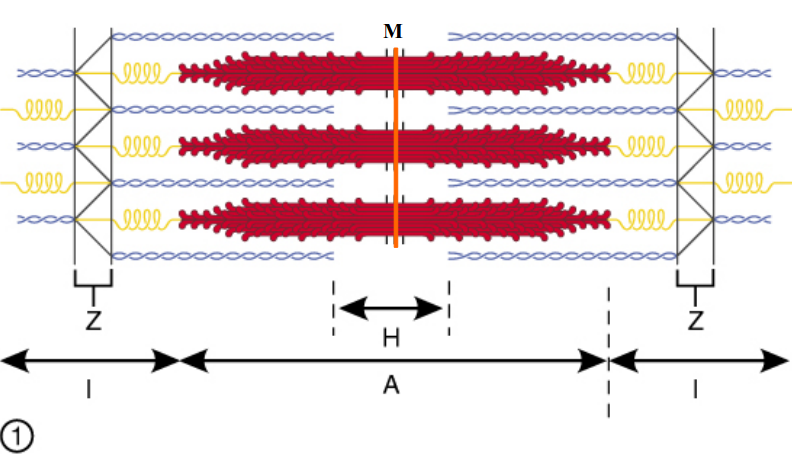
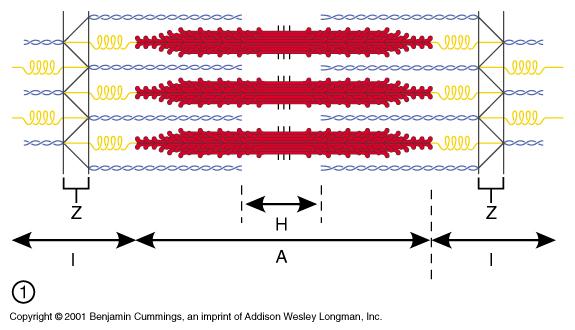
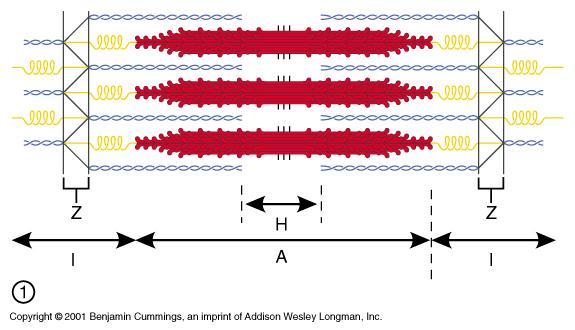
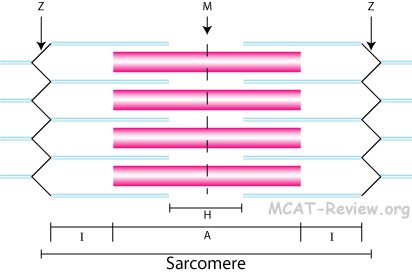
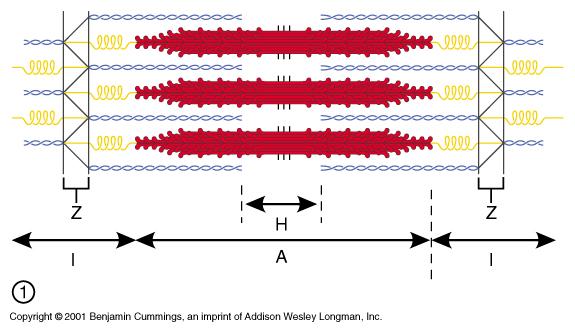
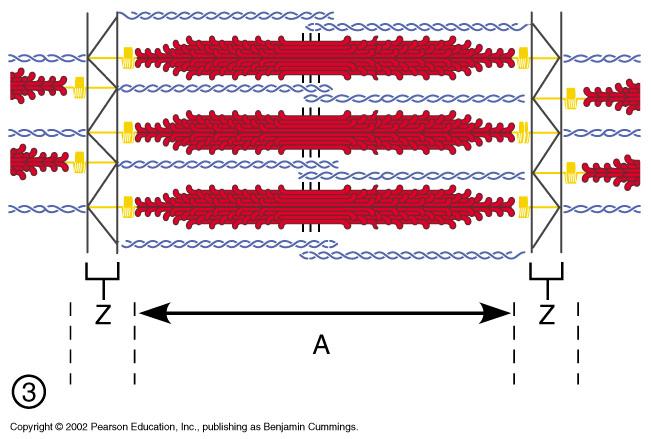
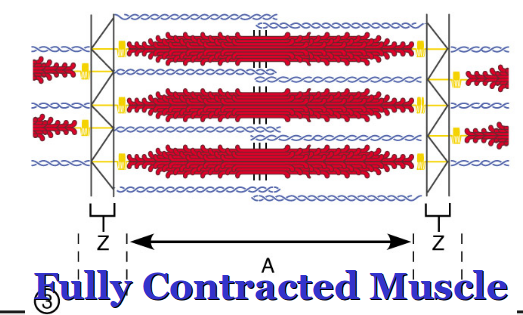
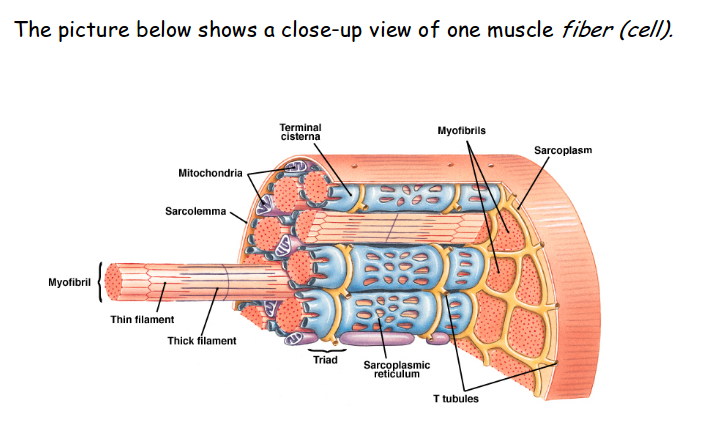
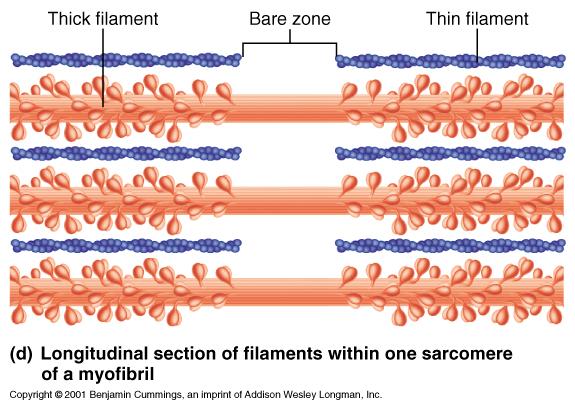
| back 5 The anisotropic band that extends form the start of the myosin filament to its end. Can also be described as the region of overlapping myosin and actin filaments. |
| back 6 Region in center of A band where ONLY myosin is present. |
| back 7 The isotropic band, an area of actin filaments next to the Z line.
*shows up as a light stripe |
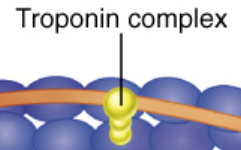
| back 8 A protein that is attached to tropomyosin.
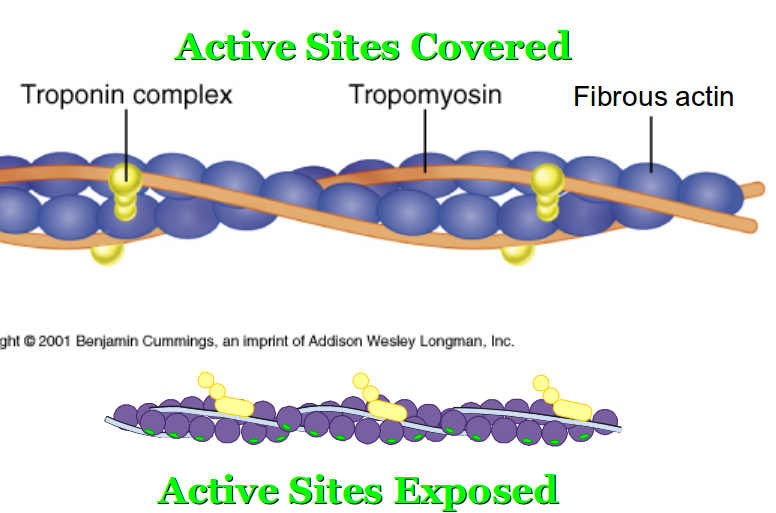
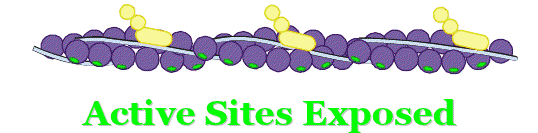
When calcium is present, troponin acts like a hand and pulls tropomyosin off of the active sites of the actin. This allows the muscle contraction to start. |
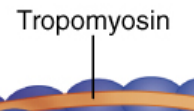
| back 9 Thread-like proten that winds aroun the actin chain so that it covers the active sites (when muscle is relaxed). |
| back 10 Made up of three proteins:
1. Actin--Bead-like proteins which form a chain that is twisted back on itself.
*Each actin bead contains an active site--An area where the myosin head attaches to during muscle contraction.
2. Tropomysoin--Thread-like proten that winds aroun the actin chain so that it cobers the active sites (when muscle is relaxed).
3. Troponin--A protein that is attached to tropomyosin.
*Each contains a calcium-binding area/site--Calcium must bind to troponin before muscle contraction can take place. When calcium is present, troponin acts like a hand and pulls tropomyosin off of the active sites of the actin. This allows the muscle contraction to start. |
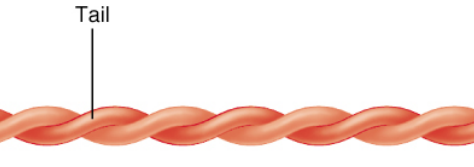
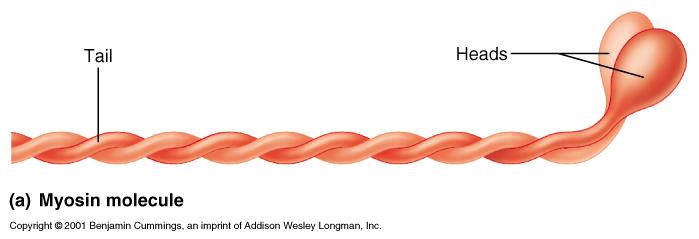
| back 11 Elongated portion of "golf club" found in the H zone. |
front 12 Myosin Head--*Most important part | back 12 a. Hinge region--A bendable neck region that attaches the head to the rod. Bending of the hinge region moves the head and is directly responsible for muscle contraction!-allows swinging
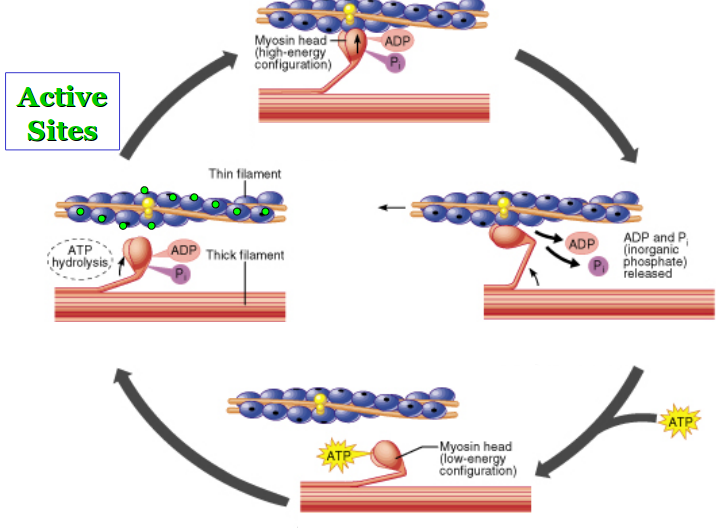
b. ATP-binding area/site--ATP or ENERGY must bind to the myosin head to allow it to move. |
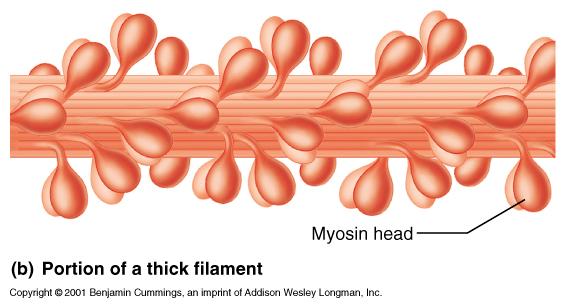
front 13 Myosin Filament in Detail | back 13 Each myosin filament is made up of 100's of golf-club shaped myosin proteins. Each myosin has two important parts:
1. Myosin Rod--Elongated portion of "golf club" found in the H zone.
2. Myosin Head--*Most important part
a. Hinge region--A bendable neck region that attaches the head to the rod. Bending of the hinge region moves the head and is directly responsible for muscle contraction!-allows swinging
b. ATP-binding area/site--ATP or ENERGY must bind to the myosin head to allow it to move. |
front 14 Skeletal Muscle Fibers Contract | |
| |
| back 16 The type of contractions that move your limbs and move your body around.
This contraction is explained by the Sliding Filament Theory of Contration, which says that: *Muscle contracts when the myosin heades pull on the actin filaments, causing them to slide inward, toward the center of the sarcomere.
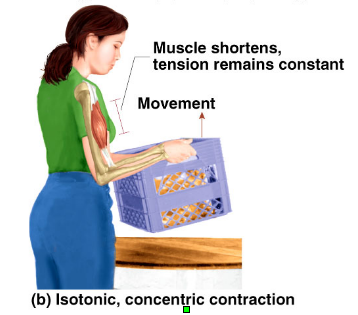
In this contraction, the muscle shortens as it contracts (due to the sliding of the actin filaments.)
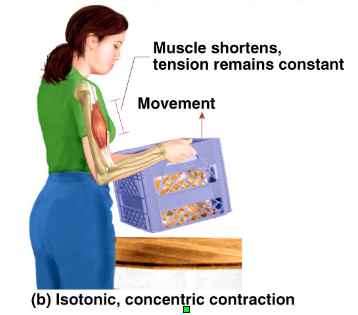
Isotonic means "same tension" because the tension in the muscle remains constant during the contraction. |
| back 17 a. Sequence of Events:
1) Myosin heads attach to actin filaments at the active sites.
2) Mysoin heads bend at hinge regions.
3) The movememt of the myosin heads pulls the actin filaments toward each other.
4) When fully contracted, the actin filaments on either side of the sarcomere overlap each other slightly.
b. Results in the Sarcomere:
1) Sacromere length shortens
2) H Zone disappears
3) I Band length shortens
4) A Band length remains the same |
front 18 Two Types of Isotonic Contractions | back 18 a. Concentric Contractions: Sliding of actin TOWARD the center of the sarcomere, shortening the sarcomere thus the muscle EX: Lifting a box
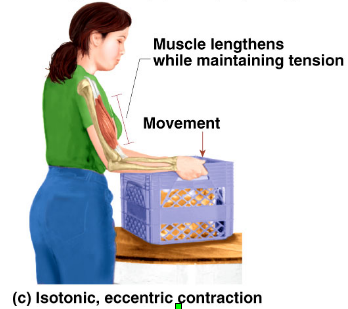
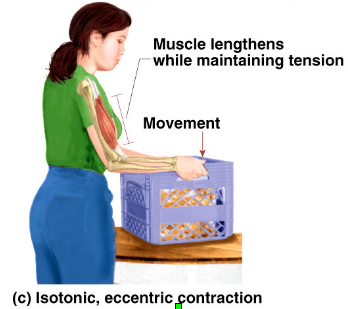
b. Eccentric Contractions: Sliding of actin AWAY from center of the sarcomere which lengthens the muscle to its original length (after a concentric contraction especially) EX: Putting box back down |
| back 19 Sliding of actin TOWARD the center of the sarcomere, shortening the sarcomere thus the muscle EX: Lifting a box |
| back 20 Sliding of actin AWAY from center of the sarcomere which lengthens the muscle to its original length (after a concentric contraction especially) EX: Putting box back down |
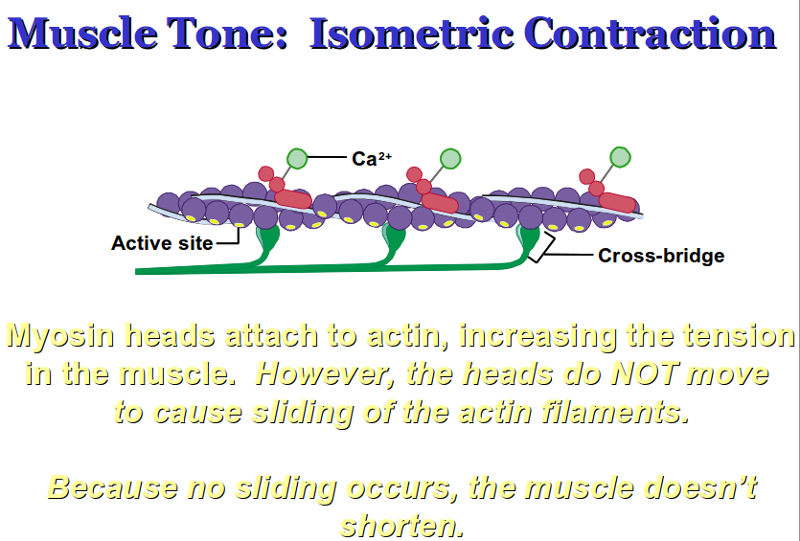
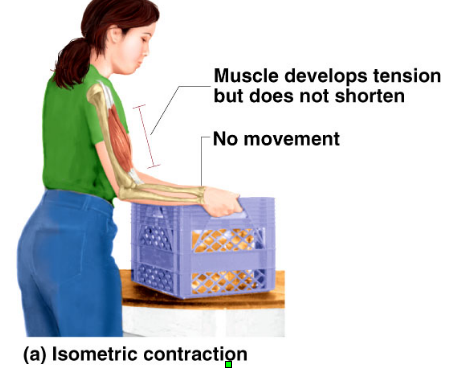
front 21 How Isometric is Different From Isotonic | back 21 a. In Isometric contractions, there is an increase in TENSION which is caused when…Myosin heads attach to actin
b. In Isometric contractions, the muscle doesn’t change in length, which means that… Actin does not slide.
c. Isometric means “same length”… No shortening or lengthening of muscle. |
| |
| back 23 a,These conractions do NOT move the limbs or body around.
b.These contractions are used in two Situations:
1) To stabilize joints/limbs after movement to hold them in position.
2) In postural muscles, to keep these muscles taunt so that:
i) Head is kept upright
ii) Back and abdomen are straight, flat
iii) Calf muscles are straight, flat
2. How Isometric is Different From Isotonic
a. In Isometric contractions, there is an increase in TENSION which is caused when…Myosin heads attach to actin
b. In Isometric contractions, the muscle doesn’t change in length, which means that… Actin does not slide.
c. Isometric means “same length”… No shortening or lengthening of muscle. |
front 24 General Characteristics of Skeletal Muscle Fibers | back 24 a. Appearance ---Very large, long, thin, may extend to a foot or more
b. Nuclei---Hundreds per cell
c. Striations/Stripes---Due to actin & myosin in the sarcomere
d. Contraction---Stimulated by nerves
e. Control---Conscious/voluntary
f. There are two types of skeletal muscles cells/fibers in muscles |
front 25 Slow Twitch Fibers "Dark Meat" | back 25 a. Thin fibers with little power; Have low sugar stores.
b. Contract slowly.
c. Designed to contract for long periods of time. Resistant to fatigue. Good for endurance sports like marathons and swimming.
d. Contain myoglobin, with makes them look dark red and which helps them turn food into energy well. (endurance) |
front 26 Fast Twitch Fibers "White Meat" | back 26 a. Thick fibers with powerful contractions; Have high sugar stores.
b. Contract quickly for speed.
c. Designed to contract for short periods of time.
Fatigue much more easily than slow twitch. Good for short bouts of exercise, as in sprinting, jumping, weight lifting.
*Especially concentrated in finger & eye muscles to give quick, darting movements
d. Lack myoglobin, causing them to be pale or whitish in color and causing them to not be as good at making energy(speed)
e. Intermediate Fibers
* Fast twitch fiber that has the endurance of a slow twitch
* intensive training can cause regular fast twitch to turn into this type |
front 27 CARDIAC MUSCLE---STRIATED INVOLUNTARY
General Characteristics of Muscle Fibers | back 27 a. Appearance---Intermediate length, thin, branched
b. Nuclei---One per cell
2. Specialization: Branched and connected via intercalated discs
-Intercalated discs allow the electrical current from nerves to pass directly from one fiber to another so that groups of fibers are stimulated simultaneously and therefore beat/contract in unison.
3. Action---Does not require stimulation from the nervous system. Instead, pacemaker cells stimulate
contraction.
*One type of smooth muscle is also controlled by pacemakers
4. Control---Unconscious/Involuntary |
front 28 SMOOTH MUSCLE---NONSTRIATED INVOLUNTARY
General Characteristics of Smooth Muscle Fibers | back 28 a. Appearance---Small, shorter, spindle-shaped cells
b. Nuclei---One per cell
c. Lack Striations because the actin and myosin filaments do not form sarcomeres
*Instead of sarcomeres, actin & myosin form a diagonal pattern or “on the bias” pattern.
2. Types of Smooth Muscle
a. Multiunit
*Multiunit: Small bundles of cells that contract independently of each other
1) Found in ciliary muscle and iris of eye, large air passageways-->*Bronchi eye(ciliary muscle:controls focusing of lens)-->Iris-->contractions of the muscle controls amount of light coming into eye.
2) Contractions initiated by nervous system
b. Visceral/Unitary
*Peristalsis: SM contractions in digestive & urinary organs that moves food (or urine)
*Visceral/Unitary:
Sheets of cells that contract simultaneously, as one unit |
front 29 Only Muscle Type Controlled by Hormones:Smooth Muscle | back 29 a. Many hormones affect blood flow and blood pressure:
1) Histamine—Causes vasodilation: blood vessel exppands, increasing blood flow
2) Angiotensin—Causes vasoconstriction: blood vessel gets smaller, decreasing blood flow
3) Adrenalin (Epinephrine)---Causes either vasodilation or vasoconstriction, depending upon location in body
b. Other hormone examples:
1) Gastrin: Juices in your stomach; cause contraction of the stomachfor digestion
2) Oxytocin: uterus contractions for labor |
front 30 Multiunit: Type of Smooth Muscle | back 30 *Multiunit: Small bundles of cells that contract independently of each other
1) Found in ciliary muscle and iris of eye, large air passageways-->*Bronchi eye(ciliary muscle:controls focusing of lens)-->Iris-->
contractions of the muscle controls amount of light coming into eye. |
front 31 Visceral/Unitary: Type of Smooth Muscle | back 31 *Visceral/Unitary:
Sheets of cells that contract simultaneously, as one unit
1) Found lining large blood vessels
*This smooth muscle is important in changing blood flow, controlling blood pressure.
2) Forms walls of many organs---digestive, urinary, reproductive tracts
*Peristalsis: SM contractions in digestive & urinary organs that moves food (or urine)
3) Contractions initiated by pacemaker cells (autorhythmic contractions) |
| back 32 Causes vasodilation: blood vessel exppands, increasing blood flow |
| back 33 Causes vasoconstriction: blood vessel gets smaller, decreasing blood flow |
| back 34 Causes either vasodilation or vasoconstriction, depending upon location in body |
| back 35 Juices in your stomach; cause contraction of the stomachfor digestion |
| back 36 uterus contractions for labor |
| back 37 1) Found lining large blood vessels
*This smooth muscle is important in changing blood flow, controlling blood pressur.
2) Forms walls of many organs---digestive, urinary, reproductive tracts
3) Contractions initiated by pacemaker cells
(autorhythmic contractions) |