Instructions for Side by Side Printing
- Print the notecards
- Fold each page in half along the solid vertical line
- Cut out the notecards by cutting along each horizontal dotted line
- Optional: Glue, tape or staple the ends of each notecard together
Lymphatic System Mastering
front 1 What is the main function of the lymphatic system? | back 1 The lymphatic system returns leaked fluid and plasma proteins that escape from the bloodstream back to the blood. |
front 2 Label the diagram: right lymphatic duct thoracic duct cisterna chyli collecting lymphatic vessels cervical nodes axillary nodes inguinal nodes | back 2 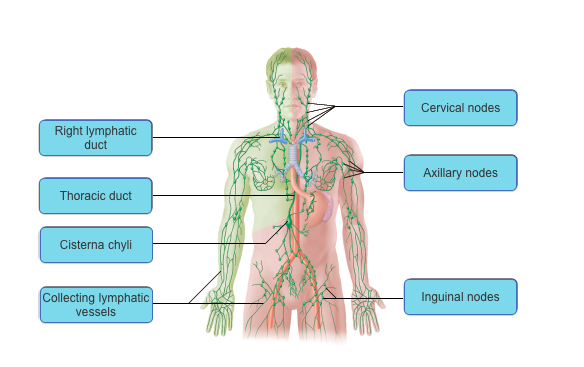 |
front 3 What is the origin of lymph fluid? | back 3 Lymph is excess fluid formed from plasma that accumulates in the tissues as interstitial fluid. |
front 4 once collected, where does lymph drain to? | back 4 the venous circulation |
front 5 Adjacent cells in lymphatic capillaries overlap each other loosely. What is the unique structural modification that increases their permeability? | back 5 mini valves (let fluid in but not out) |
front 6 What promotes closing of the mini valves accosted with lymph capillaries? | back 6 increasing pressure inside the lymph capillary. |
front 7 are lymphatic capillaries permeable to proteins? | back 7 yes |
front 8 does lymph travel to and from the heart? | back 8 no |
front 9 from what regions of the body is lymph drained into the right lymphatic duct? | back 9 the right upper limb, right side of the head and thorax. |
front 10 what are formed from the union of the largest collecting lymphatic vessels? | back 10 lymphatic trunks |
front 11 what is the name of the enlarged sac that the lumbar trunks and intestinal trunk return lymph to? | back 11 cisterna chyli |
front 12 where are the three large clusters of superficial lymph nodes? | back 12 the cervical region, axillary region, and inguinal region |
front 13 true or false? because lymph vessels are very low-pressure conduits, movements of adjacent tissues are important in propelling lymph through the lymphatics | back 13 true |
front 14 true or false? digested fats are absorbed from the intestine by the lymph capillaries | back 14 true |
front 15 true or false? lymphoid tissue is mainly reticular connective tissue | back 15 true |
front 16 which lymph cells produce antibodies? | back 16 plasma cells ( activated B cells) |
front 17 what is a role of lymph nodes | back 17 they filter lymph |
front 18 what region of the lymph node contains follicles filled with dividing b cells? | back 18 the cortex |
front 19 which lymphoid organ extracts aged and defective blood cells and platelets from the blood in addition to storing some of the breakdown products for later use? | back 19 the spleen |
front 20 which part of the spleen is the site of immune function? | back 20 white pulp (contains reticular fibers with lymphocytes which cleans the blood and are an important part of immunological surveillance and response) |
front 21 which lymphatic organ is organized with trabecular and compartments containing red and white pulp? | back 21 spleen |
front 22 payer's patches are mucosa-associated lymph tissue located where? | back 22 in the wall of the small intestine |
front 23 what is the function of bone marrow | back 23 form lymphocytes |
front 24 what is the function of the spleen | back 24 to remove red blood cells |
front 25 what is the function of the thymus | back 25 to mature t cells |
front 26 true or false? the thymus is the only lymphoid organ that does not directly fight antigens | back 26 true |
front 27 when is the thymus most active | back 27 childhood |
front 28 what is true about the thymus? | back 28 it functions strictly in t lymphocyte maturation it doesn't fight antigens directly its storm consists of epithelial tissue |
front 29 what is true about lymphocytes | back 29 b cells produce plasma cells, which secrete antibodies into the blood. |
front 30 primary lymphoid organ | back 30 thymus |
front 31 what lymphoid cell traps antigens and transport them to lymph nodes? | back 31 dendritic cells |
front 32 Which organ is not a secondary lymph organ? | back 32 thymus |