Instructions for Side by Side Printing
- Print the notecards
- Fold each page in half along the solid vertical line
- Cut out the notecards by cutting along each horizontal dotted line
- Optional: Glue, tape or staple the ends of each notecard together
Microbiology
front 1 is the study of microscopic organisms – a largely unseen world | back 1 Microbiology |
front 2 are organisms that are too small to be seen with the unaided eye | back 2 Microorganisms |
front 3 Microbes in Our Lives ,few are | back 3 pathogenic (disease-causing |
front 4 Microbes in Our Lives, they Decompose | back 4 organic waste |
front 5 Microbes in Our Lives, are producers in the ecosystem by | back 5 Are producers in the ecosystem by |
front 6 Microbes in Our Lives | back 6 photosynthesis |
front 7 Microbes in Our Lives,produce industrial chemicals such as | back 7 ethanol and acetone |
front 8 Microbes in Our Lives, produce fermented foods such as | back 8 vinegar, cheese, and bread |
front 9 Microbes in Our Lives, produce products used in manufacturing | back 9 e.g., cellulase) and treatment (e.g., insulin) |
front 10 There (3) classification of Microorganisms are | back 10 –Bacteria –Archaea –Eukarya
|
front 11 Ancestors of______were the first life on Earth | back 11 bacteria |
front 12 Oldest known fossils are of | back 12 stromatolites |
front 13 stromatolites are how old | back 13 –3.5 billion years old |
front 14 The first microbes, however, were only directly observed in | back 14 1673 |
front 15 Organism Nomenclature was established by | back 15 Carolus Linnaeus (1735) |
front 16 Each organism has unique _________species name. | back 16 two part genus |
front 17 Organism Nomenclature is usually written in | back 17
|
front 18 After first use in documents, you can | back 18
|
front 19 Name often describes organism | back 19
|
front 20 1673-1723: Anton van Leeuwenhoek described live | back 20 animalcules |
front 21 1665: Robert Hooke reported that living things were composed of | back 21 little boxes, or cells |
front 22 1858: Rudolf Virchow said cells arise from | back 22 preexisting cells |
front 23 Cell theory: All living things are composed of | back 23 cells and come from preexisting cells |
front 24 Spontaneous generation: The hypothesis that living organisms arise from nonliving | back 24 matter; a “vital force” forms life |
front 25 Biogenesis: The hypothesis that the living organisms arise from | back 25 preexisting life |
front 26 Pasteurization is the application of a | back 26 high heat for a short time |
front 27 1876: Robert Koch proved that a bacterium causes | back 27 anthrax |
front 28 Paul Erlich speculated about a | back 28 magic bullet” that could destroy a pathogen without harming the host |
front 29 Treatment with chemicals is | back 29 chemotherapy |
front 30 Chemotherapeutic agents used to treat infectious disease can be __________or antibiotics. | back 30 synthetic drugs |
front 31 _____________are chemicals produced by bacteria and fungi that inhibit or kill other microbes. | back 31 Antibiotics |
front 32 1928: Alexander Fleming discovered the_______. | back 32 first antibiotic |
front 33 Fleming observed that_______fungus made an antibiotic, penicillin, that killed S. aureus | back 33 Penicillium |
front 34 _______Penicillin was tested clinically and mass produced | back 34 1940s |
front 35 _______a new technique for biotechnology, enables bacteria and fungi to produce a variety of proteins including vaccines and enzymes | back 35 Recombinant DNA technology |
front 36 ___________infections are fatal in many insects but harmless to other animals, including humans, and to plants | back 36 Bacillus thuringiensis |
front 37 The signs of interaction between atoms and molecules is called | back 37 Chemistry |
front 38 Atoms are listed by their__________. | back 38 Atomic number |
front 39 The total number of protons and neutrons in an atom is the approximate_________. | back 39 Atomic weight |
front 40 There are___________ naturally occurring elements. | back 40 92 |
front 41 ___________Atoms with different numbers of neutrons in their nuclei. | back 41 Isotopes |
front 42 In an Adam electrons are arranged in__________. | back 42 Electron Shells |
front 43 Electron shells are region corresponding to different______________. | back 43 Energy levels |
front 44 Time it takes for one half of the atom in sample to decay | back 44 Half-life |
front 45 Atoms are mostly “empty” space – filled in by a cloud of | back 45 electrons |
front 46 Valence electrons are located in the | back 46 outermost shell of an atom |
front 47 Atoms with__________ shells can share or transfer valence electrons with certain other atoms | back 47 incomplete valence |
front 48 These interactions usually result in atoms staying close together, held by attractions called | back 48 chemical bonds |
front 49 __________are groups of atoms held together in a stable association | back 49 Molecules |
front 50 ______are molecules containing more than one type of element | back 50 Compound |
front 51 A ________ has characteristics different than those of its elements | back 51 compound |
front 52 Which bonds are stronger______ and _______. | back 52 Ionic and Covalent |
front 53 Which bond is weaker _____ and ______. | back 53 Hydrogen bond and Van der Waals. |
front 54 Compounds formed by ionic bonds are called_____. | back 54 ionic compounds, or salts |
front 55 ________form when two atoms share one or more pairs of electrons | back 55 Covalent bonds |
front 56
| back 56 nonpolar covalent bond, |
front 57 _________is an atom’s attraction for the electrons in a covalent bond | back 57 Electronegativity |
front 58 In a, _______one atom is more electronegative, | back 58 polar covalent bond |
front 59 ______are attractions between molecules that are close together as a result of these charges | back 59 Van der Waals interactions |
front 60 involve the making or breaking of bonds between atoms | back 60 Chemical reactions |
front 61 A change in ________occurs during a chemical reaction. | back 61 chemical energy |
front 62 ____________reactions absorb energy, | back 62 Endergonic |
front 63 _________reactions release energy | back 63 Exergonic |
front 64 Occur when atoms, ions, or molecules combine | back 64 Synthesis Reactions |
front 65 is the synthesis of molecules in a cell | back 65 Anabolism |
front 66 Occur when a molecule is split into smaller molecules, ions, or atoms | back 66 Decomposition Reactions |
front 67 is the decomposition reactions in a cell | back 67 Catabolism |
front 68
| back 68 Exchange Reactions |
front 69 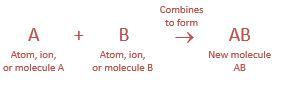 What type of reaction? | back 69 Synthesis Reactions |
front 70 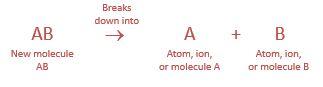 What type of reaction? | back 70 Decomposition Reactions |
front 71 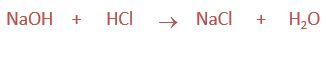 What type of reaction? | back 71 Exchange Reactions |
front 72
| back 72 Reversible Reactions |
front 73 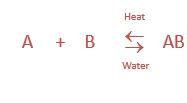 What type of reaction? | back 73 Reversible reaction |
front 74 In a ,_____ one atom is more electronegative, and the atoms do not share the electron equally | back 74 polar covalent bond |
front 75 _____is an excellent solvent | back 75 water |
front 76 Substance that resists changes in pH Act by –Releasing hydrogen ions when a base is added –Absorbing hydrogen ions when acid is added Overall effect of keeping [H+] relatively constant | back 76 Buffers |
front 77 Most _______ consist of a pair of molecules, one an acid and one a base | back 77 biological buffer |
front 78 Life molecules are mostly made up of_____ | back 78 carbon |