Print Options

Card layout: ?

← Back to notecard set|Easy Notecards home page

Instructions for Side by Side Printing
  1. Print the notecards
  2. Fold each page in half along the solid vertical line
  3. Cut out the notecards by cutting along each horizontal dotted line
  4. Optional: Glue, tape or staple the ends of each notecard together
  1. Verify Front of pages is selected for Viewing and print the front of the notecards
  2. Select Back of pages for Viewing and print the back of the notecards
    NOTE: Since the back of the pages are printed in reverse order (last page is printed first), keep the pages in the same order as they were after Step 1. Also, be sure to feed the pages in the same direction as you did in Step 1.
  3. Cut out the notecards by cutting along each horizontal and vertical dotted line
To print: Ctrl+PPrint as a list

104 notecards = 26 pages (4 cards per page)

Viewing:

A&P 2 Blood Vessels

front 1

  1. Why valves are present in veins but not in arteries?

back 1

  1. Arteries have strong pressure already and go with gravity while veins go against gravity and have low pressure.

front 2

  1. Name two events occurring within the body that aid in venous return?

back 2

  1. Skeletal Muscle contraction and valve opening and closing.

front 3

  1. The celiac artery provides blood to the?

back 3

  1. Liver, spleen and stomach

front 4

  1. Why are the walls of arteries proportionately thicker than those of the corresponding veins?

back 4

  1. They have high pressure

front 5

  1. How could you tell by simple observation whether bleeding is arterial or venous?

back 5

  1. Arterial if blood squirts out
  2. If blood seeps out

front 6

  1. The blood pressure in the large systemic arteries is greatest during_______?

back 6

  1. During Ventricular systole pressure

front 7

  1. Define blood pressure?

back 7

  1. The pressure exerted by blood on the wall of blood vessel

front 8

  1. Interpret 145/85?

back 8

  1. Has high blood pressure
  2. Ventricular contraction is 145 and ventricular relaxation is 70

front 9

  1. When renin is released from the juxtaglomerular cells angiotensinogen is converted into ___?

back 9

  1. Angiotensinogen is converted to Angiotensin I
  2. Angiotensin I is converted to Angiotensin II

front 10

  1. Define pulse pressure?

back 10

  1. The pressure wave that travels through arteries following left ventricular systole.

front 11

  1. How do venous pressures compare to arterial pressures? Why?

back 11

  1. Venous pressure is lower in pressure compared to arterial pressure.
  2. Reason: Veins are further away from pumping action of the heart.

front 12

  1. When venous pressure is too low, ____________ stimulate smooth muscles in the walls of veins to contract?

back 12

  1. Sympathetic reflexes

front 13

  1. What event causes the semilunar valves to open?

back 13

  1. Ventricular Contraction

front 14

  1. When are the AV valves closed?

back 14

  1. During ventricular systole

front 15

  1. The smallest arterial branch is called the?

back 15

  1. Arteriole

front 16

What event within the heart causes the AV valves to open?

back 16

  1. Ventricular Pressure
  2. When the ventricular pressure is lower than atrial pressure

front 17

Are both sets of valves closed during any part of the cycle? If so, when?

back 17

  1. yes, momentarily after atrial systole and ventricular systole

front 18

  1. Materials can move across capillary walls by what kind of transportation?

back 18

  1. Capillary Hydrostatic Pressure (CHP)

front 19

  1. Define pulse pressure? Why is this measurement important?

back 19

  1. The pressure wave that travels through arteries following left ventricular systole.
  2. Systolic pressure minus diastolic pressure.
    1. It indicates the actual working pressure
    2. Amount of blood forced out of the heart during systole

front 20

  1. At what point in the cardiac cycle is the pressure in the heart highest?

back 20

  1. Ventricular (systole) Contraction

front 21

  1. When measuring patient’s Blood pressure what factors may influence BP?

back 21

  • Age
  • Weight
  • Gender
  • Smoking
  • Dieght

front 22

What might an abnormal increase in venous pressure indicate? Why?

back 22

  1. Decreased Cardiac output
  2. Increased Blood Volume
  3. Muscle Contraction
  4. Venous Constriction

front 23

In which position (sitting, reclining, or standing) is the blood pressure normally the highest: Standing; Sitting, or Reclining?

back 23

Standing

front 24

  1. In which position (sitting, reclining, or standing) is the blood pressure normally the lowest: Standing; Sitting, or Reclining?

back 24

  1. Standing

front 25

  1. What effect do the following have on blood pressure (Indicate increase or decrease by)?increased diameter of the arterioles?
    • increased blood viscosity
    • increased cardiac output
    • hemorrhage
    • arteriosclerosis
    • increased pulse rate

back 25

  1. increased diameter of the arterioles?
    1. Decreases
  2. increased blood viscosity?
    1. Increases
  3. increased cardiac output?
    1. Increases
  4. hemorrhage?
    1. Decreases
  5. arteriosclerosis?
    1. Increases
  6. increased pulse rate?
    1. Increases

front 26

  1. Materials can move across capillary walls by what kind of transportation?

back 26

  1. Osmosis and diffusion

front 27

  1. As blood travels from the aorta toward the capillaries, the resistance _____?

back 27

low

front 28

  1. Trace the pathway of oxygen gas molecules from an alveolus of the lung to the right atrium of the heart. Name all structures through which it passes. Identify the areas of gas exchange by making it bold or different color font?

back 28

  1. Alveolus->Pulmonary vein->Left Atrium->Bicuspid Valve->Left Ventricle->Aortic Semilunar Valve-> Aorta->Aortic Trunk->systemic Arteries -> Arterioles -> Capillaries->Organs->Capillaries->Venules -> Veins->Inferior/Superior Vena Cava ->Right Atrium.

front 29

  1. Define the following terms: systole? diastole?

back 29

  1. Systole: Ventricle Contraction
  2. Diastole: Ventricle Relaxation

front 30

  1. Assume someone has been injured in an auto accident and is hemorrhaging badly. What pressure point would you compress: the thigh___ _____? the forearm ___ ____?, the thumb __ __?

back 30

  1. Thigh: Femoral
  2. Forearm: Brachial
  3. Thumb: Radial

front 31

If an individual’s heart rate is 80 beats/min, what is the length of the cardiac cycle?

back 31

75 sec

(80 beats/min)/60

front 32

Define pulse?

back 32

the pressure wave that travels through arteries following left ventricular systole.

front 33

  1. Identify the artery palpated at each of the pressure points listed: at the wrist_______; at the side of the neck ____; in front of the ear________?

back 33

  1. Wrist: Radial
  2. Side of Neck: Common Carotid
  3. Front of Ear: Temporal

front 34

  1. When you palpating the various pulse or pressure points, which appeared to have the greatest amplitude or tension (try this on yourself or a friend)? Why do you think this was so?

back 34

  1. The Carotid Artery
  2. Reason: Because its Closest to the Heart.

front 35

  1. Arterial systolic pressure is most closely associated with?

back 35

  1. Pulse
  2. Not to sure about this one.

front 36

Most arteries of the adult body carry oxygen-rich blood, and the veins carry oxygen-depleted, carbon dioxide–rich blood. How does this differ in the pulmonary arteries and veins?

back 36

  1. Pulmonary Arteries: Oxygen Poor to Lungs
  2. Pulmonary Veins: Oxygen Rich to Heart

front 37

How do the arteries of the pulmonary circulation differ structurally from the systemic arteries? What condition is indicated by this anatomical difference?

back 37

  • Arteries in the Pulmonary Circulation have thinner walls, they are more like Veins. This is because they have low pressure. While the arteries in the Systemic Circulation have thicker walls to handle the large amount of pressure.

front 38

  1. What is the source of blood in the hepatic portal system? Why is this blood carried to the liver before it enters the systemic circulation?

back 38

  1. The hepatic portal vein drains the digestive tract organs and carries this blood through the liver before it enters systemic circulation.
  2. As blood goes through the liver, some of the nutrients are stored or processed in various ways for release to the general circulation.

front 39

Heparin prevents blood clotting by inhibiting the formation of _______and the action of thrombin on fibrinogen?

back 39

Prothrombin activator.

front 40

The hepatic portal vein is formed by the union of (a) ________, which drains the _______, ______, ___greater curvature of the stomach, and distal large intestine via the inferior mesenteric vein and (b) superior mesenteric, which drains the _____and ______. The gastric vein, which drains the lesser curvature of the stomach, empties directly into the hepatic portal vein.

back 40

  1. Splenic Vein
  2. Spleen
  3. Pancreas
  4. Stomach
  5. Small intestine
  6. The Proximal Colon

front 41

Because net inward pressure in venular capillary ends is less than net outward pressure at the arteriolar ends of capillaries _______ fluid leaves the capillaries and ___fluid returns to the capillary?

back 41

  1. More
  2. Less

front 42

Trace the flow of a drop of blood from the small intestine to the right atrium of the heart, noting all structures encountered or passed through on the way?

back 42

  1. Small intestine -> Superior mesenteric Vein -> Hepatic portal Vein -> Inferior Vena cava -> right atrium.

front 43

What organ serves as a respiratory/digestive/excretory organ for the fetus?

back 43

Placenta

front 44

Blood flow through a capillary is regulated by the ______?

back 44

Precapillary sphincter

front 45

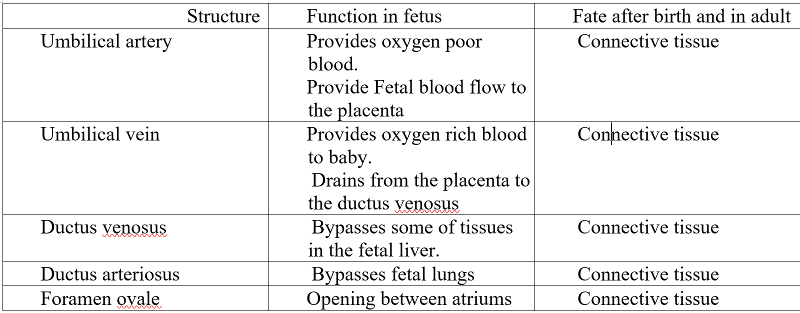
For each of the following structures, first indicate its function in the fetus; and then note its fate (what happens to it or what it is converted to after birth). Circle the blood vessel that carries the most oxygenrich blood.

  • Function in Fetus & Fate after Birth for the following.
    • Umbilical artery
    • Umbilical vein
    • Ductus venosus
    • Ductus arteriosus
    • Foramen ovale

back 45

front 46

  1. Which blood vessels are responsible for the exchange of gases and nutrients with tissues?

back 46

  1. Capillaries

front 47

Nutrients from the digestive tract enter the_____________ and delivered to the liver?

back 47

  1. Hepatic Portal Vein

front 48

  1. Which blood vessels conduct blood toward the heart, regardless of oxygen content?

back 48

  1. Veins

front 49

  1. Which blood vessel tunica is the most critical in regulating systemic blood pressure?

back 49

  1. Tunica Media

front 50

  1. Which blood vessels contains the majority of the body’s blood volume at any one time?

back 50

  1. Systemic Veins and venules

front 51

  1. Some of the least permeable capillaries are found in the ________, while some of the most permeable capillaries are found in the _________?

back 51

  1. Brain
  2. Bone Marrow

front 52

  1. What effect do the following have on blood pressure (Indicate increase or decrease by)?
    • increased diameter of the arterioles?
    • increased blood viscosity
    • increased cardiac output
    • hemorrhage
    • arteriosclerosis
    • increased pulse rate

back 52

  1. increased diameter of the arterioles?
    1. Decreases
  2. increased blood viscosity?
    1. Increases
  3. increased cardiac output?
    1. Increases
  4. hemorrhage?
    1. Decreases
  5. arteriosclerosis?
    1. Increases
  6. increased pulse rate?
    1. Increases

front 53

Heart rate in a fetus is about ____, in a newborn about _____, and in an adult about ___?

back 53

  1. 145
  2. 140
  3. 70

front 54

What effect does a long period of skeletal muscle inactivity have on blood flow?

back 54

Hypotension, Blood through the veins is inadequate causing Blood Pooling

front 55

  1. Predict what might happen to peripheral resistance in arterioles supplying skeletal muscle when pH levels drop?

back 55

  1. Vasodilation in vessels supplying skeletal muscle

front 56

List the vessels that blood passes through from the heart and back to the heart?

back 56

Elastic artery -> Muscular Artery-> Arteriole-> Continuous Capillary->Fenestrated CapillaryàVenule ->Medium-sized Vein->Large Vein

front 57

Baroreceptors detect changes in __________?

back 57

Blood Pressure in aorta and carotid arteries

front 58

If baroreceptors are primed to detect blood pressure changes and compensate for them, how is it that some patients suffer from chronic hypertension?

back 58

The baroreceptors in these patients have a new higher set point.

front 59

Which blood vessel supplies blood to parts of the intestinal tract?

back 59

Superior mesenteric artery

front 60

When blood levels of sodium are increased, which hormones would you expect to increase?

back 60

  • Atrial natriuretic peptide (ANP)
    • Produced with High Blood Pressure.

front 61

Why does blood velocity decrease as it flows into a capillary bed?

back 61

The cross-sectional area of the capillary beds is approximately 2000× than that of the aorta.

front 62

The vessel (great veins) that receives blood from the head, neck, chest, shoulders, and arms and bring it to the heart is the ______?

back 62

Superior Vena Cava

front 63

A decrease in O2 level in skeletal muscle would initiate an autoregulatory mechanism that would stimulate _________ in the arterioles supplying the muscle?

back 63

Vasodilation

front 64

Why is vasodilation prominent in the skin when a person increases physical activity?

back 64

Heat is dissipated across the skin from the blood to help cool the body

front 65

The primary mechanism driving filtration in capillary beds is ______?

back 65

Hydrostatic pressure within the capillaries

front 66

Which type of blood vessel holds the greatest volume of blood?

back 66

Vein

front 67

Capillary colloid osmotic pressure created by _________ tends to _______?

back 67

Non diffusible plasma proteins; draw fluids into the capillary

front 68

What role do the lymphatic vessels have when it comes to fluid movements across capillary beds?

back 68

  1. lymphatic vessels reclaim fluid from the tissue spaces that doesn't get returned to the blood

front 69

Blood is returned to the heart via which blood vessels?

back 69

Superior/Inferior Vena Cava coronary sinus

front 70

Blood drained from digestive organs empties into the ______ before going through the liver?

back 70

Hepatic portal vein

front 71

The major vessel delivering deoxygenated blood to the lungs is the ______?

back 71

Pulmonary Arteries

front 72

How many branches does the aortic arch give rise to?

back 72

  1. Three
    1. Brachiocevalic
    2. Left common carotid
    3. Left subclavian

front 73

What effect does a long period of skeletal muscle inactivity have on blood flow?

back 73

Blood through the veins is inadequate causing Blood Pooling

front 74

The smallest blood vessels in our body is?

back 74

Capillaries

front 75

The muscular layer (tunica) of blood vessels is?

back 75

Tunica Media

front 76

  1. Venules unite to form ________?

back 76

  1. Veins

front 77

  1. In which blood vessels, valve is found?

back 77

  1. Veins

front 78

List types of capillaries?

back 78

  1. Continuous capillaries
    1. Have complete lining
    2. Supply most region of body
    3. Can be found in all tissues except epithelial and cartilage
  2. Fenestrated Capillaries
    1. Contain windows (pores) that span endothelial lining
    2. Permit rapid exchange of large solutes as large as peptide
    3. Flattened fenestrated capillaries = sinusoids

front 79

The exchange between blood vessels and cells occurs in which blood vessels?

back 79

  1. Capillaries

front 80

Which blood vessels also serve as a blood reservoir?

back 80

Veins

front 81

If you have a blood pressure of 120/80 mmHg, what is your diastolic pressure? what is your systolic pressure?

back 81

  1. Systolic Pressure: 120
  2. Diastolic Pressure: 80 mmHg

front 82

  1. In which position (sitting, reclining, or standing) is the blood pressure normally the lowest: Standing; Sitting, or Reclining?

back 82

  1. Reclining

front 83

  1. An increase in peripheral resistance would increase or decrease blood pressure?

back 83

  1. Increase

front 84

  1. Materials can move across capillary walls by what kind of transportation?

back 84

Osmosis Diffusion

front 85

  1. When smooth muscles in the walls of the veins are stimulated to contract what happens to blood pressure?

back 85

  1. Increases

front 86

  1. The renin-angiotensin mechanism stimulates the release of which hormone?

back 86

  1. Angiotensin I -> Angiotensin I is converted into Angiotensin II at the lungs -> Angiotensin II stimulates Release of Antidiuretic Hormone.

front 87

The first portion of the aorta is called the ________?

back 87

Ascending Aorta

front 88

80% of the cerebrum is supplied with blood by which major artery?

back 88

Internal Carotid Artery

front 89

Which of the following helps force fluids out of the blood into the tissues?

back 89

Capillary Hydrostatic Pressure (CHP)

front 90

Diffusion occurs between blood and interstitial fluid in which vessels?

back 90

Capillaries

front 91

Georgia stands all day at her job. What condition may she develop and suffer as a result?

back 91

Varicose veins

front 92

While standing in the hot sun, Sally begins to feel light-headed and faints. Why?

back 92

Blood pooled in her lower limbs which decreased venous return to heart. In turn. Cardiac output decreased so less blood reached her brain. Also blood volume drops due to fluid loss from sweating.

front 93

Why does most filtration take place at the arterial end of a capillary?

back 93

Capillary Hydrostatic Pressure (CHP) is higher at the arterial end.

front 94

Why are valves located in veins, but not in arteries?

back 94

Veins have less pressure which will cause backflow thus needs valves so the blood doesn’t go back. Arteries have high pressure and go with gravity.

front 95

During increased exercise, venous return increases or decreases? why?

back 95

Increase because skeletal muscles increase Venus return through contraction

front 96

The hepatic portal system delivers _____?

back 96

Nutrient filled Blood to the liver

front 97

In fetal circulation, what is the role of the ductus venosus?

back 97

Collects blood from veins of the liver and empties into the inferior vena cava

front 98

Grace is in an automobile accident, and her celiac trunk is ruptured. Which organs are directly affected by this injury?

back 98

Stomach, Spleen, liver and Pancreas

front 99

Blood from the face and scalp is drained by the?

back 99

External jugular vein

front 100

Which is a unique characteristic of arteries, when compared to veins?

back 100

  1. Its elasticity
  2. Arteries contain an internal elastic membrane in their tunica interna.

front 101

Are both sets of valves closed during any part of the cycle? If so, when?

back 101

  1. yes, iosvolumetric ventricular

front 102

ADH, angiotensin II, EPO, and ANP are all involved in long-term regulation of blood volume. Which two are also important in regulating blood pressure?

back 102

Angiotensin II and ADH

front 103

Use the key provided to describe each tunic by selecting its characteristics from the key:

Key:

  1. innermost tunic
  2. most superficial tunic
  3. thin tunic of capillaries
  4. especially thick in elastic arteries
  5. contains smooth muscle and elastin
  6. has a smooth surface to decrease resistance to blood flow.

back 103

  1. Tunica intima?
    1. Innermost tunic
    2. Thin Tunic of Capillaries.
  2. Tunica media?
    1. Especially Thick in elastic arteries
    2. Contains smooth Muscle and elastin
  3. Tunica externa?
    1. Most Superficial Tunic
    2. Has a smooth surface to decrease resistance to blood flow.

front 104

Cross-sectional views of an artery and of a vein are shown here. Identify each; and on the lines to the sides, note the structural details that enabled you to make these identifications?

Key:

  1. vein
  2. artery
  3. somewhat collapsed lumen
  4. thick tunica media
  5. open
  6. circular lumen
  7. thinner tunica media

back 104

  1. Artery
    1. Thick Tunica media
    2. Circular Lumen
  2. Vein
    1. Somewhat collapsed lumen
    2. Thinner Tunica Media