Instructions for Side by Side Printing
- Print the notecards
- Fold each page in half along the solid vertical line
- Cut out the notecards by cutting along each horizontal dotted line
- Optional: Glue, tape or staple the ends of each notecard together
Nutrition Festival 8
front 1 The primary function of carbohydrates is energy production within cells. True | back 1 True |
front 2 Gluconeogenesis is the process in which ________. -glycogen is formed | back 2 glucose is formed from noncarbohydrate precursers |
front 3 Which of the choices below describes the pathway of cellular respiration (the complete oxidation of glucose)? -lipolysis, glycogenolysis, beta oxidation | back 3 glycolysis, Krebs cycle, electron transport chain, oxidative phosphorylation (good, kids, eat, orange popsicles) |
front 4 Which of the following is a water-soluble vitamin? -vitamin K | back 4 vitamin B |
front 5 What is the primary function of cellular respiration - its end-purpose? -to metabolize nutrients | back 5 to generate ATP |
front 6 Which of the following nutrients yield the highest amount of energy per gram when metabolized? -fats | back 6 fats |
front 7 The most abundant dietary lipids are ________. -phospholipids | back 7 triglycerides |
front 8 Which term describes the breakdown of stored fats into glycerol and fatty acids? -ketogenesis | back 8 lipolysis |
front 9 __________ is a substance in food used by the body to promote normal growth, maintenance, and repair. -A nutrient | back 9 A nutrient |
front 10 In order for amino acids to be oxidized for energy, the amine group (NH2) must be removed. True | back 10 True |
front 11 __________ refers to reactions in which large molecules are broken down into smaller molecules. -Anabolism | back 11 Catabolism |
front 12 As the body progresses from the absorptive to the postabsorptive state, only the ________ continues to burn glucose while every other organ in the body mostly switches to fatty acids. -pancreas | back 12 brain |
front 13 Which of the following food groups are considered good sources of complete proteins? -eggs, milk, yogurt, meat, and fish | back 13 eggs, milk, yogurt, meat and fish |
front 14 Cellular respiration is an anabolic process. True | back 14 false |
front 15 Which of the following would decrease body temperature? -eating a large meal | back 15 dilation of cutaneous blood vessels |
front 16 The increased use of noncarbohydrate molecules for energy to conserve glucose is called glucose sparing. True | back 16 true |
front 17 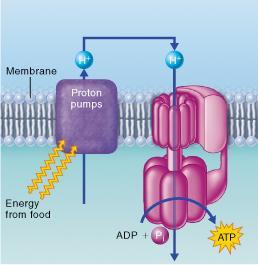 Which of the following is represented by the "membrane" indicated in the figure? -nuclear membrane | back 17 inner mitochondrial membrane |
front 18 Which of the following is a characteristic of the electron transport chain (ETC)? The electron transport chain is an anaerobic pathway. | back 18 The ETC occurs in the mitochondria. |
front 19 Cholesterol, though it is not an energy molecule, has importance in the body because it ________. -is a stabilizing component of the plasma membranes and is the
parent molecule of steroid hormones | back 19 is a stabilizing component of the plasma membranes and is the parent molecule of steroid hormones |
front 20 Glycogen is formed in the liver during the ________. -starvation period | back 20 absorptive state |
front 21 The preferred energy fuel for the brain is fat. True | back 21 false |
front 22 The "proton pumps" indicated in the figure are physically associated with ______. -the Krebs cycle | back 22 the electron transport chain |
front 23 Except for lactose and some glycogen, the carbohydrates we ingest are mainly from animals. True | back 23 False |
front 24 Which nutrients function as coenzymes and are needed in only small amounts? -electrolytes | back 24 vitamins |
front 25 Neurons and red blood cells rely exclusively on __________ to meet their energy needs. -glycerol | back 25 glucose |
front 26 The movement of H+ through the ATP synthase is best described as an example of_______? -facilitated diffusion -simple diffusion -active transport -hydrolysis | back 26 facilitate diffusion |
front 27 Oxygen is consumed during which of the lettered processes? | back 27 c |
front 28 Which of the following events is NOT depicted in the figure? | back 28 transfer of electrons and hydrogen atoms from a food molecule to a coenzyme |
front 29 Proton pumps within the electron transport chain transport H+ ions ______. | back 29 from the marix to the intermembrane space |
front 30 Which of the following is NOT an end product of the kreb cycle? -CO2 -FADH2 -NADH -citric acid | back 30 citric acid |
front 31 Most ATP in cellular respiration is generated in glycolysis true false | back 31 false |
front 32 The body is able to form glucose from non-carbohydrate precursors.The body is able to form glucose from non-carbohydrate precursors. | back 32 true |
front 33 The molecule that serves as the major source of readily available fuel for neurons and blood cells is ________. glucose acetyl CoA protein fat | back 33 glucose |
front 34 It is important to ensure that your diet is adequately rich in vitamins because ________. -most vitamins are coenzymes needed to help the body utilize essential nutrients -vitamins provide protection against the common cold -all vitamins are water soluble and pass out of the body too quickly to ensure utilization -very few foods contain vitamins | back 34 most vitamins are coenzymes needed to help the body utilize essential nutrients |
front 35 Prostaglandins play a role in ________. -skeletal muscle contraction -control of blood volume -control of blood pressure -non-inflammatory responses | back 35 control of blood pressure |
front 36 Select the correct statement about proteins. -Catabolic steroids (hormones) accelerate the rate of protein synthesis. -Strict vegetarians need not worry about adequate protein intake, as most vegetables are almost perfect sources of amino acids. -Proteins can be synthesized in the body if most of the amino acids are present. -Proteins will be used by most cells for ATP synthesis if insufficient carbohydrates are ingested. | back 36 Proteins will be used by most cells for ATP synthesis if insufficient carbohydrates are ingested. |
front 37 The term essential nutrient refers to the chemicals that can be interconverted in the liver so that the body can maintain life and good health. true false | back 37 false |
front 38 The most abundant dietary lipids in the diets of most Americans are triglycerides. true false | back 38 true |
front 39 Ammonia, which is a byproduct of protein metabolism, is converted to __________ primarily in the __________. urea; kidney ketones; liver ketones; kidney urea; liver | back 39 urea, liver |
front 40 The primary goal during the postabsorptive state is to __________. maintain blood glucose levels within an adequate range build fat reserves form glycogen break down glucose in the liver | back 40 maintain blood glucose levels within an adequate range |
front 41 The process of breaking triglycerides down into glycerol and fatty acids is known as ________. fat utilization lipogenesis lipolysis gluconeogenesis | back 41 lipolysis |
front 42 When ketone bodies are present in the blood and urine in large amounts, it usually indicates increased metabolism of ________. glycogen lactic acid fatty acids amino acids | back 42 fatty acids |