Instructions for Side by Side Printing
- Print the notecards
- Fold each page in half along the solid vertical line
- Cut out the notecards by cutting along each horizontal dotted line
- Optional: Glue, tape or staple the ends of each notecard together
Bio 102 Final Exam #'s 200-219
front 1 200) The necropsy (postmortem analysis) of a freshwater fish that died after being placed accidentally in saltwater would likely show that ____ A. high amounts of salt had diffused into the fish's cells, causing them to swell and lyse B. loss of water by osmosis from cells in vital organs resulted in cell death and organ failure C. the kidneys were not able to keep up with the water removal necessary in this hyperosmotic environment, creating an irrevocable loss of homeostasis D. the gills became encrusted with salt, resulting in inadequate gas exchange and a resulting asphyxiation | back 1 B |
front 2 201) Which of the following animals generally has the lowest volume of urine production? A. salmon in fresh water B. a marine bony fish C. shark inhabiting the Mississippi River D. a vampire bat | back 2 B |
front 3 202) One of the waste products that accumulate during the cellular functions is carbon dioxide. It is removed via the respiratory system. What is another waste product that accumulates during normal physiological functions in vertebrates? I. ammonia II. uric acid III. urea A. I, II, and III B. only II and III C. only I and II D. only I and III | back 3 A |
front 4 203) Urea is produced in the _____ A. bladder from uric acid and water B. liver from glycogen C. kidneys from glycerol and fatty acids D. liver from NH3 and carbon dioxide | back 4 D |
front 5 204) Urea is ____ A. the primary nitrogenous waste product of most birds B. the primary nitrogenous waste product of most aquatic invertebrates C. insoluble in water D. the primary nitrogenous waste product of humans | back 5 D |
front 6 205) Which nitrogenous waste has the greatest number of nitrogen atoms? A. uric acid B. ammonium ions C. urea D. ammonia | back 6 A |
front 7 206) Ammonia is likely to be the primary nitrogenous waste in living conditions that include ____ A. a moist system of burrows, such as those of naked mole rats B. a terrestrial environment, such as that supporting crickets C. lots of seawater, such as a bird living in a marine environment D. lots of fresh water flowing across the gills of a fish | back 7 D |
front 8 207) Excessive formation of uric acid crystals in humans leads to ____ A. a condition of insatiable thirst and excessive urine formation B. gout, a painful inflammatory disease that primarily affects the joints C. a condition called diabetes, where excessive urine formation occurs D. osteoarthritis, an inevitable consequence of aging | back 8 B |
front 9 208) Ammonia ______ A. is the major nitrogenous waste excreted by insects B. is metabolically more expensive to synthesize than urea C. has low toxicity relative to urea D. is soluble in water | back 9 D |
front 10 209) The advantage of excreting nitrogenous wastes as urea rather than as ammonia is that _____ A. urea is less toxic than ammonia B. urea does not affect the osmolar gradient C. less nitrogen is removed from the body D. urea can be exchanged for Na+ | back 10 A |
front 11 210) In animals, nitrogenous wastes are produced mostly from the catabolism of _____ A. phospholipids and glycolipids B. triglycerides and steroids C. starch and cellulose D. proteins and nucleic acids | back 11 D |
front 12 211) Birds secrete uric acid as their nitrogenous waste because uric acid A) is readily soluble in water. B) is metabolically less expensive to synthesize than other excretory products. C) requires little water for nitrogenous waste disposal, thus reducing body mass. D) excretion allows birds to live in desert environments. | back 12 C |
front 13 212) Among the following choices, the most concentrated urine is excreted by ____ A. frogs B. kangaroo rats C. freshwater bass D. humans | back 13 B |
front 14 213) African lungfish, which are often found in small stagnant pools of fresh water, produce urea as a nitrogenous waste. What is the advantage of this adaptation? A) Small stagnant pools do not provide enough water to dilute the toxic ammonia. B) Urea takes less energy to synthesize than ammonia. C) The highly toxic urea makes the pool uninhabitable to potential competitors. D) Urea makes lungfish tissue hypoosmotic to the pool. | back 14 A |
front 15 214) Which of the following most accurately describes selective
permeability? | back 15 D |
front 16 215) Through studies of insect Malpighian tubules, researchers found that K+accumulated on the inner face of the tubule, against its concentration gradient. What can you infer about the mechanism of transport? A) Potassium transport is a passive process. B) Movement of potassium into the lumen of the Malpighian tubules is an energy-requiring process. C) Potassium moves out of the tubules at a faster rate than it moves into the lumen of the tubules. D) Sodium ions will follow potassium ions | back 16 B |
front 17 216) A potassium ion gradient is set up in insect Malpighian tubules through an active transport process. As a result,potassium concentration is higher in the lumen of the tubules than in hemolymph.How would the potassium gradient affect water movement? A) Water would be forced out of the lumen of the Malpighian tubules through an osmotic gradient. B) The potassium gradient would have no effect on water movement. C) There would be a net movement of water into the lumen of the tubules. D) Water would be conserved, forming a hypertonic solution in the Malpighian tubules | back 17 C |
front 18 217) Why are the renal artery and vein critical to the process of osmoregulation in vertebrates? A. The renal artery and vein are the main pathways regulating how much is produced by the kidneys B. the kidneys require constant and abnormally high oxygen supply to function C. the renal artery delivers blood with nitrogenous waste to the kidney and the renal vein brings blood with less nitrogenous wastes away from the kidneys D. The kidneys require higher than normal levels of hormones | back 18 C |
front 19 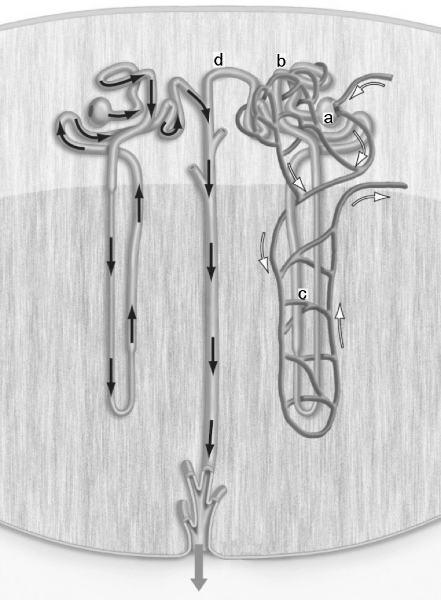 218) The figure above shows a nephron. Filtration takes place in the structure labeled _____. A) a B) b C) c D) d | back 19 A |
front 20 219) The osmoregulatory/excretory system of a freshwater flatworm is
based on the operation of | back 20 A |