Instructions for Side by Side Printing
- Print the notecards
- Fold each page in half along the solid vertical line
- Cut out the notecards by cutting along each horizontal dotted line
- Optional: Glue, tape or staple the ends of each notecard together
Chapter 35: plant anatomy
front 1 Root hairs are important to a plant because they _____. protect the plant from freezing protect the plant from soil microbes help the root slide between soil particles increase the surface area for absorption develop into lateral roots | back 1 increase the surface area for absorption |
front 2 How do cells in a meristem differ from cells in other types of plant tissue? They are growing. They photosynthesize at a faster rate. They are differentiating. They store food. They continue to divide. | back 2 They continue to divide. |
front 3 The primary growth of a plant adds _____ and secondary growth adds _____. height ... branching branching ... flowers branching ... girth height ... girth girth ... height | back 3 height ... girth |
front 4 Choose the option that best describes the relationship between the cell wall thickness of parenchyma cells versus sclerenchyma cells. The cell walls of parenchyma cells are thinner than those of sclerenchyma cells. The thickness of the cell walls for both types of cells is too variable for a comparison to be made. The cell walls of collenchyma cells are thicker than sclerenchyma or parenchyma cells. The cell walls of both types of cells are roughly equal. The cell walls of parenchyma cells are thicker than those of sclerenchyma cells. | back 4 The cell walls of parenchyma cells are thinner than those of sclerenchyma cells. |
front 5 Which structure is incorrectly paired with its tissue system? tracheid–vascular tissue palisade parenchyma–ground tissue companion cell–ground tissue guard cell–dermal tissue root hair–dermal tissue | back 5 companion cell–ground tissue |
front 6 Which of the following is derived from the ground tissue system? cuticle phloem pith periderm root hair | back 6 pith |
front 7 Which part of a plant absorbs most of the water and minerals taken up from the soil? the thick parts of the roots near the base of the stem sections of the root that have secondary xylem root hairs storage roots root cap | back 7 root hairs |
front 8 Vascular plant tissue includes all of the following cell types except cambium cells. companion cells. sieve cells. tracheids. vessel elements. | back 8 cambium cells. |
front 9 ________ is to xylem as ________ is to phloem. Vessel element; sieve-tube member Sclerenchyma cell; collenchyma cell Cortex; pith Vascular cambium; cork cambium Apical meristem; vascular cambium | back 9 Vessel element; sieve-tube member |
front 10 Which of the following cells transport sugars over long distances? sclerenchyma cells collenchyma cells sieve-tube elements parenchyma cells tracheids and vessel elements | back 10 sieve-tube elements |
front 11 Which of the following have unevenly thickened primary walls that support young, growing parts of the plant? tracheids and vessel elements sclerenchyma cells sieve-tube elements parenchyma cells collenchyma cells | back 11 collenchyma cells |
front 12 The vascular bundle in the shape of a single central cylinder in a root is called the endodermis. cortex. periderm. stele. pith. | back 12 stele. |
front 13 One important difference between the anatomy of roots and the anatomy of leaves is that leaves have epidermal tissue but roots do not. a waxy cuticle covers leaves but is absent from roots. only leaves have phloem and only roots have xylem. root cells have cell walls and leaf cells do not. vascular tissue is found in roots but is absent from leaves. | back 13 a waxy cuticle covers leaves but is absent from roots. |
front 14 A student examining leaf cross sections under a microscope finds many loosely packed cells with relatively thin cell walls. The cells have numerous chloroplasts. What type of cells are they? xylem sclerenchyma endodermis collenchyma parenchyma | back 14 parenchyma |
front 15 CO2 enters the inner spaces of the leaf through the cuticle. epidermal trichomes. phloem. stoma. walls of guard cells. | back 15 stoma. |
front 16 Gas exchange, which is necessary for photosynthesis, can occur most easily in which leaf tissue? palisade mesophyll vascular tissue bundle sheath epidermis spongy mesophyll | back 16 spongy mesophyll |
front 17 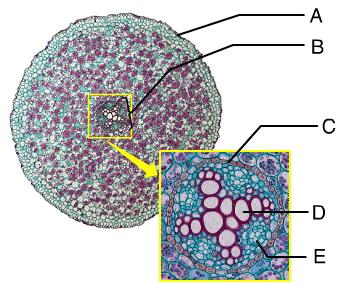 Xylem is indicated by the letter _____. A D E B C | back 17 D |
front 18 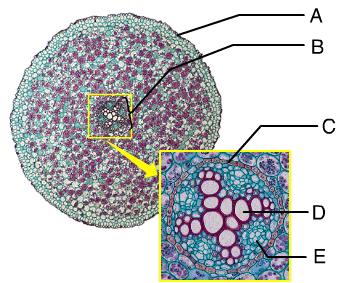 The letter A indicates the _____. epidermis xylem vascular cylinder cortex endodermis | back 18 epidermis |
front 19 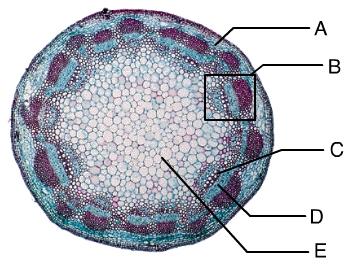 The letter A indicates the _____. phloem cortex pith xylem vascular bundle | back 19 cortex |
front 20  Pith is indicated by the letter _____. E B C A D | back 20 E |
front 21 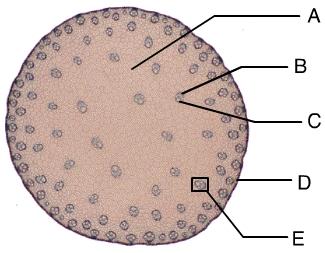 Ground tissue is indicated by the letter _____. D E A C B | back 21 A |
front 22 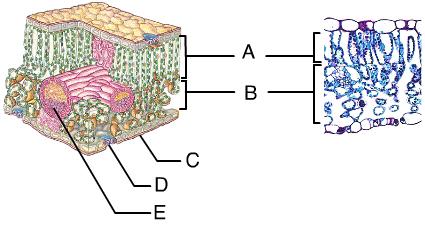 The region surrounded by guard cells is indicated by the letter _____. D C A B E | back 22 D |
front 23 Plants contain meristems whose major function is to produce more cells. produce flowers. absorb ions. photosynthesize. attract pollinators. | back 23 produce more cells. |
front 24 Axillary buds do not form a vascular connection with the primary shoot. are composed of a series of internodes lacking nodes. grow immediately into shoot branches. have dormant meristematic cells. are initiated by the cork cambium. | back 24 have dormant meristematic cells. |
front 25 The following question is based on parts of a growing primary root. A) III, V, I, II, IV B) II, IV, I, V, III C) IV, II, III, I, V D) I, II, V, III, IV E) I, V, III, II, IV | back 25 E |
front 26 Which of the following root tissues gives rise to lateral roots? A) epidermis B) cortex C) endodermis D) phloem E) pericycle | back 26 E |
front 27 Pores on the leaf surface that function in gas exchange are called A hairs. B xylem cells. C stomata. D phloem cells. E sclereids. | back 27 C |
front 28 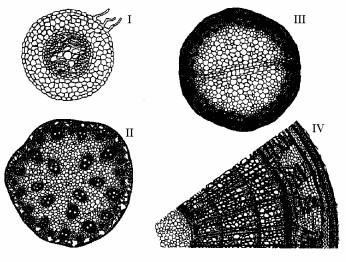 The following question is based on the drawing of root or stem cross
sections shown in the figure. I only. II only. III only. IV only. both I and III. | back 28 IV only. |
front 29 Secondary growth NEVER occurs in _____. stems leaves roots and leaves stems and leaves roots | back 29 leaves |
front 30 _____ provides cells for secondary growth. Secondary xylem Secondary phloem Apical meristem The root Vascular cambium | back 30 Vascular cambium |
front 31 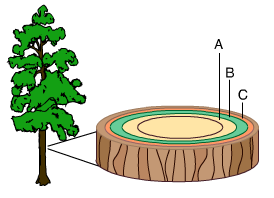 The letter A indicates _____. secondary xylem cork cambium lateral meristem vascular cambium apical meristem | back 31 secondary xylem |
front 32 Vascular cambium forms wood toward the stem's _____ and secondary phloem toward the stem's _____. top ... bottom surface ... center center ... surface center ... center surface ... surface | back 32 center ... surface |
front 33 What is the function of cork? regulating the opening and closing of stomata providing a site for photosynthesis providing cells for primary growth insulation and waterproofing providing cells for secondary growth | back 33 insulation and waterproofing |
front 34 How is the supply of vascular cambium maintained? by the differentiation of secondary xylem by the differentiation of secondary phloem by the division of its cells by the differentiation of cork by the differentiation of apical meristem | back 34 by the division of its cells |
front 35 Cell division in the vascular cambium adds to the girth of a tree by adding new _____ to the layer's interior and _____ to the layer's exterior. xylem and phloem ... bark pith ... xylem and phloem xylem ... cortex xylem ... phloem phloem ... xylem | back 35 xylem ... phloem |
front 36 As the epidermis is pushed outward and sloughed off, it is replaced by tissues produced by the _____. cork cambium lenticels suberin vascular cambium pith | back 36 cork cambium |
front 37 Which of the following cells or tissues arise from lateral meristem activity? cortex trichomes leaves secondary xylem tubers | back 37 secondary xylem |
front 38 A plant has the following characteristics: a taproot system, several growth rings evident in a cross section of the stem, and a layer of bark around the outside. Which of the following best describes the plant? woody monocot herbaceous eudicot woody eudicot herbaceous monocot woody annual | back 38 woody eudicot |
front 39 Which of the following is a true statement? Secondary growth is produced by both the vascular cambium and the cork cambium. Primary growth and secondary growth alternate in the life cycle of a plant. Flowers may have secondary growth. Secondary growth is a common feature of eudicot leaves. Plants with secondary growth are typically the smallest ones in an ecosystem. | back 39 Secondary growth is produced by both the vascular cambium and the cork cambium. |
front 40 What tissue makes up most of the wood of a tree? primary xylem vascular cambium mesophyll cells secondary xylem secondary phloem | back 40 secondary xylem |
front 41 If you were able to walk into an opening cut into the center of a large redwood tree, when you exit from the middle of the trunk (stem) outward, you would cross, in order, A) the annual rings, new xylem, vascular cambium, phloem, and bark. B) the vascular cambium, oldest xylem, and newest xylem. C) the secondary xylem, cork cambium, phloem, and periderm. D) the secondary xylem, secondary phloem, and vascular cambium. E) the summer wood, bark, and phloem. | back 41 A |
front 42 Which of the following is correctly matched with its tissue system? cortex ... ground tissue system xylem ... ground tissue system phloem ... epidermis pith ... vascular tissue system guard cells ... ground tissue | back 42 cortex ... ground tissue system |
front 43 What is the primary function of stems? Facilitation of gas exchange Water absorption and movement Reproduction Maximization of photosynthesis by leaves | back 43 Maximization of photosynthesis by leaves |
front 44 One important difference between the anatomy of roots and the anatomy of leaves is that _____. only leaves have phloem and only roots have xylem a waxy cuticle covers leaves but is absent from roots root cells have cell walls and leaf cells do not vascular tissue is found in roots but is absent from leaves leaves have epidermal tissue but roots do not | back 44 a waxy cuticle covers leaves but is absent from roots |
front 45 Trichomes _____. open and close for gas exchange increase water loss from leaves repel or trap insects absorb sunlight, increasing the temperature of leaves | back 45 repel or trap insects |
front 46 Which of the following is correctly paired with its structure and function? guard cells – waterproof ring of cells surrounding the central stele in roots sclerenchyma – supporting cells with thick secondary walls ground meristem – protective coat of woody stems and roots periderm – parenchyma cells functioning in photosynthesis in leaves | back 46 sclerenchyma – supporting cells with thick secondary walls |
front 47 Which of the following are water-conducting cells that are dead at functional maturity? parenchyma cells tracheids and vessel elements sieve-tube elements collenchyma cells | back 47 tracheids and vessel elements |
front 48 Which of the following cells transport sugars over long distances? parenchyma cells sclerenchyma cells sieve-tube elements tracheids and vessel elements | back 48 sieve-tube elements |
front 49 Plant meristematic cells _____. subdivide into three distinct cell types named parenchyma, ground meristem, and procambium are undifferentiated cells that produce new cells increase the surface area of dermal tissue by developing root hairs are distributed evenly in all tissues throughout the plan | back 49 are undifferentiated cells that produce new cells |
front 50 Which of the following cells or tissues arise from lateral meristem activity? secondary xylem tubers trichomes leaves | back 50 secondary xylem |
front 51 Which of the following is the correct sequence of the zones in the primary growth of a root, moving from the root cap inward? zone of cell division, zone of elongation, zone of differentiation zone of differentiation, zone of elongation, zone of cell division zone of elongation, zone of cell division, zone of differentiation zone of cell division, zone of differentiation, zone of elongation | back 51 zone of cell division, zone of elongation, zone of differentiation |
front 52 You find a plant unfamiliar to you and observe that it has vascular bundles scattered throughout the stem cross section. What do you conclude about the plant? It will probably get annual rings of wood. It is probably an herbaceous eudicot. It could be either a young eudicot or a monocot. It is probably a monocot. | back 52 It is probably a monocot. |
front 53 The veins of leaves are _____. only I only II only III I, II, and III | back 53 I, II, and III |
front 54 Where is primary growth occurring in an old tree? Nowhere; trees more than a year old have only secondary growth. in young branches where leaves are forming where the vascular cambium and cork cambium are located closest to ground level at the base of the tree | back 54 in young branches where leaves are forming |
front 55 What tissue makes up most of the wood of a tree? secondary xylem vascular cambium primary xylem secondary phloem | back 55 secondary xylem |