Print Options

Card layout: ?

← Back to notecard set|Easy Notecards home page

Instructions for Side by Side Printing
  1. Print the notecards
  2. Fold each page in half along the solid vertical line
  3. Cut out the notecards by cutting along each horizontal dotted line
  4. Optional: Glue, tape or staple the ends of each notecard together
  1. Verify Front of pages is selected for Viewing and print the front of the notecards
  2. Select Back of pages for Viewing and print the back of the notecards
    NOTE: Since the back of the pages are printed in reverse order (last page is printed first), keep the pages in the same order as they were after Step 1. Also, be sure to feed the pages in the same direction as you did in Step 1.
  3. Cut out the notecards by cutting along each horizontal and vertical dotted line
To print: Ctrl+PPrint as a list

54 notecards = 14 pages (4 cards per page)

Viewing:

AP Biology Chapter 38

front 1

The male wasp Campsoscolia ciliata transfers pollen from one orchid to another orchid of the
same species. What ʺrewardʺ does the male wasp receive from the orchid plants for helping
with the orchid pollination?
A) a supply of energy-rich nectar
B) volatile chemical hormones that help the male wasp find a sexually receptive female
C) There is no reward. The male wasp is deceived by the flower shape and odor
D) successful copulation with the flower
E) a store of nectar that the wasp can use in time of famine

back 1

C

front 2

For this pair of items, choose the option that best describes their relationship.
(A) The number of cells within the embryo sac
(B) The number of nuclei within the embryo sac
A) Item (A) is greater than item (B).
B) Item (A) is less than item (B).
C) Item (A) is exactly or very approximately equal to item (B).
D) Item (A) may stand in more than one of the above relations to item (B).

back 2

B

front 3

For this pair of items, choose the option that best describes their relationship.
(A) The ploidy of the angiosperm seed endosperm
(B) The ploidy of the angiosperm seed embryo
A) Item (A) is greater than item (B).
B) Item (A) is less than item (B).
C) Item (A) is exactly or very approximately equal to item (B).
D) Item (A) may stand in more than one of the above relations to item (B).

back 3

A

front 4

For this pair of items, choose the option that best describes their relationship.
(A) The percentage of dandelion plants that produce seeds by apomixis.
(B) The percentage of creosote bushes that produce seeds by apomixis
A) Item (A) is greater than item (B).
B) Item (A) is less than item (B).
C) Item (A) is exactly or very approximately equal to item (B).
D) Item (A) may stand in more than one of the above relations to item (B)

back 4

A

front 5

For this pair of items, choose the option that best describes their relationship.
(A) The GABA levels in pop2 mutant Arabidopsis flowers
(B) The GABA levels in wild-type Arabidopsis flowers
A) Item (A) is greater than item (B).
B) Item (A) is less than item (B).
C) Item (A) is exactly or very approximately equal to item (B).
D) Item (A) may stand in more than one of the above relations to item (B)

back 5

A

front 6

For this pair of items, choose the option that best describes their relationship.
(A) The amount of fumonisin in processed maize products
(B) The amount of fumonisin in processed Bt maize products
A) Item (A) is greater than item (B).
B) Item (A) is less than item (B).
C) Item (A) is exactly or very approximately equal to item (B).
D) Item (A) may stand in more than one of the above relations to item (B)

back 6

B

front 7

At the conclusion of meiosis in plants the end products are always four haploid
A) spores.
B) eggs.
C) sperm.
D) seeds.
E) gametes.

back 7

A

front 8

) Which of the following is the correct sequence during the alternation of generations life
cycle in a flowering plant?
A) sporophyte-meiosis-gametophyte-gametes-fertilization-diploid zygote
B) sporophyte-mitosis-gametophyte-meiosis-sporophyte
C) haploid gametophyte-gametes-meiosis-fertilization-diploid sporophyte
D) sporophyte-spores-meiosis-gametophyte-gametes
E) haploid sporophyte-spores-fertilization-diploid gametophyte

back 8

A

front 9

Which of the following is true in plants?
A) Mitosis occurs in gametophytes to produce gametes.
B) Meiosis occurs in sporophytes to produce spores.
C) The gametophyte is within the flower in angiosperms.
D) A and B only
E) A, B, and C

back 9

E

front 10

) Which of the following are true of most angiosperms?
A) a triploid endosperm within the seed
B) an ovary that becomes a fruit
C) a small (reduced) sporophyte
D) A and B only
E) A, B, and C

back 10

D

front 11

Based on studies of plant evolution, which flower part is not a modified leaf?
A) stamen
B) carpel
C) petals
D) sepals
E) receptacle

back 11

E

front 12

All of the following floral parts are directly involved in pollination or fertilization except the
A) stamen.
B) carpel.
C) petals.
D) sepals.
E) receptacle.

back 12

D

front 13

Location of the ovary:
A) stamen
B) carpel
C) petals
D) sepals
E) receptacle

back 13

B

front 14

Location of the microsporangia:
A) stamen
B) carpel
C) petals
D) sepals
E) receptacle

back 14

A

front 15

) Which of the following is the correct order of floral organs from the outside to the inside of a
complete flower?
A) petals-sepals-stamens-carpels
B) sepals-stamens-petals-carpels
C) spores-gametes-zygote-embryo
D) sepals-petals-stamens-carpels
E) male gametophyte-female gametophyte-sepals-petals

back 15

D

front 16

In some angiosperms, other floral parts contribute to what is commonly called the fruit.
Which of the following fruits is derived mostly from an enlarged receptacle?
A) pea
B) raspberry
C) apple
D) pineapple
E) peach

back 16

C

front 17

All of the following are primary functions of flowers except
A) pollen production.
B) photosynthesis.
C) meiosis.
D) egg production.
E) sexual reproduction.

back 17

B

front 18

) Meiosis occurs within all of the following flower parts except the
A) ovule.
B) style.
C) megasporangium.
D) anther.
E) ovary.

back 18

B

front 19

A perfect flower is fertile, but may be either complete or incomplete. Which of the following
correctly describes a perfect flower?
A) It has no sepals.
B) It has fused carpels.
C) It is on a dioecious plant.
D) It has no endosperm.
E) It has both stamens and carpels

back 19

E

front 20

Carpellate flowers
A) are perfect.
B) are complete.
C) produce pollen.
D) are found only on dioecious plants.
E) develop into fruits.

back 20

E

front 21

Which of the following statements regarding flowering plants is false?
A) The sporophyte is the dominant generation.
B) Female gametophytes develop from megaspores within the anthers.
C) Pollination is the placing of pollen on the stigma of a carpel.
D) The food-storing endosperm is derived from the cell that contains two polar nuclei
and one sperm nucleus.
E) Flowers produce fruits within the ovul

back 21

B

front 22

Which of the following types of plants is not able to self-pollinate?
A) dioecious
B) monoecious
C) complete
D) wind-pollinated
E) insect-pollinated

back 22

A

front 23

) In flowering plants, pollen is released from the
A) anther.
B) stigma.
C) carpel.
D) filament.
E) pollen tube.

back 23

A

front 24

In the life cycle of an angiosperm, which of the following stages is diploid?
A) megaspore
B) generative nucleus of a pollen grain
C) polar nuclei of the embryo sac
D) microsporocyte
E) both megaspore and polar nuclei

back 24

D

front 25

Where does meiosis occur in flowering plants?
A) megasporocyte
B) microsporocyte
C) endosperm
D) pollen tube
E) megasporocyte and microsporocyte

back 25

E

front 26

Which of the following is a correct sequence of processes that takes place when a flowering
plant reproduces?
A) meiosis-fertilization-ovulation-germination
B) fertilization-meiosis-nuclear fusion-formation of embryo and endosperm
C) meiosis-pollination-nuclear fusion-formation of embryo and endosperm
D) growth of pollen tube-pollination-germination-fertilization
E) meiosis-mitosis-nuclear fusion-pollen

back 26

C

front 27

Which of these is incorrectly paired with its life-cycle generation?
A) anthergametophyte
B) pollengametophyte
C) embryo sacgametophyte
D) stamensporophyte
E) embryosporophyte

back 27

A

front 28

Which of the following is the correct sequence of events in a pollen sac?
A) sporangiameiosistwo haploid cellsmeiosistwo pollen grains per cell
B) pollen grainmeiosistwo generative cellstwo tube cells per pollen grain
C) two haploid cellsmeiosisgenerative cell-tube cellfertilizationpollen grain
D) pollen grainmitosismicrosporesmeiosisgenerative cell plus tube cell
E) microsporocytemeiosismicrosporesmitosistwo haploid cells per pollen grain

back 28

E

front 29

Which of the following occurs in an angiosperm ovule?
A) An antheridium forms from the megasporophyte.
B) A megaspore mother cell undergoes meiosis.
C) The egg nucleus is usually diploid.
D) A pollen tube emerges to accept pollen after pollination.
E) The endosperm surrounds the megaspore mother cell.

back 29

B

front 30

Where and by which process are sperm cells formed in plants?
A) meiosis in pollen grains
B) meiosis in anthers
C) mitosis in male gametophyte pollen tube.
D) mitosis in the micropyle
E) mitosis in the embryo sac

back 30

C

front 31

In which of the following pairs are the two terms equivalent?
A) ovuleegg
B) embryo sacfemale gametophyte
C) endospermmale gametophyte
D) seedzygote
E) microsporepollen grain

back 31

B

front 32

Which of the following is the male gametophyte of a flowering plant?
A) ovule
B) microsporocyte
C) pollen grain
D) embryo sac
E) stamen

back 32

C

front 33

33) Which of the following would be considered to be a multiple fruit?
A) apple
B) strawberry
C) raspberry
D) pineapple
E) corn on the cob

back 33

D

front 34

In flowering plants, a mature male gametophyte contains
A) two haploid gametes and a diploid pollen grain.
B) a generative cell and a tube cell.
C) two sperm nuclei and one tube cell nucleus.
D) two haploid microspores.
E) a haploid nucleus and a diploid pollen wall.

back 34

C

front 35

Three mitotic divisions within the female gametophyte of the megaspore produce
A) three antipodal cells, two polar nuclei, one egg, and two synergids.
B) the triple fusion nucleus.
C) three pollen grains.
D) two antipodal cells, two polar nuclei, two eggs, and two synergids.
E) a tube nucleus, a generative cell, and a sperm cell.

back 35

A

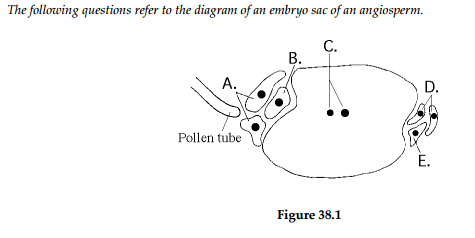
front 36

Which cell(s), after fertilization, give(s) rise to the embryo plant?

back 36

B

front 37

Which cell(s) become(s) the triploid endosperm?

back 37

C

front 38

Which cell(s) guide(s) the pollen tube to the egg cell?

back 38

A

front 39

What is the difference between pollination and fertilization in flowering plants?
A) Fertilization precedes pollination.
B) Pollination easily occurs between plants of different species, fertilization is within a
species.
C) Pollen is formed within megasporangia so that male and female gametes are near
each other.
D) Pollination is the transfer of pollen from an anther to a stigma. Fertilization is the
fusion of haploid nuclei
E) If fertilization occurs, pollination is unnecessary.

back 39

D

front 40

Recent research has shown that pollination requires that carpels recognize pollen grains as
ʺself or nonself.ʺ For self-incompatibility, the system requires
A) rejection of nonself cells.
B) the rejection of self cells.
C) carpel incompatibility with the egg cells.
D) that the flowers be incomplete.
E) the union of genetically identical sperm and egg cells.

back 40

B

front 41

) Genetic incompatibility does not affect the
A) attraction of a suitable insect pollinator.
B) germination of the pollen on the stigma.
C) growth of the pollen tube in the style.
D) membrane permeability of cells.
E) different individuals of the same species.

back 41

A

front 42

You are studying a plant from the Amazon that shows strong self-incompatibility. To
characterize this reproductive mechanism, you would look for
A) ribonuclease (RNAase) activity in stigma cells.
B) RNA in the plants.
C) pollen grains with very thick walls.
D) carpels that cannot produce eggs by meiosis.
E) systems of wind, but not insect, pollination.

back 42

A

front 43

What effects would occur in a mutant of Arabidopsis that cannot synthesize GABA within its
flowers?
A) Pollen tube growth would not be directed toward the egg, and fertilization would not
occur.
B) The seeds from the flowers would be unable to break dormancy.
C) The pollen grain would not form a pollen tube due to incompatibility with the pollen
tube.
D) The length of the style would be increased to the point where the growing pollen tube
would be unable to reach the synergids.

back 43

A

front 44

Biofuels are mainly produced by
A) the breakdown of cell wall biopolymers into sugars that can be fermented.
B) plants that convert hemicellulose into gasoline.
C) the genetic engineering of ethanol generating genes into plants.
D) transgenic crops that have cell walls containing ethylene.
E) plants that are easy to grow in arid environments.

back 44

A

front 45

A plant that has small, green petals is most likely to be
A) bee-pollinated.
B) bird-pollinated.
C) bat-pollinated.
D) wind-pollinated.
E) moth-pollinated.

back 45

D

front 46

A seed develops from
A) an ovum.
B) a pollen grain.
C) an ovule.
D) an ovary.
E) an embryo.

back 46

C

front 47

A fruit is a(an)
A) mature ovary.
B) mature ovule.
C) seed plus its integuments.
D) fused carpel.
E) enlarged embryo sac.

back 47

A

front 48

Double fertilization means that
A) flowers must be pollinated twice in order to produce fruits and seeds.
B) every egg must receive two sperm to produce an embryo.
C) one sperm is needed to fertilize the egg, and a second sperm is needed to fertilize the
polar nuclei.
D) the egg of the embryo sac is diploid.
E) every sperm has two nuclei.

back 48

C

front 49

Some dioecious species have the XY genotype for male and XX for female. After double
fertilization, what would be the genotypes of the endosperm nuclei and embryos?
A) embryo X and endosperm XX or embryo Y and endosperm XY
B) embryo XX and endosperm XX or embryo XY and endosperm XY
C) embryo XX and endosperm XXX or embryo XY and endosperm XYY
D) embryo XX and endosperm XXX or embryo XY and endosperm XXY
E) embryo XY and endosperm XXX or embryo XX and endosperm XXY

back 49

D

front 50

Sources of genetic variability in an asexually propagated species may involve all of the
following processes except
A) protoplast fusion.
B) mutation.
C) hybridization.
D) genetic engineering.
E) apomixis.

back 50

C

front 51

Plant biotechnologists use protoplast fusion mainly to
A) culture plant cells in vitro.
B) asexually propagate desirable plant varieties.
C) introduce bacterial genes into a plant genome.
D) study the early events following fertilization.
E) produce new hybrid species.

back 51

E

front 52

The basal cell formed from the first division of a plant zygote will eventually develop into
A) the suspensor that anchors the embryo and transfers nutrients.
B) the proembryo.
C) the endosperm that nourishes the developing embryo.
D) the root apex of the embryo.
E) two cotyledons in eudicots, but one in monocots.

back 52

A

front 53

) The development of Bt crops raises concerns because
A) Bt crops have been shown to be toxic to humans.
B) pollen from these crops is harmful to monarch butterfly larvae in the field.
C) if genes for Bt toxin ʺescapeʺ to related weed species, the hybrid weeds could have
harmful ecological effects.
D) Bacillus thuringiensis is a pathogen of humans.
E) Bt toxin reduces the nutritional quality of crops.

back 53

C

front 54

ʺGolden Riceʺ is a transgenic variety that
A) is resistant to various herbicides, making it practical to weed rice fields with those
herbicides.
B) is resistant to a virus that commonly attacks rice fields.
C) includes bacterial genes that produce a toxin that reduces damage from insect pests.
D) produces much larger, golden grains that increase crop yields.
E) contains daffodil genes that increase vitamin A content.

back 54

E