Instructions for Side by Side Printing
- Print the notecards
- Fold each page in half along the solid vertical line
- Cut out the notecards by cutting along each horizontal dotted line
- Optional: Glue, tape or staple the ends of each notecard together
Campbell Biology Chapter 38 Key Terms
front 1  sepals | back 1 A modified leaf in angiosperms that helps enclose and protect a flower bud before it opens. |
front 2 petals | back 2 A modified leaf of a flowering plant. Petals are the often colorful parts of a flower that advertise it to insects and other pollinators. |
front 3 stamens | back 3 The pollen-producing reproductive organ of a flower, consisting of an anther and a filament. |
front 4 carpels | back 4 The ovule-producing reproductive organ of a flower, consisting of the stigma, style, and ovary. |
front 5 receptacle | back 5 The base of a flower; the part of the stem that is the site of attachment of the floral organs. |
front 6 anther | back 6 In an angiosperm, the terminal pollen sac of a stamen, where pollen grains containing sperm-producing male gametophytes form. |
front 7 ovary | back 7 In flowers, the portion of a carpel in which the egg-containing ovules develop. |
front 8 style | back 8 The stalk of a flower’s carpel, with the ovary at the base and the stigma at the top. |
front 9 stigma | back 9 The sticky part of a flower’s carpel, which receives pollen grains. |
front 10 ovules | back 10 A structure that develops within the ovary of a seed plant and contains the female gametophyte. |
front 11 pistil | back 11 A single carpel or a group of fused carpels. |
front 12 complete flowers | back 12 A flower that has all four basic floral organs: sepals, petals, stamens, and carpels. |
front 13 incomplete flowers | back 13 A flower in which one or more of the four basic floral organs (sepals, petals, stamens, or carpels) are either absent or nonfunctional. |
front 14 .svg/240px-Dreifachdolde_(inflorescence).svg.png) inflorescences | back 14 A group of flowers tightly clustered together. |
front 15 microspores | back 15 A spore from a heterosporous plant species that develops into a male gametophyte. |
front 16 pollen grain | back 16 In seed plants, a structure consisting of the male gametophyte enclosed within a pollen wall. |
front 17 pollen tube | back 17 A tube that forms after germination of the pollen grain and that functions in the delivery of sperm to the ovule. |
front 18 embryo sac | back 18 The female gametophyte of angiosperms, formed from the growth and division of the megaspore into a multicellular structure that typically has eight haploid nuclei. |
front 19 megaspores | back 19 A spore from a heterosporous plant species that develops into a female gametophyte. |
front 20 pollination | back 20 The transfer of pollen to the part of a seed plant containing the ovules, a process required for fertilization. |
front 21 coevolution | back 21 The joint evolution of two interacting species, each in response to selection imposed by the other. |
front 22  endosperm | back 22 In angiosperms, a nutrient-rich tissue formed by the union of a sperm with two polar nuclei during double fertilization. The endosperm provides nourishment to the developing embryo in angiosperm seeds. |
front 23  double fertilization | back 23 A mechanism of fertilization in angiosperms in which two sperm cells unite with two cells in the female gametophyte (embryo sac) to form the zygote and endosperm. |
front 24 dormancy | back 24 A condition typified by extremely low metabolic rate and a suspension of growth and development. |
front 25  seed coat | back 25 A tough outer covering of a seed, formed from the outer coat of an ovule. In a flowering plant, the seed coat encloses and protects the embryo and endosperm. |
front 26 hypocotyl | back 26 In an angiosperm embryo, the embryonic axis below the point of attachment of the cotyledon(s) and above the radicle. |
front 27 radicle | back 27 An embryonic root of a plant. |
front 28 epicotyl | back 28 In an angiosperm embryo, the embryonic axis above the point of attachment of the cotyledon(s) and below the first pair of miniature leaves. |
front 29  coleoptile | back 29 The covering of the young shoot of the embryo of a grass seed. |
front 30 coleorhiza | back 30 The covering of the young root of the embryo of a grass seed. |
front 31 imbibition | back 31 The physical adsorption of water onto the internal surfaces of structures. |
front 32 fruit | back 32 A mature ovary of a flower. The fruit protects dormant seeds and often aids in their dispersal. |
front 33 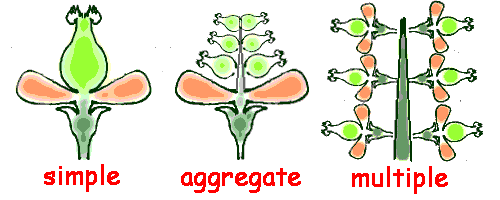 simple fruits | back 33 A fruit derived from a single carpel or several fused carpels. |
front 34 aggregate fruit | back 34 A fruit derived from a single flower that has more than one carpel. |
front 35 multiple fruit | back 35 A fruit derived from an entire inflorescence. |
front 36 accessory fruit | back 36 A fruit, or assemblage of fruits, in which the fleshy parts are derived largely or entirely from tissues other than the ovary. |
front 37 fragmentation | back 37 A means of asexual reproduction whereby a single parent breaks into parts that regenerate into whole new individuals. |
front 38 apomixis | back 38 The ability of some plant species to reproduce asexually through seeds without fertilization by a male gamete. |
front 39 vegetative reproduction | back 39 Cloning of plants by asexual means. |
front 40 dioecious | back 40 In plant biology, having the male and female reproductive parts on different individuals of the same species. |
front 41 self-incompatability | back 41 The ability of a seed plant to reject its own pollen and sometimes the pollen of closely related individuals. |
front 42 callus | back 42 A mass of dividing, undifferentiated cells growing in culture. |
front 43 stock | back 43 The plant that provides the root system when making a graft. |
front 44 scion | back 44 The twig grafted onto the stock when making a graft. |
front 45 transgenic | back 45 Pertaining to an organism whose genome contains a gene introduced from another organism of the same or a different species. |
front 46 protoplast fusion | back 46 The fusing of two protoplasts from different plant species that would otherwise be reproductively incompatible. |
front 47 biofuels | back 47 A fuel produced from dry organic matter or combustible oils produced by plants. |