Instructions for Side by Side Printing
- Print the notecards
- Fold each page in half along the solid vertical line
- Cut out the notecards by cutting along each horizontal dotted line
- Optional: Glue, tape or staple the ends of each notecard together
lower extremity
front 1 lhow many facets make up the subtakar joint | back 1 three |
front 2 another term for osteochondroma is | back 2 exostosis |
front 3 what is one advantage of the lateromedial projection of the foot? | back 3 the foot assumes a more true lateral position |
front 4 to properly visualize the joint spaces with the AP projection of the foot, the CR must be: | back 4 perpendicular to the metatarsals |
front 5 situation: a patient enters radiology with a possible ligament tear to the lateral aspect of the ankle. initial ankle radiographs are negative for fracture or dislocation. because the clinic is ina rural setting, the patient cant have an MRI performed to evaluate the ligaments of the ankle. Which of the following techniques may provide an assessment of the soft-tissue structures of the ankle? | back 5 AP stress projections |
front 6 where would the interphalangeal joint be in the foot? | back 6 between the phalanges of the first digit |
front 7 what is the major disadvantage of using 45 degrees of flexion for the lateral projection of the knee? | back 7 draws the patella into the intercondylar sulcus |
front 8 which term describes the top or anterior surface of the foot? | back 8 dorsum |
front 9 a correctly positioned AP 45-degree medial oblique ankle projection frequently may also demonstrate a fracture of the base of the 5th metatarsal if present | back 9 true |
front 10 situatuion: a patient enters the ED with an injury near the base of the first and second metatarsals. the basic foot projections are inconclusive on demonstrating a fracture to the medial cuneiform. Which of the following projections would best demonstrate this bone? | back 10 AP oblique with lateral rotation |
front 11 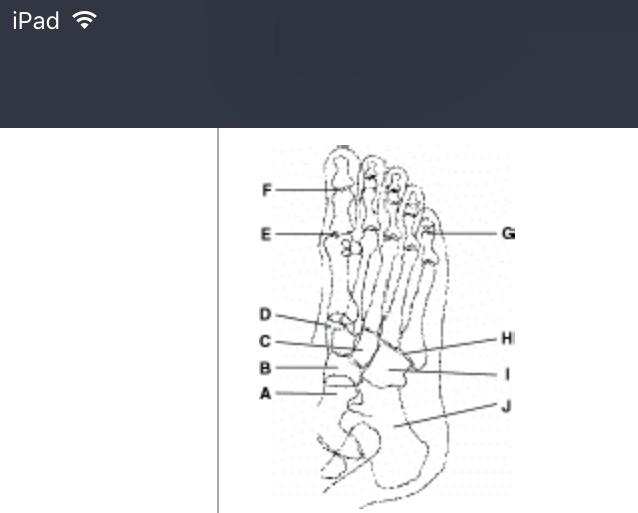 (picture) which of these labeled structures or bones identifies the navicular? | back 11 b |
front 12 situation: a patient comes to the radiology department for a knee study with special interest in the region of the proximal tibiofibular joint and the lateral condyle of the tibia. Which of the following positioning routines should the technologist obtain? | back 12 AP,lateral,and medial oblique knee |
front 13 to reduce scatter radiation during tabletop procedures, the bucky tray should not be positioned directly under the lower limb being radiographed | back 13 true |
front 14 where is the CR placed for a mediolateral projection of the calcaneus? | back 14 1 inch distal to the medial malleolus |
front 15 a radiograph of a lateral projection of the patella reveals that the femoropatellar joint space isnt open. the patella is superimposed over the distal femur. The most likely cause of this is: | back 15 excessive flexion of the knee |
front 16 the foot must be force dorsiflexed so the long axis of the foot is perpendicular to the image receptor for AP and mortise projections of the ankle. | back 16 false |
front 17 what CR angle should be used for a lateral projection of the knee on a short, wide-pelvis patient? | back 17 7-10 degrees cephalad |
front 18 how much rotation from an AP of the ankle will typically produce a mortise view? | back 18 15-20 degrees |
front 19 a correctly positioned lateral ankle will demonstrate the lateral malleolus superimposed over the posterior half of the tibia. | back 19 true |
front 20 another term for the intercondylar sulcus is the: | back 20 patellar surface |
front 21 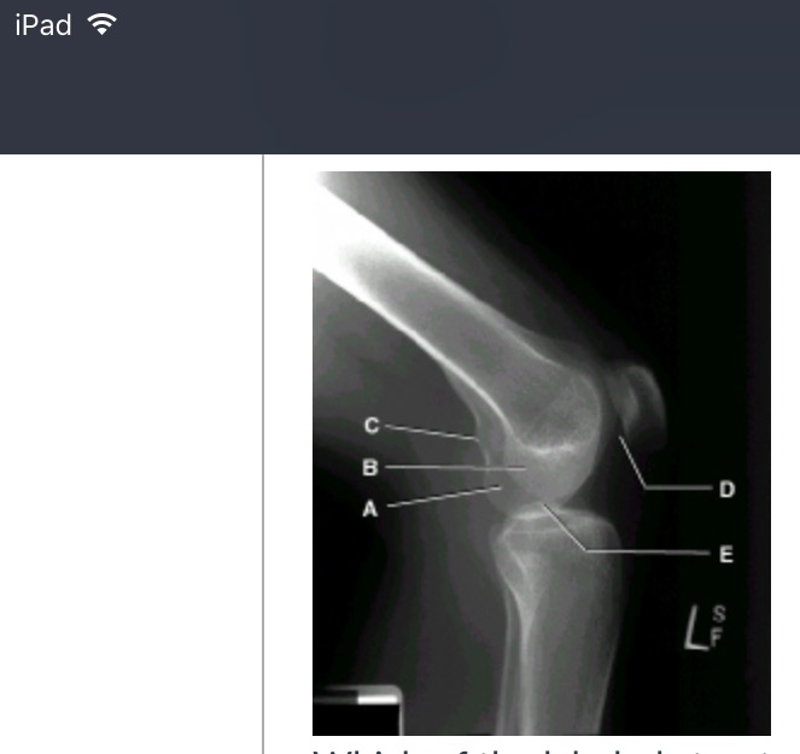 (picture) which of the labeled structures is the lateral condyle? | back 21 b |
front 22 situation: a patient comes to radiology for an evaluation of the longitudinal arch of the foot. Which of the following projections would provide the best information about the arch? | back 22 lateral weight-bearing projections |
front 23 a radiograph of an AP projection of the second toe reveals that the interphalangeal joints are not open. What is the most likely cause for this radiographic outcome? | back 23 incorrect CR centering or angle |
front 24 follow-up radiographs for a fractured tibia and fibula may include only the joint closest to the site of injury | back 24 true |
front 25 a radiographic appearance of a highly malignant and extensive destructive lesion that usually occurs in long bones and produces a sunburst pattern describes: | back 25 an osteogenic sarcoma |
front 26 which metatarsal bone of the foot has a prominent tuberosity frequently fractured? | back 26 fifth |
front 27 which of the following imaging modalities/procedures will provide the best assessment for osteomyelitis of the foot? | back 27 nuclear medicine |
front 28 to decrease the angle between the antrior surface of the foot and antrior surface of the lower leg is described as | back 28 dorisiflexion |
front 29 the best method of evaluating injuries to the menisci and ligaments of the knee joint involves: | back 29 and MRI procedure |
front 30 a radiograph of an AP ankle projection reveals that the lateral joint space is not open(lateral malleolus is partially superimposed by the talus).The superior and medial joint spaces are open. WHat should the technologist do to correct the problem and improve the image? | back 30 nothing; this is an acceptable image |
front 31 placing two images on the same computed radiographic imaging plate is not permitted with newer CR systems | back 31 false |
front 32 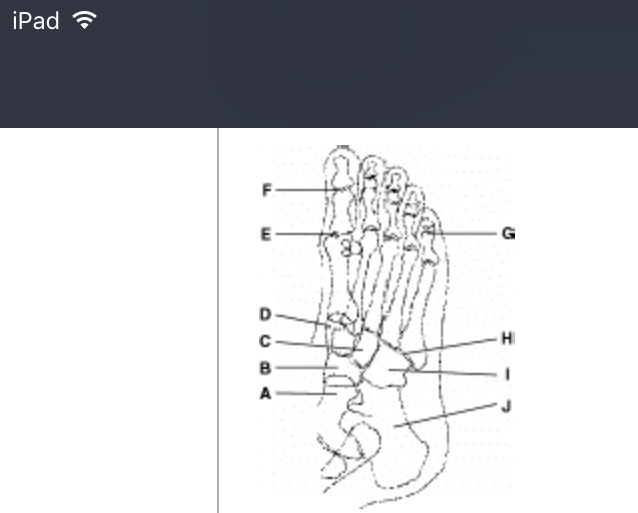 which of these labeled structures or bones identifies the talus?(picture) | back 32 a |
front 33 which projection of the knee will best demonstrate the styloid process of the fibula? | back 33 AP oblique with medial rotation |
front 34 a radiograph of a plantodorsal (axial) projection of the calcaneus reveals foreshortening. The technologist used 60 kv, 6 MAS,40-inch (100cm) SID, and a 30-degree cephalad angle from the long axis of the foot. Which of the following modifications will produce a more diagnostic image of the calcaneus? | back 34 increase CR angulation |
front 35 how much CR angulation (if any) should be used for an AP projection of the toes? | back 35 10-15 degrees toward calcaneus |
front 36 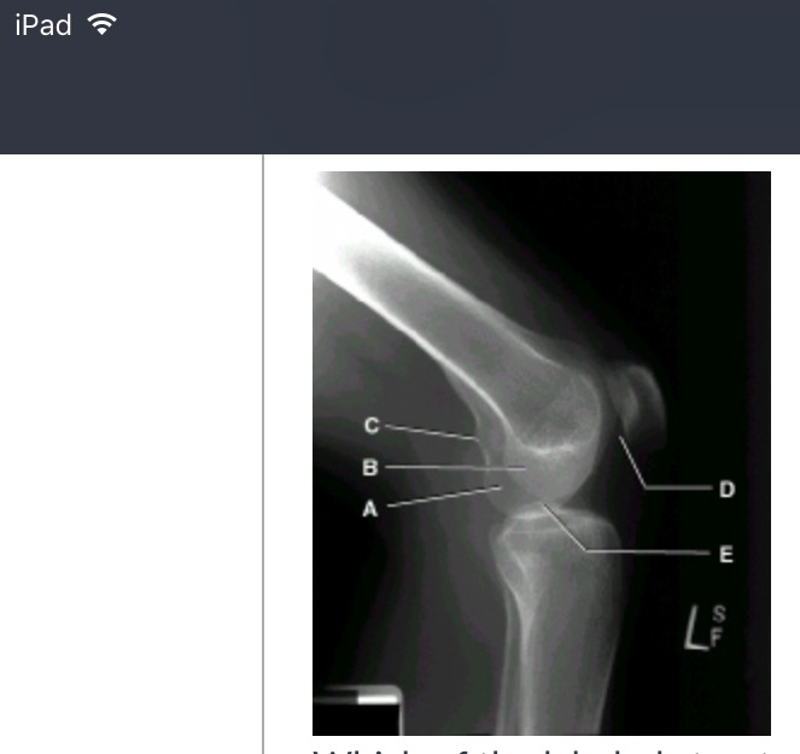 this radiograph represents which of the following positions?(picture) | back 36 lateral knee under-rotated toward the IR |
front 37 the adductor is present on the lateral femoral condlye and can be used to determine possible rotation of a lateral projection. | back 37 false |
front 38 how much flexion of the knee is recommened for the lateral projection of the patella? | back 38 5 to 10 degrees or less |
front 39 the adductor tubercle is located on the posterior aspect of the medial femoral condyle. | back 39 true |
front 40 which structure or bone contains the sustentaculum tali? | back 40 calcaneus |
front 41 a radiograph of an oblique foot with medial rotation demonstrates considerable superimposition of the third through fifth metatarsals. How must the original position be changed to eliminate this problem? | back 41 decrease obliquity of the foot |
front 42 extending the ankle joint or pointing the and toes downward is called: | back 42 plantar flexion |
front 43 what CR angulation is required for the AP oblique projection of the foot? | back 43 CR is perpendicular to the image receptor |
front 44 the correct CR placement for an AP projection of the knee is midpatella? | back 44 false |
front 45 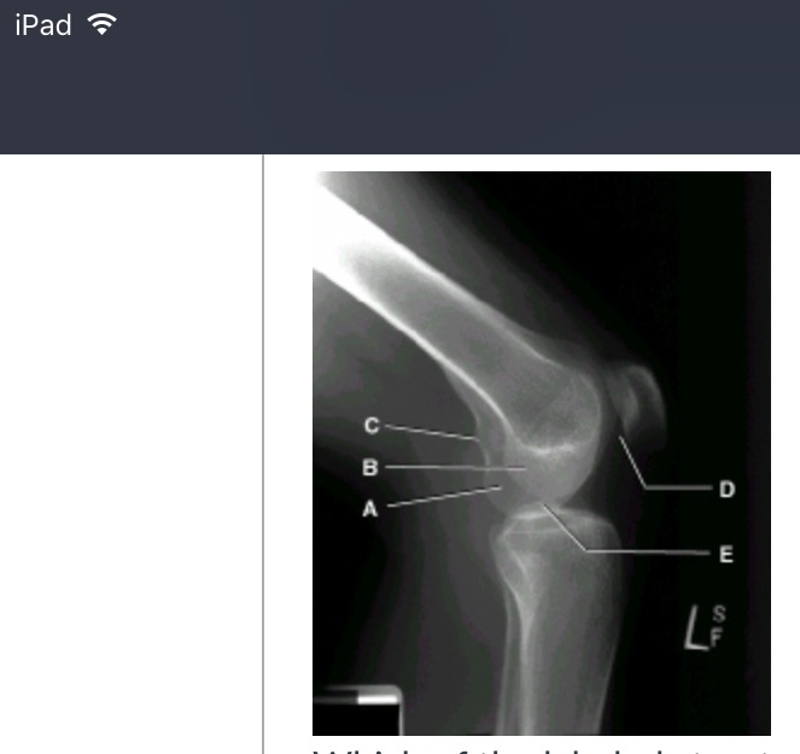 which of the labeled structures is the adductor tubercle? (picture) | back 45 c |
front 46 when using computed radiography, lead masking should not be placed on the regions of the imaging plate not within the collimation field. | back 46 false |
front 47 the calcaneus articulations with the talus and the: | back 47 cuboid |
front 48 how much CR angulation to the long axis of the foot is required for the plantodorsal (Axial) projection of the calcaneus? | back 48 40 degrees |
front 49 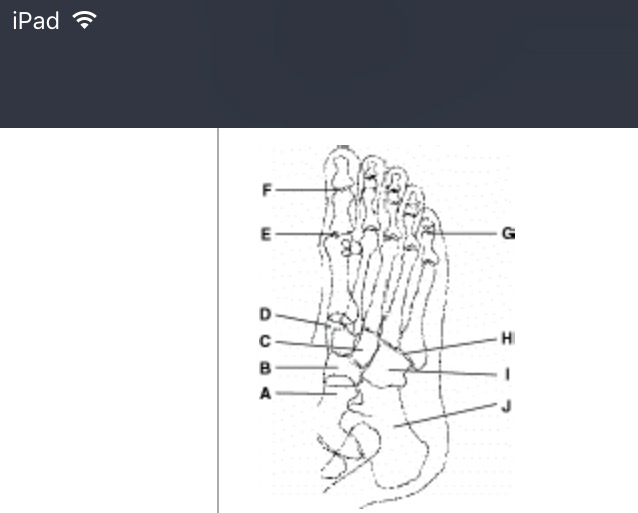 which of these labeled structures or bones identifies the metatarsophalangeal joint? (picture) | back 49 e |
front 50 a lateral knee radiograph that is over-rotated toward the image receptor can be recognized by which of the following? | back 50 the fibular head will appear less superimposed by the tibia than a true lateral |
front 51 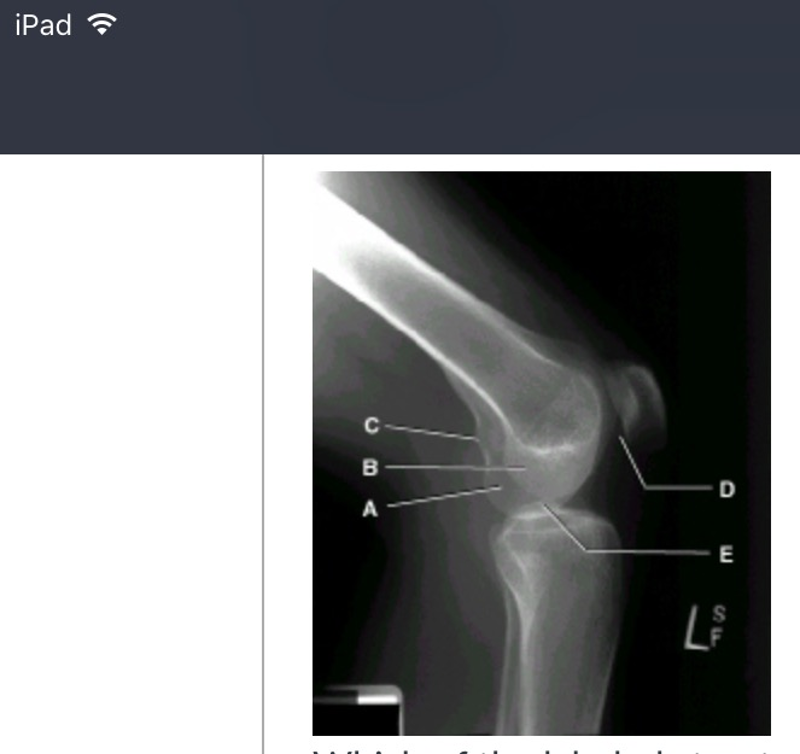 which one of the labeled structures is the medial condyle? (picture) | back 51 a |
front 52 to ensure that both joints are included on an AP projection of the tibia and fibula on an adult, the technologist should: | back 52 turn image receptor diagonally |
front 53 a radiograph of a mortise view of the ankle reveals that the lateral malleolus is slightly superimposed over the talus and the lateral joint space is not open. What is most likely the cause for this radiographic outcome? | back 53 insuffcient medial rotation of the foot and ankle |
front 54 the patella is drawn into the intercondylar sulcus when the knee is overextended. | back 54 false |
front 55 which position of the foot will best demonstrate the lateral (third) cuneiform? | back 55 AP oblique with medial rotation |
front 56 situation: a patient enters the ED with a possible transverse fracture of the patella. Which of the following routines would safely provide the best images of the patella? | back 56 AP and horizontal beam lateral,no flexion |
front 57 situation: A patient has a lower leg fracture reduced and cast in the ED. The following factors were used initially: 65kv,10 mAS,40 inch SID,detail screens. a large plaster cast is applied. Which of the following exposure factors should be used on the postreduction study? | back 57 65kv, 20 MAS, 40inch SID, detail-speed screens |
front 58 saclike structures found in the knee joint that allow smooth articulation between ligaments and tendons are called: | back 58 bursae |
front 59 a radiograph of an AP knee reveals rotation with almost total superimposition of the fibular head and the proximal tibia. What must the technologist do to correct this positioning error on the repeat exposure? | back 59 nothing;this is an acceptable image |
front 60 a 3-to 5-degree caudad should be used for an AP knee projection for patients with thick thighs | back 60 false |
front 61 what CR angulation is required for an AP projection of the knee on a patient with an ASIS-to-tabletop measurement of 18cm? | back 61 5 to 5 degrees caudad |
front 62 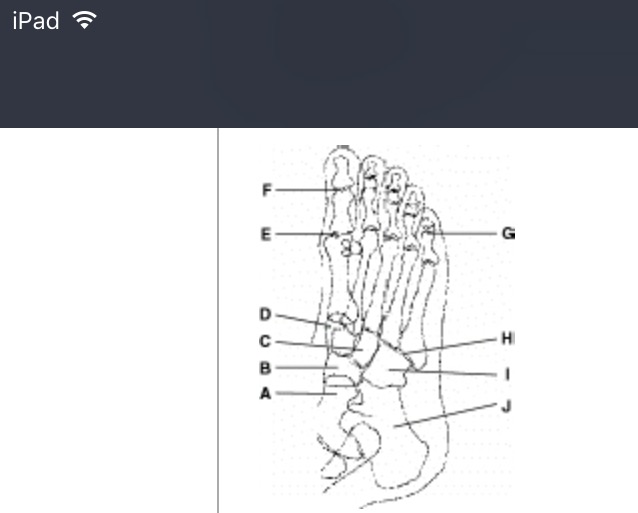 which of these labeled structures or bones identifies the lateral cuneiform?(picture) | back 62 c |
front 63 which projection of the ankle best demonstrates the distal tibiofibular joint? | back 63 AP oblique with 45-degree rotation |
front 64 a radiograph appearance of a well-circumscribed lucency within bones describes: | back 64 a bone cyst |
front 65 how many tarsal bones are found in the foot? | back 65 7 |
front 66 the posterior visibility of the adductor tubercle on a lateral knee projection indicates: | back 66 under-rotation of knee toward the IR |
front 67 a radiograph of an AP medial oblique projection of the foot, if positioned correctly, should demonstrate: | back 67 third through fifth metatarsals free of superimposition |
front 68 which tendon attaches directly to the tibial tuberosity? | back 68 patellar |
front 69 what is the purpose for the AP stress views of the ankle? | back 69 to demonstrate possible joint seperations or ligament tear |
front 70 which joint surfaces of the ankle joint are open with a true AP projection of the ankle? | back 70 medial and superior |
front 71 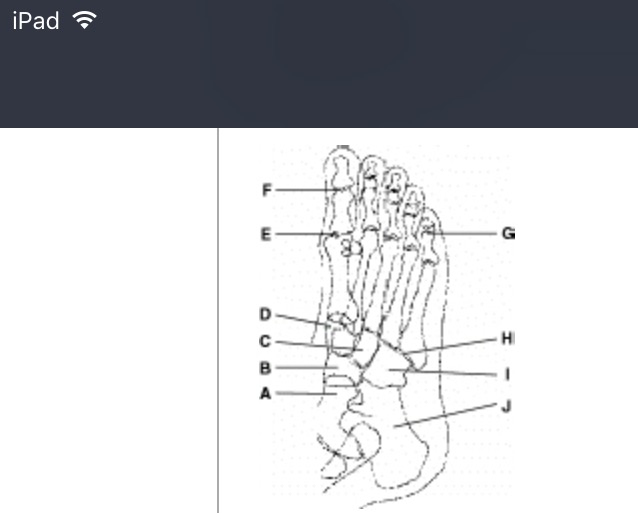 which projection/position of the foot is represented by this drawing of the foot?(picture) | back 71 AP oblique, 45 degrees medial rotation |
front 72 what are the two arches of the foot? | back 72 longitudinal and transverse |
front 73 which of the following routines should be performed for a study of the second toe? | back 73 AP,AP oblique with medial rotation, lateromedial projection |
front 74 the medial malleolus is part of the: | back 74 tibia |