Instructions for Side by Side Printing
- Print the notecards
- Fold each page in half along the solid vertical line
- Cut out the notecards by cutting along each horizontal dotted line
- Optional: Glue, tape or staple the ends of each notecard together
Microbial growth
front 1 Figure 6.1, which line best depicts a facultative anaerobe in the absence of O2? | back 1 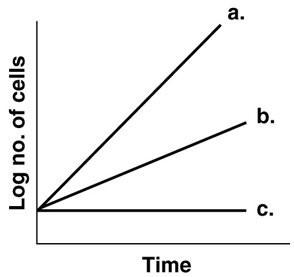 B |
front 2 In figure 6.1, which line best depicts an obligate anaerobe in the presence of O2? | back 2 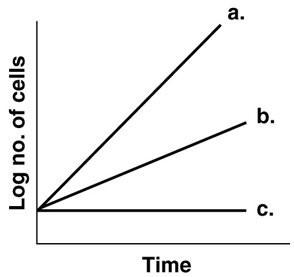 C |
front 3 In figure 6.1, which line shows the growth of an obligate aerobe incubated anaerobically | back 3 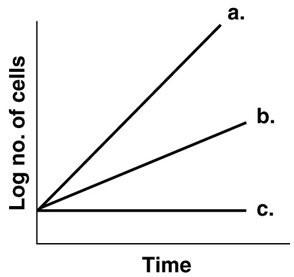 C |
front 4 In figure 6.1, which line best illustrates the growth of a facultative anaerobe incubated aerobically | back 4 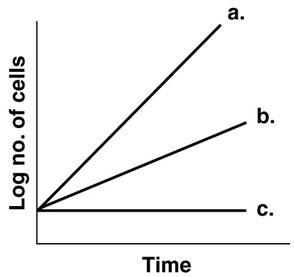 A |
front 5 In figure 6.1, which line best depicts a psychrotroph incubated at 0 degree Celsius | back 5 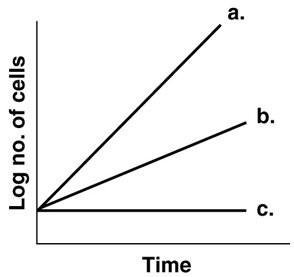 B |
front 6 If cells are grown in media containing amino acids labeled with radioactive nitrogen, most of the radioactivity will be found in the cells' | back 6 DNA and proteins |
front 7 Which of the following elements is NOT correctly matched with its cellular function | back 7 phosphorous - Used for production of carbohydrates |
front 8 Pathogenic bacteria isolated from the respiratory or intestinal tracts of humans are | back 8 Capnophiles that grow best in carbon dioxide incubators |
front 9 A sample of milk tested for its bacterial content in a plate count assay. a one-milliliter sample of the milk is diluted in a 1:10 dilution series. One milliliter of the third dilution tube is plated in a pour plate. After incubation, the plate has 54 colonies, indicating that the original milk sample contained | back 9 54,000 cells per milliliter |
front 10 The addition of which of the following to a culture medium will neutralize acides | back 10 buffers |
front 11 salts and sugars work to preserve foods by creating a | back 11 hypertonic environment |
front 12 the term aerotolerant anaerobe refers to an organism that | back 12 does not use oxygen but tolerates it |
front 13 Which of the following is an advantage of the standard plate count | back 13 determines the number of viable cells |
front 14 Which of the following is an advantage of the direct microscopic count | back 14 requires no incubation time |
front 15 quorum sensing | back 15 cell-to-cell chemical communication allows bacteria to coordinate their activity and group together |
front 16 thirty-six colonies grew in nutrient agar from 1.0ml of undiluted sample in a standard plate count. How many cells were in the original sample | back 16 36 per milliliter |
front 17 figure 6.2 shows a typical bacterial growth curve with the y-axis indicating the lof of the number of bacteria and the x-axis indicating time in culture. In the figure, which section shows a growth phase where the number of cells dying equals the number of cells dividing | back 17 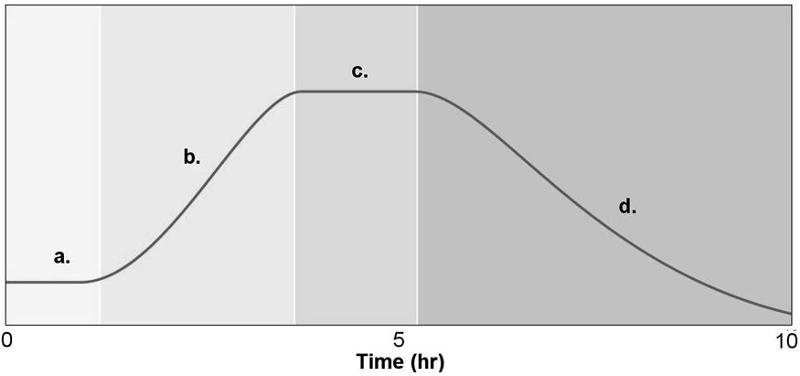 C |
front 18 figure 6.2 shows a typical bacterial growth curve with the y-axis indicating the log of the number of bacteria and x-axis indicating time in culture. IN the figure, which sections of the graph illustrate a logarithmic change in cell numbers | back 18 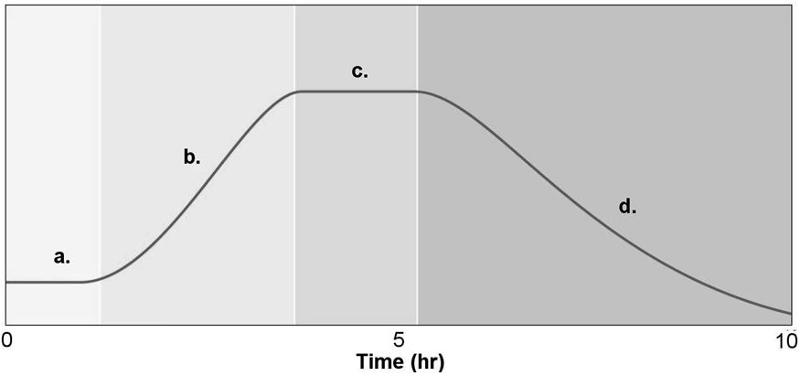 B |
front 19 Most bacteria grow best at pH | back 19 7 |
front 20 Most fungi grow best at pH | back 20 5 |
front 21 consider a culture medium on which only gram-positive organism such at Staphylococcus aureus colonies can grow due to an elevated NaCl level. A yellow halo surrounds the growth, indicating the bacterium fermented a sugar in the medium, decreasing the pH as a result and changing the color of a pH indicator chemical. This type of medium would be referred to as an | back 21 selective and differential medium |
front 22 a culture medium consisting of agar, peptone, and beef heart, is a | back 22 complex medium |
front 23 Which of the following pairs of microbe classification terms and optimal growth temperatures is mismatched | back 23 thermophile - growth at 37 degrees celsius |
front 24 during which growth phase will gram-positive bacteria be most susceptible to penicillin | back 24 log phase |
front 25 which of the following is the best definition of generation time | back 25 the length of time needed for a cell to divide |
front 26 which of the following is not a direct method to measure microbial growth | back 26 metabolic activity |
front 27 which group of microorganisms is most likely to spoil a freshwater trout preserved with salt | back 27 facultative halophiles |
front 28 which of the following is an organic growth factor | back 28 vitamin B1 |
front 29 which of the following is an example of metabolic activity that could be used to measure microbial growth | back 29 glucose consumption |
front 30 an experiment began with 4 cells and ended with 128 cells. How many generations did the cells go through | back 30 5 |
front 31 three cells with generation times of 60 minutes are inoculated into a culture medium. How many cell are there after 5 hours | back 31 96 |
front 32 In figure 6.3 which tube shows the expected growth pattern for a microaerophile | back 32 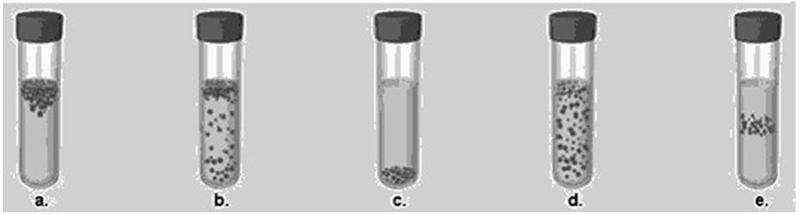 E |
front 33 in figure 6.3 which tube shows the expected growth pattern for facultative anaerobe | back 33 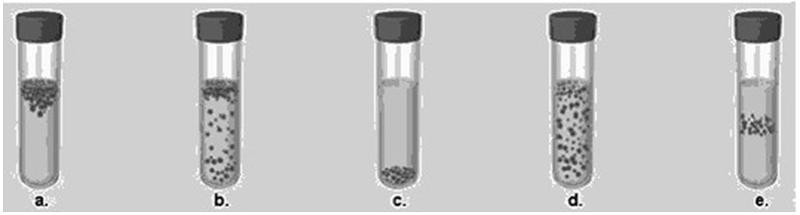 B |
front 34 In one hospital, Pseudomonas aeruginosa seroptype 10 infected the biliary tract of 10% of 1300 patients, who underwent gastrointestinal endoscopic procedures. After each use, endoscopes were washed with an automatic reprocessor that flushed detergent and glutaraldehyde through the endoscopes, followd by a tap water rinse. P. aeruginosa serotype 10 was not isolated from the detergent, gluataraldehyde, or tap water. What was the source of the infections | back 34 a biofilm in the reprocessor |
front 35 for the three types of media, which medium (or media) is/are chemically defined | back 35 Medium A |
front 36 in which medium (or media) would an autotroph grow | back 36 Medium A |
front 37 Assume you inoculated 100 cells, with a generation time of 20 minutes, into 100ml of nutrient broth. You then inoculated 100 cells of the same species into 200ml of nutrient broth. After incubation for 4 hours, you can reasonably expect to have | back 37 the same number of cells in both |
front 38 The source of nutrients in nutrient agar is | back 38 peptone and beef extract |
front 39 which enzyme catalyzes the reaction O2- + O2- + 2H+ → H2O2 + O2? | back 39 superoxide dismutase (SOD) |
front 40 Which enzyme catalyzes the reaction: 2H2O2 → 2H2O + O2? | back 40 catalase |
front 41 Which enzyme catalyzes the reaction: H2O2 + 2H+ → 2H2O? | back 41 peroxidase |
front 42 the data in table 6.2 indicate that S. aureus is a(n) | back 42 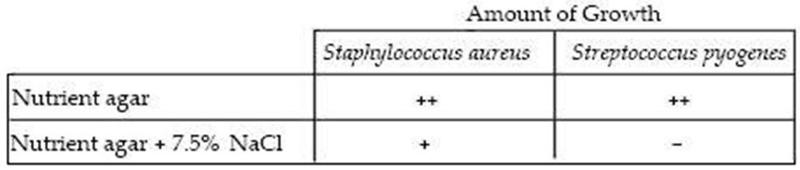 facultative halophile |
front 43 Patients with indwelling catheters are susceptible to infections because | back 43 biofilms develop on catheters |
front 44 an isolated colony on a streak plate contains millions (or even billions) of identical cells all arising from one initial cell | back 44 true |
front 45 bacterial growth refers to an increase in the numbers of cells in a bacterial culture | back 45 true |
front 46 pure cultures can easily be obtained on streak plates, even if the desired bacteria are present in very low concentrations in the initial culture broth | back 46 false |
front 47 agar is used as a solidifying agent in microbiological media since few bacteria can degrade it | back 47 true |
front 48 laboratory cultivation of obligate anaerobes requires reducing media or special growth chambers filled with inert gases | back 48 true |
front 49 most pathogenic bacteria are thermophiles | back 49 false |
front 50 in performing a ten-fold dilutions series from a sample containing 10,000 bacteria per milliliter, the fourth tube in the dilution series will have 10 cells per milliliter | back 50 false |
front 51 What are the physical requirements for growth? | back 51 temperature pH osmotic pressure |
front 52 What are the chemical requirements for growth | back 52 Carbon nitrogen, sulfur, phosphorus trace elements oxygen organic growth factors |
front 53 what are the 3 groups based on range of temperature | back 53 psychrophiles mesophiles thermophiles |
front 54 psychrophiles | back 54 cold-loving microbes -10 - 20oC |
front 55 mesophiles | back 55 moderate-temperature loving 10 - 30oC |
front 56 Thermophiles | back 56 heat-loving 50-60oC |
front 57 minimum growth temperature | back 57 lowest temperature at which species will grow |
front 58 optimum growth temperature | back 58 temperature at which species grow best |
front 59 maximum growth temperature | back 59 highest temperature at which growth is possible |
front 60 psychrotrophs | back 60 can grow at 20 - 30oC temperatur. Found in low temperature food spoilage |
front 61 hyperthermophiles | back 61 optimum growth temperature of 80 oC or higher. sulfur is important in metabolic activity |
front 62 pH | back 62 acidity or alkalinity of a solution bacteria grow best between pH 6.5 and 7.5 |
front 63 osmotic pressure | back 63 plasmolysis - shrinkage of cell's cytoplasm high salt or sugar concentrations draw water out of microbial cells and prevents their growth microorganism require water for growth. their composition is 80-90% water |
front 64 extreme halophiles | back 64 high salt concentrations. organisms require 30% salt |
front 65 falcultative halophiles | back 65 do not require high salt concentrations |
front 66 carbon | back 66 needed for all organic compounds that make up a living cell. one of the most important requirements for microbial growth |
front 67 nitrogen, sulfur and phosphorus | back 67 nitrogen is used to form amino group sulfur is used to synthesize sulfur-containing amino acids and vitamins phosphorus is used for the synthesis of nucleic acids and phospholipids of cell membranes |
front 68 nitrogen fixation | back 68 using gaseous nitrogen directly from the atmosphere |
front 69 obligate aerobes | back 69 organisms that require oxygen to live |
front 70 facultative anaerobes | back 70 ability to grow in the absence of oxygen |
front 71 obligate anaerobes | back 71 bacteria that are unable to use molecular oxygen for energy-yielding reactions |
front 72 how microorganisms can be harmed by O2 | back 72 singlet oxygen superoxide radicals peroxide anion hydroxyl radical |
front 73 organic growth factors | back 73 essential organic compounds an organism is unable to synthesize must be directly obtained from the environment b |
front 74 biofilms | back 74 thin, slimy layer encasing bacteria that adheres to a surface can be considered a hydrogel |
front 75 quorum sensing | back 75 cell-to-sell chemical communication allows bacteria to coordinate their activity and group together |
front 76 growth rates of different types of microorganisms in response to temperature | back 76 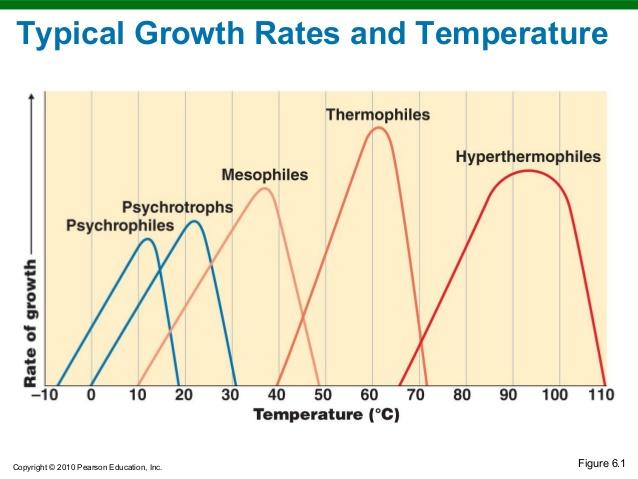 |
front 77 culture media | back 77 nutrients prepared for microbial growth |
front 78 inoculum | back 78 microbes that are introduced into a culture medium to initiate growth |
front 79 culture | back 79 microbes that grow and multiply in or on a culture medium |
front 80 criteria for culture medium | back 80 must contain the right nutrients for the specific microorganism growing should contain sufficient moisture, properly adjusted pH, and suitable level of O2 must be sterile |
front 81 sterile | back 81 must contain no living microorganism |
front 82 agar | back 82 solidifying agent liquefies at 1000C and solidifies at ~ 400C |
front 83 chemically defined media | back 83 one whose exact chemical composition is known medium must provide an energy source organism that require many growth factors are fastidious |
front 84 complex media | back 84 made up of nutrients including extracts from yeast, meats, or plants |
front 85 anaerobic growth media and methods | back 85 reducing media is used because anaerobes might be killed by exposure to oxygen. Medium contains sodium thioglycolate that chemically combine with dissolved oxygen and deplete oxygen in the culture medium. |
front 86 capnophiles | back 86 microbes that can grow better at high CO2 concentrations |
front 87 selective media | back 87 designed to suppress the growth of unwanted bacteria and encourage the growth of desire microbes |
front 88 differential media | back 88 makes it easier to distinguish colonies of desired organisms from unnecessary ones |
front 89 enrichment culture | back 89 designed to increase very small numbers of the desired type of organism to detectable levels |
front 90 reducing media | back 90 takes away the oxygen anaerobic bacteria grows in ot |
front 91 gas gangreen | back 91 anaerobes produces to protect itself |
front 92 anaerobic chamber | back 92 takes away O2 and creates CO2 |
front 93 generation time | back 93 time required for a cell to divide generation number is the exponent |
front 94 phases of growth | back 94 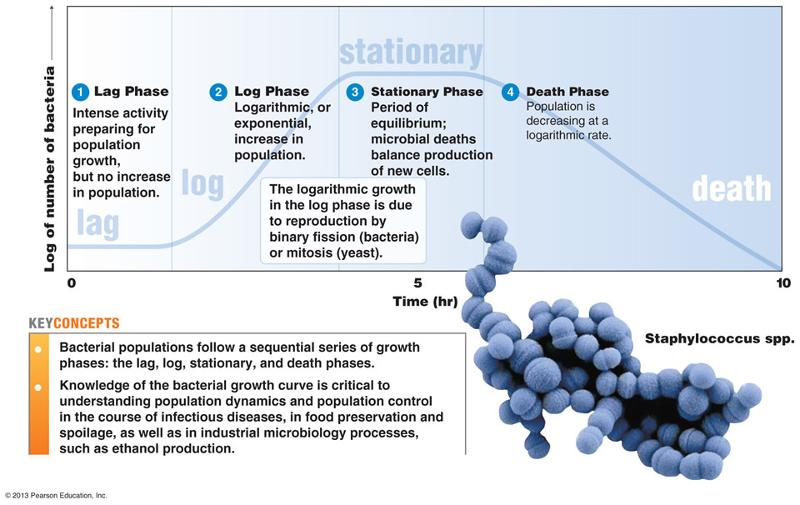 |