Instructions for Side by Side Printing
- Print the notecards
- Fold each page in half along the solid vertical line
- Cut out the notecards by cutting along each horizontal dotted line
- Optional: Glue, tape or staple the ends of each notecard together
Chapter 12
front 1 1) Which of the following statements regarding fungi is FALSE? A) Most fungi are pathogenic for humans. B) Fungi are eukaryotic heterotrophs. C) Fungi reproduce by forming asexual or sexual spores. D) Most fungi grow well in acidic culture condition. E) Fungi tolerate low moisture conditions. | back 1 Answer: A |
front 2 2) Which of the following statements about helminths is FALSE?
| back 2 Answer: D |
front 3 3) Which of the following statements about the oomycote algae is FALSE?
| back 3 Answer: D |
front 4 4) Seventeen patients in ten hospitals had cutaneous infections caused by Rhizopus. In all seventeen patients, Elastoplast bandages were placed over sterile gauze pads to cover wounds. Fourteen of the patients had surgical wounds, two had venous line insertion sites, and one had a bite wound. Lesions present when the bandages were removed ranged from vesiculopustular eruptions to ulcerations and skin necrosis requiring debridement. Fungi are more likely than bacteria to contaminate bandages because they
| back 4 Answer: B |
front 5 5) Which of the following statements regarding lichens is FALSE? A) Lichens are a mutualistic relationship between a fungus and a protozoan. B) Lichens represent a mutualistic relationship between a fungus and an alga. C) Lichens are often the first life form to colonize rock or soil. D) The algal partner produces carbohydrates that are absorbed by the fungal partner. E) The fungal partner provides a means of attachment and protects the algal partner from desiccation. | back 5 Answer: A |
front 6 6) Which of the following pairs is mismatched? A) Basidiomycota — basidiospores B) Ascomycota — conidiospores C) Zygomycota — sporangiospores D) microsporidia — lack mitochondria E) anamorphs — lack spores | back 6 Answer: E |
front 7 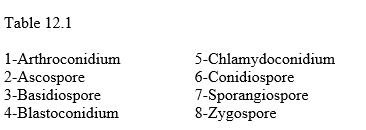 7) In Table 12.1, which of these spores are characteristic of Penicillium? A) 1 and 2 B) 3 and 4 C) 2 and 6 D) 1 and 4 E) 4 and 6 | back 7 Answer: C |
front 8 8) In Table 12.1, which of these spores are characteristic of Rhizopus? A) 1 and 2 B) 6 and 7 C) 2 and 8 D) 1 and 4 E) 7 and 8 | back 8 Answer: E |
front 9 9) In Table 12.1, which is a thick-walled spore formed as a segment within a hypha? A) 1 B) 3 C) 5 D) 7 E) None of the answers is correct. | back 9 Answer: C |
front 10 10) In Table 12.1, which of these spores are asexual spores? A) 1, 4, 5, 6, 7 B) 2, 3, 6, 8 C) 1, 3, 5, 8 D) 2, 4, 6, 7, 8 E) All of the spores are asexual. | back 10 Answer: A |
front 11 11) Which of the following pairs is mismatched? A) teleomorph — produces both sexual and asexual spores B) dermatomycosis — fungal infection of the skin C) dimorphic fungus — grows as a yeast or a mold D) systemic mycosis — fungal infection of body organs E) coenocytic hyphae — hyphae with cross-walls | back 11 Answer: E |
front 12 12) Which of the following statements regarding protozoa is FALSE? A) Protozoa are unicellular eukaryotes. B) Nearly all protozoa cause disease. C) Most protozoa reproduce asexually. D) Protozoa are common in water and soil. E) Some protozoan pathogens are transmitted by arthropod vectors. | back 12 Answer: B |
front 13 13) In mid-December, a woman with insulin-dependent diabetes who had been on prednisone fell and received an abrasion on the dorsal side of her right hand. She was placed on penicillin. By the end of January, the ulcer had not healed, and she was referred to a plastic surgeon. On January 30, a swab of the wound was cultured at 35°C on blood agar. On the same day, a smear was made for Gram staining. The Gram stain showed large (10 µm) cells. Brownish, waxy colonies grew on the blood agar. Slide cultures set up on February 1 and incubated at 25°C showed septate hyphae and single conidia. The most likely cause of the infection is a A) gram-negative bacterium. B) dimorphic fungus. C) parasitic alga. D) yeast. E) protozoan. | back 13 Answer: B |
front 14 14) Which of the following tends to be more complex in a parasitic helminth than in free-living helminths? A) digestive system B) nervous system C) reproductive system D) digestive and nervous systems E) digestive, reproductive, and nervous systems | back 14 Answer: C |
front 15 15) Which of the following statements is FALSE? A) Fungi produce sexual spores. B) Fungi produce asexual spores. C) Fungal spores are used in identification of fungi. D) Fungal spores are highly resistant to heat and chemical agents. E) Fungal spores are for asexual or sexual reproduction. | back 15 Answer: D |
front 16 16) Which of the following pairs are mismatched? 1.arthroconidium — formed by fragmentation 2.sporangiospore — formed within hyphae 3.conidiospore — formed in a chain 4.blastoconidium — formed from a bud 5.chlamydoconidium — formed in a sac A) 1 and 2 B) 2 and 3 C) 2 and 5 D) 3 and 4 E) 4 and 5 | back 16 Answer: C |
front 17 17) Which of the following pairs is mismatched? A) dinoflagellates — paralytic shellfish poisoning B) brown algae — algin C) red algae — agar D) diatoms — petroleum E) green algae — prokaryotic | back 17 Answer: E |
front 18 18) Helminthic diseases are usually transmitted to humans by A) respiratory route. B) genitourinary route. C) gastrointestinal route. D) vectors. E) aerosols. | back 18 Answer: C |
front 19 19) All of the following are characteristic of the Platyhelminthes EXCEPT that they A) are hermaphroditic. B) are dorsoventrally flattened. C) have highly developed digestive and nervous systems. D) can be divided into flukes and tapeworms. E) are multicellular animals. | back 19 Answer: C |
front 20 20) In the malaria parasite life cycle, humans are the ________ host, while mosquitoes are the ________ host as well as the vector.
| back 20 Answer: E |
front 21 21) Three weeks after a river rafting trip, three family members experienced symptoms of coughing, fever, and chest pain. During the rafting trip, the family had consumed crayfish that they caught along the river banks. An examination of the patients' sputum revealed helminth eggs, and serum samples were positive for antibodies to Paragonimus. All of the family members recovered following treatment with praziquantel. In the Paragonimus life cycle,
| back 21 Answer: B |
front 22 22) The encysted larva of the beef tapeworm is called a A) redia. B) cercaria. C) cysticercus. D) metacercaria. E) proglottid. | back 22 Answer: C |
front 23 23) Which of the following arthropods does NOT transmit diseases by sucking blood from a human host? A) lice B) fleas C) houseflies D) mosquitoes E) kissing bugs | back 23 Answer: C |
front 24 24) Which of the following statements about algae is FALSE? A) They use light as their energy source. B) They use CO2as their carbon source. C) They produce oxygen from hydrolysis of water. D) All are unicellular. E) Some are capable of sexual reproduction. | back 24 Answer: D |
front 25 25) Below are paired items referring to the heartworm Dirofilaria immitis. Which of the pairs is mismatched? A) dog — definitive host B) dog — sexual reproduction C) mosquito — vector D) mosquito — definitive host E) None of the pairs is mismatched. | back 25 Answer: D |
front 26 26) All of the following are characteristic of algae EXCEPT which ONE of the following? A) Most are photoautotrophs. B) They are currently classified as plants. C) They may be unicellular or multicellular. D) Some produce harmful toxins. E) They mostly live in aquatic habitats. | back 26 Answer: B |
front 27 27) A definitive host harbors which stage of a parasite? A) miracidium B) cyst C) adult D) larva E) All of the answers are correct. | back 27 Answer: C |
front 28 28) What do tapeworms eat? A) intestinal bacteria B) host tissues C) red blood cells D) intestinal contents E) plant matter | back 28 Answer: D |
front 29 29) Giardia and Trichomonas are unusual eukaryotes because they A) are motile. B) lack mitochondria. C) lack nuclei. D) do not produce cysts. E) do produce cysts. | back 29 Answer: B |
front 30 30) The life cycle of the fish tapeworm is similar to that of the beef tapeworm. Which of the following is the most effective preventive measure? A) salting fish before eating B) refrigerating stored fish C) cooking fish before eating D) wearing gloves while handling fish E) not swimming in fish-infested waters | back 30 Answer: C |
front 31 31) Which of the following is the most effective control for malaria? A) vaccination B) treating patients C) eliminate Anopheles mosquitoes D) eliminate the intermediate host E) None of these is an effective control. | back 31 Answer: C |
front 32 32) In the microscope, you observe multinucleated amoeboid cells with sporangia that form spores. This is a(n) A) ascomycete. B) cellular slime mold. C) Euglenozoa. D) tapeworm. E) plasmodial slime mold. | back 32 Answer: E |
front 33 33) You observe a mass of amoeba-like cells that swarm together, form a stalk, and produce spores. This is a(n) A) ascomycete. B) cellular slime mold. C) Euglenozoa. D) tapeworm. E) plasmodial slime mold. | back 33 Answer: B |
front 34 34) Which of the following pairs is mismatched? A) nematodes — complete digestive tract B) cestodes — segmented body made of proglottids C) trematodes — flukes D) nematodes — many are free-living E) cestodes — all are free-living | back 34 Answer: E |
front 35 35) Which of the following is a nucleated, unicellular organism that,
if you changed the incubation temperature, would form filaments with
conidiospores? | back 35 Answer: A |
front 36 36) Which of the following organisms is photoautotrophic protozoan? A) oomycote B) cellular slime mold C) Euglena D) Phytophthora E) plasmodial slime mold | back 36 Answer: C |
front 37 37) Which of the following pairs is mismatched? A) tick — Rocky Mountain spotted fever B) tick — Lyme disease C) mosquito — malaria D) mosquito — Pneumocystis E) mosquito — encephalitis | back 37 Answer: D |
front 38 38) Which of the following groups of algae does NOT produce compounds that are toxic to humans? A) diatoms B) dinoflagellates C) green algae D) red algae E) None of the answers is correct; all of these groups of algae produce compounds toxic to humans. | back 38 Answer: C |
front 39 39) The cells of plasmodial slime molds can grow to several centimeters in diameter because A) they have organelles. B) they distribute nutrients by cytoplasmic streaming. C) the large surface can absorb nutrients. D) they form spores. E) they have a mouth to ingest nutrients. | back 39 Answer: B |
front 40 40) Assume you have isolated a multicellular heterotrophic organism that produces coenocytic hyphae, motile zoospores, and cellulose cell walls. It is most likely a(n) A) ascomycete fungus. B) green alga. C) oomycote alga. D) tapeworm. E) zygomycete fungus. | back 40 Answer: C |
front 41 41) If a larva of Echinococcus granulosus is found in humans, humans are the A) definitive host. B) infected host. C) intermediate host. D) reservoir. E) None of the answers is correct. | back 41 Answer: C |
front 42 42) Ringworm is caused by a(n) A) fungus. B) cestode. C) nematode. D) protozoan. E) trematode. | back 42 Answer: A |
front 43 43) Yeast infections are caused by A) Aspergillus. B) Candida albicans. C) Histoplasma. D) Penicillium. E) Saccharomyces cerevisiae. | back 43 Answer: B |
front 44 44) All of the following are characteristic of lichens EXCEPT
| back 44 Answer: D |
front 45 45) You see acid-fast oocysts in a fecal sample from a patient who has diarrhea. What is the MOST likely cause? A) Cryptosporidium B) diatoms C) Entamoeba D) Giardia E) Taenia | back 45 Answer: A |
front 46 1) Plasmogamy, karyogamy, and meiosis are stages of the fungal sexual life cycle. | back 46 Answer: TRUE |
front 47 2) Arthropod vectors are blood-sucking animals such as ticks, lice, and fleas that transmit microbial pathogens. | back 47 Answer: TRUE |
front 48 3) Cercariae, metacercaria, redia, and sporocysts are all life cycle stages of trematodes. | back 48 Answer: TRUE |
front 49 4) The Platyhelminthes group includes roundworms, tapeworms, and flukes. | back 49 Answer: FALSE |
front 50 5) Some species of dinoflagellates produce neurotoxins that cause fish kills and red tides. | back 50 Answer: TRUE |
front 51 6) Both the cellular slime molds and the plasmodial slime molds are members of the phylum Amoebozoa. | back 51 Answer: TRUE |
front 52 7) In helminth life cycles, the organism that harbors the adult sexually reproductive phase of the parasite is called the intermediate host. | back 52 Answer: FALSE |
front 53 8) The sporozoite, merozoite, gametocyte, and ring stages are all part of the Plasmodium life cycle. | back 53 Answer: TRUE |
front 54 9) The insect vectors have six legs and include spiders, ticks, mosquitoes, and lice. | back 54 Answer: FALSE |
front 55 10) Most cases of hookworm infection are acquired by ingestion of adult forms in contaminated food or water. | back 55 Answer: FALSE |