Instructions for Side by Side Printing
- Print the notecards
- Fold each page in half along the solid vertical line
- Cut out the notecards by cutting along each horizontal dotted line
- Optional: Glue, tape or staple the ends of each notecard together
Chapter 22: The Respiratory System
front 1 What is the most immediate driving force behind pulmonary ventilation? | back 1 Intrapulmonary Pressure Change |
front 2 The larynx contains ___. | back 2 The thyroid cartilage |
front 3 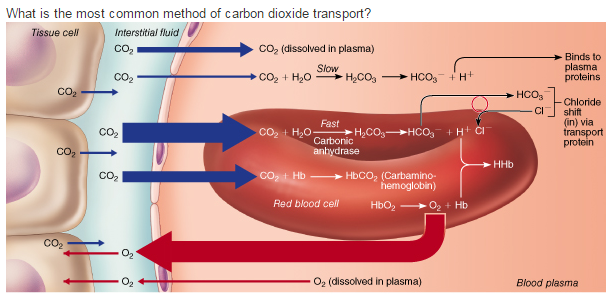 | back 3 As bicarbonate ions in the plasma |
front 4 Which of the following is not a stimulus for breathing? A) rising blood pressure B) rising carbon dioxide levels C) arterial Po2 below 60 mm Hg D) acidosis resulting from CO2 retention | back 4 A) rising blood pressure |
front 5 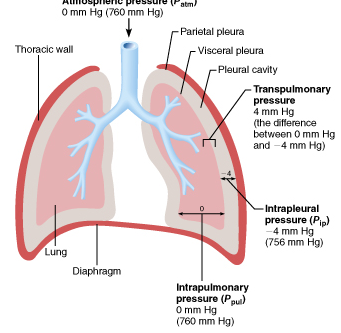 Calculate the transpulmonary pressure if atmospheric pressure is 755 mmHg | back 5 -1 mm Hg |
front 6 Inspiratory capacity is ________. | back 6 the total amount of air that can be inspired after a tidal expiration |
front 7 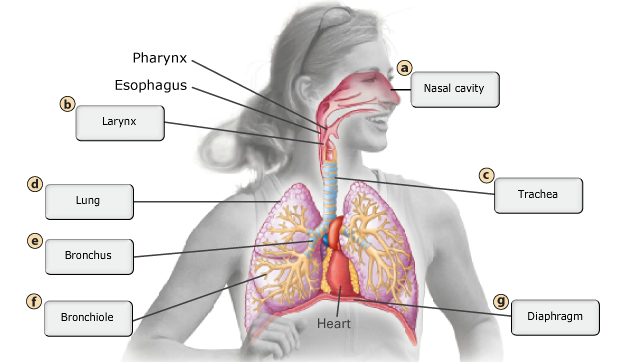 | back 7 no data |
front 8 The main site of gas exchange is the ________. | back 8 Alveoli |
front 9 Gas Exchange: Steps in O2 Transport | back 9 1. Oxygen diffuses from the alveoli into surrounding capillaries 2. Oxygen enters a red blood cell 3. Oxygen binds to a molecule of hemoglobin 4. Oxygen is carried through blood vessels to a capillary 5. Oxygen diffuses from the blood to the body's tissues. |
front 10 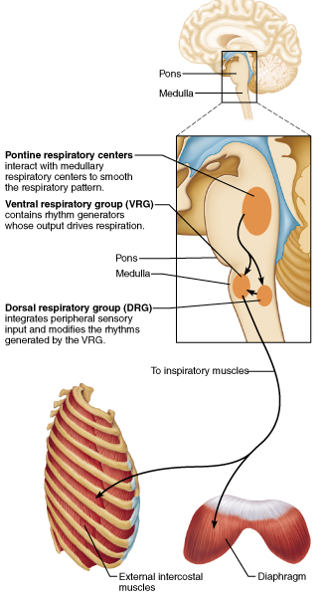 Which of the following respiratory rates illustrates eupnea for an average, healthy adult at rest? | back 10 15 breaths per minute |
front 11 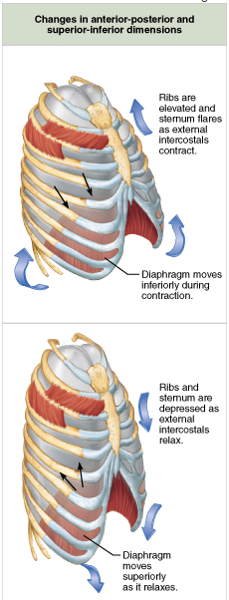 Which muscles are activated during normal quiet inspiration? | back 11 Diaphragm and external intercostal muscles |
front 12 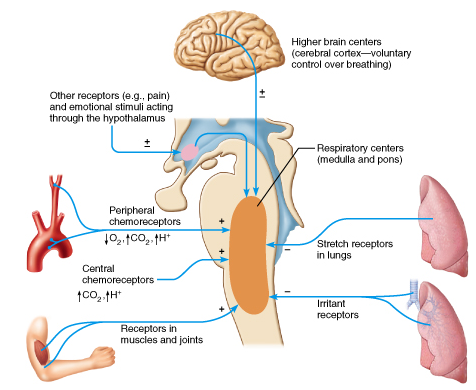 Which of the following stimuli is the most powerful respiratory stimulant to increase respiration? | back 12 Rising carbon dioxide levels |
front 13 Which of the choices below determines the direction of respiratory gas movement? | back 13 Partial pressure gradient |
front 14 The adenoids normally destroy pathogens because they contain ______. | back 14 lymphocytes |
front 15 Which of the following is not possible? A) The amount of gas flowing in and out of the alveoli is directly proportional to the difference in pressure or pressure gradient between the external atmosphere and the alveoli. B) Gas flow equals pressure gradient over resistance. C) Resistance equals pressure gradient over gas flow. D) Pressure gradient equals gas flow over resistance. | back 15 D) Pressure gradient equals gas flow over resistance. |
front 16 Gas Exchange: Carbon Dioxide Transport | back 16 1. Carbon Dioxide is released from the mitochondria 2. Carbon Dioxide diffuses into a capillary 3. Carbon Dioxide is carried to the lungs 4. Carbon Dioxide diffuses into an alveolus 5. Air exits through the nose or mouth |
front 17 Select the correct statement about the physical factors influencing pulmonary ventilation. A) A decrease in compliance causes an increase in ventilation. B) As alveolar surface tension increases, additional muscle action will be required. C) Surfactant helps increase alveolar surface tension. D) A lung that is less elastic will require less muscle action to perform adequate ventilation. | back 17 B) As alveolar surface tension increases, additional muscle action will be required. |
front 18 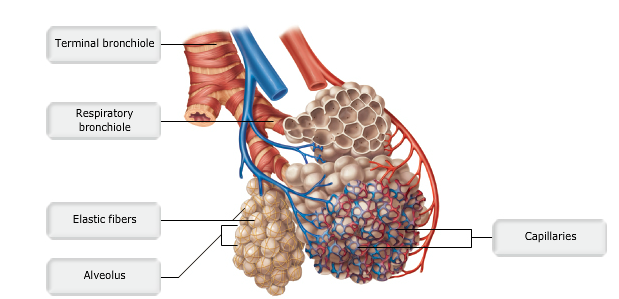 | back 18 no data |
front 19 Factors that influence the rate and depth of breathing include ________. | back 19 voluntary cortical control |
front 20 Which of the following determines lung compliance? A) muscles of inspiration B) flexibility of the thoracic cage C) airway opening D) Alveolar Surface Tension | back 20 D) Alveolar Surface Tension |
front 21 The relationship between gas pressure and gas volume is described by ________. | back 21 Boyle's Law |
front 22 Oxygen and carbon dioxide are exchanged in the lungs and through all cell membranes by ________. | back 22 Diffusion |
front 23 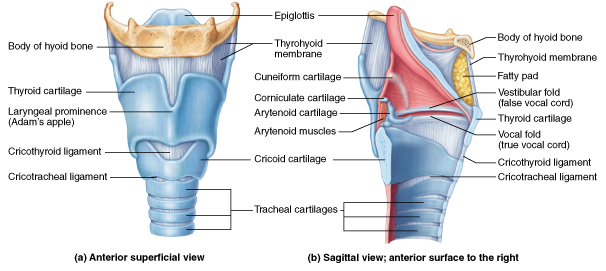 During the Valsalva's maneuver, what part of the larynx closes to increase intra-abdominal pressure, such as to help with defecation? | back 23 Glottis |
front 24 Most inspired particles such as dust fail to reach the lungs because of the ________. | back 24 ciliated mucous lining in the nose |
front 25 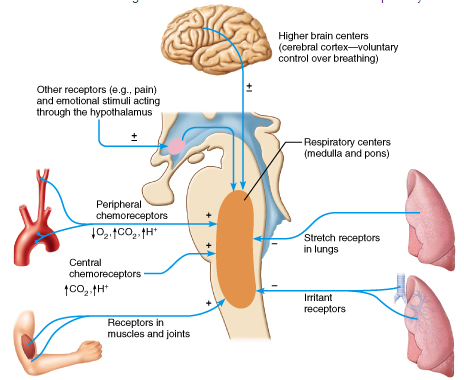 Which of the following conditions or scenarios increases the respiratory rate? | back 25 Acidosis |
front 26  The indentation on the medial surface of each lung through which pulmonary and systemic blood vessels, bronchi, lymphatic vessels, and nerves enter and leave is called the ___________. | back 26 Hilum |
front 27 During pleurisy, the inflamed parietal pleura of one lung rubs against the inflamed ______. | back 27 visceral pleura of the same lung |
front 28  Which of the following is NOT a function of the nasal conchae? A) filtering, heating, and moistening incoming air during inhalation B) increasing the mucosal surface area exposed to air C) reclaiming heat and moisture from expired air D) Routing air and food into proper channels | back 28 D) Routing air and food into proper channels |
front 29 Which of the following respiratory structures is more commonly known as the "throat"? | back 29 Pharynx |
front 30 The most powerful respiratory stimulus for breathing in a healthy person is ________. | back 30 Increase of carbon dioxide |
front 31 Functional Residual Capactiy | back 31 ERV + RV |
front 32 Vital Capacity | back 32 TV + IRV + ERV |
front 33 Inspiratory Capacity | back 33 TV + IRV |
front 34 Total Lung Capacity | back 34 TV + IRV + ERV + RV |
front 35 Surfactant helps to prevent the alveoli from collapsing by ________. | back 35 interfering with the cohesiveness of water molecules, thereby reducing the surface tension of alveolar fluid |
front 36 What is the tidal volume of an average adult male? | back 36 500 mL |
front 37 Which blood vessels supply oxygenated systemic blood to the lung tissue? | back 37 bronchial arteries |
front 38  | back 38 no data |
front 39 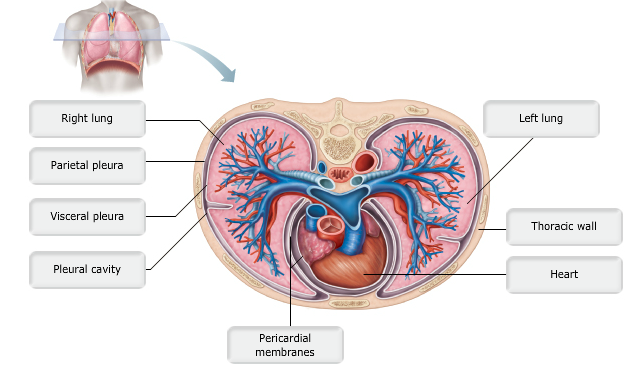 | back 39 no data |
front 40 Which of the following would NOT be involved in causing bronchiolar constriction during an asthma attack? A) acetylcholine B) central nervous system C) peripheral nervous system D) adrenal medulla | back 40 D) adrenal medulla |
front 41 Which of the following arterial blood levels is the most powerful respiratory stimulant? A) low CO2 level B) rising CO2 levels C) low oxygen level D) arterial pH | back 41 B) rising CO2 levels |
front 42 Which of the following is NOT a function of the larynx? A) providing a patent airway B) serving as part of the respiratory zone C) voice production D) routing air and food into the proper channels | back 42 B) serving as part of the respiratory zone |
front 43 What part of the larynx covers the laryngeal inlet during swallowing to keep food out of the lower respiratory passages? A) epiglottis B) vocal folds C) glottis D) thyroid cartilage | back 43 A) epiglottis |
front 44 The amount of air that can be inspired above the tidal volume is called ________. | back 44 Inspiratory Reserve |
front 45 Which cartilage belonging to the larynx anchors the vocal cords? | back 45 Arytenoid Cartilages |
front 46 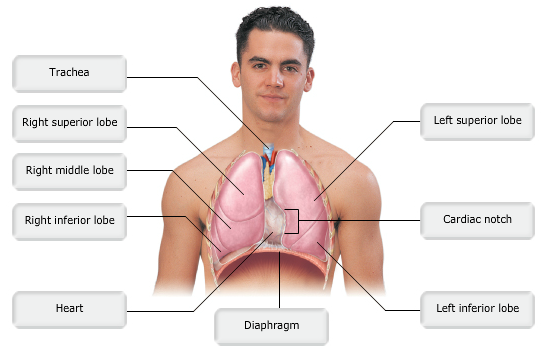 | back 46 no data |
front 47 The smallest subdivisions of the lung visible with the naked eye are the __________, which appear to be connected by black carbon in smokers. | back 47 Lobules |
front 48 In which region are the palatine tonsils found? | back 48 Oropharynx |
front 49 Which form of CO2 transport accounts for the least amount of CO2 transported in blood? | back 49 Dissolved in Plasma |
front 50 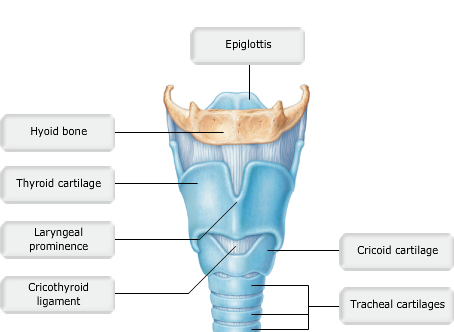 | back 50 no data |
front 51 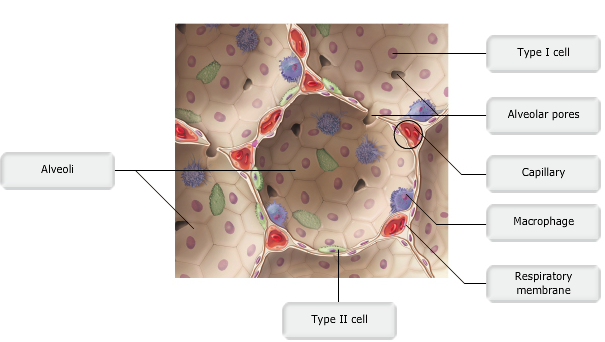 | back 51 no data |
front 52 What is the amount of air that can be exhaled with the greatest possible exhalation after the deepest inhalation called? | back 52 vital capacity |
front 53 Which of the following is the primary factor in oxygen attachment to, or release from, hemoglobin? A) temperature B) blood pH C) partial pressure of oxygen D) partial pressure of carbon dioxide | back 53 C) partial pressure of oxygen |
front 54 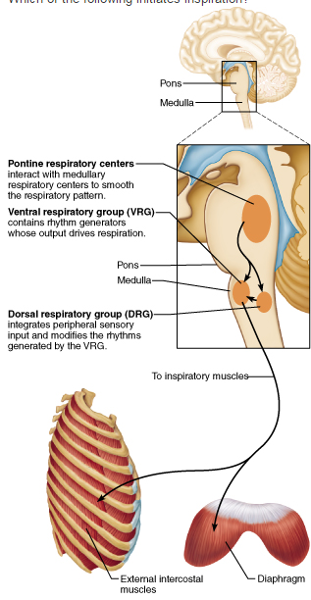 Which of the following initiates inspiration? A) ventral respiratory group (VRG) B) dorsal respiratory group (DRG) C) diencephalon D) pontine respiratory centers | back 54 A) ventral respiratory group (VRG) |
front 55 For gas exchange to be efficient, the respiratory membrane must be ________. | back 55 0.5 to 1 micrometer thick |
front 56 Hypocapnia causes ______. | back 56 Hypoxia |
front 57 Which of the following gives the relationship between the pressure and volume of a gas? A) Henry's law B) Haldane effect C) Dalton's law of partial pressures D) Boyle's law | back 57 D) Boyle's law |
front 58 Select the correct statement about oxygen transport in blood: A) Increased BPG levels in the red blood cells enhance oxygen-carrying capacity. B) During normal activity, a molecule of hemoglobin returning to the lungs carries one molecule of O2. C) During conditions of acidosis, hemoglobin is able to carry oxygen more efficiently. D) A 50% oxygen saturation level of blood returning to the lungs might indicate an activity level higher than normal. | back 58 D) A 50% oxygen saturation level of blood returning to the lungs might indicate an activity level higher than normal. |
front 59 Why is a patient with tuberculosis often noncompliant with treatment? | back 59 Due to the time length of treatment, the pt may stop taking the medication when they start to feel better |
front 60  | back 60 no data |
front 61 In babies born prematurely, pulmonary surfactant may not be present in adequate amounts ______. | back 61 due to insufficient exocytosis in the type II alveolar cells |
front 62 T/F: The alveoli are also known as alveolar sacs. | back 62 False |
front 63 Patients with rhinitis often have "watery eyes" because ______. | back 63 the infection has caused inflammation of the nasolacrimal ducts |
front 64 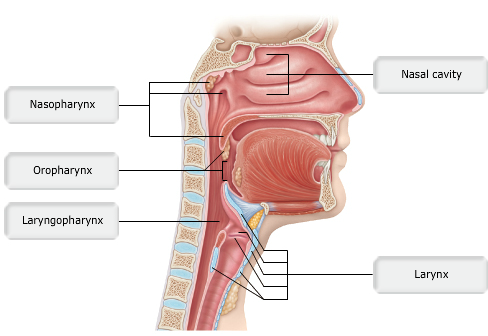 | back 64 no data |
front 65 Which respiratory-associated muscles would contract if you were to blow up a balloon? | back 65 internal intercostals and abdominal muscles would contract |
front 66 The loudness of a person's voice depends on the ________. | back 66 force with which air rushes across the vocal folds |
front 67 Which of the following represents all of the processes involved in respiration in the correct order? A) pulmonary ventilation; external ventilation; internal ventilation; transport of respiratory gases B) external respiration; internal respiration; transport of respiratory gases C) pulmonary respiration; external ventilation; transport of respiratory gases; internal ventilation D) pulmonary ventilation; external respiration; transport of respiratory gases; internal respiration | back 67 D) pulmonary ventilation; external respiration; transport of respiratory gases; internal respiration |
front 68 Which of the choices below is not a role of the pleura? A) helps divide the thoracic cavity into three chambers B) allows the lungs to inflate and deflate without friction C) helps limit the spread of local infections D) aids in blood flow to and from the heart because the heart sits between the lungs | back 68 D) aids in blood flow to and from the heart because the heart sits between the lungs |
front 69 Gas Exchange: Path of Air | back 69 1. Air enters through the nose or mouth 2. Air travels down the trachea and then enters the bronchi 3. Air travels down smaller and smaller bronchioles 4. Air reaches small sacs called alveoli |
front 70 The erythrocyte count increases after a while when an individual goes from a low to a high altitude because the ________. | back 70 concetration of oxygen and/or total atmospheric pressure is lower at high altitudes |
front 71 Which of the following pressures must remain negative to prevent lung collapse? A) intrapleural pressure B) atmospheric pressure C) intrapulmonary pressure D) transpulmonary pressure | back 71 A) intrapleural pressure |
front 72 Which of the following pressures rises and falls with the phases of breathing, but eventually equalizes with the atmospheric pressure? A) atmospheric pressure B) intrapleural pressure C) intrapulmonary pressure D) transpulmonary pressure | back 72 C) intrapulmonary pressure |
front 73 Which of the choices below describes the forces that act to pull the lungs away from the thorax wall and thus collapse the lungs? A) compliance and transpulmonary pressures B) the natural tendency for the lungs to recoil and transpulmonary pressures C) the natural tendency for the lungs to recoil and the surface tension of the alveolar fluid D) compliance and the surface tension of the alveolar fluid | back 73 C) the natural tendency for the lungs to recoil and the surface tension of the alveolar fluid |
front 74 The lung volume that represents the total volume of exchangeable air is the ________. | back 74 Vital Capacity |
front 75 Since mucus-producing cells and cilia are sparse in the bronchioles and alveoli, how does the body remove microorganisms that make their way into the respiratory zone? | back 75 alveolar macrophages crawl freely along internal alveolar surfaces |
front 76 What type of epithelial tissue forms the walls of the alveoli? | back 76 simple squamous epithelium |
front 77 Which parts of the respiratory system function as the main sites of gas exchange? | back 77 Alveoli |
front 78 The local matching of blood flow with ventilation is ________. | back 78 Ventilation-perfusion coupling |