Instructions for Side by Side Printing
- Print the notecards
- Fold each page in half along the solid vertical line
- Cut out the notecards by cutting along each horizontal dotted line
- Optional: Glue, tape or staple the ends of each notecard together
TEAS SCIENCE
front 1 deductive reasoning 1) all men are mortal 2) Sultan is a man | back 1 a method whereby conclusions follow from general principles. since statement 2 says that sultan is a man and statement 1 says all men are mortal, deductive reasoning can be used to conclude that sultan is mortal. |
front 2 inductive reasoning 1) i observed the sun setting this evening 2) I have observed the sun set daily, hundreds of times in my lifetime | back 2 is a method of arriving at general principles from specific facts. ex) Inductive reasoning can be used to conclude that the sun must set every day. |
front 3 Anatomy | back 3 The study of the structure of organs and the body systems |
front 4 Physiology | back 4 the study of the function of the organs and body system. |
front 5 Hierarchy of the structure of the human body | back 5 from smallest to highest: Atoms (the smallest parts of the elements that still retain all the original properties of the element), Molecules (atoms combined, a chemical bonding that possess its own characteristics independent of the atoms themselves), Cells (specific molecules combine to form cells which is the basic unit of life), Tissues (cells combine in terms of function and type to form tissues), Organs (two or more types work together to perform a specific function), Organ system (when organs work together to perform a task), Organism (all 11 organ systems are working together within the body.) |
front 6 four basic tissue types | back 6 Epithelial connective muscular nervous |
front 7 Epithelial Tissue | back 7 layers of cells that cover internal and external surfaces and produce secretions. can only exist in sheets and cannot have its own blood supply the shape of epithelial cells include: squamous, cuboidal, and columnar |
front 8 simple epithelium | back 8 contains one layer of cells, found in body structures where absorption secretion and filtration occurs. |
front 9 Stratified epithelium | back 9 has more than one layer of cells and serves as protection. |
front 10 Connective Tissue | back 10 Found throughout the body; it serves to connect different structures of the body. has its own blood supply, but ligaments (which is a type of connective tissue) does not. Bones, cartilage, adipose (fat) and blood vessel. |
front 11 Muscle Tissue 3 types of muscle tissue are: Skeletal cardiac smooth | back 11 Producing movement. skeletal: supports voluntary movement since it is connected to bones in the skeletal system Cardiac: involuntary and only found in the heart smooth: involuntary. found in walls of the hollow organs like intestines, blood vessels, bladder and uterus |
front 12 Nervous Tissue | back 12 Provides the structure for the brain, spinal cord, and nerves, Nerves are made up of specialized cells called neurons that send electrical impulses throughout the body, supports cells, such a myelin help protect nervous tissue. |
front 13 Circulatory System (Cardiovascular system) | back 13 Consists of the Heart, vessels, arteries, veins, and arterioles and blood. it supports the circulation and distribution of various substances throughout the body. oxygen, hormones and nutrients from food are some of these substances. |
front 14 Digestive System | back 14 consists of all the organs from the mouth to the anus involved in the ingestion and breakdown or processing of food. the organs along the path include the esophagus, stomach, small and large intestines, rectum, and anus. digestive tract manufactures enzymes that break down food so that the nutrients can easily pass into the blood for use throughout the body. |
front 15 digestive system continued. where does the food that is not digested go? | back 15 it is expelled through the anus. |
front 16 Digestive system continued. Where does the absorption of nutrients actually occur? | back 16 in the small intestine, which consists of the duodenum, jejunum, and ileum. After that the colon removes water from the waste that remains. |
front 17 Digestive continued. The 2 other organs that are included in the DS are the liver and the pancreas. What does the pancreas and liver do? | back 17 Liver: Produces bile that helps break down fats Pancreas: delivers enzymes to the small intestine that aid in the digestion. |
front 18 Endocrine System | back 18 a collection of glands and groups of cells that secrete hormones that regulate growth,development, and homeostasis Pineal, pituitary, thalamus, hypothalamus, thyroid, thymus, and adrenal regulate process such as growth. the Pancreas, testis and ovaries have endocrine functions also |
front 19 Integumentary System | back 19 the skin, mucus membrane and hair and nails guard the body's physical and biochemical integrity, maintain a constant body temperature, water proofs the skin, and provide sensory information about the surrounding environment also serves as a barrier to pathogens. |
front 20 Lymphatic System | back 20 consists of the lymph nodes, lymph vessels that carry lymph (a clear fluid rich in antibodies), the spleen, the thymus and the tonsils which are made of lymphoid tissue. It supports the immune systems by housing and transporting white blood cells to and from lymph nodes. the lymphatic system also returns fluid that has leaked from the cardiovascular system back into the blood vessels. |
front 21 Muscular System | back 21 the muscular system consists of skeletal muscles, tendons that connect muscles to bones,and ligaments that attach bones together to form joints. the cardiac and smooth muscles are not included in this organ system. |
front 22 Nervous System | back 22 Brain, spinal cord and nerves and it serves as the body's control system, sends high speed messages throughout the body. flight or fight response. sensory receptors detect stimuli that can occur both inside and outside the body. |
front 23 Reproductive System | back 23 the main purpose is to produce offspring. this system consists of the testes, penis, ovaries, vagina and breasts. the RS is specialized in men to produce sperm and in women to produce eggs (or ova). the R organs also house hormones that encourage or suppress activities within the body. |
front 24 Respiratory System | back 24 The respiratory system is a biological system consisting of specific organs and structures used for the process of respiration in an organism. The respiratory system is involved in the intake and exchange of oxygen and carbon dioxide between an organism and the environment. consists of nasal cavity, pharynx, larynx. trachea, bronchi, and lungs. the lungs house tiny air sacs called aveoli. it is through the walls of the aveoli that oxygen and carbon dioxide move in and out of the lungs via small blood vessels called arterioles. |
front 25 Skeletal System | back 25 Provides support and protection for the body and its organs and supplies framework that , when used in conjunction with the muscles, creates movement. it consists of bones, cartilage, ligament, and joints. SS also serves as storage for minerals such as calcium ans phosphorus. |
front 26 Urinary system (excretory system) | back 26 Helps maintain the water and electrolytes (sodium, chloride and potassium are electrolytes) balance within the body, regulates the acid-base balance of the blood, and removes all nitrogen-containing wastes from the body. the nitrogen-containing wastes are by-products of the breakdowns of proteins and nucleic acids. |
front 27 Anatomical Position | back 27 the position of the body to which health professionals refer when noting body planes, posisiton, or direction: the person is assumed to be standing upright, torward, palms facing forward |
front 28 Superior | back 28 Toward the upper end of the body or body structure situated above another structure, toward the head |
front 29 Inferior | back 29 towards the lower end of the body (opposite of superior) situated below another structure, away from the head |
front 30 Anterior | back 30 Toward the front of the body (front of the body) |
front 31 Posterior | back 31 Toward to back of the body (opposite anterior) |
front 32 Medial | back 32 Toward the middle of the body |
front 33 Lateral | back 33 Toward the outer side of the body (opposite Medial) |
front 34 Intermediate | back 34 between medial and lateral |
front 35 Proximal | back 35 Close to the origin of the body part or point of attachment. |
front 36 Distal | back 36 Away from the origin of the body part or point of attachment (opposite proximal) |
front 37 Superficial | back 37 Toward or at the body surface |
front 38 Deep | back 38 Away from or below the body surface ( opposite of superficial) |
front 39 Sagittal Section | back 39 Cut made along a longitudinal plane dividing the body into right and left parts vertical division of the body into right and left portions |
front 40 Midsagittal Sectionnn | back 40 Sagittal section made down the median of the body |
front 41 Transverse Section (cross section) | back 41 Cut made along a horizontal lane to divide the body into upper and lower regions. horizontal division of the body into upper and lower portions |
front 42 Frontal Section (coronal Section) | back 42 Cut made a long a longitudinal plane that dives the body into front and back regions vertical division of the body into front and back portions |
front 43 Dorsal Body Cavity | back 43 Contains the Cranial cavity and spinal column |
front 44 Ventral Body Cavity | back 44 Contains all the structures within the chest and abdomen; diaphragm divides the ventral cavity into the thoracic cavity (superior to the diaphragm); below the diaphragm are the abdominal and pelvic cavities. |
front 45 Functions of the human body Adaptation | back 45 Receive, interpret, and respond to internal and external stimuli via the nervous system. |
front 46 Functions of the human body continued Circulation | back 46 Transport oxygen and other nutrients to tissues vie the cardiovascular system |
front 47 Functions of the human body continued Elimintaiton | back 47 Remove metabolic wastes from the body via the renal system. |
front 48 Functions of the human body continued Locomotion | back 48 Allow voluntary and involuntary movement of body via the musculoskeletal and neurological systems. |
front 49 Functions of the human body continued Nutrition | back 49 Take in and break down nutrients to be used for metabolism via the digestive system |
front 50 Functions of the human body continued regulation | back 50 hormonal control of the body functions via the endocrine system |
front 51 Functions of the human body continued Self-Duplication | back 51 Production of offspring via the reproductive system |
front 52 Homeostasis | back 52 When all the needs of the body are met and all of the organ systems are working properly, the body is in a stable state. |
front 53 Ways in Which the Organ Systems Interact Maintaining Boundaries | back 53 The cells in the human body are Eukaryotic cells, which means they are surrounded by a membrane as are the organelles inside the cells. The membrane, which is semipermeable, allows some substances to pass through while restricting others. The integumentary system that surrounds the entire body protects it from environmental stimuli and pathogens. |
front 54 Ways in Which the Organ Systems Interact Responding to Environmental Changes | back 54 The human body has the ability to sense and respond to environmental stimuli, both voluntarily and involuntarily. An individual's ability to physically move away from danger is an example of a voluntary response. The hand's ability to withdraw from painful stimuli before the brain preceives the pain is an example of an involuntary reflex response. |
front 55 Ways in Which the Organ Systems Interact Moving | back 55 The primary purpose of the muscular tissue is to support movement of the body. The muscular system moves the bones in the skeletal system and this movement is voluntary. the muscular tissue in the cardiovascular, digestive, reproductive, urinary, and respiratory systems also support movements, and this movement is involuntary. |
front 56 Ways in Which the Organ Systems Interact Ingesting and digesting | back 56 The organs in the digestive system work to remove nutrients from food and transport those nutrients to other parts of the body using the cardiovascular system. |
front 57 Ways in Which the Organ Systems Interact Reproducing | back 57 The reproductive system plays a key role in reproduction, and hormones regulate this process. |
front 58 Ways in Which the Organ Systems Interact Growing | back 58 Growth occurs due to changes in several body systems. The skeletal and muscular systems change shape. The digestive system removes needed nutrients from food. The cardiovascular system transport these nutrients to the cells. The endocrine system releases hormones that signal when and how much growth should occur. |
front 59 Ways in Which the Organ Systems Interact Excreting | back 59 Once nutrients have been removed from food in the digestive system, the waste that remains is excreted from the body using organs in both the digestive systems and the urinary systems. |
front 60 Ways in Which the Organ Systems Interact Metabolizing | back 60 Metabolism is the use of energy by cells as a result of chemical reactions within the cells. the digestive and respiratory systems supply the nutrients and oxygen that the body needs to support metabolism. the blood distributes these materials throughout the body and hormones secreted by the glands of the endocrine system regulate the body's metabolism. |
front 61 Circulatory system (cardiovascular system) | back 61 is the transport highway for the entire body. consists of the heart, blood, and blood vessels. |
front 62 Circulatory system (cardiovascular system) Heart | back 62 An organ that contracts and pumps blood throughout the body. rhythmatic contractions of the heart enable blood to be transported throughout the body. |
front 63 Circulatory system (cardiovascular system) Arteries | back 63 Are blood vessels that transport blood away from the heart to the capillaries. |
front 64 Circulatory system (cardiovascular system) Veins | back 64 Are blood that transport blood from the capillaries back to the heart. |
front 65 Circulatory system (cardiovascular system) Capillaries | back 65 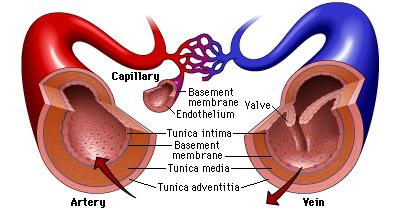 Are tiny blood vessels that transport blood from arteries to veins within the body. Capillaries also serve as the location for the exchange of oxygen, carbon dioxide, fluid, and nutrients within the body. |
front 66 Circulatory system (cardiovascular system) 1) how many chambers does the heart consist of? 2) how many valves does the heart consist of? | back 66 1) Consists of four chambers: Right and Left atriums and the Right and Left ventricles. 2) Four Valves that prevent the flow of blood back into the heart's chambers after a contraction. The Tricuspid and Pulmonary valves on the right side of the heart and the Mitral and aortic valve on the left side of the heart. |
front 67  Circulatory system (cardiovascular system) Flow of blood through the heart | back 67 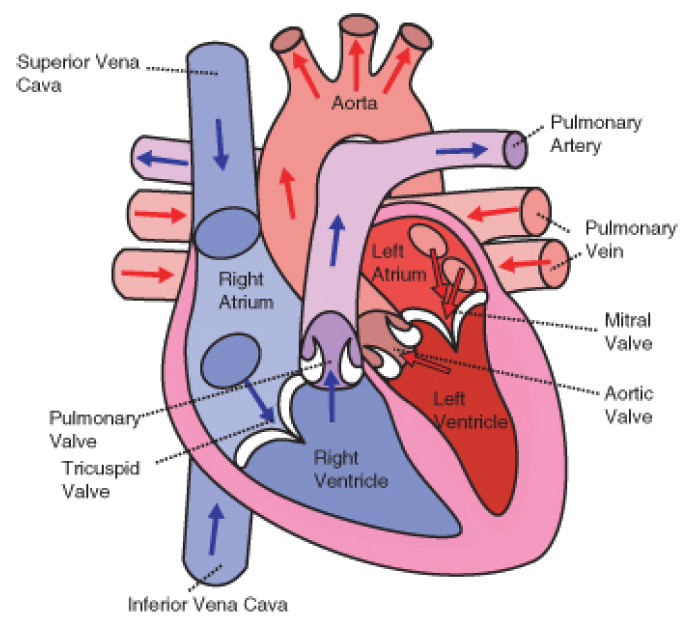 1 )Deoxygenated blood enters into the heart through the superior and inferior vena cava. 2) the blood travels into the right atrium and during contraction of the atrium, flows through the tricuspid valve into the right ventricle. 3) the blood is pushed through the pulmonary valve into the pulmonary artery and lungs when the right ventricle contracts, here it picks up oxygen. 4) the oxygenated blood is then carried back to the heart (by the pulmonary veins) into the left atrium, through the mitral valve and into the left ventricle. 5) contraction of the left ventricle forces blood through the aortic valve, through the aorta, and out to the entire body. |
front 68 Respiratory System | back 68 Provides for air exchange and supplies tissues with oxygenated blood. |
front 69 Respiratory System Lungs | back 69 The primary function is breathing in oxygen and exhaling carbon dioxide. This process begins as air is inhaled through the nose into the Trachea. |
front 70 Respiratory System steps | back 70  1) after air is inhaled through the nose into the Trachea the air is passed into the right and left Bronchial Tubes. 2) within the bronchial tubes are tiny hairs called Cilia, which keeps the airway clear by removing unwanted matter from the lungs. 3) after leaving the Bronchial tubes air travels into the Alveoli; which are tiny air sacs that are surrounded by capillaries. The Alveoli permit the exchange of oxygen and carbon dioxide to occur. 4) the oxygen is then transported by red blood cells into the blood stream. This process begins when the Diaphragm an abdominal muscle that contracts, pulls air into the lungs during Inspiration (the act og taking in oxygenated air). 5) when the diaphragm relaxes carbon dioxide is forced out of the body through Expiration. |
front 71 Nervous System | back 71 Contains the Central Nervous System (CNS) and the Peripheral Nervous System (PNS). Three main functions: to provide sensory, motor, and integrative functions within the body. All of these functions work together with other body systems to react to Stimuli and maintain homeostasis within the body. |
front 72 Nervous System Central Nervous System | back 72 the Brain and Spinal Cord |
front 73 Nervous System Peripheral Nervous System | back 73 Cranial and Spinal nerves that extend beyond the CNS |
front 74 Nervous System (PNS) 1) Automatic Nervous System 2) Sensory- Somatic Nervous System | back 74 1) controls automatic body functions (heartbeat, and digestion) this system includes both sympathetic nerves (which are active when a person is excited or scared) and parasympathetic nerves (which are active when a person is eating or at rest). 2) Consists of 12-pairs of cranial nerves and 31 pairs of spinal nerves and associated Ganglia (collections of nerve cell bodies); this system controls voluntary actions like walking and talking. |
front 75 Nervous System Dendrites | back 75 Receive stimuli from the internal and external environment and bring those stimuli the the Neurons (specialized cells that make up the nervous system and transmit messages) for interpretations. |
front 76 Nervous System Axon | back 76 connects one neuron with another neuron over a fluid filled gap called a Synapse. Chemical neurotransmitters pass through the synapse to transmit an impulse to another neuron. |
front 77 Nervous System Sensory Functions | back 77 Feeling pain, heat, and other stimuli. The face, fingers and toes are more sensitive to stimuli because they have a greater number of Sensory Neurons than other parts of the body. when the body senses pain it automatically withdraws from it. This respond is called a Reflex and occurs when neurons transmit a message to the spinal cord, which in turn sends a message back to the muscles to react before the message is transmitted to the brain. |
front 78 Nervous System Motor Functions | back 78 Carry electrical impulses from the CNS to the Effectors (commonly are glands and muscles). ex: if a person who is hungry saw a table of available food, the integrative function of the brain tells the body's muscles to move toward the food and the salivary glands begin to produce saliva. |
front 79 Nervous System Integrative Function | back 79 Uses sensory information to make decisions by joining together sensory input with memories already stored within the brain. The integrative function also uses sensory information to develop thoughts and feelings upon which decisions may be based at a later time. |
front 80 Digestive system | back 80 Composed of the alimentary canal and accessory structures. Includes mouth, esophagus, stomach, small intestine (made up of the duodenum, jejunum, and ileum), large intestine (colon), and anus. Accessory structures include teeth, salivary glands, pancreas, liver, and gallbladder. |
front 81 Digestive system Peristalsis | back 81 The movement of food through the intestines. the gastrointestinal tract (stomach and intestines) is a long, muscular tube lined with smooth muscle in which peristalsis, rhythmic contractions that propel food towards the colon and anus, occurs. These contractions move the food along the gastrointestinal tract as the food is mechanically and chemically broken down. |
front 82 What are the main functions of the kidney? | back 82 Regulate the amount of water lost from the body/ balance water levels
in the body Your kidneys are complex organs. They regulate the amount of water
lost from the body and get rid of waste products, especially urea.
Urea is made when any excess amino acids are broken down in your
liver. The amino acids come from protein you have eaten. |
front 83 Where are the kidneys? | back 83 Your kidneys are just under your ribcage above the small of your back. The blood arrives through the renal arteryand leaves in the renal vein. The kidneys produce urine which is carried to the bladder along the ureter. The urine is kept in the bladder until you urinate. The muscular sphincters relax and let urine out of the body through the urethra. The diagram below shows the structure of the kidneys and their position in your body. |
front 84 What is the difference in function between the ureter and the urethra? | back 84 The ureter carries urine from the kidney to the bladder. The urethra carries urine from the bladder to be expelled by the body/to the outside of the body. |
front 85 Factors that influence Birth and Fertility Rates Fertility Rates | back 85 Refer to the average number of children a women will have during her child bearing years which occur between the ages of 15-44. Fertility rates coincide with replacement rates. |
front 86 Factors that influence Birth and Fertility Rates Replacement rates | back 86 number of births needed to to maintain the population at its current number. |
front 87 Factors that influence Birth and Fertility Rates Fertility rates in less developed countries vs Fertility rates in developed countries, | back 87 is much higher than 2.3 in less developed, less than 2.1 in developed countries. ex: Fertility rate in Africa is about 7 children per women and in Europe and developed Asian countries it is about 1 child per women. |
front 88 Population growth and decline | back 88 the growth and decline Of a population in a country is a result of the difference between that populations birth and death rates as well as the number of people who immigrate to or emigrate tom that country. |
front 89 Crude birth rate | back 89 the number of births per 1,000 people per year |
front 90 Crude death Rate | back 90 Humber of deaths per 1,000 people per year . |
front 91 Immigration | back 91 tue act of an individual moving into a region Or country to live. |
front 92 Emigration | back 92 the act of an individual moving out Of one region or country to live in another. |
front 93 Life science biological classification system Taxonomy | back 93 Domain, kingdom, Phylum, Class,Order, family, Genus, and species |
front 94 Domain | back 94 Archaea, Eubacteria, & Eukarya |
front 95 What are the six kingdoms? | back 95 1. Animalia 2.Fungi 3. Plantae 4.Protista (part of the Eukarya domain) 5. Eubacteria (Only kingdom in the Eubacteria domain) 6. Archabacteria (the only kingdom in the Archaea domain) |
front 96 Classifying Individual species | back 96 the Latin name Of the genus and species is written in Italicswith the genus capitalized and the species not capitalized ex: binomial nomenclature for humans is Homo sapiens and the common fruit fly is classified as Drosophila melanogasten |
front 97 Natural selection& Adaptation Charles Darwin | back 97 was the first to study and write about species and adaptation! In 1859 Darwin wrote On the Origin of species |
front 98 Natural selection | back 98 Occurs when some individuals of a species are better able to survive in their own environment and reproduce than others. (Survival Of the fittest) |
front 99 Genes | back 99 stretches of DNA On a Chromosomes that provide information for an organism's characteristics which are responsible for heredity |
front 100 Alleles | back 100 Every gene exists in a different forms Known as alleles. Some alleles Contain one on more mutations [which are changes in the DNA that affect the way agene functions. ' |
front 101 Adaptation | back 101 the increase in alleles of certain genes from generation to generation that allows a species to survive and reproduce better. |
front 102 Nucleic Acids | back 102 to store and transmit hereditary information |
front 103 Nucleic Acids Nucleotides | back 103 a nucleic acid is a chain of Nucleotides. that Consists of a pentose a phosphate group and a Nitrogenous baseacid is a chain of Nucleotides. that Consists of a pentose a phosphate group and a Nitrogenous base |
front 104 Nucleic Acids PENTOSE | back 104 a type of sugar has five carbon atoms |
front 105 Nucleic Acids PHOSPHATE GROUP | back 105 A molecule in the backbone of DNA and RNA that links adjoining bases together |
front 106 Nucleic Acids NITROGENOUS BASE | back 106 A molecule found in DNA & RNA that encodes the genetic information in cells. |
front 107 Nucleic Acids What are the five types of nitrogenous bases? | back 107 Adenine, cytosine, Guanine, thymine and Uracil. Adenine, cytosine and guanine are found in Both DNA and RNA! Thymine is found in DNA Uracil is found In RNA |
front 108 Nudie acids DNA is most often Seen in what Structural form? | back 108 Double Helix This complex is able to form because weak bonds are able to form between the hydrogen atoms and oxygen or Nitrogen atoms between bases in the Complementary strands of DNA. |
front 109 Nudie Acids Hydrogen bonds | back 109 Bond in which hydrogen atom is covalently linked to an electronegative atom but still attracted to other electronegative atoms |
front 110 Nudiec Acids adenine (A) and Guanine (G) pair up with what? | back 110 adenine (A) always pairs with Thymine (T) Guanine (G) always pairs up with Cytosine (c) |
front 111 Nudie Acids Purines | back 111 Class of nucleotides with two rings Adenine and Guanine have two rings |
front 112 Nucliec Acids Pyrimidines | back 112 Class of nucleotides with one ring Thymine & Cytosine |
front 113 Nudie Acids Differences between DNA & RNA | back 113 1. In RNA the pyrimidine base ofuracil is used instead Of thymine base found in DNA 2. DNA contains Deoxy-Ribose while RNA Contains Ribose |
front 114 Nucliec Acids DNA | back 114 genetic blueprint Of the cell |
front 115 Nueliee Acids RNA | back 115 Protein synthesis, or the assembly of amino acids into proteins. Messenger within the cell. |
front 116 Nucliec Acids. Protein production Process of DNA and RNA | back 116 Message stored in the the basesof DNA must be transferred to the Ribosomes to make proteins. So, cells Copy the instructions in DNA into RNA (Transcription) and Send themessenger RNA to the Ribosome.Then Proteinsare made by ribosomes from tthemessenger RNA to the Ribosome.Then Proteins are made by ribosomes from the information and sent out to the entire cell. This is process of protein production from mRNA is Called Translation |
front 117 Parts of a Cell Prokaryotic | back 117 Cell wall, cytoplasm, Organelles, Nucleoid, plasmids,Ribosomes, Flagella |
front 118 Parts of a Cell (Prokaryotic) Cell wall | back 118 an outside rigid layer that helps separate the inside and Outside Of the Cell With a semi permeable membrane allowing certain substances in and out of the cell as needed. |
front 119 Parts of a cell Cytoplasm | back 119 An inner layer which is a rich protein fluid with gel like Consistency that houses organelles. |
front 120 Parts of a cell Organlles | back 120 "Tiny organs" which serves a unique function within the cell. |
front 121 Part of a cell Nucleoid | back 121 The condensed DNA of the cell it contains genes and the genetic blueprints for the formation of proteins that make up the machinery of the cell. |
front 122 Parts of a cell Plasmids | back 122 Are small circular portions of DNA not associated with the nucleod. they contain a small number of genes compared to the DNA in the nucleoid. |
front 123 Parts of a Cell Ribosomes | back 123 Manufacture proteins for the cell from the RNA messages, they are very small bodies that are free-floating within the cytoplasm. Proteins do most of the work in the cells |
front 124 Parts of a cell Flagella | back 124 Are lng and whip-like and project outward from the cell. Bacteria also have Pili that allows communication and transfer of information between two cells. |
front 125 Parts of a Cell Eukarya | back 125 a cell containing a nucleus and other membrane bound organelles. some eukaryotic cells live as single cells, but man esixt as part of a larger complex of cells comprising a mulitcellular orgaism. |
front 126 Parts of a cell (eukaryotic) Plasma Membrane | back 126 Which envelopes the cell an is semipermeable to allow certain substances and water in and out. Cytoplasm which contains the cell contents d the organells and is gel-like |
front 127 Parts of a cell (E) Ribosomes | back 127 Manufacture proteins for the cell from the RNA messages, they are very small bodies that are free-floating within the cytoplasm. Proteins do most of the work in the cells |
front 128 Part of a cell (E) Endoplasmic reticulum (ER) | back 128 Atubular transport network within the cell. it appears as a stack of flattened membranous sacs. there are two types of ER: smooth (smooth is not gritty, the smooth varitety is important for numerous metabolic processes in the cell) and Rough (studded with ribosomes causing it to have a rough gritty apperance) The ER is responsible for moving proteins from one part of a cell to another and for moving proteins to the outside of a cell. (Process known as secretion) |
front 129 Cell Differentiation | back 129 Differentiation produces a more specialized Cell from a less-specialized cell. To form an embryo Differentiation determines What cell type each Cell will become. process occurs with cells in the developing embryo but can also Occur in adults. |
front 130 Embryo | back 130 An early stage of an organism's development, when cells have begun to differentiate. |
front 131 Zygote | back 131 a fertilized egg whichbegins dividing and becomes a Mass of Cells. |
front 132 Gastrulation | back 132 The most Critical stage Of development in which individual tissue layers begins to form |
front 133 stem Cells | back 133 Stem cells are spcialize cells that continually self-divide and generate progneny cells for organ formation and maintenance ex: Totipotent, pluripotent and multipotent |