Instructions for Side by Side Printing
- Print the notecards
- Fold each page in half along the solid vertical line
- Cut out the notecards by cutting along each horizontal dotted line
- Optional: Glue, tape or staple the ends of each notecard together
Chapter 12-Neural Tissue
front 1 The action potential is a transient change in the resting membrane potential from -70 mV to +30 mV, then back to -70 mV. This change is caused by the opening of first _____ then _____ voltage-gated channels. | back 1 Na+ then K+ |
front 2 What area(s) of the neuron generate signals that open the voltage-gated channels in the first part of the axon, thus causing an action potential? | back 2 Dendrites and cell body |
front 3 As the axon hillock depolarizes, Voltage-gated Na+ channels open and Na+ moves (into or out of) __________ the cell causing further (depolarization or repolarization) __________. | back 3 into; depolarization |
front 4 If depolarization reaches -55 mV, an action potential will be generated. What is this -55 mV trigger point called? | back 4 Threshold |
front 5 At the end of the depolarization phase, what voltage-gated channels open to help restore the resting membrane potential? | back 5 Voltage-gated K+ channels |
front 6 Repolarization is caused by the movement of what ion (sodium or potassium), in what direction (into or out of the cell)? | back 6 potassium; out of the cell |
front 7 After an action potential, the membrane becomes more negative than -70 mV. This period is called: | back 7 hyperpolarization. |
front 8 After a neuron has generated an action potential, it cannot generate another one for a while. This period is called: | back 8 the absolute refractory period. |
front 9 The fastest conduction of an action potential would occur in an axon with which of the following characteristics? | back 9 Large diameter and myelinated |
front 10 What is the name of the disease in which the myelin sheaths of central nervous system axons are destroyed? | back 10 Multiple sclerosis |
front 11 Which anatomical division of the nervous system consists of the brain and spinal cord? | back 11 central nervous system |
front 12 Which functional division of the nervous system controls skeletal muscle contractions? | back 12 somatic nervous system |
front 13 What part of the neuron is a long cytoplasmic process capable of propagating an action potential? | back 13 axon |
front 14 What part of the neuron consists of the cytoplasm that surrounds the nucleus? | back 14 perikaryon |
front 15 Which structural class of neurons consists of neurons with one axon and one dendrite? | back 15 bipolar neurons |
front 16 Which functional class of neurons carries electrical signals to control the contraction of smooth muscle and cardiac muscle? | back 16 visceral motor neurons |
front 17 What type of neuroglial cell participates in the production and circulation of cerebrospinal fluid? | back 17 ependymal cells |
front 18 What type of neuroglial cell myelinates axons in the peripheral nervous system? | back 18 Schwann Cells |
front 19 Which type of neuroglial cell functions in the central nervous system to engulf cellular debris, waste products, and pathogens? | back 19 microglia |
front 20 Which type of active channels in the plasma membrane open or close when they bind certain chemicals, such as neurotransmitters? | back 20 chemically gated channels |
front 21 A movement of ions that increases the negativity of the resting membrane potential is _____. | back 21 hyperpolarization |
front 22 What is the term for the period when the voltage-gated sodium channels are opened and the membrane cannot respond to a new stimulus, even a strong one? | back 22 absolute refractory period |
front 23 An action potential increases the membrane potential to ___ mV. | back 23 +30mV |
front 24 Which type of axon would propagate action potentials at the highest speed? | back 24 large diameter, myelinated |
front 25 What type of synapse has the presynaptic and postsynaptic membranes locked together at gap junctions? | back 25 Electrical synapses have presynaptic and postsynaptic membranes locked together at gap junctions. |
front 26 What causes the release of acetylcholine (ACh) into the synaptic cleft in a cholinergic synapse? | back 26 calcium ions entering the cytoplasm of the synaptic terminal |
front 27 Which neurotransmitter is associated with a person's emotional states and moods and is linked to depression? | back 27 Serotonin |
front 28 Which of the following has/have effects similar to morphine and function(s) to relieve pain?
| back 28 Endorphin |
front 29 A graded depolarization caused by the arrival of a neurotransmitter at the postsynaptic membrane is a(n) __________. | back 29 excitatory postsynaptic potential (EPSP) |
front 30 The addition of stimuli occurring in rapid succession at a single synapse is called __________. | back 30 temporal summation |
front 31 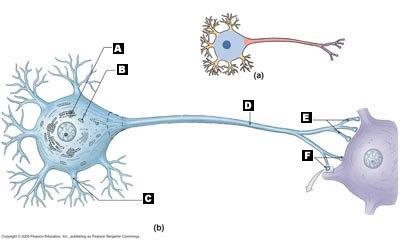 Label the following structural components of a neuron. | back 31 A. Nissl bodies (RER and free ribosomes)
|
front 32 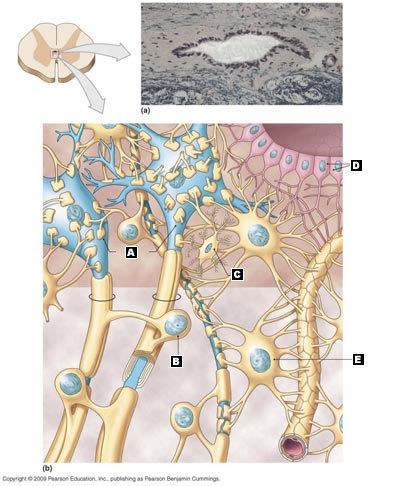 Correctly label the cells of the central nervous system on the diagram. | back 32 A. Neuron
|
front 33 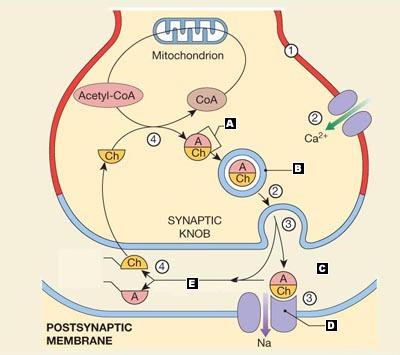 Correctly match the labels to the following parts of a cholinergic synapse. | back 33 A. Acetylcholine
|
front 34 What is the implication of a mature neuron having no centrioles? | back 34 The cell is not able to divide. |
front 35 The axon emerges from the soma at a thickened region called the __________. | back 35 Axon Hillock |
front 36 The movement of materials from the soma to the synaptic terminal is called __________. | back 36 axoplasmic transport |
front 37 The movement of substances from the synaptic terminal to the soma is called __________. | back 37 retrograde flow |
front 38 Motor neurons form the __________ division of the __________. | back 38 efferent; PNS |
front 39 What type of sensory neurons would Amy, a gymnast, use to inform her brain of the position of her skeletal muscles and joints? | back 39 proprioceptors |
front 40 The ventricles of the brain and the central canal of the spinal cord are filled with __________. | back 40 cerebrospinal fluid |
front 41 Which of the following glial cells surrounds cell bodies in the PNS and regulates levels of oxygen and carbon dioxide around ganglionic neurons? | back 41 satellite cells |
front 42 Which of the following glial cells can form a myelin sheath around axon fibers in the central nervous system? | back 42 oligodendrocyte |
front 43 The transmembrane potential found in all living cells is maintained by __________. | back 43 the sodium–potassium pump |
front 44 There are two major categories of ion channels: leak channels and __________. | back 44 Active Channels |
front 45 Which one of the following statements about the transmembrane potential is correct? | back 45 The resting negative charge on the interior of the plasma membrane is due mainly to charges on proteins. |
front 46 The refractory period occurs __________. | back 46 from the time an action potential begins until the normal resting potential has stabilized |
front 47 The speed at which an action potential is transmitted depends on __________. | back 47 the myelination and diameter of the axon |
front 48 Compared with type C fibers, type A fibers have a larger diameter and can increase propagation ________ times faster. | back 48 120 |
front 49 Presynaptic facilitation __________. | back 49 is activity at an axoaxonal synapse that increases the amount of neurotransmitter released when an action potential arrives at the synaptic terminal |
front 50 Name some of the functions of the astrocytes. | back 50 -Guiding neuron development.
|
front 51 A stimulus causes a neuron's membrane potential to rise to −60 mV. What occurs? | back 51 Depolarization, action potential, opening of sodium channels |
front 52 Give some characteristics of saltatory transmission. | back 52 -Occurs in myelinated neurons.
|
front 53 During the initiation of an action potential in an area of excitable membrane, what happens? | back 53 A graded potential raises the transmembrane potential toward threshold.
|
front 54 Name the three classes of mechanisms by which neurotransmitters function. | back 54 -lipid-soluble gases that can diffuse into the cell and bind to enzymes inside the cell.
|
front 55 Extracellular chemicals other than neurotransmitters and neuromodulators can cause ___________________? | back 55 facilitation or inhibition of function in neurons. |
front 56 If the axon hillock remains depolarized for an extended time, what will happen? | back 56 A new action potential will be generated as soon as the absolute refractory period of the previous one has ended. |
front 57 True/False. The ependymal cells line the blood vessels that supply the neural tissues of the brain, thereby forming the blood-brain barrier. | back 57 False. Ependymal cells line the central canal and brain ventricles and may monitor or produce some of the CSF that fills these open spaces. |
front 58 True/False. Neurotransmitters that depress the resting potential are called excitatory. | back 58 False. Depressing the resting potential causes hyperpolarization of the membrane and inhibits action potential. |
front 59 True/False. The all-or-none principle applies to excitable membranes, such as neuron membranes. This principle states that either a stimulus is great enough to depolarize a membrane to threshold and thus trigger an action potential, or the stimulus is not able to depolarize to threshold and thus an action potential does not occur. | back 59 True. Once the action potential has been triggered, all impulses are identical in strength and speed. However, the stimulus must be great enough to cause the triggering of the action potential. |
front 60 True/False. Unipolar neurons have only one cell process, the axon. | back 60 False. Unipolar neurons have both dendrites and an axon. |
front 61 True/False. Acetylcholine is broken down in the mitochondrion by acetylcholinesterase. | back 61 False. Acetylcholine is broken down in the synaptic cleft by acetylcholinesterase. |
front 62 Which part of the nervous system performs the higher-order thinking required to complete these set of note cards? | back 62 Central Nervous System |
front 63 Neurons are responsible for __________. | back 63 information transfer and processing in the nervous system |
front 64 The region of a neuron with voltage-gated sodium channels is the __________. | back 64 axon hillock |
front 65 Neurons are classified on the basis of their structure as __________. | back 65 anaxonic, unipolar, bipolar, multipolar |
front 66 Neurons are classified on the basis of their function as __________. | back 66 motor, sensory, association |
front 67 What are the two major cell populations of neural tissue? | back 67 neurons and neuroglia |
front 68 Which of the following CNS glial cells removes debris, wastes, and pathogens by phagocytosis? | back 68 microglia |
front 69 The white matter of the CNS represents a region dominated by the presence of __________. | back 69 oligodendrocytes |
front 70 Depolarization of the membrane will shift the membrane potential toward __________. | back 70 0mV |
front 71 What is the term given to describe a shift in transmembrane potential from −70 mV to −90 mV? | back 71 hyperpolarization |
front 72 If resting membrane potential is −70 mV and the threshold is −60 mV, a membrane potential of −62 mV will __________. | back 72 not produce an action potential |
front 73 At the site of an action potential, the membrane contains __________. | back 73 an excess of positive ions inside and an excess of negative ions outside |
front 74 A node along the axon represents an area where __________. | back 74 there is an absence of myelin |
front 75 Nerve cell bodies in the PNS are clustered together in masses called __________. | back 75 ganglia |
front 76 What are the most important factors that determine the rate of action potential conduction? | back 76 the presence or absence of a myelin sheath and the diameter of the axon |
front 77 At an electrical synapse, the presynaptic and postsynaptic membranes are locked together at __________. | back 77 gap junctions |
front 78 Exocytosis and the release of acetylcholine into the synaptic cleft are triggered by __________. | back 78 calcium ions flooding into the synaptic terminal |
front 79 An important neurotransmitter in emotional states and moods is __________. | back 79 serotonin |
front 80 An excitatory postsynaptic potential (EPSP) is __________. | back 80 a graded depolarization produced by the arrival of a neurotransmitter |
front 81 An inhibitory postsynaptic potential (IPSP) is a __________. | back 81 graded hyperpolarization of the postsynaptic membrane |
front 82 Rabies is a viral disease contracted from the bite of an infected animal. Rabies bypasses many immune system defenses by traveling in peripheral neurons to reach the CNS. Which method of transport is NOT used by the rabies virus to reach the CNS? | back 82 anterograde flow |
front 83 Sensory neurons are responsible for carrying impulses __________.
| back 83 to the CNS
|
front 84 Interneurons, or association neurons, differ from sensory and motor neurons in their __________. | back 84 exclusive location in the brain and spinal cord |
front 85 Graded potentials that develop on the postsynaptic membrane in response to a neurotransmitter are __________. | back 85 postsynaptic potentials |
front 86 The addition of stimuli occurring in rapid succession at a single synapse is __________. | back 86 temporal summation |
front 87 What type of gated channel opens or closes in response to distortion of the membrane? | back 87 mechanically gated channel |
front 88 Interneurons are responsible for __________. | back 88 analysis of sensory inputs and coordination of motor outputs |
front 89 Sensory (ascending) pathways distribute information __________. | back 89 from peripheral receptors to processing centers in the brain |
front 90 Tyson decides to travel overseas but does not have all the required vaccines needed before he goes. While on his trip, he contracts diphtheria. Which type of glial cell is particularly at risk from this disease? | back 90 Schwann cells |
front 91 Schwann cells are glial cells responsible for __________. | back 91 producing a neurilemma around peripheral axons |
front 92 What happens when a barrier prevents the movement of opposite charges toward one another? | back 92 A potential difference exists. |
front 93 Which of the following statements about the sodium–potassium pump is correct? | back 93 The activity of the sodium–potassium pump is needed after every action potential to restore resting potential. |
front 94 Which of the following is a correct statement of the all-or-nothing principle? | back 94 A given stimulus either triggers a typical action potential or does not produce one at all. |
front 95 During the relative refractory period, a larger-than-normal depolarizing stimulus can __________. | back 95 bring the membrane to threshold and initiate a second action potential |
front 96 Saltatory conduction conducts impulses along an axon __________. | back 96 five to seven times faster than continuous conduction |
front 97 In type C fibers, action potentials are conducted at speeds of approximately __________. | back 97 2 mph |
front 98 The larger the diameter of the axon, the __________. | back 98 faster the rate of transmission |
front 99 Rachel decides to go swimming, but when she sticks her big toe into the water, she changes her mind because the water is too cold. The sensory neurons responsible for sending the message about the temperature of the cold water are __________. | back 99 exteroceptors |
front 100 The main functional difference between the autonomic nervous system and the somatic nervous system is that the activities of the ANS are __________. | back 100 primarily involuntary, or under "automatic" control |
front 101 Lulu, who is 50 years old, decides she wants to receive Botox treatments. If Botox, short for botulism toxin, prevents the release of ACh from synaptic terminals, what effect should Lulu expect from having Botox injected into her facial muscles? | back 101 temporary paralysis in the injected facial muscles |
front 102 What happens when depolarization to threshold occurs? | back 102 Voltage-gated sodium channels are opened. |
front 103 Emma is very excited because after taking up running several months ago, she has begun to experience the phenomenon called "runner's high." This is caused by the production of endorphins. What is the effect of the endorphins on Emma when she runs? | back 103 Endorphins are blocking the transmission of substance P, a neurotransmitter that sends information about pain to the CNS. |
front 104 Which of the following is the most excitatory neurotransmitter in the brain and functions in learning and memory? | back 104 glutamate |
front 105 Ann and Elise are two college students on an overseas vacation. Because they both love seafood, they stop at a restaurant in a coastal town for lunch. After dining on shellfish, they become very sick and have trouble breathing. What may have happened to Ann and Elise? | back 105 -They may have consumed some tetrodotoxin (TTX), which can cause abnormal sensations.
|
front 106 Facilitation in the neuron's transmembrane potential toward threshold results from __________. | back 106 -any shift that makes the cell more sensitive to further stimulation
|
front 107 The reason that active neurons need ATP is to support_______. | back 107 -the synthesis, release, and recycling of neurotransmitter molecules.
|
front 108 The primary functions of the nervous system include ______. | back 108 -providing sensation of the internal and external environments
|
front 109 Name some structure parts of the PNS. | back 109 -a ganglion
|
front 110 The CNS has _ types of neuroglia. Name them. | back 110 4 types, ependymal cells, astrocytes, oligodendrocytes and microglia. |
front 111 Ependymal Cells. Where are they located, name their functions. | back 111 CNS. They line ventricles (brain) and central canal (spinal cord); assist in producing, circulating, and monitoring CSF. |
front 112 Astrocytes. Where are they located, name their functions. | back 112 CNS. Maintain blood-brain barrier; provide structural support; regulate ion, nutrient, and dissolved gas concentrations; absorb and recycle neurotransmitters; form scar tissue after injury. |
front 113 Oligodendrocytes. Where are they located, name their functions. | back 113 CNS. Myelinate CNS axons; provide structural framework. |
front 114 Microglia. Where are they located, name their functions. | back 114 CNS. Remove cell debris, wastes, and pathogens by phagocytosis. |
front 115 The PNS has _ types of neuroglia. Name them and their functions. | back 115 2 types. Satallite cells- surround neuron cell bodies in ganglia; regulate O2, CO2, nutrient, and neurotransmitter levels around neurons in ganglia.
|
front 116 Describe Wallerian degeneration. | back 116 The axon distal to the injury site degenerates, and macrophages migrate into the area to clean up the debris. |
front 117 The sequence of events at a typical cholinergic synapse | back 117 Step 1: An arriving ap depolarizes the synaptic terminal.
|