Instructions for Side by Side Printing
- Print the notecards
- Fold each page in half along the solid vertical line
- Cut out the notecards by cutting along each horizontal dotted line
- Optional: Glue, tape or staple the ends of each notecard together
Chapter 15 Connect Quiz
front 1 Primitive functions, such as blood pressure, heart rate, body temperature, metabolism, and respiratory airflow, are regulated by | back 1 Visceral Reflexes |
front 2 The ____ system quietly manages a myriad of unconscious processes responsible for the body's homeostasis | back 2 Autonomic nervous |
front 3 This function is among the most ___ of functions for animals to maintain healthy conditions for life | back 3 Basic |
front 4 Many drug therapies are based on the ___ alteration of autonomic functions | back 4 Alterations |
front 5 In autonomic motor pathways, the nerve signal must travel along ___ neurons to reach a target cell | back 5 Two |
front 6 The first neuron emerges from the CNS and synapses with a second neuron in a ___ outside the CNS | back 6 Ganglion |
front 7 The second neuron’s axons extend to the ____ from the ganglion | back 7 Target cell |
front 8 The first neurons are called ____ and are myelinated | back 8 Preganglionic |
front 9 The second neurons are called ____ and are unmyelinated | back 9 Postganglionic |
front 10 Also known as the ____ division, the parasympathetic nervous system. Has axons exiting the CNS at the medulla oblongata | back 10 Crainosacral |
front 11 Action potentials travel down the preganglionic nerve axons of the ____ , towards the effector organs | back 11 Vagus nerve |
front 12 These impulses arrive at the cardiac plexus where secretion of acetylcholine creates an action potential in the ____ neuron | back 12 Postganglionic |
front 13 The impulse arrives relatively quickly at the heart, as parasympathetic postganglionic axons are ____ compared sympathetic postganglionic axons | back 13 Short |
front 14 Action potentials arriving at the sinoatrial and atrioventricular nodes of the heart cause ___ to be released | back 14 Acetylcholine |
front 15 This parasympathetic neurotransmitter causes a ___ in heart rate and contractility | back 15 Decrease |
front 16 Also known as the ___ division, the sympathetic nervous system exits the CNS via the spinal nerves from T1-L2 | back 16 Thoracolumbar |
front 17 Action potentials travel along the preganglionic axons and enter the ___ | back 17 Sympathetic chain ganglion |
front 18 Axons exiting the sympathetic chain ganglia take one of three routes: the spinal nerves route, the sympathetic nerve route, or the ___ nerve route | back 18 Splanchnic |
front 19 Arriving at target cells, ____ axons release acetylcholine or norepinephrine into the synaptic cleft | back 19 Postganglionic |
front 20 The effect of norepinephrine binding to ___ receptors stimulates cardiac muscle cells | back 20 Adrenergic |
front 21 Which division of the nervous system has two neurons connecting the CNS to an effector? | back 21 Autonomic |
front 22 When body temperature increases, thermoreceptors are stimulated and send nerve signals to the CNS. The CNS sends motor signals to sweat glands, which attempt to reduce body temperature. This is an example of a ____ reflex | back 22 Visceral |
front 23 A malfunctioning visceral reflex can be the cause of a(n) ____ ,which can result in disorder and/or disease | back 23 Homeostatic imbalance |
front 24 The ___ division of the ANS increases alertness. The ___ division has a calming effect on the body | back 24 Sympathetic; Parasympathetic |
front 25 Where are the cell bodies of sympathetic preganglionic axons located in the spinal cord? | back 25 Lateral gray horn |
front 26 In the ___ division of the ANS, the preganglionic axons are short, while in the ___ division, the preganglionic axons are relatively long | back 26 Sympathetic; Parasympathetic |
front 27 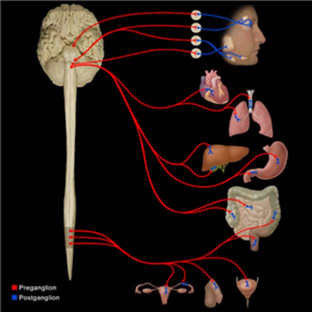 Which of the following is illustrated here? | back 27 Parasympathetic outflow to effectors |
front 28 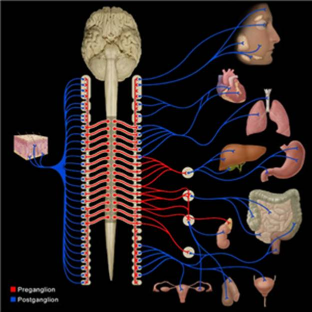 Which of the following is illustrated here? | back 28 Sympathetic outflow to effectors |
front 29 The digestive tract has a nervous system of its own called the ___ plexus | back 29 Enteric |
front 30 Which type of receptor binds to ACh | back 30 Cholinergic |
front 31 Which of the following is not an example of an autonomic receptor | back 31 Ganglionic |
front 32 An organ that receives both sympathetic and parasympathetic axons is said to have what? | back 32 Dual innervation |
front 33 Which nervous system controls glands, smooth muscle, and cardiac muscle | back 33 Autonomic |
front 34 Which division of the ANS is referred to as the “rest-and-digest” division | back 34 Parasympathetic |
front 35 Regarding the adrenal gland, which of the following pairings is correct? | back 35 Medulla: The inner part |