Instructions for Side by Side Printing
- Print the notecards
- Fold each page in half along the solid vertical line
- Cut out the notecards by cutting along each horizontal dotted line
- Optional: Glue, tape or staple the ends of each notecard together
Chapter 14 Connect Quiz
front 1 The cerebrum exhibits folds called gyri separated by grooves called sulci | back 1 True |
front 2 There are three cranial nerves involved in eye movement and two in the sense of taste | back 2 False |
front 3 What is the most posterior component of the brainstem | back 3 Medulla Oblongata |
front 4 The right and left cerebral hemispheres are separated from each other by | back 4 The longitudinal fissure |
front 5 The cerebellum is ___ to the cerebrum | back 5 Posterior |
front 6 The pons and cerebellum arise from which secondary embryonic vescile | back 6 Metencephalon |
front 7 Which of the following structures appears as a large bulge just rostral to the medulla | back 7 Pons |
front 8 From superficial to deep, the meninges occur in which order | back 8 Dura mater, Arachnoid, Pia mater |
front 9 Which of the following is NOT a function of CSF | back 9 To provide oxygen and nutrients to the nervous tissue |
front 10 Cerebrospinal fluid is secreted by choroid plexuses in the ventricles and reabsorbed by arachnoid granulations in the | back 10 Superior sagittal sinus |
front 11 Which structures create the blood brain barrier (BBB)? | back 11 Tight junctions between endothelial cells that form the capillary walls |
front 12 The medulla oblongata originates from which structure? | back 12 Myelencephalon |
front 13 Where are the cardiac, vasomotor, and respiratory centers found? | back 13 Medulla Oblongata |
front 14 The ___ functions in visual attention, such as to look and follow the flight of a butterfly | back 14 Superior Colliculi |
front 15 The reticular formation is a web of ___ scattered throughout the ____ | back 15 Gray matter; Brainstem |
front 16 What is the largest part of the hindbrain? | back 16 Cerebellum |
front 17 Loss of equilibrium and motor coordination would most likely be related to a lesion in which structure? | back 17 Cerebellum |
front 18 In which structure is the arbor vitae found? | back 18 Cerebellum |
front 19 There are no cranial nerves associated with which part of the brain | back 19 Cerebellum |
front 20 Which of the following is not associated with the pons? | back 20 Neck movement |
front 21 The thalamus, hypothalamus, and epithalamus are derivatives of which embryonic structure | back 21 Diencephalon |
front 22 Nearly all the somatosensory input to the cerebrum passes by way of the synapses in which region of the brain | back 22 Thalamus |
front 23 Sex drive, body temperature, and food and water intake are regulated by which part of the brain | back 23 Hypothalamus |
front 24 A lesion in which structure would cause a person to have an erratic waking/sleeping cycle | back 24 Suprachiasmatic nucleus |
front 25 The pineal gland is part of which larger region of the brain | back 25 Epithalamus |
front 26 Planning, motivation, and social judgement are functions of the brain associated with which part of the cerebrum | back 26 Frontal lobe |
front 27 Most gray matter of the cerebrum is located in which region | back 27 Neocortex |
front 28 Where are the hippocampus and amygdala found? | back 28 Limbic system |
front 29 The ___ is responsible for awareness of general sensation (i.e. touch), and the ____ is responsible for making cognitive sense of it | back 29 Primary somatosensory cortex; Somatosensory association area |
front 30 Short-term memory is associated with the ____, whereas long-term memory is associated with the ____ | back 30 Hippocampus; Cerebral cortex |
front 31 Destruction of the amygdala would mostly affect which of the following | back 31 Expression of emotional feelings |
front 32 Which body region is controlled by the largest area of the motor cortex | back 32 Fingers |
front 33 Which of the following functions would most likely be controlled by the representational hemisphere of the cerebrum | back 33 Painting a picture |
front 34 After a stroke, a patient complains about a lack of sensitivity in their right hand. The stroke most likely affected which part of their brain | back 34 Postcentral gyrus in the left parietal lobe |
front 35 Which of the following is NOT a motor cranial nerve | back 35 Vestibulocochlear nerve (VIII) |
front 36 What is the largest of the cranial nerves and the most important sensory nerve of the face | back 36 Trigeminal nerve (V) |
front 37 Which of the following structures does not contain CSF? | back 37 Dural sinus |
front 38 If the cerebrum was no longer able to communicate with the midbrain, what type of tract would you suspect has been damaged | back 38 Projection |
front 39 In the cerebral cortex, which cells process information on a local level? | back 39 Stellate |
front 40 Which of the following cranial nerves is mispraired | back 40 Optic - I |
front 41 Your dentist gives you an injection of anesthetic in preparation for a filling. Which cranial nerve did they target | back 41 V |
front 42 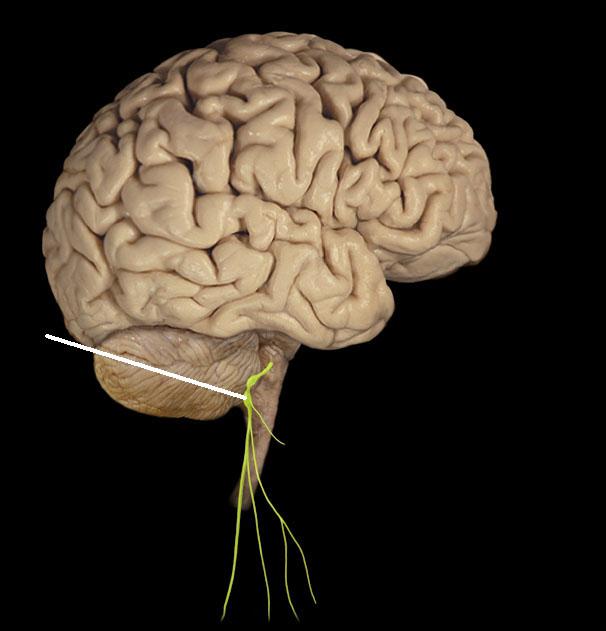 Damage to this cranial nerve could result in which symptom | back 42 Impaired swallowing and gastrointestinal motillity |
front 43 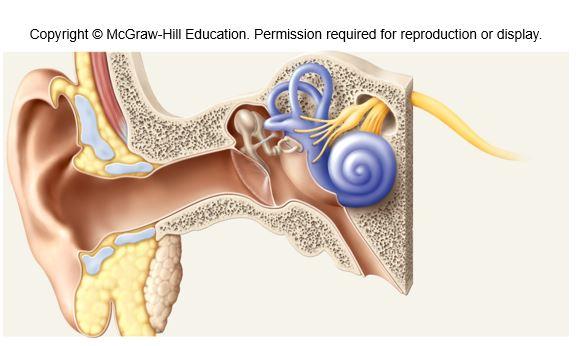 This cranial nerve is shown entering the cranium through which of the following? | back 43 Internal acoustic meatus |
front 44 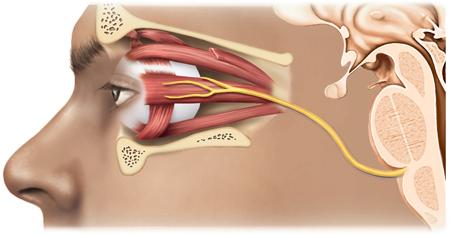 Based on the picture, what is the function of this cranial nerve? | back 44 Lateral eye movement |
front 45 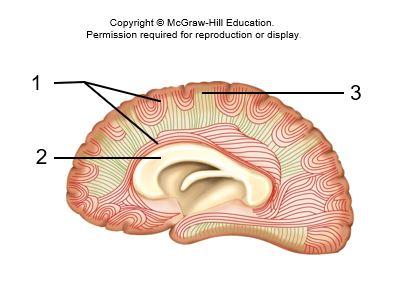 What type of tract is labeled 1 in this diagram? | back 45 Association tract |
front 46 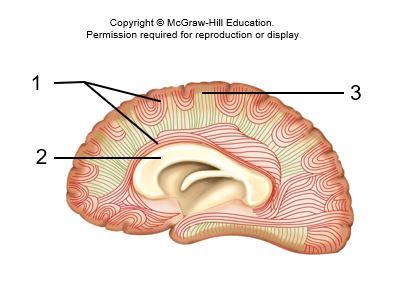 What type of tract is labeled 2 in this diagram? | back 46 Commissural tract |
front 47 What type of tract is labeled 3 in this diagram? | back 47 Projection tract |
front 48 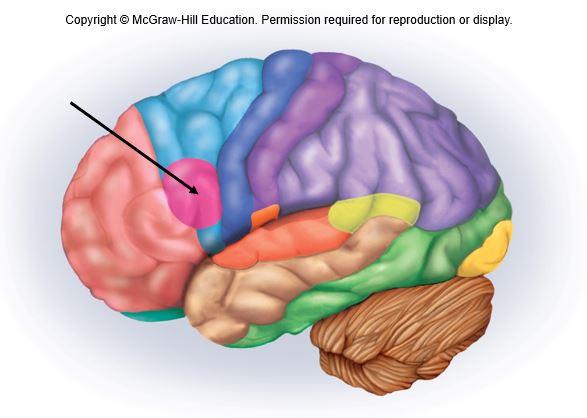 What is the function of the indicated brain region | back 48 Production of speech |
front 49 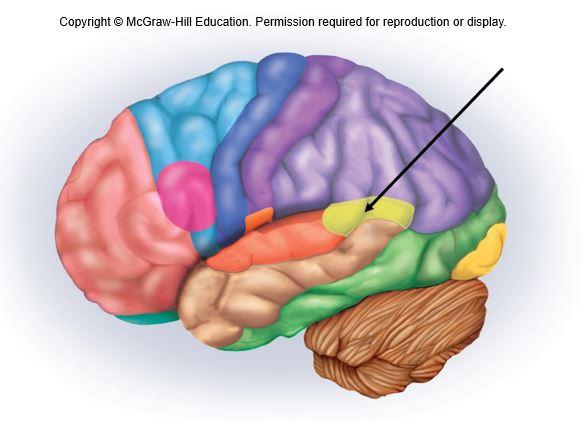 What is the function of the indicated brain region | back 49 Understanding written language |
front 50 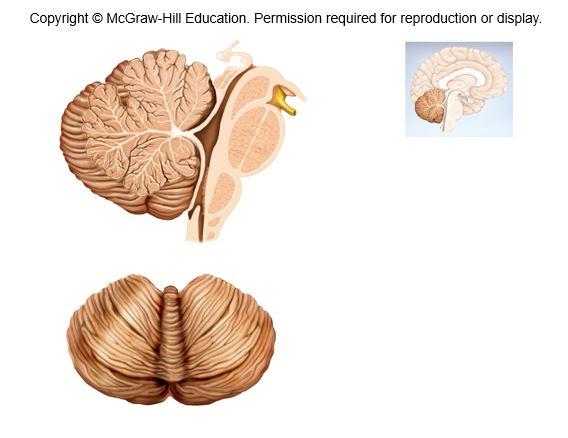 People with lesions in the structure shown here may have difficulty with rhythmic finger-tapping tasks | back 50 True |