Instructions for Side by Side Printing
- Print the notecards
- Fold each page in half along the solid vertical line
- Cut out the notecards by cutting along each horizontal dotted line
- Optional: Glue, tape or staple the ends of each notecard together
A1.2 Nucleic Acids
front 1 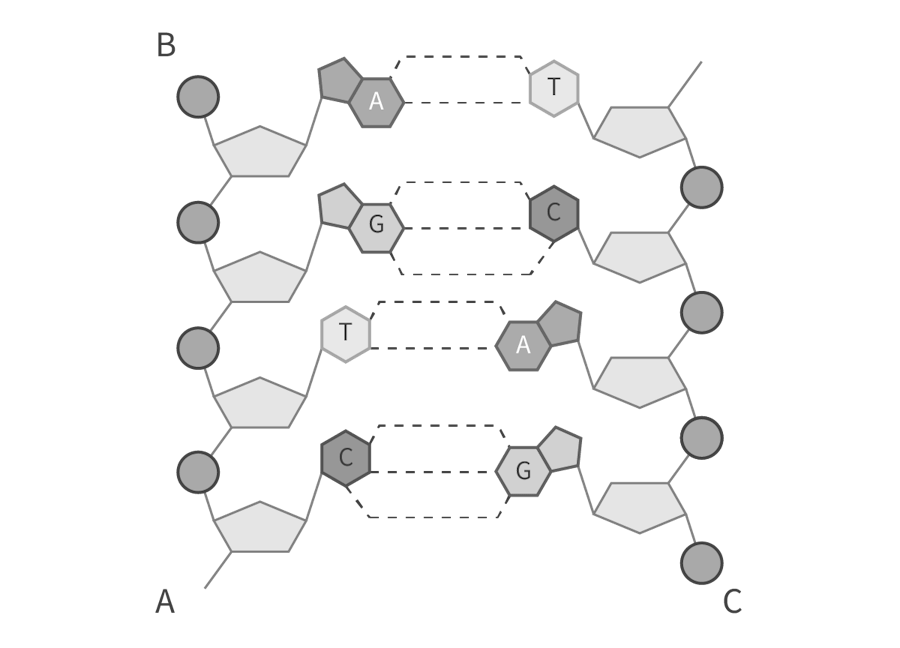 From the diagram below, where would new DNA nucleotides be added in order to grow the strand? Answer using letters A, B, or C only. | back 1 A (the 3' end) |
front 2 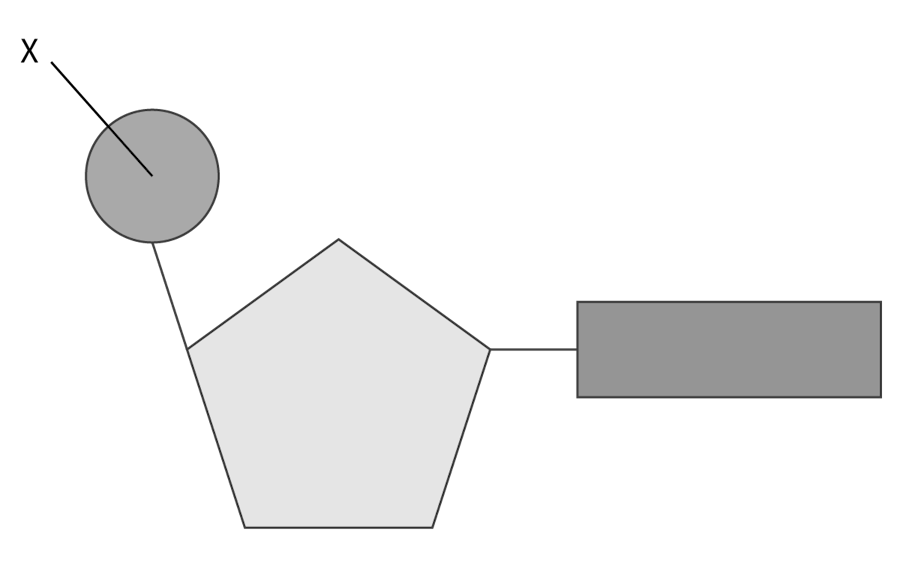 Which component is labelled ‘X’ in the diagram of a DNA nucleotide below? | back 2 Phosphate |
front 3 In a strand of DNA or RNA, a _____ bond forms between the sugar of one nucleotide and the phosphate of another. | back 3 Covalent |
front 4 Which of the following provides the strongest evidence for universal common ancestry amongst living species? a) highly conserved sequences of DNA amongst living organisms b) low levels of genetic variation amongst living organisms c) lowly conserved sequences of DNA amongst living organisms d) high levels of genetic variation amongst living organisms | back 4 a) highly conserved sequences of DNA amongst living organisms |
front 5 Which type of reaction forms RNA polymers from nucleotide monomers? | back 5 Condensation |
front 6 If 15% of a sample of DNA is thymine, what percentage of the DNA is guanine? a) 35% b) can't be determined from the information given c) 15% d) 30% | back 6 35% (If there is 15% thymine, then there must be 15% adenine. So 100 - 30 = 70% is left which means that there must be 35% guanine and 35% cytosine.) |
front 7 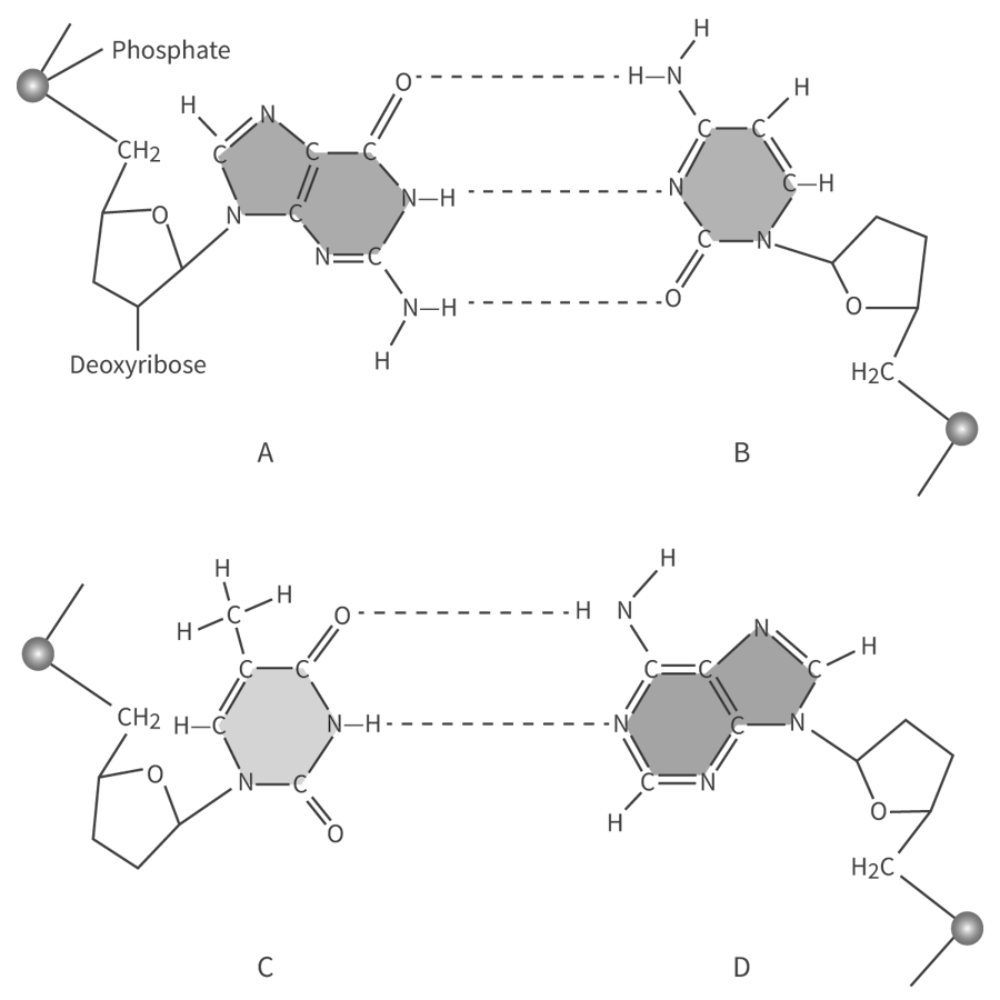 Which of the following correctly identifies the purines in the diagram below. a) B&C b) A&D c) C&D d) A&B | back 7 b) A&D |
front 8 Which of the following statements about DNA is true? a) DNA normally forms a double helix, and the two strands are anti-parallel. b) In DNA, complementary base pairing means G always pairs with T and A always pairs with C. c) In DNA, the two strands are held together by covalent bonds between the bases. | back 8 a) DNA normally forms a double helix, and the two strands are anti-parallel. |
front 9 Which of the following best defines the term nucleic acid backbone? a) Nucleic acids are composed of a backbone of nitrogen bases and sugar molecules. The phosphate groups are attached to nitrogen bases. b) Nucleic acids are composed of a backbone of sugar molecules and phosphate groups. The nitrogen bases are attached to the sugars. c) Nucleic acids are composed of a backbone of nitrogen bases and phosphate groups. Sugars are attached to nitrogen bases but not to phosphate groups. | back 9 b) Nucleic acids are composed of a backbone of sugar molecules and phosphate groups. The nitrogen bases are attached to the sugars. |
front 10 DNA and RNA are synthesised in a _____ prime to _____ prime direction. | back 10 5', 3' |
front 11 T/F DNA is the genetic material of all living organisms. | back 11 True. |
front 12 Which of the following results from the Hershey–Chase experiment, support the conclusion that DNA is genetic material. a) Radioactively labelled phosphorus was detected in the pellet. b) Radioactively labelled phosphorus was detected in the supernatant c) Radioactively labelled sulfur was detected in the pellet d) Radioactively labelled sulfur was detected in the supernatant | back 12 a) Radioactively labelled phosphorus was detected in the pellet. |
front 13 The pentose sugar in a DNA nucleotide is _____, but in an RNA nucleotide it is _____. | back 13 Deoxyribose, ribose |
front 14 What type of bond connects two DNA strands? | back 14 Hydrogen bonds |
front 15 Which of the following is an example of a purine? a) Adenine b) Phosphate c) Thymine d) Cytosine | back 15 a) Adenine |
front 16 According to Chargaff’s rule, in natural DNA, the number of guanine bases should be _____ to the number of _____. | back 16 Equal, cytosine bases |
front 17 Which term refers to the specificity of hydrogen bonding between base pairs such as adenine and thymine? | back 17 Complementary base pairing |
front 18 What makes up a nucleosome? | back 18 DNA wrapped around 8 histone proteins |
front 19 Which nitrogenous base is found in RNA but not DNA? | back 19 Uracil |
front 20 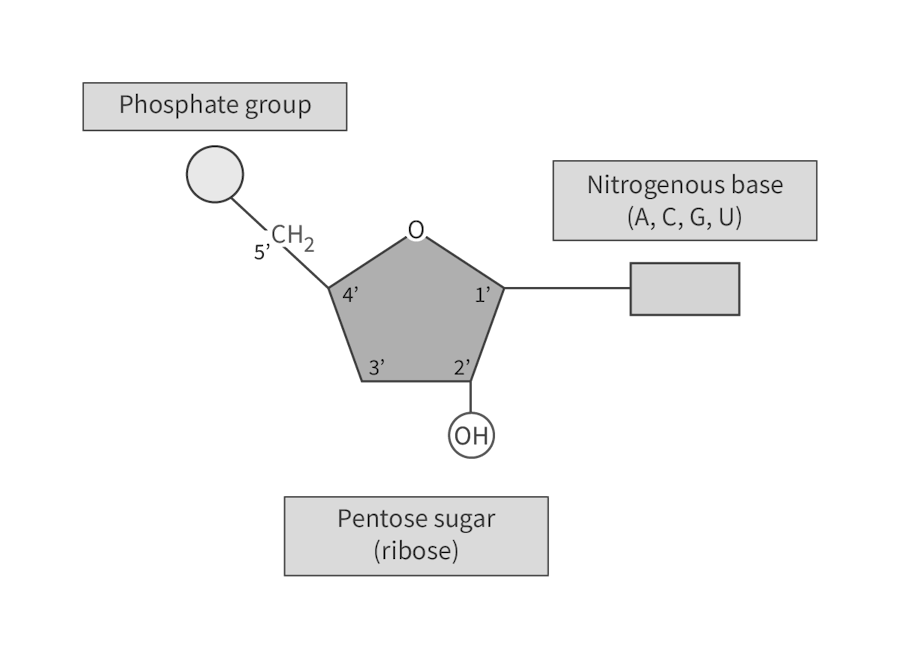 Which type of nucleotide is represented in the diagram below? | back 20 RNA |
front 21 What base does adenine pair with? | back 21 Thymine |
front 22 What are the three main components of a DNA nucleotide? | back 22 Phosphate, deoxyribose sugar, nitrogenous base |