Instructions for Side by Side Printing
- Print the notecards
- Fold each page in half along the solid vertical line
- Cut out the notecards by cutting along each horizontal dotted line
- Optional: Glue, tape or staple the ends of each notecard together
microbial genetics
front 1 what is a genome? | back 1 the sum total of genetic material of an organism, the most exists in the form of chromosomes, some may appear in non-chromosomal forms |
front 2 what are the non-chromosomal forms of a genome? | back 2 plasmid and organelles |
front 3 what is a plasmid? | back 3 tiny extra pieces of DNA |
front 4 non-chromosomal genome in organelles? | back 4 mitochondria and chloroplasts have their own DNA |
front 5 what is a chromosome? | back 5 a distinct cellular structure composed of a neatly packaged DNA molecule |
front 6 what is a eukaryotic chromosome? | back 6 located in the nucleus; they vary in number from a few to hundreds; they can occur in pairs (diploid) or singles (haploid); they have a linear appearance |
front 7 what is a bacterial chromosome? | back 7 usually single, circular (double-stranded) chromosome, although many bacteria have multiple, circular chromosomes and some have linear chromosomes |
front 8 what is a gene? | back 8 basic informational packets in which a chromosome is subdivided containing the necessary code for a particular cell function |
front 9 what are the three categories of genes? | back 9 structural genes that code for proteins genes that code for the RNA machinery used in protein production regulatory genes that control gene expression |
front 10 what is a geneotype? | back 10 the sum of all types of genes constituting an organism's distinctive genetic makeup |
front 11 what is a phenotype? | back 11 the expression of the genotype that creates certain structures or functions (traits) |
front 12 structure of DNA | back 12 phosphate, deoxyribose sugar, nitrogenous base |
front 13 nitrogenous bases | back 13 purines (A,G) and pyrimidines (T,C) |
front 14 adenine always pairs with | back 14 thymine |
front 15 guanine always pairs with | back 15 cytosine |
front 16 DNA arrangement | back 16 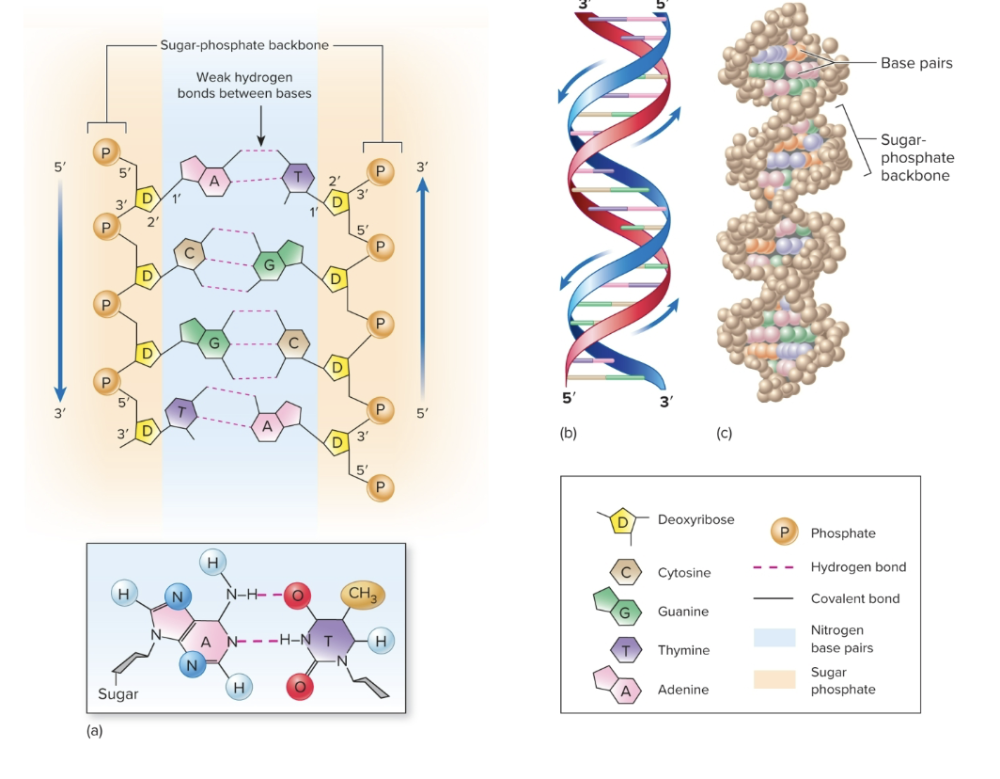 antiparallel one side of the helix runs in the opposite direction of the other (5'-3' and 3'-5') |
front 17 what are the steps of DNA replication? | back 17 semiconservative replication each daughter molecule is identical to the parent in composition neither is completely new the template strand is an original parental DNA strand |
front 18 helicase | back 18 unzipping the DNA helix |
front 19 primase | back 19 synthesizing an RNA primer |
front 20 DNA polymerase 3 | back 20 adding bases to the new DNA chain and proofreading the chain for mistakes functions once the DNA helix strands are unwound and separated synthesizes a daughter strand of DNA using the parental strand as a template can only add nucleotides to an existing chain 5'-3' direction |
front 21 DNA polymerase 1 | back 21 removing primer, closing gaps, and repairing mismatches |
front 22 ligase | back 22 final binding of nicks in DNA during synthesis and repair |
front 23 topoisomerase 1 | back 23 making single-stranded DNA breaks to relieve supercoiling at origin |
front 24 topoisomerase 2 and 4 | back 24 making double-stranded DNA breaks to remove supercoiling ahead of origin and separate replicated daughter DNA molecules |
front 25 replication fork | back 25 the place in the helix where the strands are unwound and replication is taking place each circular DNA molecule will have two replication forks |
front 26 primer | back 26 a length of RNA that is inserted initially during replication before being replaced by DNA |
front 27 how does the synthesis of the leading strand differ from the synthesis of the lagging strand? | back 27 leading strand: new DNA synthesized continuously in a 5' to 3' direction lagging strand: new strand must be synthesized in short segments (5' to 3'), later sealed together to form a strand in 3' to 5' direction |
front 28 Okazaki fragments | back 28 short segments of DNA synthesized in a 5' to 3' direction which are then sealed together to form the 3' to 5' strand |
front 29 the central dogma | back 29 transcription: DNA is used to synthesize RNA translation: RNA used to produce proteins |
front 30 why is the central dogma incomplete? | back 30 a wide variety of RNAs are used to regulate gene function many genetic malfunctions that cause human disease are found in regulatory RNA, not in genes for proteins the DNA that codes for these crucial RNA molecules was once called "junk" DNA |
front 31 connection between DNA and an organism's traits | back 31 a protein's primary structure determines its characteristic shape and function proteins ultimately determine phenotype DNA mainly a blueprint that tells the cell which kinds of proteins to make and how to make them |
front 32 participants in transcription and translation | back 32 mRNA tRNA rRNA ribosomes several types of enzymes many raw materials |
front 33 mRNA | back 33 transports the DNA master code to the ribosome synthesized in a process similar to synthesis of the leading strand during DNA replication |
front 34 tRNA | back 34 brings amino acids to ribosome during translation |
front 35 rRNA | back 35 forms the major part of a ribosome and participates in protein synthesis 3-dimensional shapes that create the two subunits of the ribosome |
front 36 miRNA | back 36 regulation of gene expression and coiling of chromatin |
front 37 primer | back 37 primes DNA |
front 38 ribozymes and spliceosomes | back 38 remove introns from other RNAs in eukaryotes |
front 39 codon | back 39 a series of triplet bases that hold the message of the transcribed mRNA |
front 40 anticodon | back 40 found at the bottom loop of the cloverleaf designates the specificity of the tRNA and complements the mRNA codon |
front 41 redudancy | back 41 certain amino acids are represented by multiple codons allows for the insertion of correct amino acids even when mistakes occur in the DNA sequence |
front 42 wobble | back 42 only the first two nucleotides are required to encode the correct amino acid the third nucleotide does not change its sense permits some variation or mutation without altering the message |
front 43 start codon | back 43 the first 3 RNA nucleotides that signal the beginning of the message AUG |
front 44 stop codons | back 44 nonsense codons - one of three codons that has no corresponding tRNA and causes translation to be terminated UAA, UAG, UGA |
front 45 introns | back 45 intervening sequences of bases that do not code for protein excised into lariats by spliceosome |
front 46 exons | back 46 coding regions |
front 47 promoter sequence | back 47 recognized by RNA polymerase |
front 48 operator | back 48 acts as an on/off switch for transcription |
front 49 regulator | back 49 composed of the gene that codes for the repressor, a protein capable of repressing the operon |
front 50 A site | back 50 A site accepts incoming tRNA molecules carrying amino acids |
front 51 P site | back 51 P site holds the tRNA attached to the growing polypeptide chain until the next amino acid is added |
front 52 operons | back 52 coordinated set of genes regulated as a single unit found only in bacteria and archaea can be inducible or repressible, determined by how transcription is affected by the environment surrounding the cell |
front 53 transcription factors | back 53 insert into the grooves of the DNA molecule and enhance the transcription of specific genes regulate gene expression in response to environmental stimuli |
front 54 DNA "knot" | back 54 cytosines bind to other cytosines forming a "knot" in the helix of DNA blocks the promoter region of genes in order to stop transcription |
front 55 drugs that inhibit protein synthesis | back 55 rifamycins actinomycin D |
front 56 drugs that interfere with the ribosome | back 56 erythromycin spectinomycin |
front 57 recombination | back 57 an event in which one bacterium donates DNA to another bacterium |
front 58 recombinant | back 58 any organism that contains and expresses genes that originated in another organism |
front 59 horizontal gene transfer | back 59 any transfer of DNA that results in organisms acquiring new genes that did not come directly from parent organisms |
front 60 conjugation | back 60 direct donor cell with pilus fertility plasmid in donor, both donor and recipient alive, bridge forms between cells to transfer DNA |
front 61 transformation | back 61 indirect free donor DNA (fragment), live; competent recipient cell the acceptance by a bacterial cell of small fragments of soluble DNA from the surrounding environment |
front 62 transduction | back 62 indirect toxins; enzymes for sugar fermentation; drug resistance |
front 63 conjugation F factor | back 63 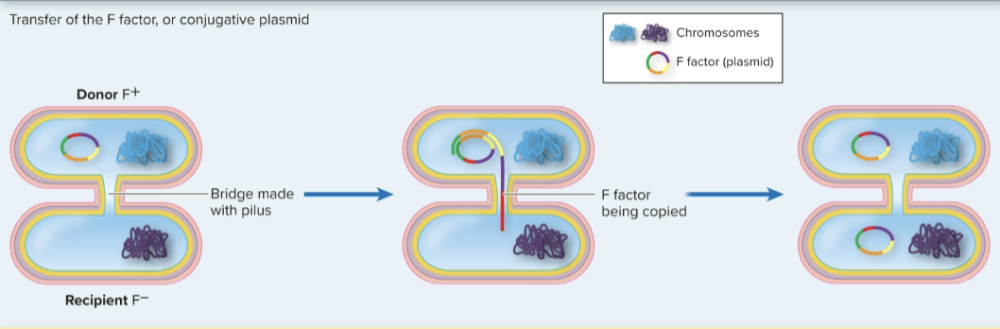 |
front 64 resistance (R) plasmids or factors | back 64 carry genes for resisting antibiotics or other drugs commonly shared among bacteria through conjugation can confer multiple resistance to antibiotics R factors can also carry genetic codes for resistance to heavy metals or for synthesizing virulence factors |
front 65 competent | back 65 cells that are capable of accepting genetic material through transformation |
front 66 generalized transduction | back 66 random fragments of disintegrating host DNA are taken up by a phage during assembly any gene from the bacterium can be transmitted |
front 67 specialized transduction | back 67 a highly specific part of the host genome is incorporated into the virus when the prophage DNA separates from the chromosome (carrying host genes with it) |
front 68 transposable elements | back 68 jumping genes shift from one part of the genome to another from one chromosomal site to another, from a chromosome to a plasmid, and from a plasmid to a chromosome |
front 69 insertion elements | back 69 the smallest TEs consist only of two tandem repeats |
front 70 retroptransposon | back 70 a type of TE that can transcribe DNA into RNA and then back into DNA for insertion in a new location |
front 71 general effects of TEs | back 71 scramble genetic language can be beneficial or adverse, depending on: where the insertion occurs in a chromosome, what kind of genes are relocated, the type of cell involved |
front 72 effects of TEs in bacteria | back 72 changes in colony morphology, pigmentation, and antigenic characteristics replacement of damaged DNA transfer of drug resistance between bacteria |
front 73 pathogenicity islands | back 73 contain multiple genes that are coordinated to create a new trait in bacterium, making it pathogenic |
front 74 mutation | back 74 any change to the nucleotide sequence in the genome the driving force of evolution in microorganisms, mutations become evident in altered gene expression, such as altered pigment production or development of resistance to a drug |
front 75 wild type mutation | back 75 a microorganism that exhibits a natural, non-mutated characteristic the trait present in the highest numbers in a population |
front 76 mutant strain | back 76 an organism that bears a mutation |
front 77 spontaneous mutation | back 77 a random change in the DNA arising from errors in replication that occur randomly |
front 78 induced mutations | back 78 result from exposure to known physical or chemical agents that damage DNA (known as mutagens) |
front 79 nitrous acid, bisulfite | back 79 chemical agent remove an amino group from some bases |
front 80 ethidium bromide | back 80 chemical agent inserts between the paired bases |
front 81 acridine dyes | back 81 chemical agent cause frameshift due to insertion between base pairs |
front 82 nitrogen base analogs | back 82 chemical agent compete with natural bases for sites of replicating DNA |
front 83 ionizing (gamma rays, X rays) | back 83 radiation agent form free radicals that cause single or double breaks in DNA |
front 84 ultraviolet | back 84 radiation agent causes cross-links between adjacent pyrimidines |
front 85 point mutation | back 85 small mutation that affects only a single base on a gene involve addition, deletion, or substitution of single bases |
front 86 lethal mutation | back 86 mutation that leads to cell dysfunction or death |
front 87 neutral mutation | back 87 produce neither adverse nor helpful changes |
front 88 missense mutation | back 88 any change in the code that leads to the placement of different amino acids |
front 89 nonsense mutation | back 89 changes in normal codon into a stop codon |
front 90 silent mutation | back 90 alters a base but does not change the amino acid the redudancy by a change in the third base of the codon |
front 91 back mutation | back 91 occurs when a gene that has undergone mutation reverses to its original base composition |
front 92 frameshift mutation | back 92 occurs when one or more bases are inserted into or deleted from a newly synthesized DNA strand alters the reading frame of mRNA nearly always results in a nonfunctional protein |
front 93 photoactivation | back 93 light repair of damage caused by ultraviolet radiation requires visible light and a light-sensitive enzyme called DNA photolyase, which can detect and attach to the damaged areas |
front 94 mismatch repair | back 94 a repair system can locate mismatched bases that were missed during proofreading the base must be replaced soon after the mismatch is made, or the repair enzymes will not recognize it |
front 95 excision repair | back 95 mutations are excised by a series of enzymes that remove the incorrect bases and add the correct ones |
front 96 the ames test | back 96 used to rapidly detect chemicals with carcinogenic potential uses bacteria (salmonella typhimurim) rather than experimental animals histone + colonies arising from spontaneous back-mutation on control plate histone + colonies in presence of chemical on test plate |