Instructions for Side by Side Printing
- Print the notecards
- Fold each page in half along the solid vertical line
- Cut out the notecards by cutting along each horizontal dotted line
- Optional: Glue, tape or staple the ends of each notecard together
Anatomy JV Exam 3: Ear Vestibulocochlear
front 1 The external ear consists of the __________, also called the __________, and the __________ __________ __________. | back 1 auricle, pinna, external auditory meatus |
front 2 The middle ear contains the __________ __________ and the __________ __________. | back 2 tympanic cavity, epitympanic recess |
front 3 The inner ear is made up of the __________ __________ and the __________ __________. | back 3 bony labyrinth, membranous labyrinth |
front 4 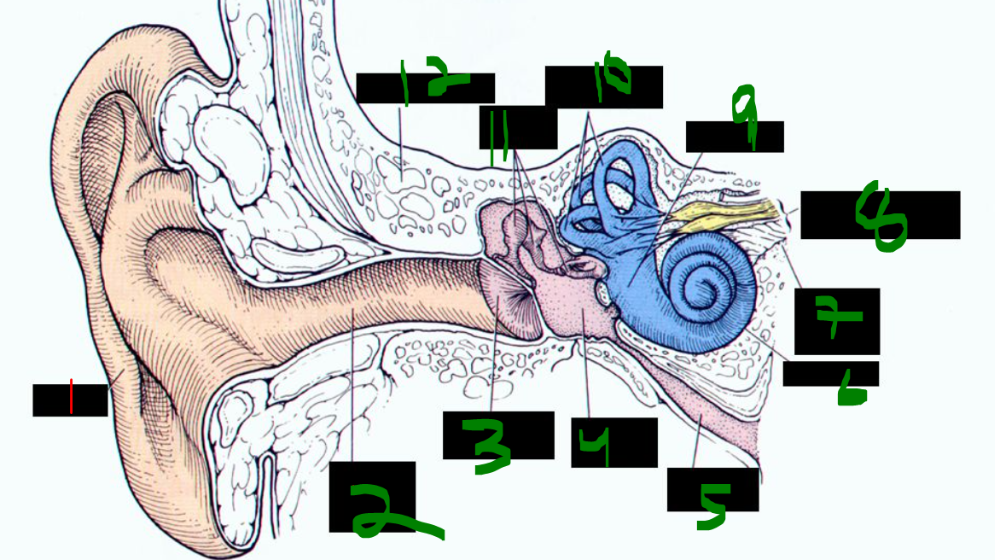 What is 1? | back 4 auricle |
front 5 What is 2? | back 5 external acoustic meatus |
front 6 What is 3? | back 6 tympanic membrane |
front 7 What is 4? | back 7 tympanic cavity |
front 8 What is 5? | back 8 auditory tube |
front 9 What is 6? | back 9 cochlea |
front 10 What is 7? | back 10 internal acoustic meatus |
front 11 What is 8? | back 11 vestibulocochlear nerve |
front 12 What is 9? | back 12 vestibule |
front 13 What is 10? | back 13 semicircular canals |
front 14 What is 11? | back 14 auditory ossicles |
front 15 What is 12? | back 15 temporal bone |
front 16 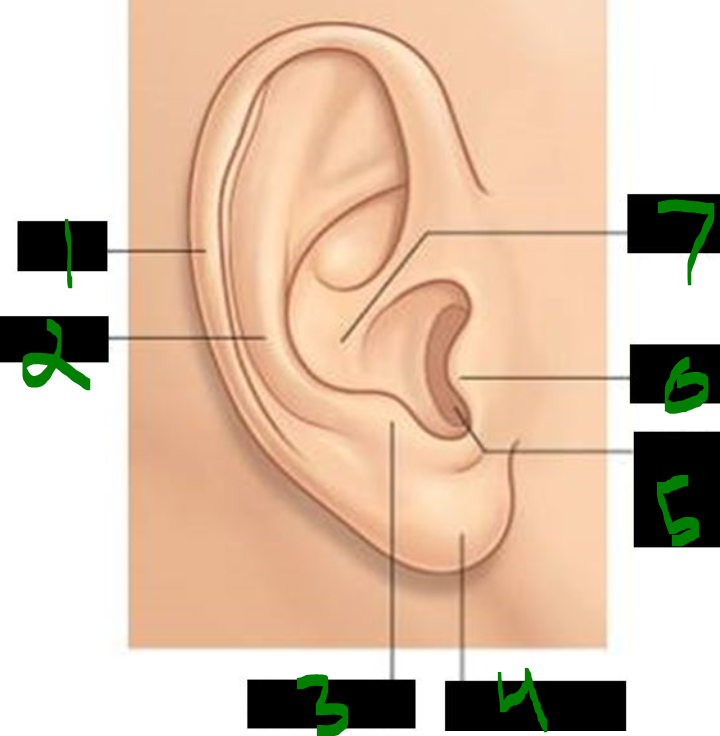 What is 1? | back 16 helix |
front 17 What is 2? | back 17 antihelix |
front 18 What is 3? | back 18 antitragus |
front 19 What is 4? | back 19 lobule |
front 20 What is 5? | back 20 external acoustic meatus |
front 21 What is 6? | back 21 concha |
front 22 What is 7? | back 22 tragus |
front 23 The auricle, also called the __________, functions in __________ __________ and __________. | back 23 pinna, sound localization, amplification |
front 24 Dr. Liuzzi suggests the majority of auricular innervation comes from the __________ __________ nerve, __________ __________ nerve, and some innervation from the __________ nerve. | back 24 lesser occipital, great auricular, vagus |
front 25 The pinna, also called the __________, is innervated by multiple nerves including the __________ __________ nerve (C2), __________ __________ nerve (C2, C3), and the __________ branch of CN __________. | back 25 auricle, lesser occipital, great auricular, auriculotemporal, V3 |
front 26 Additional innervation of the auricle comes from cranial nerves __________ and __________, corresponding to the __________ nerve and the __________ nerve. | back 26 X, VII, vagus, facial |
front 27 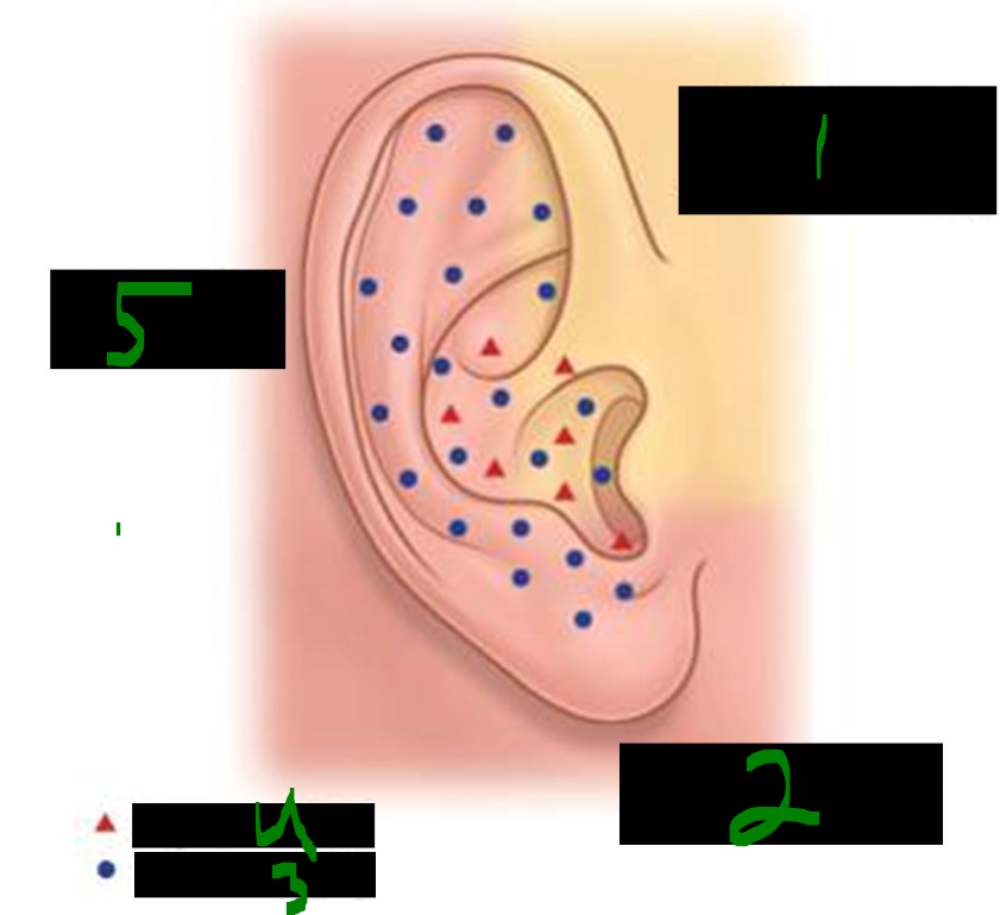 What is 1? | back 27 auriculotemporal branch of mandibular nerve v3 |
front 28 What is 2? | back 28 great auricular nerve c2 c3 |
front 29 What is 3? | back 29 facial nerve (VII) |
front 30 What is 4? | back 30 Vagus nerve (X) |
front 31 What is 5? | back 31 lesser occipital nerve (c2) |
front 32 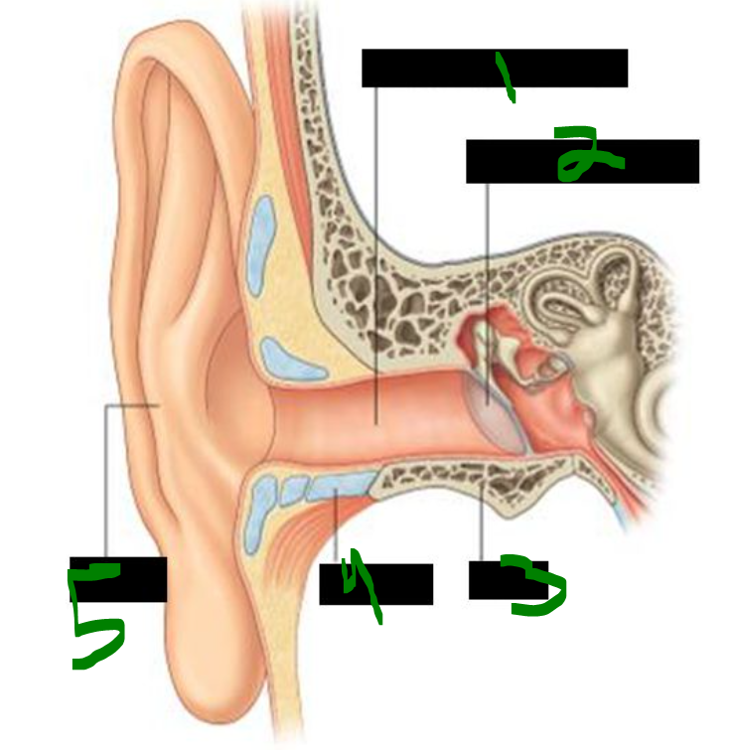 What is 1? | back 32 external acoustic meatus |
front 33 What is 2? | back 33 tympanic membrane |
front 34 What is 3? | back 34 bone |
front 35 What is 4? | back 35 cartilage |
front 36 What is 5? | back 36 auricle |
front 37 The lateral ______ of the external auditory meatus is ______, while the medial ______ is made of ______ from the ______ bone. | back 37 one-third, cartilaginous, two-thirds, bone, temporal |
front 38 The lateral part of the external auditory meatus is lined by skin containing ______, ______ glands, and ______ glands, which are modified ______ ______ glands that secrete ______. | back 38 hairs, sebaceous, ceruminous, apocrine sweat, cerumen |
front 39 The lateral external auditory meatus contains no ______ ______ glands. | back 39 eccrine sweat |
front 40 Cerumen, also known as ______ ______, is secreted by ______ glands, which are modified ______ ______ glands. | back 40 ear wax, ceruminous, apocrine sweat |
front 41 Cerumen is found in the ______ part of the ______ ______ ______. | back 41 lateral, external auditory meatus |
front 42 The lateral part of the external auditory meatus contains ______ glands and ______ glands, which are modified ______ ______ glands that secrete ______. | back 42 sebaceous, ceruminous, apocrine sweat, cerumen |
front 43 The external auditory meatus does not contain any ______ ______ glands. | back 43 eccrine sweat |
front 44 The external auditory meatus is mainly innervated by the ______ nerve, with additional minor contributions from the ______ nerve (CN ______) and ______ branches of the ______ nerve (CN ______). | back 44 auriculotemporal, facial, VII, vagal, vagus, X |
front 45 Stimulation of the external auditory meatus can cause a gag reflex in some individuals due to ______ innervation from the ______ nerve (CN ______). | back 45 sensory, vagus, X |
front 46 Some people gag when cleaning their ears because of ______ innervation from the ______ nerve (CN ______), which supplies part of the external auditory meatus. | back 46 vagal, vagus, X |
front 47 The outer surface of the tympanic membrane is mainly innervated by the ______ nerve (branch of CN ______) and has a small contribution from the ______ branch of the ______ nerve (CN ______). | back 47 auriculotemporal, V3, auricular, vagus, X |
front 48 The inner surface of the tympanic membrane is innervated by the ______ nerve (CN ______). | back 48 glossopharyngeal, IX |
front 49 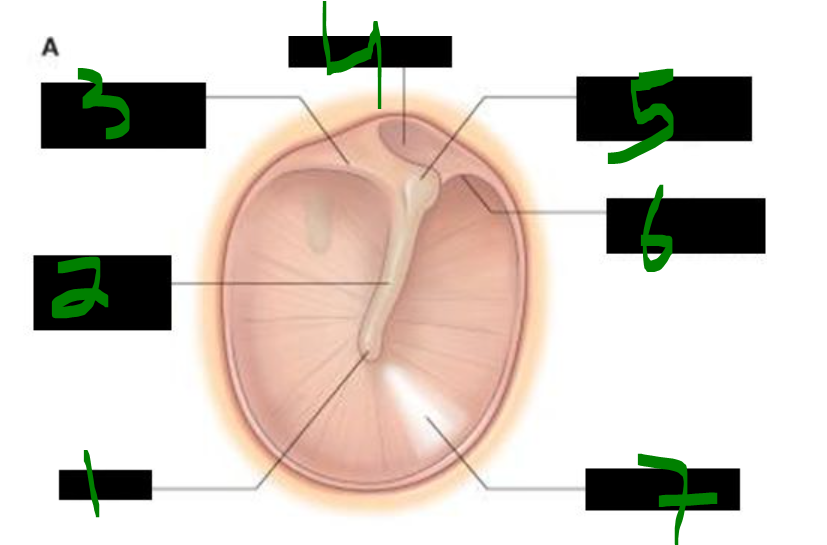 What is 1? | back 49 umbo |
front 50 What is 2? | back 50 handle of malleus |
front 51 What is 3? | back 51 posterior malleolar fold |
front 52 What is 4? | back 52 pars flaccida |
front 53 What is 5? | back 53 lateral process of malleus |
front 54 What is 6? | back 54 anterior malleolar fold |
front 55 What is 7? | back 55 cone of light |
front 56 Otitis media is a middle ear infection characterized by a ______, ______ tympanic membrane. | back 56 bulging, red |
front 57 Otitis media may cause ______ of the tympanic membrane. | back 57 perforation |
front 58 Otitis media is more common in younger children because their ______ tubes have a ______ angle, impairing drainage from the middle ear to the ______. | back 58 pharyngotympanic, narrower, pharynx |
front 59 If otitis media is severe, a common treatment is an ______ of the ______ part of the tympanic membrane to avoid damaging the ______ ______, followed by placement of a ______ ______. | back 59 incision, posteroinferior, chorda tympani, tympanostomy tube |
front 60 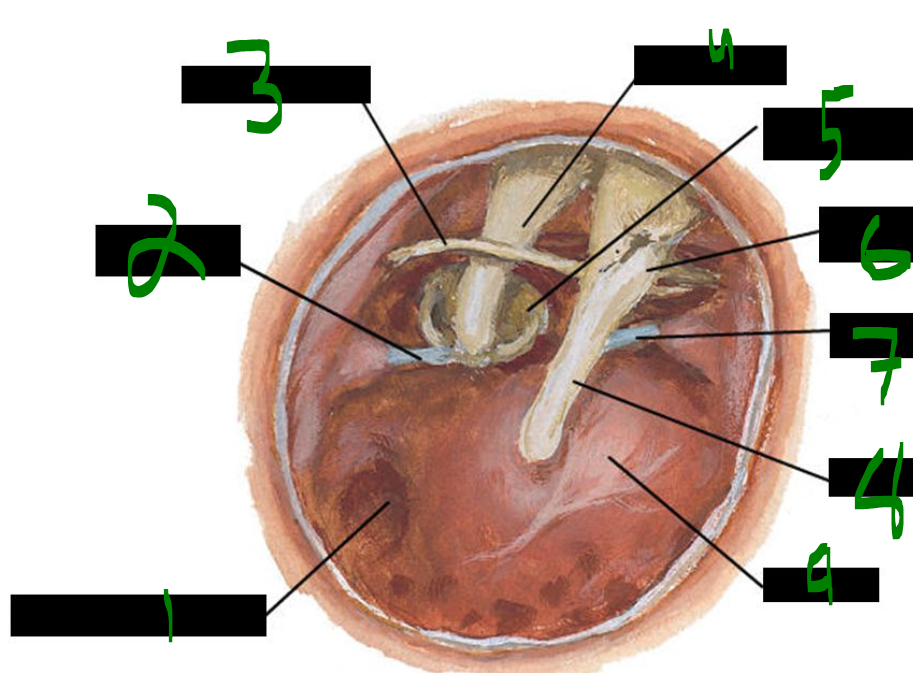 What is 1? | back 60 fossa of round (cochlear) window |
front 61 What is 2? | back 61 tendon of stapedius muscle |
front 62 What is 3? | back 62 chorda tympani nerve |
front 63 What is 4? | back 63 long limb of incus |
front 64 What is 5? | back 64 stapes in oval (vestibular) window |
front 65 What is 6? | back 65 lateral process of malleus |
front 66 What is 7? | back 66 tendon of tensor tympani muscle |
front 67 What is 8? | back 67 handle of malleus |
front 68 What is 9? | back 68 promontory |
front 69 The chorda tympani passes just behind/medial to the tympanic membrane between the long limb of the ______ and the ______. | back 69 incus, malleus |
front 70 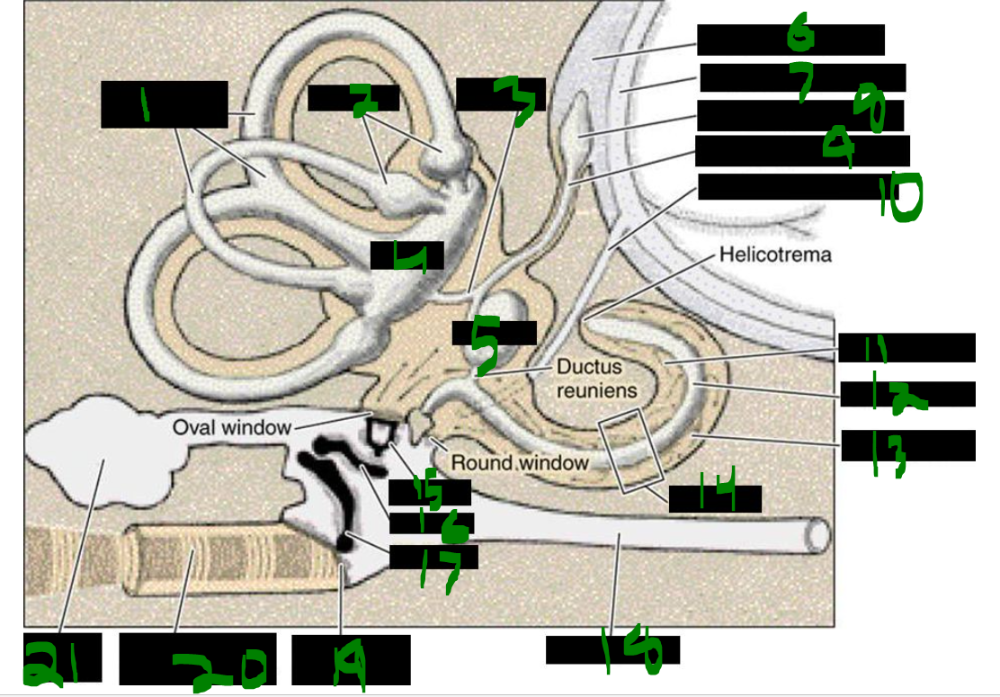 What is 1? | back 70 semicircular ducts |
front 71 What is 2? | back 71 ampullae |
front 72 What is 3? | back 72 vestibule |
front 73 What is 4? | back 73 utricle |
front 74 What is 5? | back 74 saccule |
front 75 What is 6? | back 75 subdural space |
front 76 What is 7? | back 76 subarachnoid space |
front 77 What is 8? | back 77 endolymphatic space |
front 78 What is 9? | back 78 endolymphatic duct |
front 79 What is 10? | back 79 perilymphatic duct |
front 80 What is 11? | back 80 scala vestibuli |
front 81 What is 12? | back 81 scala media |
front 82 What is 13? | back 82 scala tympani |
front 83 What is 14? | back 83 cochlea |
front 84 What is 15? | back 84 stapes |
front 85 What is 16? | back 85 incus |
front 86 What is 17? | back 86 malleus |
front 87 What is 18? | back 87 auditory tube |
front 88 What is 19? | back 88 tympanic membrane |
front 89 What is 20? | back 89 external acoustic meatus |
front 90 What is 21? | back 90 mastoid cavities |
front 91 The middle ear includes the ______ cavity and the ______ recess, where the ______ are located. | back 91 tympanic, epitympanic, ossicles |
front 92 Anteriorly, the middle ear connects to the ______ via the ______ ______ tube. | back 92 pharynx, pharyngotympanic (eustachian) |
front 93 Posteriorly, the middle ear connects to the ______ air cells via the ______ ______. | back 93 mastoid, mastoid antrum |
front 94 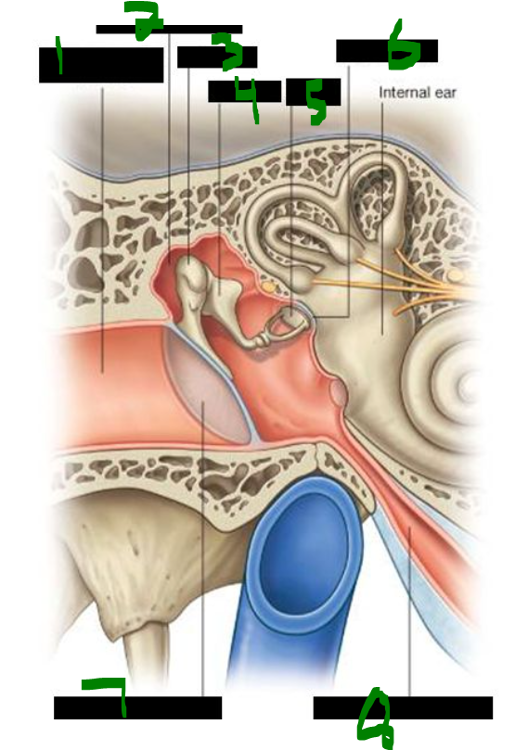 What is 1? | back 94 external acoustic meatus |
front 95 What is 2? | back 95 epitympanic recess |
front 96 What is 3? | back 96 malleus |
front 97 What is 4? | back 97 incus |
front 98 What is 5? | back 98 stapes |
front 99 What is 6? | back 99 oval window |
front 100 What is 7? | back 100 tympanic membrane |
front 101 What is 8? | back 101 pharyngotympanic tube |
front 102 The middle ear, including the inner surface of the tympanic cavity, is innervated by the ______ nerve (CN ______), also called ______ nerve. | back 102 tympanic, IX, Jacobson's |
front 103 Jacobson’s nerve, also known as the ______ nerve (CN ______), innervates the ______ ear cavity, including the inner surface of the ______ cavity. | back 103 tympanic, IX, middle, tympanic |
front 104 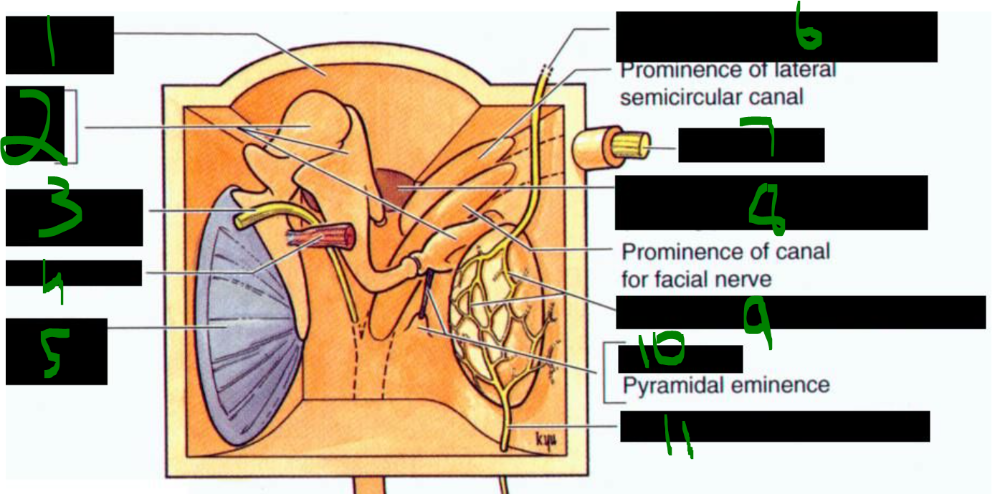 What is 1? | back 104 epitympanic recess |
front 105 What is 2? | back 105 malleus incus stapes |
front 106 What is 3? | back 106 chorda tympani nerve |
front 107 What is 4? | back 107 tensor tympani |
front 108 What is 5? | back 108 tympanic membrane |
front 109 What is 6? | back 109 lesser petrosal nerve (preganglionic parasympathetics) |
front 110 What is 7? | back 110 facial nerve |
front 111 What is 8? | back 111 aditus to mastoid antrum |
front 112 What is 9? | back 112 tympanic plexus on promontory |
front 113 What is 10? | back 113 stapedius |
front 114 What is 11? | back 114 tympanic nerve (from CN IX) |
front 115 what vessel has a very close relationship to the middle ear? _____ _____ _____ | back 115 internal carotid a. |
front 116 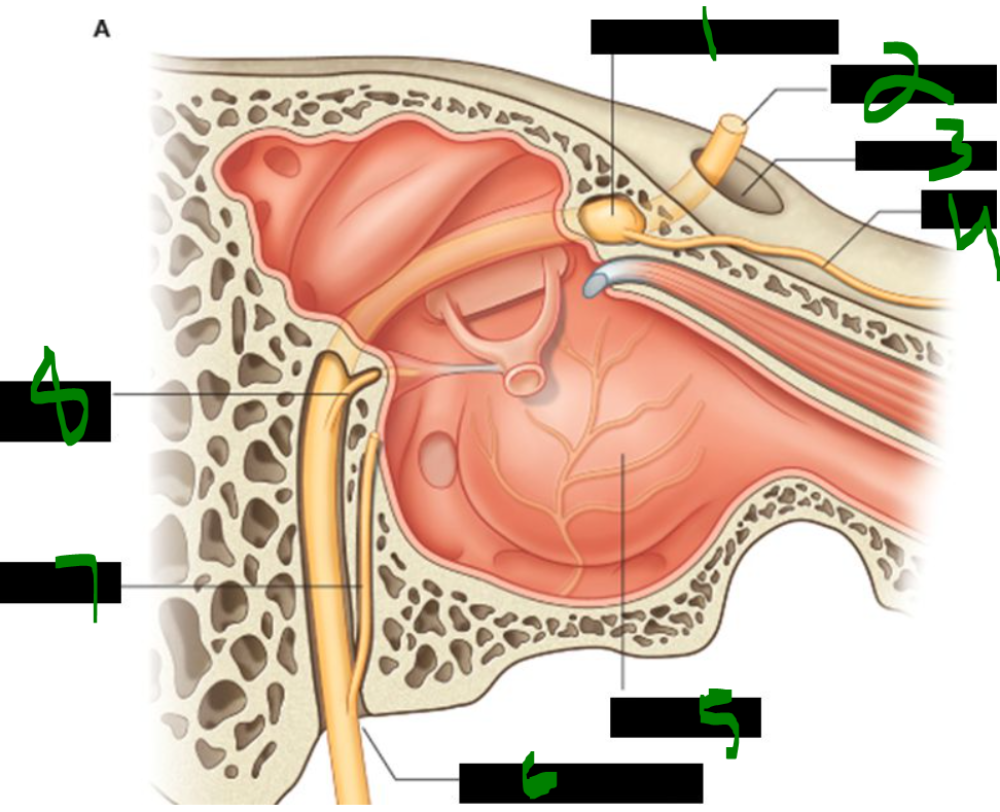 What is 1? | back 116 geniculate ganglion |
front 117 What is 2? | back 117 facial neve (VII) |
front 118 What is 3? | back 118 internal acoustic meatus |
front 119 What is 4? | back 119 greater petrosal |
front 120 What is 5? | back 120 middle ear |
front 121 What is 6? | back 121 stylomastoid foramen |
front 122 What is 7? | back 122 chorda tympani |
front 123 What is 8? | back 123 nerve to stapedius muscle |
front 124 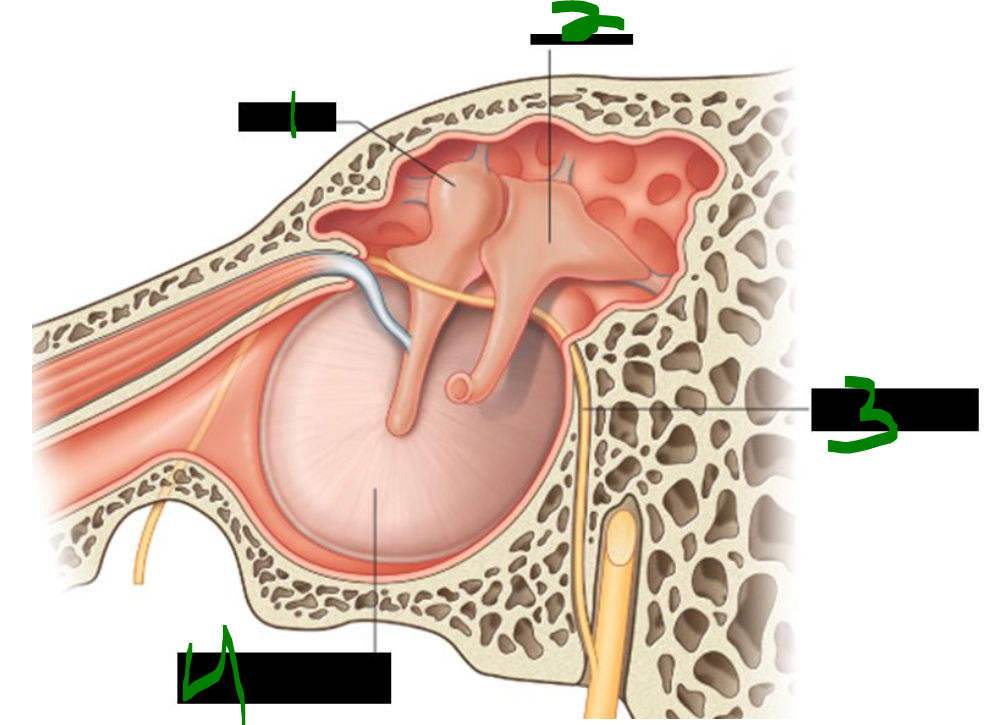 What is 1? | back 124 malleus |
front 125 What is 2? | back 125 incus |
front 126 What is 3? | back 126 chorda tympani |
front 127 What is 4? | back 127 tympanic membrane |
front 128 The ______ ______ is attached to the handle of the ______, functions to tense the ______ membrane to attenuate sound, and is innervated by the ______ nerve, mandibular division (CN ______). | back 128 tensor tympani, malleus, tympanic, trigeminal, V3 |
front 129 The ______ muscle is attached to the neck of the ______, functions to prevent excessive movement of the ______, and is innervated by the ______ nerve (CN ______). | back 129 stapedius, stapes, stapes, facial, VII |
front 130 Paralysis of the facial nerve can cause ______. | back 130 hyperacusis |
front 131 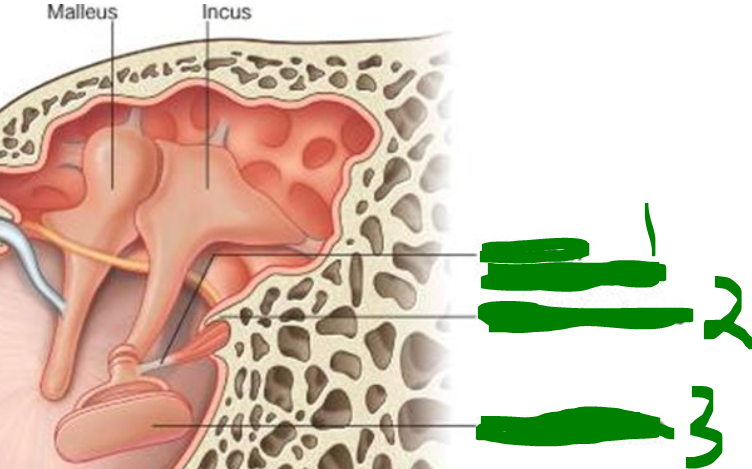 What is 1? | back 131 tendon of stapedius muscle |
front 132 What is 2? | back 132 pyramidal eminence |
front 133 What is 3? | back 133 footplate of stapes |
front 134 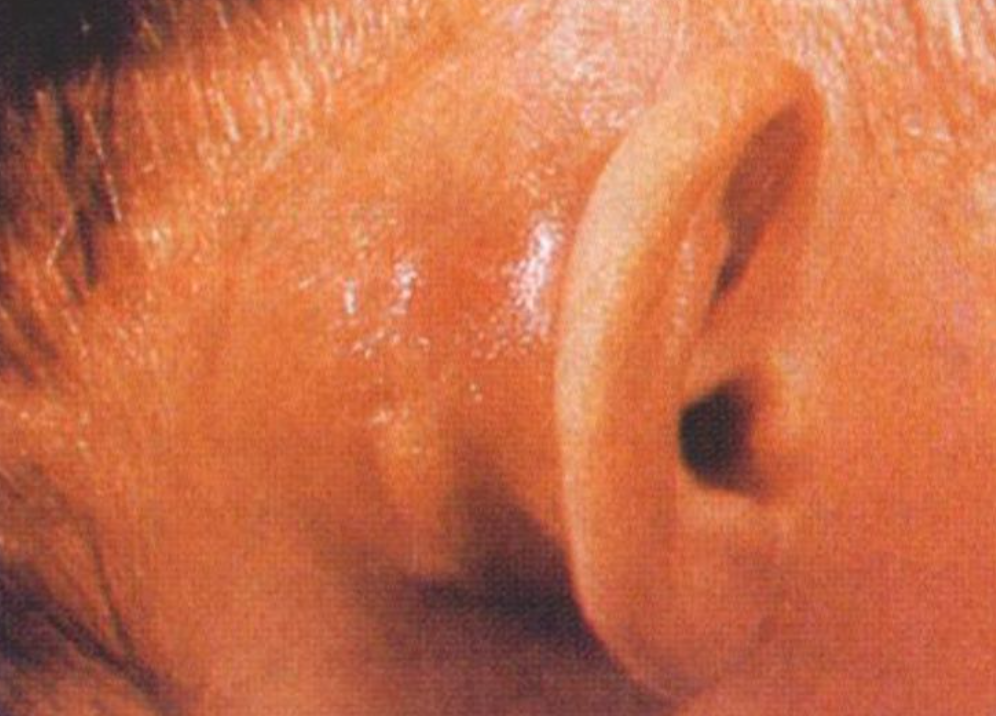 What is this? | back 134 Mastoiditis |
front 135 Mastoiditis is inflammation of the ______ ______ and ______ ______, often resulting from ______ ______. | back 135 mastoid antrum, air cells, otitis media |
front 136 Mastoiditis can spread superiorly into the ______ ______ cavity, potentially causing ______ meningitis. | back 136 middle cranial, bacterial |
front 137 The otic vesicle divides into two parts during development:
| back 137 ventral, saccule, cochlear dorsal, utricle, semicircular, endolymphatic |
front 138 what is the external auditory meatus derived from (development/embryo)? ______ ______ ______ | back 138 1st pharyngeal cleft |
front 139 what are the ossicles derived from (development/embryo)? ______ ______ | back 139 mesenchymal condensation |
front 140 what is the tympanic membrane derived from (development/embryo)? outer part - ______ inner part - ______ | back 140 ectoderm endoderm |
front 141 what is the embryonic origin of the middle ear cavity? ______ | back 141 pharynx |
front 142 The ______ and ______ develop from the 1st pharyngeal arch cartilage, also known as ______ cartilage. | back 142 malleus, incus, Meckel's |
front 143 The ______ develops from the 2nd pharyngeal arch cartilage, also known as ______ cartilage. | back 143 stapes, Reichert |
front 144 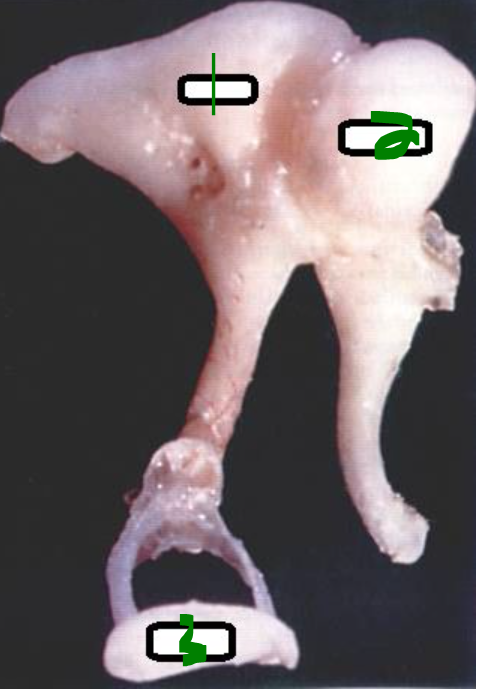 What is 1, 2, 3? | back 144 incus malleus stapes |
front 145 The bony labyrinth, located within the ______ portion of the ______ bone, includes the ______ canals, the ______, and the ______, and it contains ______. | back 145 petrous, temporal, semicircular, vestibule, cochlea, perilymph |
front 146 The membranous labyrinth includes the ______ duct, ______, ______, ______ ducts, and the ______ duct, and it contains ______. | back 146 cochlear, saccule, utricle, semicircular, endolymphatic, endolymph |
front 147 The vestibular apparatus detects ______ position (______ acceleration) and ______ movement (______ acceleration), orients us in ______ space, and serves as a ______ stabilizer for the ______ system. | back 147 head, linear, head, angular, 3-D, gyroscopic, visual |
front 148 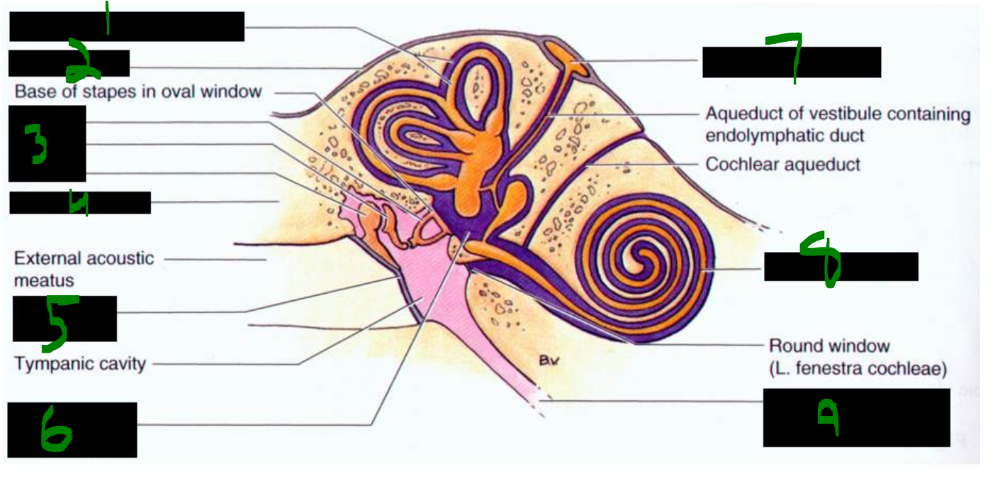 What is 1? | back 148 semicircular duct and canal |
front 149 What is 2? | back 149 dura mater |
front 150 What is 3? | back 150 stapes incus malleus |
front 151 What is 4? | back 151 tympanic bone |
front 152 What is 5? | back 152 tympanic membrane |
front 153 What is 6? | back 153 vestibule of bony labyrinth |
front 154 What is 7? | back 154 endolymphatic sac |
front 155 What is 8? | back 155 duct of cochlea |
front 156 What is 9? | back 156 pharyngotympanic tube |
front 157 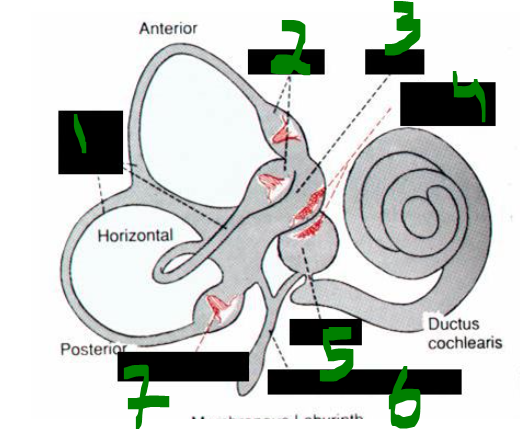 What is 1? | back 157 semicircular canals |
front 158 What is 2? | back 158 ampullae |
front 159 What is 3? | back 159 utricle |
front 160 What is 4? | back 160 maculae and statoconia |
front 161 What is 5? | back 161 saccule |
front 162 What is 6? | back 162 ductus endolymphaticus |
front 163 What is 7? | back 163 crista ampullae |
front 164 Vestibular hair cells have a single ______ called the ______ and numerous ______ (about 60), all embedded within a ______ matrix. | back 164 cilium, kinocilium, stereocilia, gelatinous |
front 165 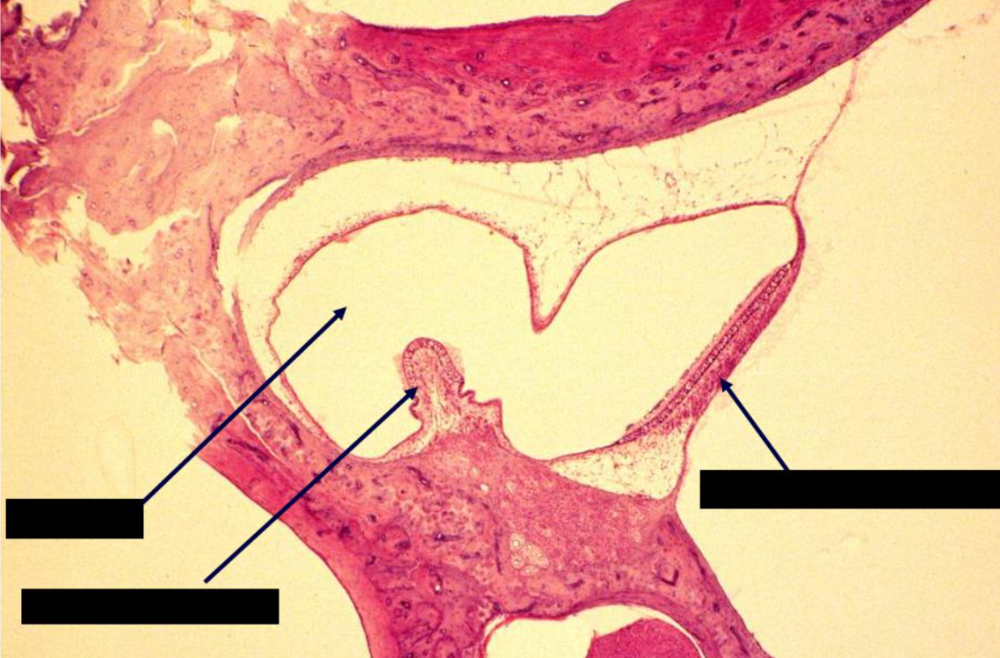 what is shown here? | back 165 vestibular apparatus |
front 166 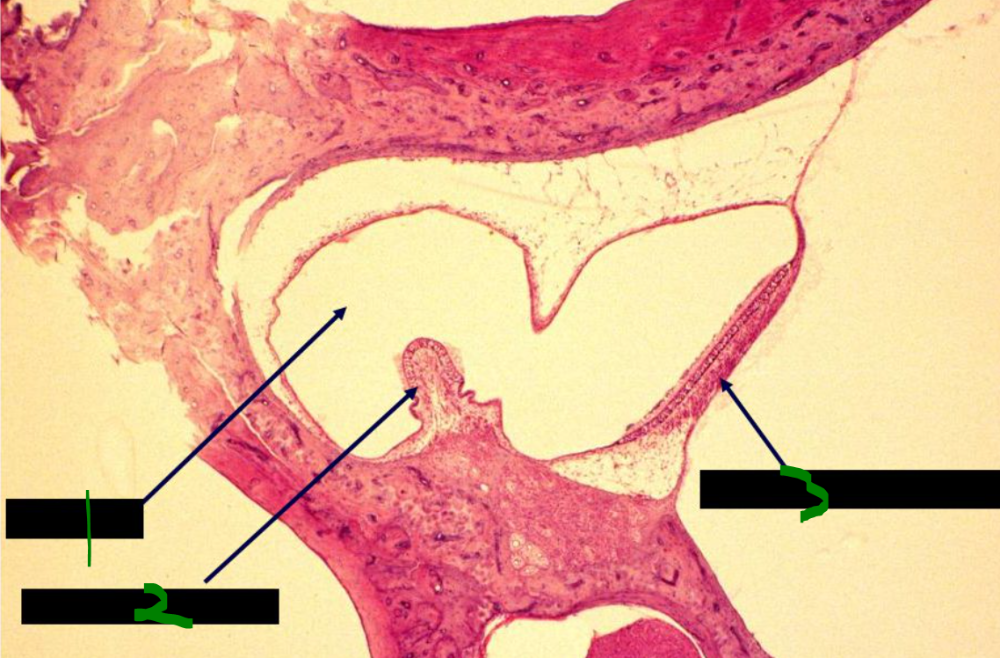 What is 1? | back 166 ampulla |
front 167 What is 2? | back 167 crista ampullaris |
front 168 What is 3? | back 168 macula of the utricle |
front 169 Head position (gravity and ______ acceleration) is detected by specialized regions of neuroepithelial cells called ______. | back 169 linear, maculae |
front 170 The maculae are located in the ______ and ______, and are oriented ______ to one another. | back 170 utricle, saccule, perpendicular |
front 171 The maculae, located in the ______ and ______, function to detect ______ position by sensing ______ and ______ acceleration. They are oriented ______ to one another. | back 171 utricle, saccule, head, gravity, linear, perpendicular |
front 172 Embedded within the surface of the gelatinous matrix of the maculae are ______, which are ______ ______ crystals. Gravity causes their weight to ______ the gelatinous matrix, leading the ______ cells to fire. | back 172 otoliths, calcium carbonate, distort, receptor |
front 173 Otoliths are ______ ______ crystals found embedded in the surface of the ______ matrix of the ______. Their weight, influenced by ______, distorts the matrix and stimulates the ______ cells. | back 173 calcium carbonate, gelatinous, maculae, gravity, receptor |
front 174 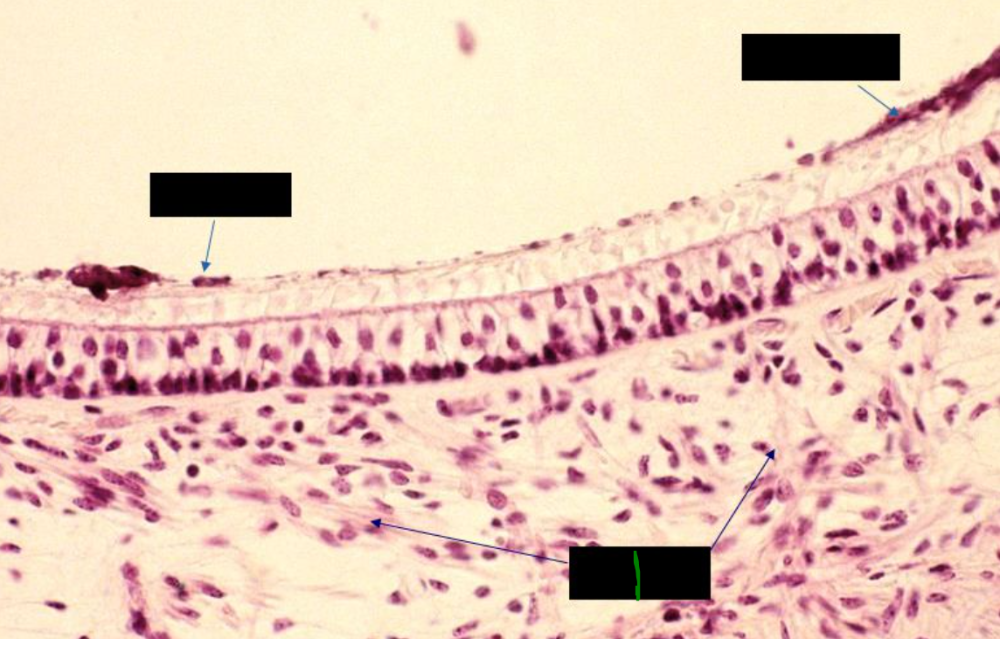 what is this? | back 174 macula |
front 175 What is 1? | back 175 nerves |
front 176 The semicircular canals detect head ______ by sensing ______ acceleration. | back 176 movements, angular |
front 177 The ampullae of the semicircular canals contain a ridge of neuroepithelial cells called the ______ ______, whose cilia and stereocilia are embedded in a gelatinous matrix that forms the ______. | back 177 crista ampullaris, cupula |
front 178 The ______ ______ detect head movements (angular acceleration). They have specialized dilations called ______, which contain neuroepithelial hair cells called the ______ ______. The hair cells’ cilia and stereocilia are embedded in a gelatinous matrix called the ______. | back 178 semicircular canals, ampullae, crista ampullaris, cupula |
front 179 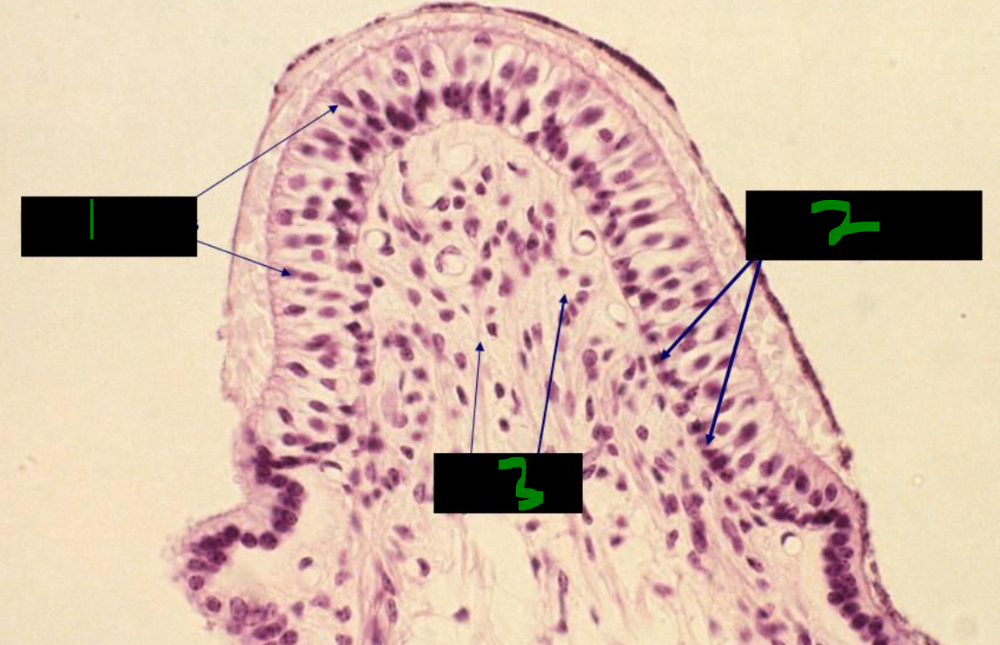 What is 1? | back 179 receptor cells |
front 180 What is 2? | back 180 nerves |
front 181 What is 3? | back 181 supporting cells |
front 182 Nystagmus is a rhythmic eye movement where the eyes smoothly follow a moving object and then quickly ______ back to fixate on a new object. | back 182 snap |
front 183 During nystagmus, the eyes follow a moving object at the same ______ as the object’s movement relative to the ______.velocity, head | back 183 velocity, head |
front 184 Vestibular nuclei in the brainstem connect to the oculomotor nuclei (CN ______, ______, and ______) via the ______ ______ fasciculus (MLF), coordinating eye movements in nystagmus. | back 184 VI, IV, III, medial longitudinal |
front 185 Damage to the ______ system or its connections with the ______, and use of ______ or other intoxicants can cause pathologic nystagmus. In vestibular nystagmus, the eyes move slowly toward the side of ______ damage and then rapidly snap back. | back 185 vestibular, cerebellum, alcohol, damage |
front 186 Meniere’s disease causes recurrent attacks of ______, ______ loss, and ______. | back 186 vertigo, hearing, tinnitus |
front 187 Meniere’s disease may be accompanied by ______ and most commonly affects people in their ______ and ______ decades. | back 187 nystagmus, fourth, fifth |
front 188 Attacks in Meniere’s disease last from a few ______ to several ______. | back 188 moments, hours |
front 189 A consistent feature of Meniere’s disease is ______ ______, which is an increase in the volume of ______. | back 189 endolymphatic hydrops, endolymph |
front 190 function of middle ear ossicles: convert ______ ______to ______ ______ | back 190 sound waves fluid waves |
front 191 The auditory apparatus captures and conducts ______. | back 191 sound |
front 192 Fluid waves travel through ______, which is not ______ and transmits waves with relative ______. | back 192 perilymph, compressible, fidelity |
front 193 The ______ is the central core of the spiral cochlea and contains the ______ ______ and the acoustic portion of the ______ nerve (CN ______). | back 193 modiolus, spiral ganglion, vestibulocochlear, VIII |
front 194 how big is the human cochlea? ______ turns over distance of ______ mm | back 194 2.5 turns over distance of 35 mm |
front 195 what is suspended wtihin the bony cochlea? ______ ______ duct aka ______ ______ | back 195 membranous cochlear duct aka scala media |
front 196 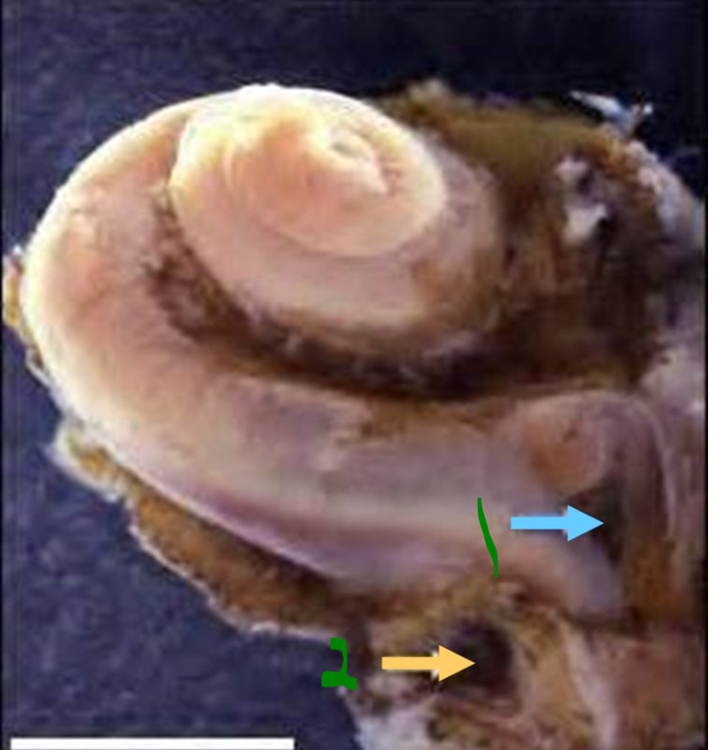 What is 1? | back 196 oval window |
front 197 What is 2? | back 197 round window |
front 198 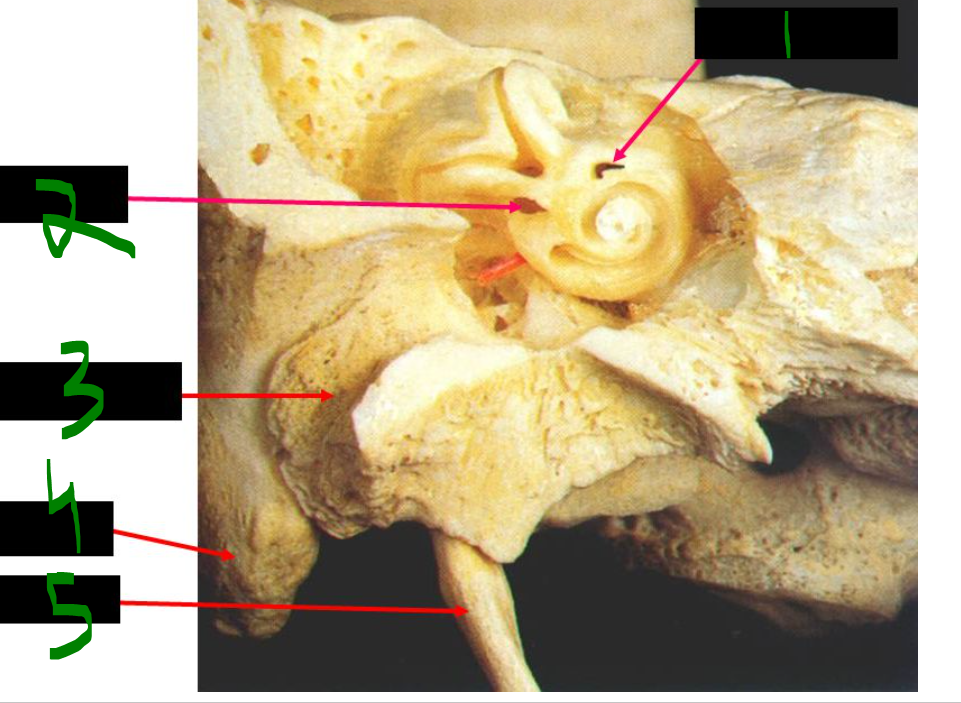 What is 1? | back 198 facial canal |
front 199 What is 2? | back 199 oval window |
front 200 What is 3? | back 200 external auditory meatus |
front 201 What is 4? | back 201 mastoid process |
front 202 What is 5? | back 202 styloid process |
front 203 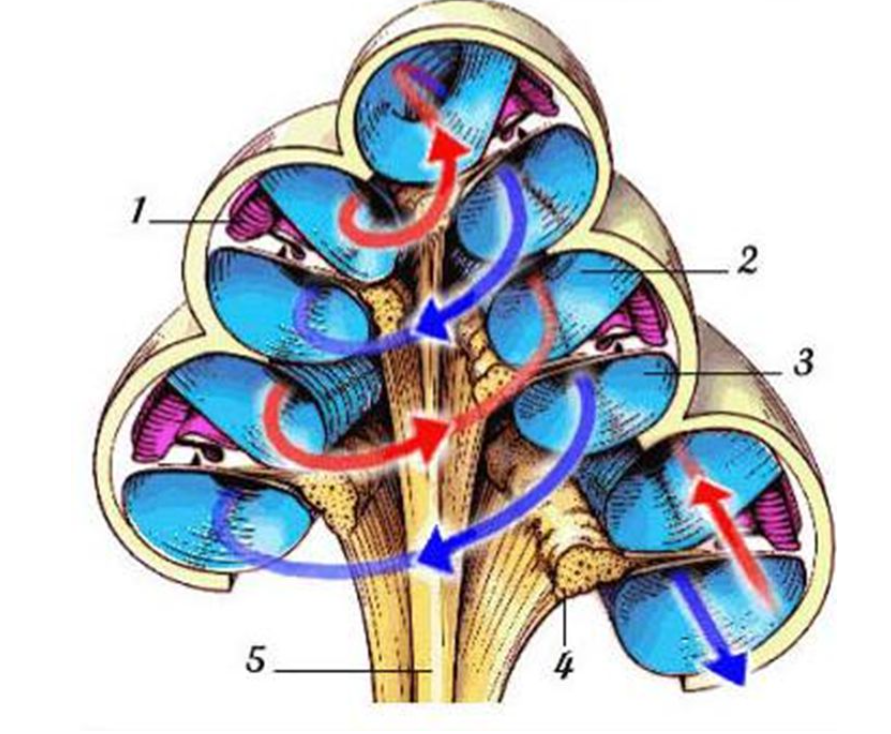 What is 1? | back 203 1) scala media/cochlear duct |
front 204 What is 2? | back 204 2) scala vestibuli (above scala media) |
front 205 What is 3? | back 205 3) scala tympani (below scala media) |
front 206 What is 4? | back 206 4) spiral ganglion |
front 207 What is 5? | back 207 5) vestibular nerve |
front 208 The ______ vestibuli and ______ contain perilymph and are part of the ______ labyrinth. | back 208 scala, tympani, bony |
front 209 The ______ media contains endolymph and is part of the ______ labyrinth. | back 209 scala, membranous |
front 210 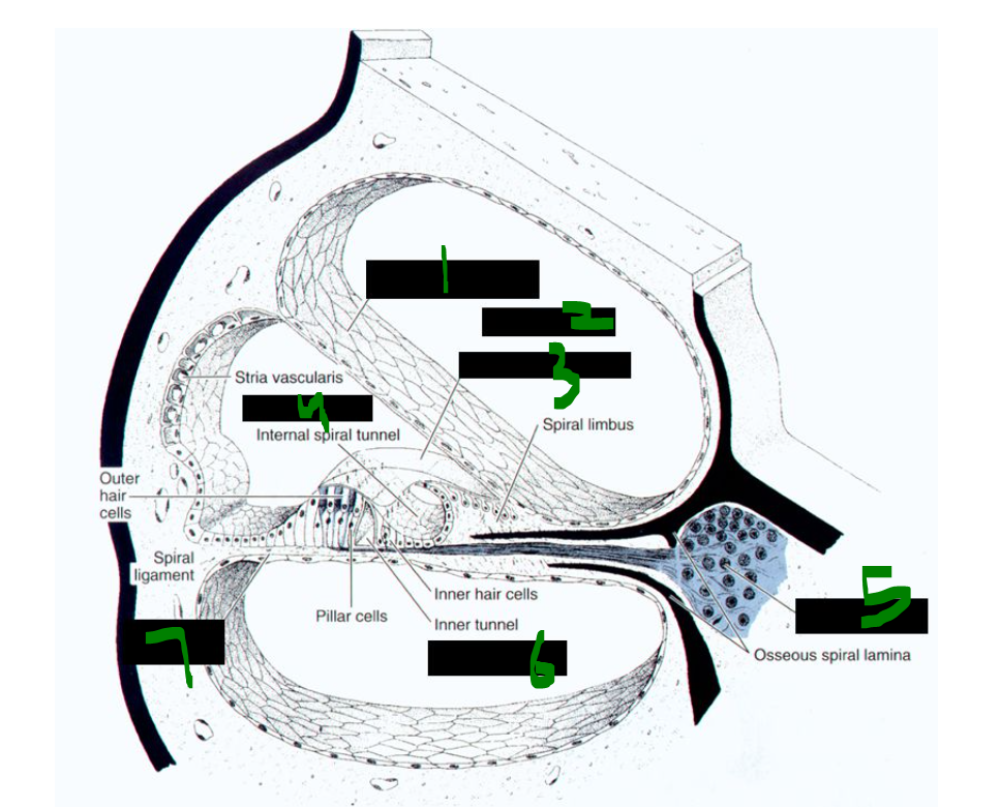 What is 1? | back 210 vestibular membrane |
front 211 What is 2? | back 211 scala vestibuli |
front 212 What is 3? | back 212 tectorial membrane |
front 213 What is 4? | back 213 scala media |
front 214 What is 5? | back 214 spiral ganglion |
front 215 What is 6? | back 215 scala tympani |
front 216 What is 7? | back 216 basilar membrane |
front 217 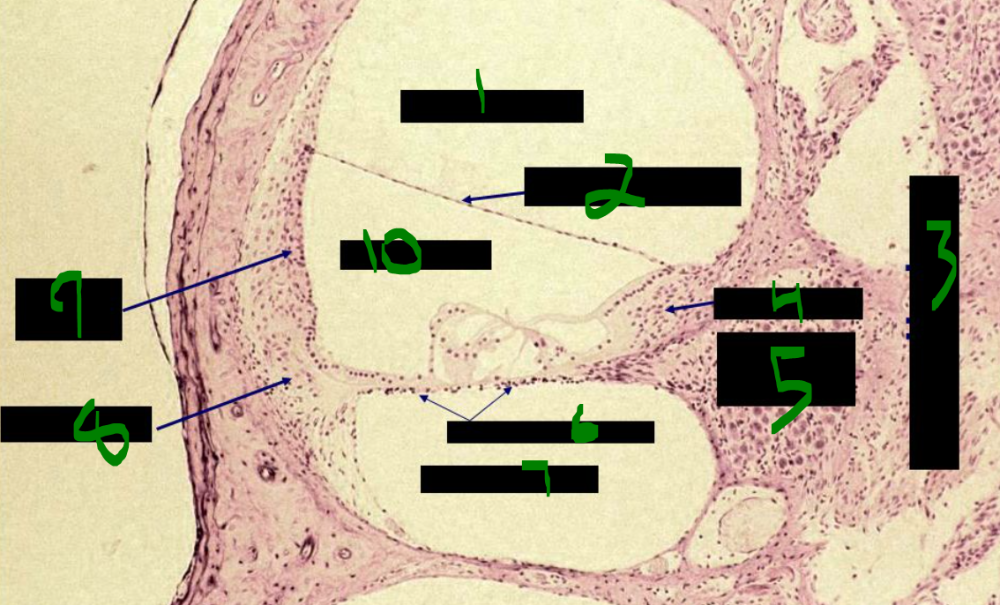 what is this? | back 217 cochlea |
front 218 what is 1? | back 218 scala vestibuli |
front 219 what is 2? | back 219 vestibular membrane |
front 220 what is 3? | back 220 modiolus |
front 221 what is 4? | back 221 spiral limbus |
front 222 What is 5? | back 222 spiral ganglion |
front 223 What is 6? | back 223 basilar membrane |
front 224 What is 7? | back 224 scala tympani |
front 225 What is 8? | back 225 spiral ligament |
front 226 What is 9? | back 226 stria vascularis |
front 227 What is 10? | back 227 scala media |
front 228 The ______ ______ is found within the ______ duct (scala media) and is the only ______ epithelium in the human body. It contains ______ and produces ______. | back 228 stria vascularis, cochlear, vascular, blood vessels, endolymph |
front 229 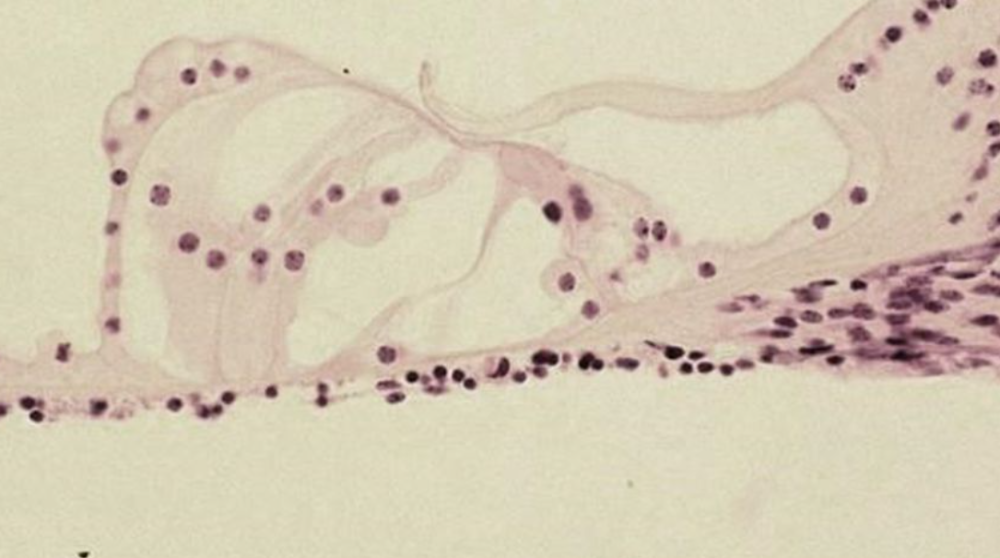 what is this? | back 229 organ of corti |
front 230 The auditory apparatus contains ______ hair cells arranged in 3 rows with a ______-shaped array of stereocilia. It also contains ______ hair cells arranged in 1 row with 50–60 ______-shaped stereocilia. Auditory hair cells do not have ______. | back 230 outer, W, inner, V, kinocilia |
front 231 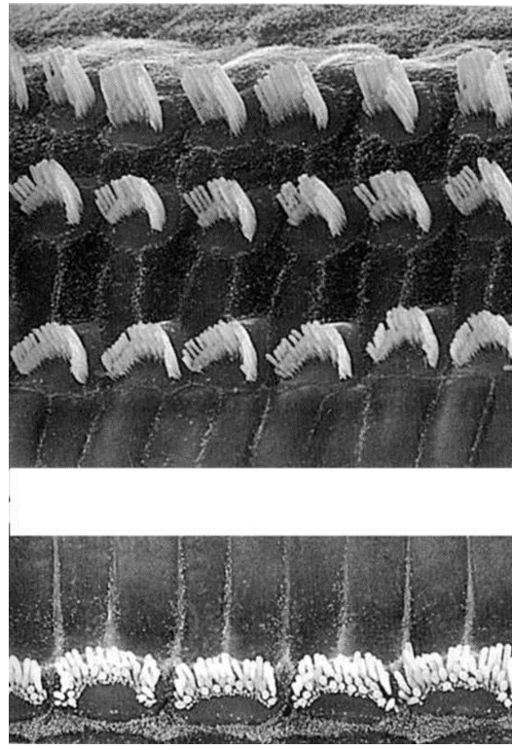 Which hair cell is which? | back 231 outer- top inner- bottom |
front 232 Constant exposure to loud sounds at specific frequencies can damage ______ cells, which do not ______. The ______ nerve may be injured at its entrance into the brainstem by a ______ (acoustic neuroma), which may also involve the ______ nerve causing ______ palsy. | back 232 hair, regenerate vestibulocochlear, Schwannoma, facial, facial |