Instructions for Side by Side Printing
- Print the notecards
- Fold each page in half along the solid vertical line
- Cut out the notecards by cutting along each horizontal dotted line
- Optional: Glue, tape or staple the ends of each notecard together
Anatomy JV Exam 3: Temporal Infratemporal Pterygopalatine Fossae
front 1 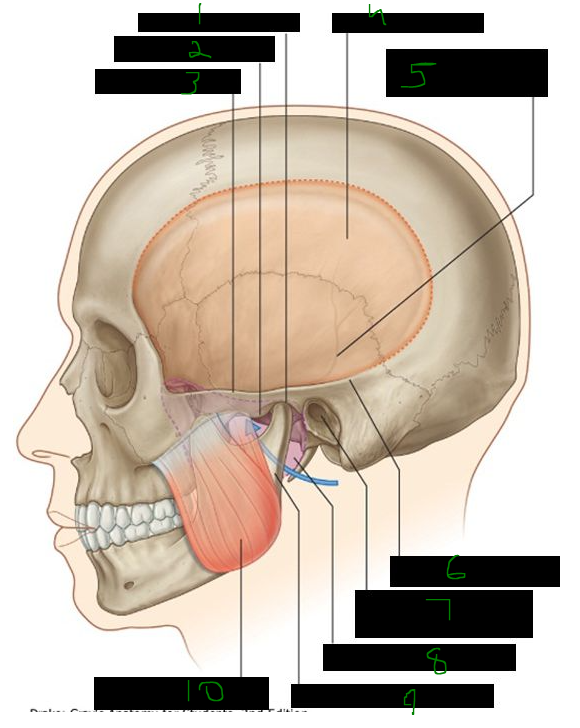 What is 1? | back 1 mandibular fossa |
front 2 What is 2? | back 2 articular tubercle |
front 3 What is 3? | back 3 zygomatic arch |
front 4 What is 4? | back 4 temporal fossa |
front 5 What is 5? | back 5 groove for middle temporal artery |
front 6 What is 6? | back 6 supramastoid crest |
front 7 What is 7? | back 7 external auditory meatus |
front 8 What is 8? | back 8 infratemporal fossa |
front 9 What is 9? | back 9 ramus of mandible |
front 10 What is 10? | back 10 masseter mucle |
front 11 The ______ ______ separates the temporal from the infratemporal fossae, which are ______ with each other; the temporal fossa lies ______ to the infratemporal fossa. | back 11 zygomatic arch, continuous, superior |
front 12 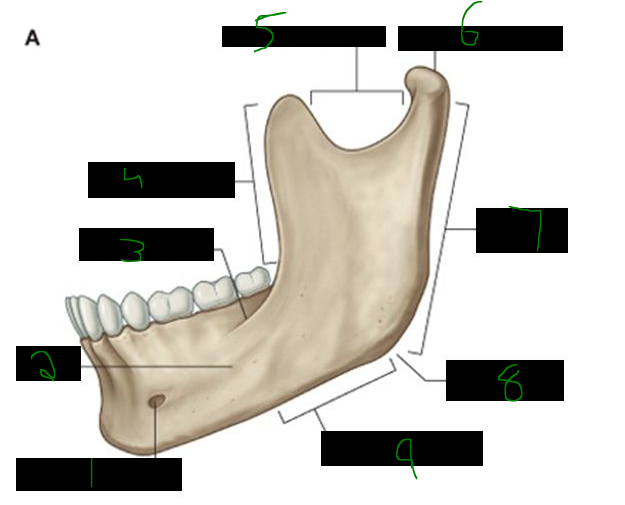 What is 1? | back 12 mental foramen |
front 13 What is 2? | back 13 body |
front 14 What is 3? | back 14 oblique line |
front 15 What is 4? | back 15 anterior border |
front 16 What is 5? | back 16 superior border |
front 17 What is 6? | back 17 condylar process |
front 18 What is 7? | back 18 ramus |
front 19 What is 8? | back 19 angle |
front 20 What is 9? | back 20 inferior border |
front 21 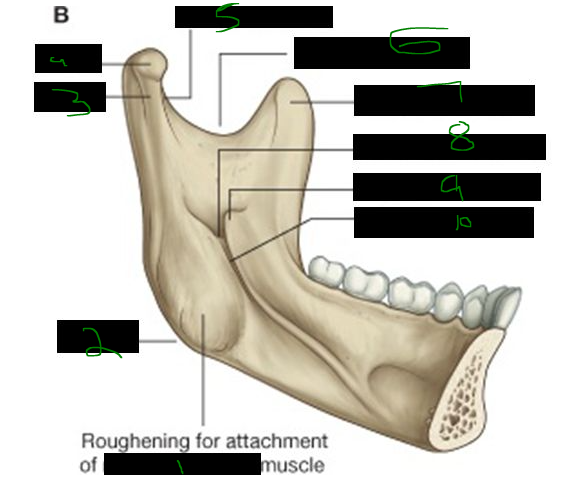 What is 1? | back 21 medial pterygoid muscle |
front 22 What is 2? | back 22 angle |
front 23 What is 3? | back 23 neck |
front 24 What is 4? | back 24 head |
front 25 What is 5? | back 25 pterygoid fovea |
front 26 What is 6? | back 26 mandibular notch |
front 27 What is 7? | back 27 coronoid process |
front 28 What is 8? | back 28 mandibular foramen |
front 29 What is 9? | back 29 lingula |
front 30 What is 10? | back 30 mylohyoid groove |
front 31 The infratemporal fossa is located deep to the ______ muscle and the ______ of the ______. | back 31 masseter, ramus, mandible |
front 32 The lingula is located on the ______ part of the ______, where the ______ ligament attaches. | back 32 medial, mandible, sphenomandibular |
front 33 where does the sphenomandibular ligament attach? ______ of ______ (______ surface) | back 33 lingula of mandible (medial surface) |
front 34 Protrusion of the mandible at the TMJ is primarily performed by the ______ pterygoid and assisted by the ______ pterygoid. | back 34 lateral, medial |
front 35 Retraction of the mandible involves the posterior fibers of the ______, the deep part of the ______, and the ______ and digastric muscles. | back 35 temporalis, masseter, geniohyoid |
front 36 Elevation of the mandible is performed by the ______, ______, and ______ pterygoid muscles. | back 36 temporalis, masseter, medial |
front 37 Depression of the mandible is assisted by ______, the ______ muscle, the ______ muscle, and the mylohyoid. | back 37 gravity, digastric, geniohyoid |
front 38 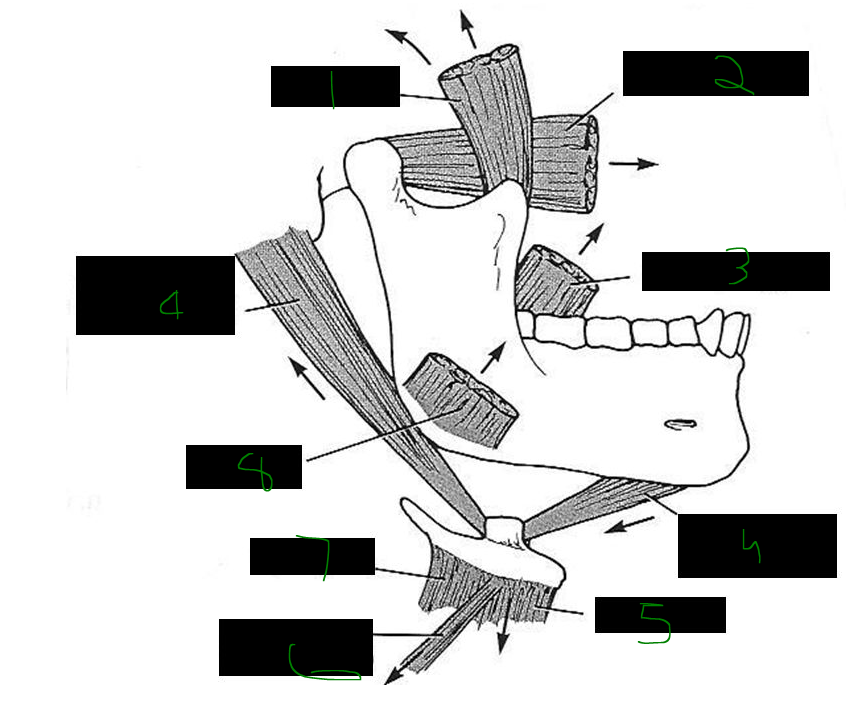 What is 1? | back 38 temporalis |
front 39 What is 2? | back 39 lateral pterygoid |
front 40 What is 3? | back 40 medial pterygoid |
front 41 What is 4? | back 41 digastric (anterior belly) |
front 42 What is 5? | back 42 sternohyoid |
front 43 What is 6? | back 43 omohyoid (superior belly) |
front 44 What is 7? | back 44 thyrohyoid |
front 45 What is 8? | back 45 masseter |
front 46 What is 9? | back 46 digastric (posterior belly) |
front 47 At the TMJ, forward movement of the mandible and articular disc occurs in the ______ portion of the joint, while ______ movement between the condylar process and articular disc occurs in the ______ portion. | back 47 upper, hinge, lower |
front 48 what is the main muscle that allows protrusion of the jaw? ______ ______ (assisted by ______ pterygoid) | back 48 lateral pterygoid (assisted by medial pterygoid) |
front 49 opening of the jaw is a composite of what actions? mandibular ______ & ______ | back 49 mandibular protrusion & depression |
front 50 what muscle inserts into the TMJ joint capsule in the region of the articular disc? ______ ______ | back 50 lateral pterygoid |
front 51 Jaw dislocation most often occurs when the mandible is fully ______, making the joint ______ and susceptible to dislocation from minor ______. | back 51 depressed, unstable, trauma |
front 52 To reduce a dislocated jaw, apply downward pressure on the ______ ______ and push the mandible ______. | back 52 lower molars, backward |
front 53 Traumatic dislocation of the jaw can injure the ______ nerve, a branch of the mandibular division of cranial nerve ______. | back 53 auriculotemporal, V3 |
front 54 during surgical procedures involving the TMJ, what nerve(s) are susceptible to damage? ______ & ______ | back 54 facial & auriculotemporal |
front 55 Jaw clicking and popping is caused by delayed movement of the ______ ______ followed by its sudden movement during ______ and ______ of the mandible. | back 55 articular disc, opening, closing |
front 56 The sphenomandibular ligament runs from the ______ of the sphenoid to the ______ of the ______ of the mandible. | back 56 spine, lingula, ramus |
front 57 The stylomandibular ligament extends from the ______ process of the ______ bone to the ______ of the mandible. | back 57 styloid, temporal, angle |
front 58 The lateral ligament connects the margin of the ______ ______ to the ______ of the mandible. | back 58 articular tubercle, neck |
front 59 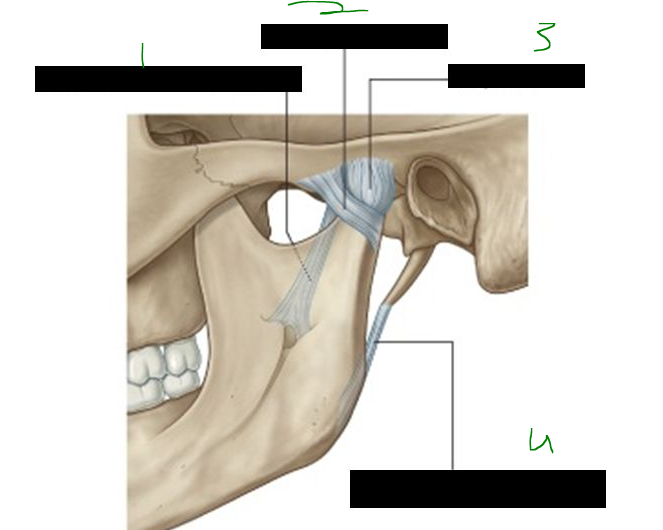 What is 1? | back 59 sphenomandibular ligament |
front 60 What is 2? | back 60 lateral ligament |
front 61 What is 3? | back 61 capsule |
front 62 What is 4? | back 62 stylomandibular ligament |
front 63 The masseter muscle originates from the ______ ______ and the maxillary process of the ______ bone. | back 63 zygomatic arch, zygomatic |
front 64 The insertion of the masseter is at the ______ and ______ surface of the ______. | back 64 angle, lateral, mandible |
front 65 The masseter is innervated by the ______ nerve, a branch of the mandibular division of cranial nerve ______. | back 65 masseteric, V3 |
front 66 The masseter functions in powerful ______ of the mandible and contributes slightly to ______. | back 66 elevation, protrusion |
front 67 The blood supply to the masseter muscle comes from the ______ branch of the ______ artery. | back 67 masseteric, maxillary |
front 68 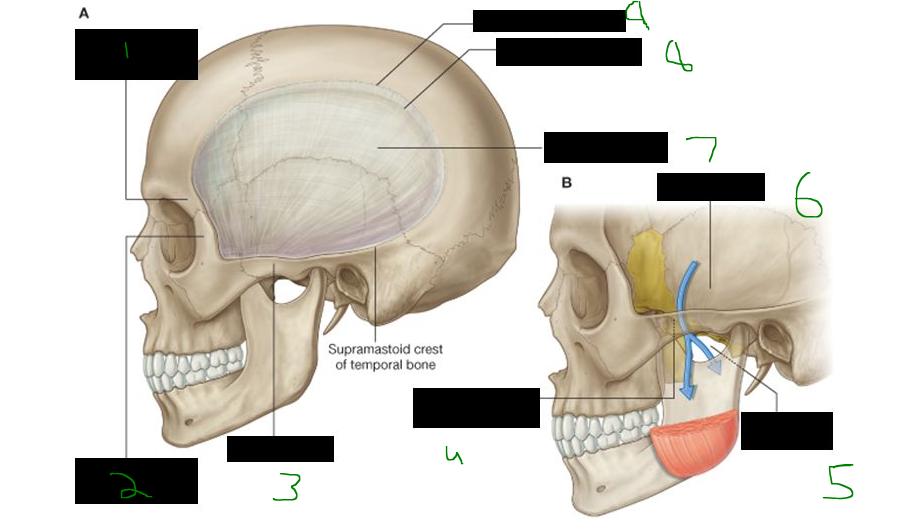 What is 1? | back 68 zygomatic process of frontal bone |
front 69 What is 2? | back 69 frontal process of zygomatic bone |
front 70 What is 3? | back 70 zygomatic arch |
front 71 What is 4? | back 71 infratemporal crest of sphenoid |
front 72 What is 5? | back 72 infratemporal fossa |
front 73 What is 6? | back 73 temporal fossa |
front 74 What is 7? | back 74 temporal fascia |
front 75 What is 8? | back 75 inferior temporal line |
front 76 What is 9? | back 76 superior temporal line |
front 77 The temporalis muscle originates from the ______ ______, with anterior fibers oriented ______ and posterior fibers more ______. | back 77 temporal fossa, vertically, horizontal |
front 78 The temporalis inserts on the anterior surface of the ______ process and the ______ of the mandible. | back 78 coronoid, ramus |
front 79 The temporalis is a powerful ______ of the mandible, assists in ______, and also produces ______ movements. | back 79 elevator, retraction, side to side |
front 80 Innervation to the temporalis muscle comes from the ______ ______ nerves, which are branches of cranial nerve ______. | back 80 deep temporal, V3 |
front 81 Blood supply to the temporalis comes from the ______ ______ arteries (from the maxillary artery) and the ______ ______ artery (from the superficial temporal artery). | back 81 deep temporal, middle temporal |
front 82 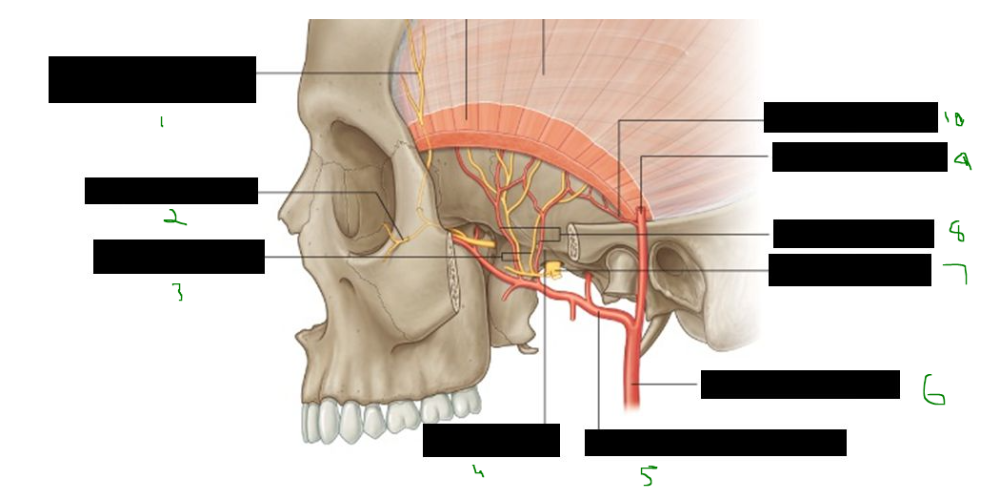 What is 1? | back 82 zygomaticotemporal nerve (branch of maxillary nerve v2) |
front 83 What is 2? | back 83 zygomaticofacial nerve |
front 84 What is 3? | back 84 deep temporal nerves |
front 85 What is 4? | back 85 infratemporal crest |
front 86 What is 5? | back 86 maxillary artery in infratemporal fossa |
front 87 What is 6? | back 87 external carotid artery |
front 88 What is 7? | back 88 mandibular nerve (v3) |
front 89 What is 8? | back 89 deep temporal arteries |
front 90 What is 9? | back 90 superficial temporal artery |
front 91 What is 10? | back 91 middle temporal artery |
front 92 Contents of the temporal fossa include the ______ muscle, deep ______ nerves and vessels, and the ______ branches of the maxillary nerve (V2). | back 92 temporalis, temporal, zygomaticotemporal |
front 93 Openings into or out of the roof of the infratemporal fossa include the ______ fossa, foramen ______, foramen ______, and the ______ fissure. | back 93 temporal, ovale, spinosum, petrotympanic |
front 94 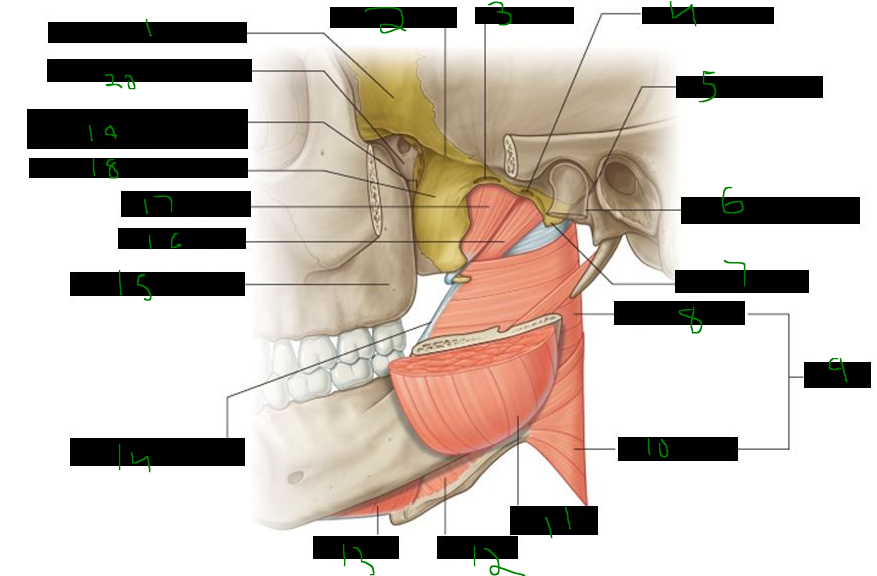 What is 1? | back 94 greater wing of sphenoid bone |
front 95 What is 2? | back 95 infratemporal crest |
front 96 What is 3? | back 96 foramen ovale |
front 97 What is 4? | back 97 foramen spinosum |
front 98 What is 5? | back 98 petrotympanic fissure |
front 99 What is 6? | back 99 head and neck of mandible |
front 100 What is 7? | back 100 spine of sphenoid |
front 101 What is 8? | back 101 superior constrictor |
front 102 What is 9? | back 102 pharynx |
front 103 What is 10? | back 103 middle constrictor |
front 104 What is 11? | back 104 masseter |
front 105 What is 12? | back 105 hyoglossus |
front 106 What is 13? | back 106 mylohyoid |
front 107 What is 14? | back 107 pterygomandibular raphe |
front 108 What is 15? | back 108 posterior surface of maxilla |
front 109 What is 16? | back 109 levator veli palatini |
front 110 What is 17? | back 110 tensor veli palatini |
front 111 What is 18? | back 111 lateral plate of pterygoid process |
front 112 What is 19? | back 112 pterygomaxillary fissure |
front 113 What is 20? | back 113 pterygopalatine fossa |
front 114 Openings in the anterior part of the infratemporal fossa include small foramina in the ______ for the ______ ______ alveolar blood vessels and nerves supplying the ______. | back 114 maxilla, posterior superior, teeth |
front 115 The medial part of the infratemporal fossa has the ______ ______, which leads into the ______ ______. | back 115 pterygomaxillary fissure, pterygopalatine fossa |
front 116 The medial pterygoid muscle has two heads: the deep head originates from the ______ plate of the ______ process, and the superficial head originates from the ______ of the maxilla. | back 116 lateral, pterygoid, tuberosity |
front 117 Both heads of the medial pterygoid muscle insert on the ______ surface of the mandible near the ______, passing deep to the ______ ligament. | back 117 medial, angle, sphenomandibular |
front 118 The medial pterygoid muscle functions to ______ the mandible and assist with ______. | back 118 elevate, protrusion |
front 119 Innervation to the medial pterygoid muscle is via the ______ to medial pterygoid nerve, a branch of cranial nerve ______. | back 119 nerve, V3 |
front 120 The lateral pterygoid muscle has two heads: the upper head originates from the ______ bone, and the lower head originates from the ______ plate of the ______ process. | back 120 sphenoid, lateral, pterygoid |
front 121 The lateral pterygoid inserts on the neck of the mandible at the ______ ______ and the capsule of the TMJ at the ______ ______. | back 121 pterygoid fovea, articular disc |
front 122 The lateral pterygoid functions to ______ the mandible and pull the ______ ______ anteriorly; most fibers are ______ oriented. | back 122 protrude, articular disc, horizontally |
front 123 Innervation of the lateral pterygoid comes from the ______ to lateral pterygoid nerve, a branch of cranial nerve ______. | back 123 nerve, V3 |
front 124 When the lateral and medial pterygoid muscles contract on one side, the chin moves to the ______ side, helping to ______ food by the ______. | back 124 opposite, grind, molars |
front 125 The four muscles of mastication are ______, lateral ______, medial ______, and ______, all innervated by branches of the mandibular nerve (CN ______). | back 125 temporalis, pterygoid, pterygoid, masseter, V3 |
front 126 The buccinator assists in mastication by holding food between the ______ and ______ teeth, and is innervated by the ______ nerve (buccal branch). | back 126 upper, lower, facial |
front 127 The mandibular nerve (V3) provides sensation from the teeth and gingivae of the ______, anterior two-thirds of the ______, mucosa on the floor of the ______ cavity, lower lip, skin over the ______, lower ______, and part of the cranial dura mater. | back 127 mandible, tongue, oral, temple, face |
front 128 Motor functions of the mandibular nerve include innervating the muscles of ______, the ______ tympani, and the tensor ______ ______ of the soft palate. | back 128 mastication, tensor, veli palatini |
front 129 All branches of the mandibular nerve (V3) originate in the ______ ______. | back 129 infratemporal fossa |
front 130 The nine branches of the mandibular nerve (V3) are ______, nerve to ______ pterygoid, nerve to ______ pterygoid (which branches to ______ veli palatini and ______ tympani), ______ temporal, ______, ______, ______ temporal, ______ alveolar (which branches to ______ and anterior belly of ______), and ______. | back 130 masseteric, lateral, medial, tensor, tensor, deep, meningeal, buccal, auriculotemporal, inferior, mylohyoid, digastric, lingual |
front 131 Just distal to the foramen ovale, the mandibular nerve gives off the ______ branch, which enters the foramen ______, and the nerve to ______ ______. | back 131 meningeal, spinosum, medial, pterygoid |
front 132 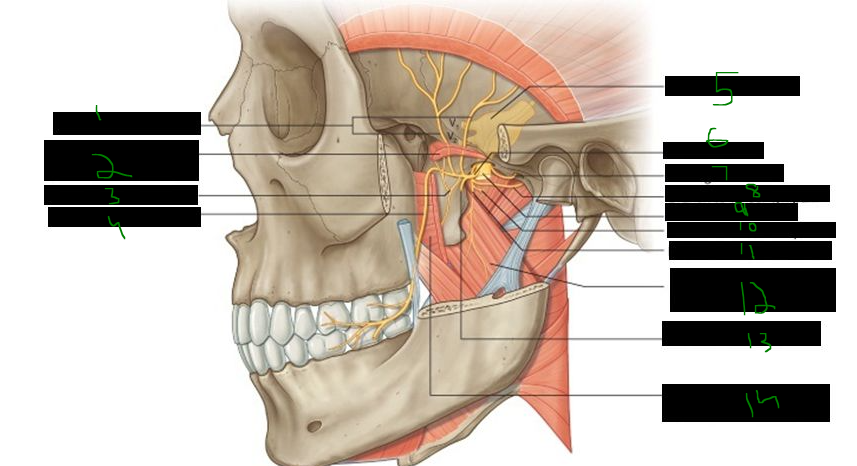 What is 1? | back 132 deep temporal nerves |
front 133 What is 2? | back 133 upper head lateral pterygoid (cut) |
front 134 What is 3? | back 134 nerve to lateral pterygoid |
front 135 What is 4? | back 135 buccal nerve |
front 136 What is 5? | back 136 trigeminal nerve |
front 137 What is 6? | back 137 anterior trunk |
front 138 What is 7? | back 138 meningeal nerve |
front 139 What is 8? | back 139 branch to tensor tympani |
front 140 What is 9? | back 140 posterior trunk |
front 141 What is 10? | back 141 branch to tensor veli palatini |
front 142 What is 11? | back 142 nerve to medial pterygoid |
front 143 What is 12? | back 143 deep head medial pterygoid |
front 144 What is 13? | back 144 nerve to masseter |
front 145 What is 14? | back 145 lower head lateral pterygoid (cut) |
front 146 The four branches of the anterior trunk of V3 are ______ (sensory), ______, ______, and nerve to ______ pterygoid (all motor). | back 146 buccal, masseteric, deep temporal, lateral |
front 147 The three nerves of the posterior trunk of V3 are ______, ______, and ______ alveolar, which gives motor branches to ______ and anterior belly of ______ muscles before entering the mandibular foramen. | back 147 auriculotemporal, lingual, inferior, mylohyoid, digastric |
front 148 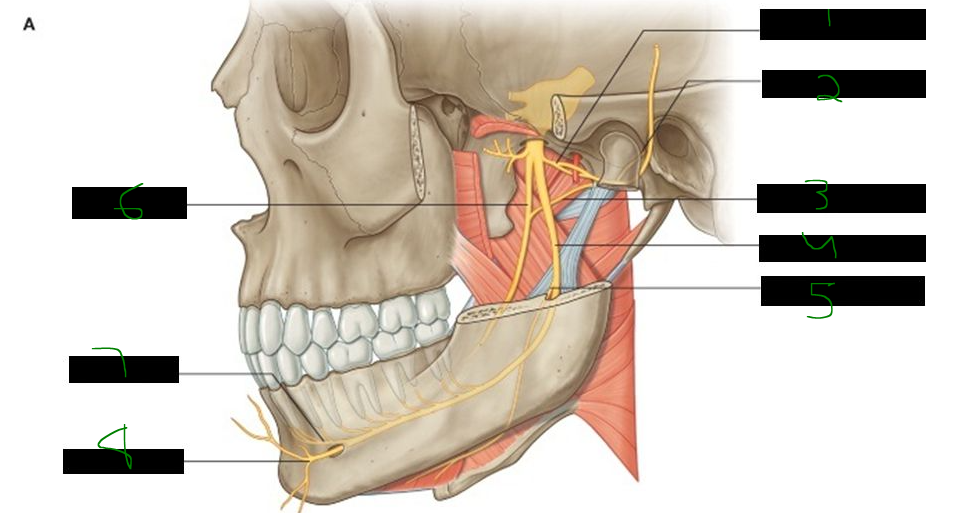 What is 1? | back 148 auriculotemporal nerve |
front 149 What is 2? | back 149 petrotympanic fissure |
front 150 What is 3? | back 150 chorda tympani nerve |
front 151 What is 4? | back 151 inferior alveolar nerve |
front 152 What is 5? | back 152 nerve to mylohyoid |
front 153 What is 6? | back 153 lingual nerve |
front 154 What is 7? | back 154 incisive nerve |
front 155 What is 8? | back 155 mental nerve |
front 156 Motor branches from the inferior alveolar nerve to ______ and the anterior belly of ______ branch off before the nerve enters the ______ foramen. | back 156 mylohyoid, digastric, mandibular |
front 157 The ______ nerve carries parasympathetic axons from the otic ganglion to the ______ gland and is a branch of the mandibular nerve (CN ______). | back 157 auriculotemporal, parotid, V3 |
front 158 The ______ nerve supplies general sensation to the anterior two-thirds of the tongue, while ______ ______ (from CN ______) provides taste to the same region and carries parasympathetics to the sublingual and submandibular glands. | back 158 lingual, chorda tympani, VII |
front 159 The ______ alveolar nerve (branch of ______) passes through the mandibular foramen, gives sensation to the lower ______, and exits the mental foramen as the ______ nerve to supply the ______. | back 159 inferior, V3, teeth, mental, chin |
front 160 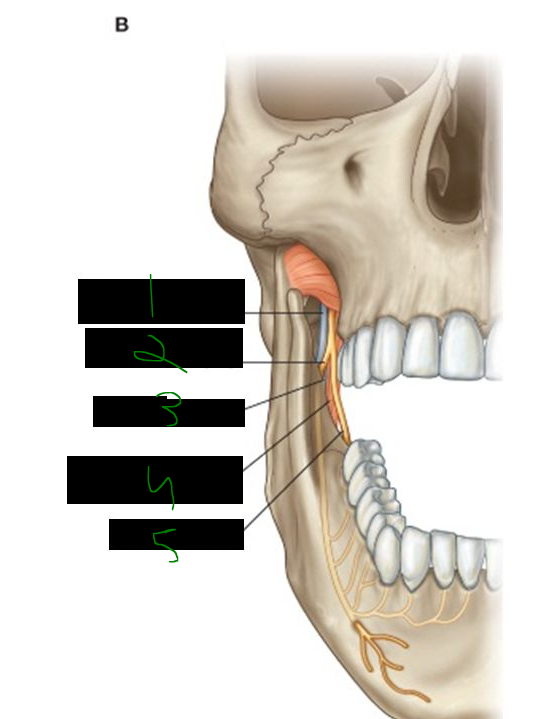 What is 1? | back 160 sphenomandibular ligament |
front 161 What is 2? | back 161 inferior alveolar nerve |
front 162 What is 3? | back 162 lingula |
front 163 What is 4? | back 163 medial pterygoid muscle |
front 164 What is 5? | back 164 lingual nerve |
front 165 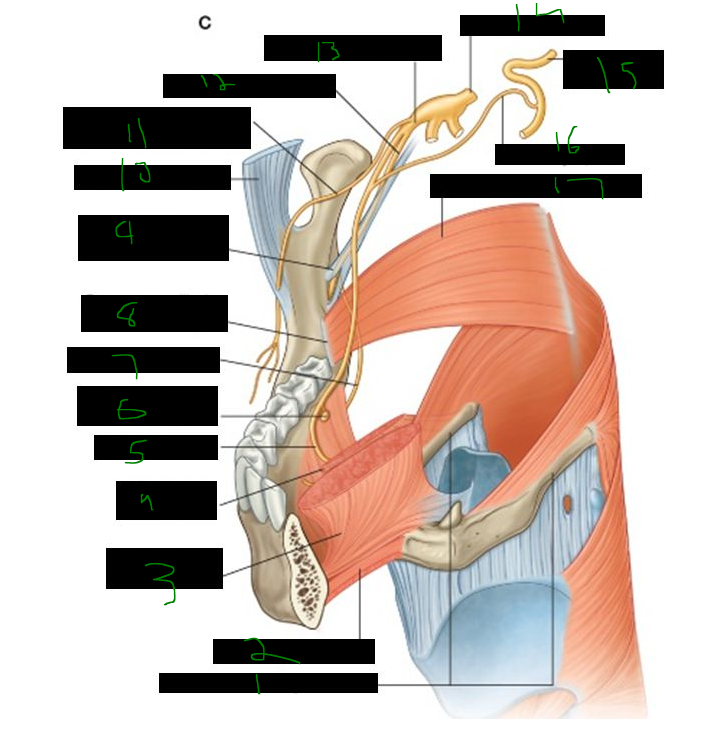 What is 1? | back 165 greater horns of hyoid bone |
front 166 What is 2? | back 166 geniohyoid muscle |
front 167 What is 3? | back 167 genioglossus muscle |
front 168 What is 4? | back 168 hyoglossus muscle |
front 169 What is 5? | back 169 lingual nerve |
front 170 What is 6? | back 170 submandibular ganglion |
front 171 What is 7? | back 171 nerve to mylohyoid |
front 172 What is 8? | back 172 pterygomandibular raphe |
front 173 What is 9? | back 173 sphenomandibular ligament |
front 174 What is 10? | back 174 temporalis tendon |
front 175 What is 11? | back 175 buccal nerve (branch of anterior trunk) |
front 176 What is 12? | back 176 inferior alveolar nerve |
front 177 What is 13? | back 177 mandibular nerve (v2) |
front 178 What is 14? | back 178 trigeminal nerve (V) |
front 179 What is 15? | back 179 facial nerve (7) |
front 180 What is 16? | back 180 chorda tympani |
front 181 What is 17? | back 181 superior constrictor muscle |
front 182 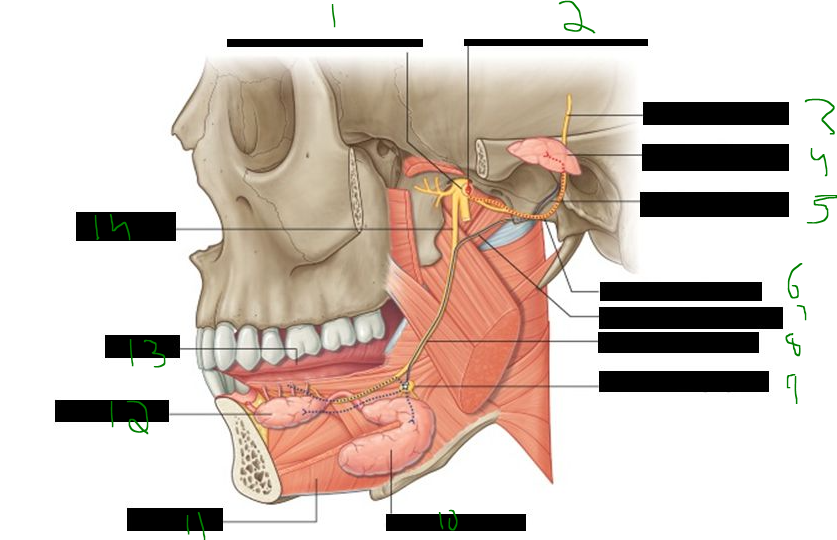 What is 1? | back 182 otic ganglion (medial to V3) |
front 183 What is 2? | back 183 lesser petrosal nerve (IX) |
front 184 What is 3? | back 184 auriculotemporal nerve |
front 185 What is 4? | back 185 top of parotid gland |
front 186 What is 5? | back 186 petrotympanic fissure |
front 187 What is 6? | back 187 auriculotemporal nerve |
front 188 What is 7? | back 188 chroda tympani nerve of VII |
front 189 What is 8? | back 189 lingual nerve |
front 190 What is 9? | back 190 submandibular ganglion |
front 191 What is 10? | back 191 submandibular gland |
front 192 What is 11? | back 192 mylohyoid |
front 193 What is 12? | back 193 sublingual gland |
front 194 What is 13? | back 194 tongue |
front 195 What is 14? | back 195 lingual nerve |
front 196 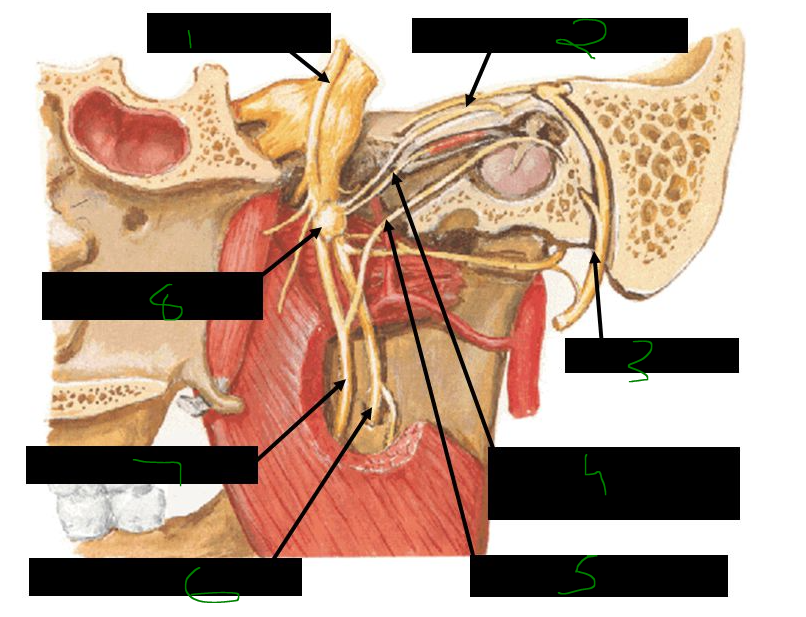 What is 1? | back 196 motor root |
front 197 What is 2? | back 197 lesser petrosal nerve |
front 198 What is 3? | back 198 VII |
front 199 What is 4? | back 199 nerve to tensor tympani |
front 200 What is 5? | back 200 chorda tympani |
front 201 What is 6? | back 201 inferior alveolar |
front 202 What is 7? | back 202 lingual nerve |
front 203 What is 8? | back 203 otic ganglion |
front 204 The maxillary artery has three parts:
| back 204 middle, inferior, lateral, muscular, pterygopalatine |
front 205 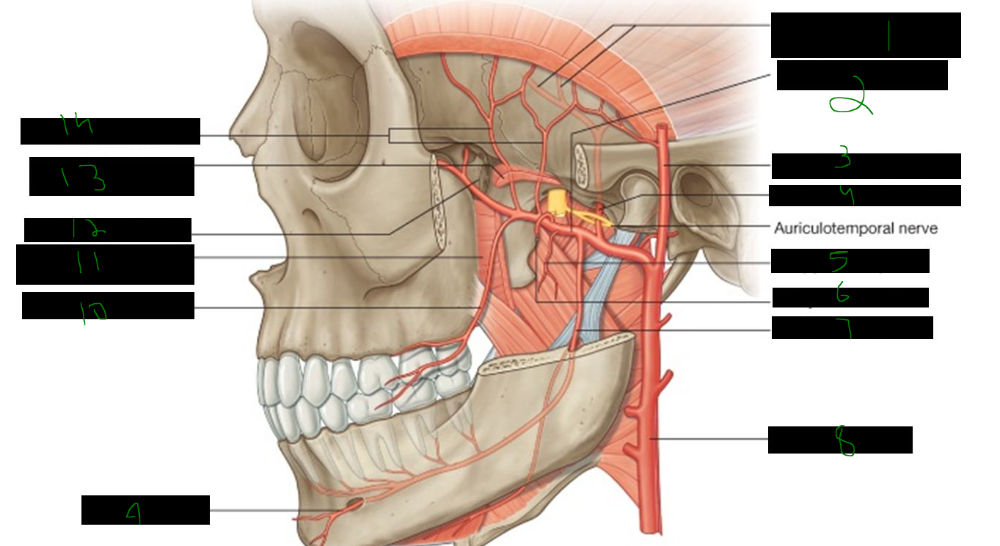 What is 1? | back 205 branches of middle meningeal in cranail artery |
front 206 What is 2? | back 206 maxillary artery |
front 207 What is 3? | back 207 superficial temporal artery |
front 208 What is 4? | back 208 middle meningeal artery |
front 209 What is 5? | back 209 pterygoid artery |
front 210 What is 6? | back 210 artery to masseter |
front 211 What is 7? | back 211 inferior alveolar artery |
front 212 What is 8? | back 212 external carotid |
front 213 What is 9? | back 213 mental artery |
front 214 What is 10? | back 214 buccal artery |
front 215 What is 11? | back 215 lower head of pterygoid (cut) |
front 216 What is 12? | back 216 pterygopalatine fossa |
front 217 What is 13? | back 217 upper head of lateral pterygoid (cut) |
front 218 What is 14? | back 218 deep temporal arteries |
front 219 The maxillary artery is a branch of the ______ carotid artery, arises within the ______ gland, and passes between the ______ and the sphenomandibular ligament. | back 219 external, parotid, mandible |
front 220 what artery passes between the mandible & sphenomandibular ligament? ______ ______ | back 220 maxillary a. |
front 221 what veins connect the pterygoid plexus to the cavernous sinus? ______ ______ | back 221 emissary veins |
front 222 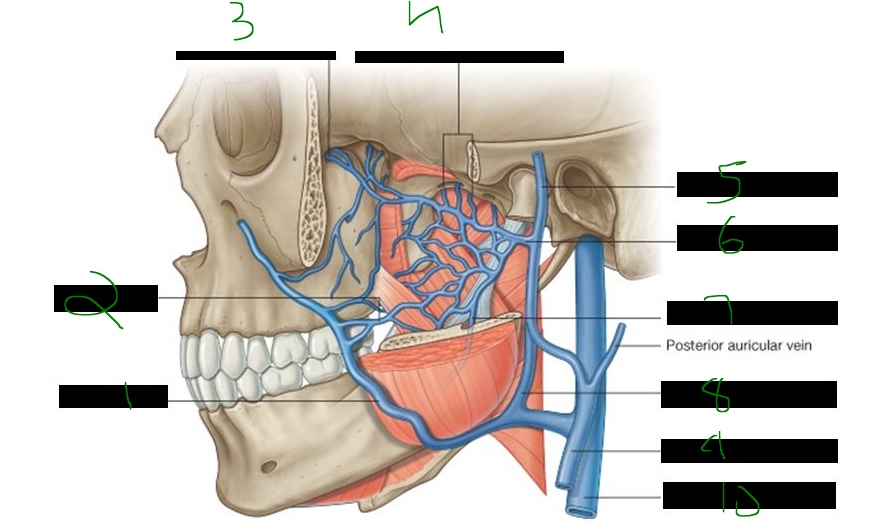 What is 1? | back 222 facial vein |
front 223 What is 2? | back 223 deep facial vein |
front 224 What is 3? | back 224 inferior ophthalmic vein |
front 225 What is 4? | back 225 emissary veins |
front 226 What is 5? | back 226 superficial temporal vein |
front 227 What is 6? | back 227 maxillary vein |
front 228 What is 7? | back 228 inferior alveolar vein |
front 229 What is 8? | back 229 retromandibular vein |
front 230 What is 9? | back 230 external jugular vein |
front 231 What is 10? | back 231 internal jugular vein |
front 232 The contents of the infratemporal fossa include the ______ nerve (V3), ______ petrosal nerve and ______ ganglion, ______ tympani nerve, ______ plexus of veins, medial and lateral ______ muscles, the ______ artery, and the sphenomandibular ligament. | back 232 mandibular, lesser, otic, chorda, pterygoid, pterygoid, maxillary |
front 233 borders of the pterygopalatine fossa? anterior wall - ______ surface of ______ medial wall - ______ surface of ______ bone posterior wall & roof - ______ of ______ bone | back 233 anterior wall - posterior surface of maxilla medial wall - lateral surface of palatine bone posterior wall & roof - parts of sphenoid bone |
front 234 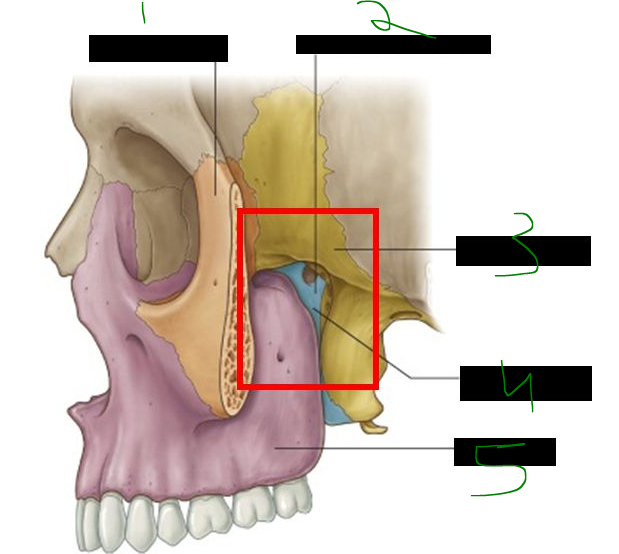 What is 1? | back 234 zygomatic bone |
front 235 What is 2? | back 235 pterygopalatine fossa |
front 236 What is 3? | back 236 sphenoid bone |
front 237 What is 4? | back 237 palatine bone |
front 238 What is 5? | back 238 maxilla |
front 239 The openings into the pterygopalatine fossa include the ______ orbital fissure, ______ foramen, ______ canal (which opens to the pharynx), ______ rotundum, ______ canal, and ______ canal. | back 239 inferior, sphenopalatine, palatovaginal, foramen, pterygoid, palatine |
front 240 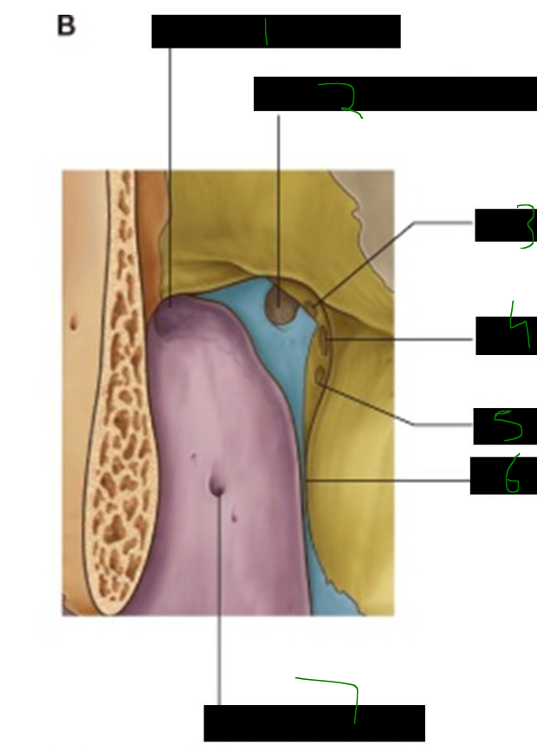 What is 1? | back 240 inferior orbital fissure |
front 241 What is 2? | back 241 sphenopalatine foramen |
front 242 What is 3? | back 242 palatovaginal canal |
front 243 What is 4? | back 243 foramen rotundum |
front 244 What is 5? | back 244 pterygoid canal |
front 245 What is 6? | back 245 palatine canal |
front 246 What is 7? | back 246 alveolar foramen |
front 247 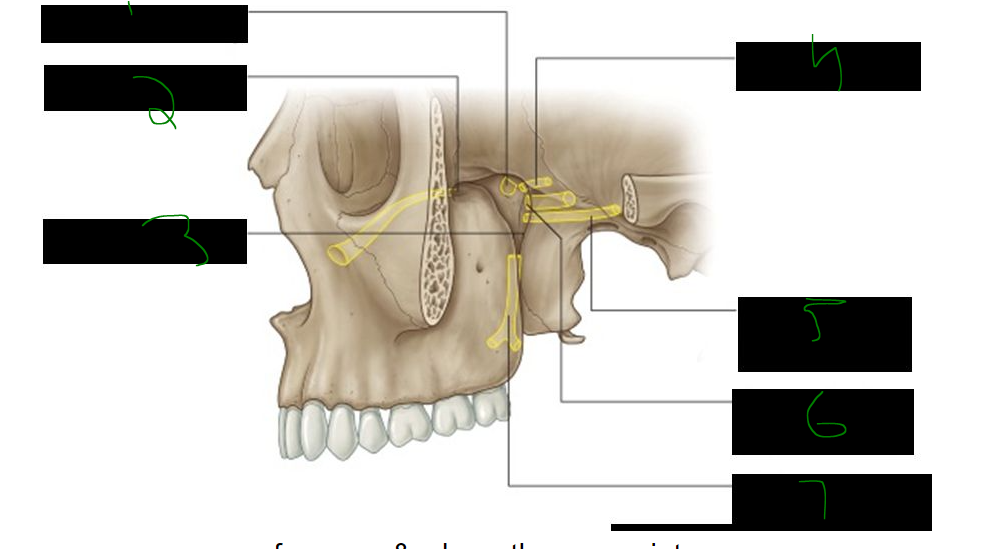 What is 1? | back 247 sphenopalatine foramen |
front 248 What is 2? | back 248 inferior orbital fissure |
front 249 What is 3? | back 249 pterygomaxillary fissure |
front 250 What is 4? | back 250 palatovaginal canal |
front 251 What is 5? | back 251 pterygoid canal |
front 252 What is 6? | back 252 foramen rotundum |
front 253 What is 7? | back 253 palatine canal |
front 254 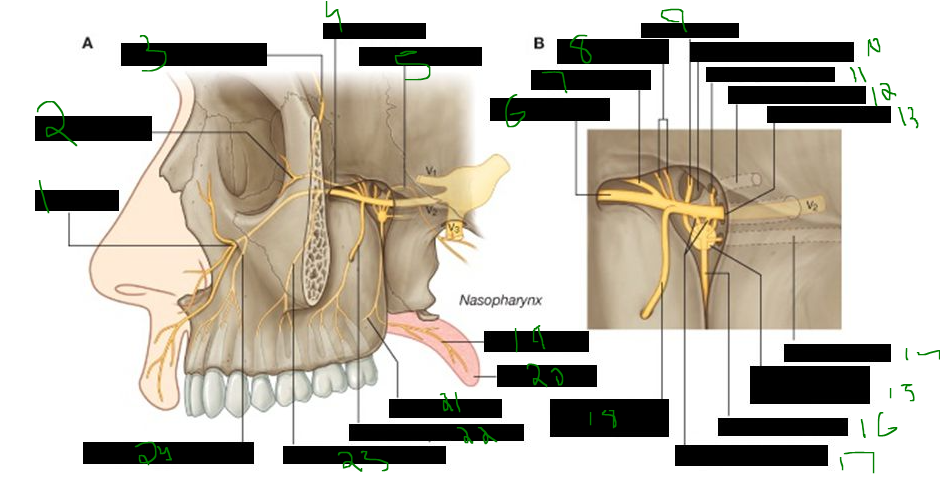 What is 1? | back 254 infra-orbital |
front 255 What is 2? | back 255 zygomaticofacial |
front 256 What is 3? | back 256 zygomaticotemporal |
front 257 What is 4? | back 257 zygomatic |
front 258 What is 5? | back 258 pharyngeal nerve |
front 259 What is 6? | back 259 infra-orbital nerve |
front 260 What is 7? | back 260 zygomatic nerve |
front 261 What is 8? | back 261 orbital branches |
front 262 What is 9? | back 262 nasal nerves |
front 263 What is 10? | back 263 sphlenopalatine foramen |
front 264 What is 11? | back 264 pharyngeal nerve |
front 265 What is 12? | back 265 palatovaginal canal |
front 266 What is 13? | back 266 foramen rotundum |
front 267 What is 14? | back 267 pterygoid canal |
front 268 What is 15? | back 268 pterygopalatine ganglion |
front 269 What is 16? | back 269 palatine nerves |
front 270 What is 17? | back 270 ganglionic branches |
front 271 What is 18? | back 271 posterior superior alveolar |
front 272 What is 19? | back 272 lesser palatine |
front 273 What is 20? | back 273 soft palate |
front 274 What is 21? | back 274 greater palatine |
front 275 What is 22? | back 275 posterior superior alveolar |
front 276 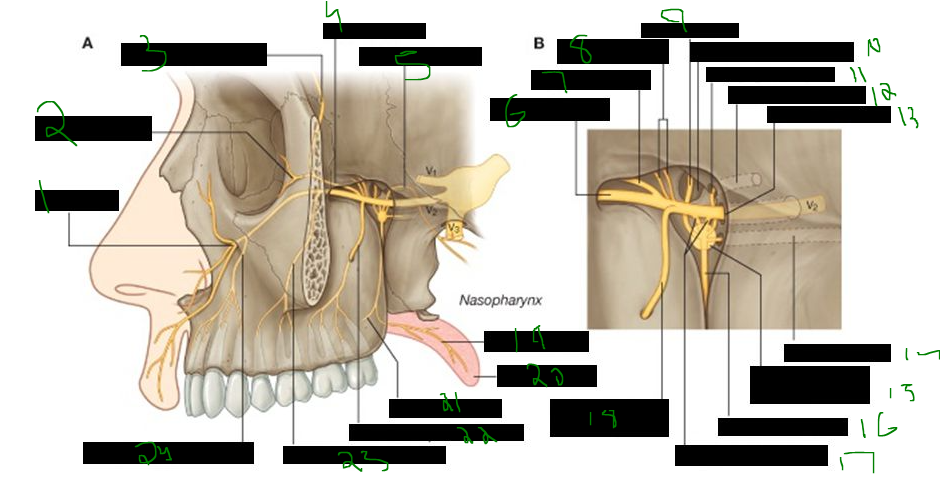 What is 23? | back 276 middle superior alveolar |
front 277 What is 24? | back 277 antioer superior alveolar |
front 278 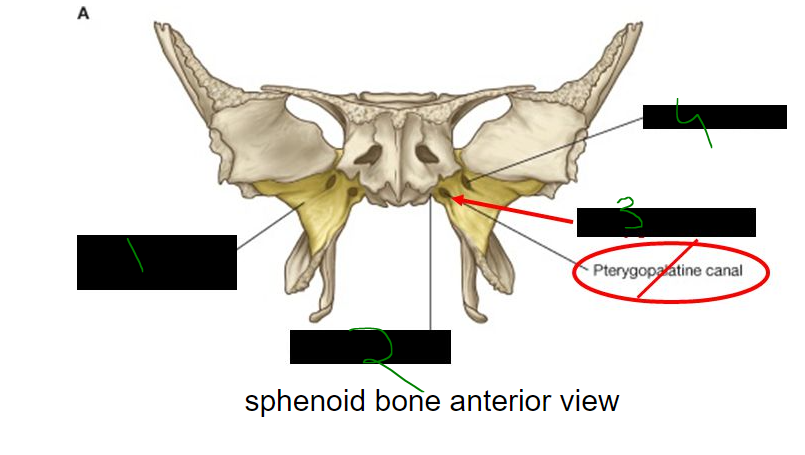 What is 1? | back 278 surface related to pterygopalatine fossa |
front 279 What is 2? | back 279 palatovagianl groove |
front 280 What is 3? | back 280 pterygoid canal |
front 281 What is 4? | back 281 foramen rotundum |
front 282 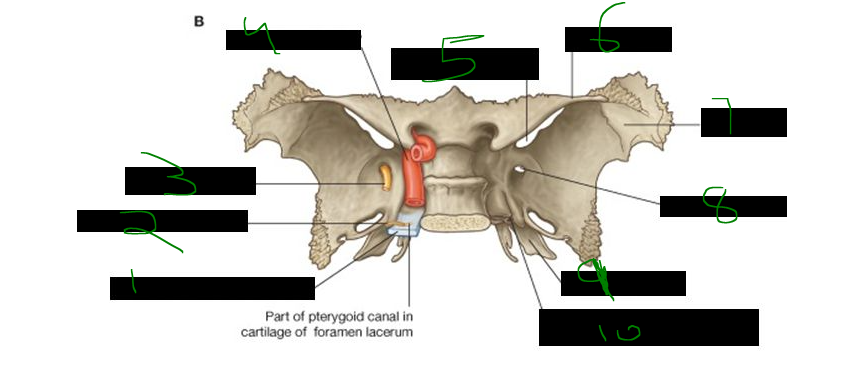 What is 1? | back 282 cartilage filling foramen lacerum |
front 283 What is 2? | back 283 greater petrosal nerve of VII |
front 284 What is 3? | back 284 maxillary nerve (v2) |
front 285 What is 4? | back 285 internal carotid artery |
front 286 What is 5? | back 286 superior orbital fissure |
front 287 What is 6? | back 287 lesser wing |
front 288 What is 7? | back 288 greater wing |
front 289 What is 8? | back 289 foramen rotundum |
front 290 What is 9? | back 290 pterygoid process |
front 291 What is 10? | back 291 posterior opening of bony part of pterygoid canal |
front 292 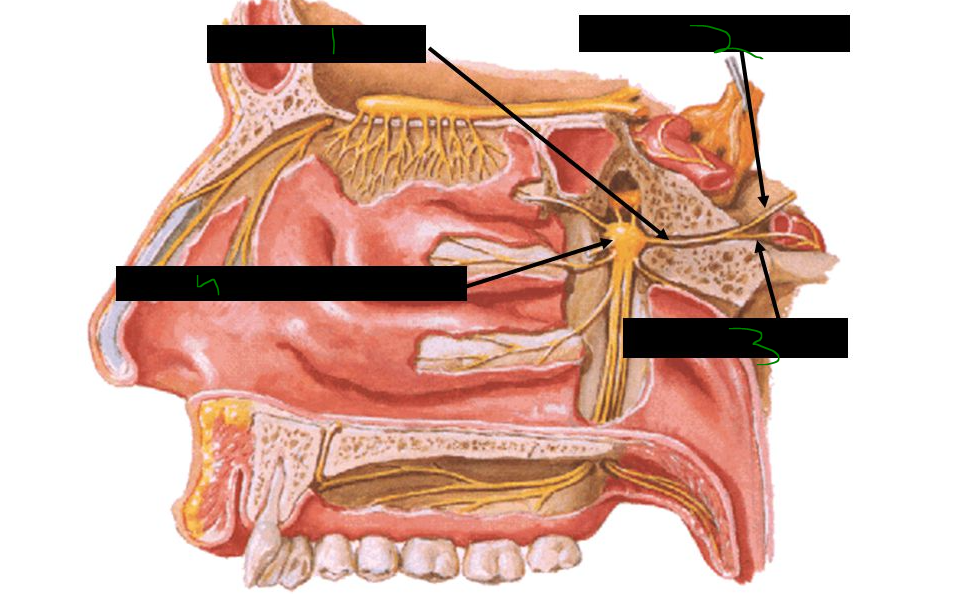 What is 1? | back 292 pterygoid canal |
front 293 What is 2? | back 293 greater petrosal nerve |
front 294 What is 3? | back 294 deep petrosal nerve |
front 295 What is 4? | back 295 pterygopalatine ganglion |
front 296 The nerve of the pterygoid canal is formed by the ______ petrosal nerve (from CN ______) and the ______ petrosal nerve (from the internal carotid plexus), and it carries preganglionic parasympathetics and postganglionic sympathetics to the pterygopalatine ganglion. | back 296 greater, VII, deep |
front 297 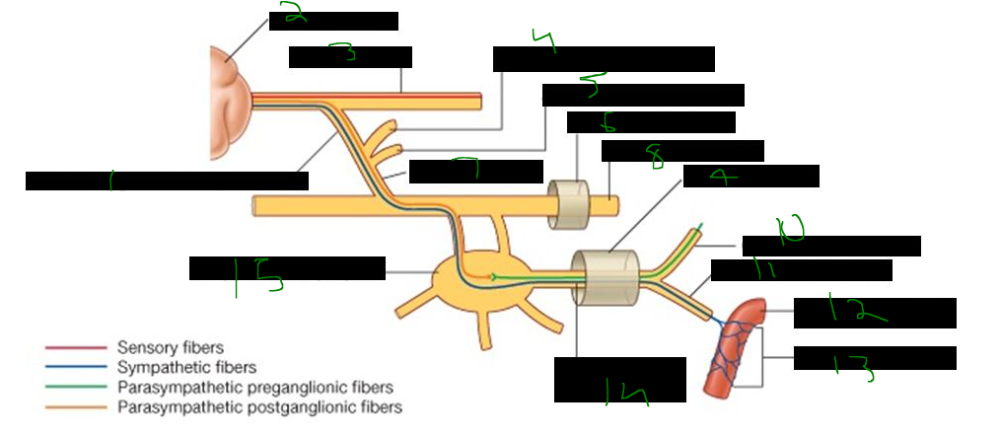 What is 1? | back 297 branch of zygomaticotemporal nerve |
front 298 What is 2? | back 298 lacrimal gland |
front 299 What is 3? | back 299 lacrimal nerve |
front 300 What is 4? | back 300 zygomaticotemporal nerve |
front 301 What is 5? | back 301 zygomaticofacial nerve |
front 302 What is 6? | back 302 foramen rotundum |
front 303 What is 7? | back 303 zygomatic nerve |
front 304 What is 8? | back 304 maxillary nerve (v2) |
front 305 What is 9? | back 305 pterygoid canal |
front 306 What is 10? | back 306 greater petrosal nerve |
front 307 What is 11? | back 307 deep petrosal nerve |
front 308 What is 12? | back 308 internal carotid artery |
front 309 What is 13? | back 309 sympathetic plexus |
front 310 What is 14? | back 310 nerve of pterygoid canal |
front 311 What is 15? | back 311 pterygopalatine ganglion |
front 312 The six terminal branches of the maxillary artery are the ______ artery (which gives rise to the anterior alveolar artery), ______ superior alveolar artery, ______ palatine artery, ______ artery, ______ artery, and the artery of the ______ canal. | back 312 infraorbital, posterior, greater, sphenopalatine, pharyngeal, pterygoid |
front 313 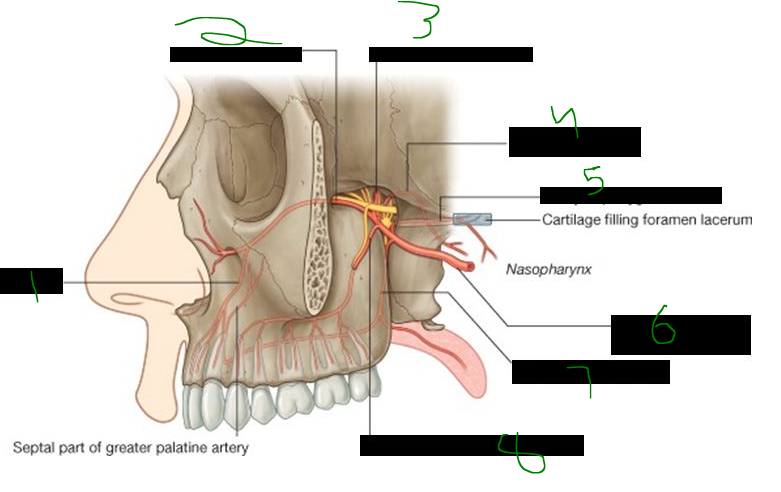 What is 1? | back 313 anterior alveolar artery |
front 314 What is 2? | back 314 infraorbital artery |
front 315 What is 3? | back 315 sphenopalatine artery |
front 316 What is 4? | back 316 pharyngeal artery |
front 317 What is 5? | back 317 artery of pterygoid canal |
front 318 What is 6? | back 318 maxillary artery in infratemporal fossa |
front 319 What is 7? | back 319 greater palatine artery |
front 320 What is 8? | back 320 posterior superior alveolar artery |
front 321 Veins from the pterygopalatine fossa pass out through the ______ fissure into the ______ fossa and drain into the ______ plexus of veins. | back 321 pterygomaxillary, infratemporal, pterygoid |
front 322 The pterygopalatine fossa contains the ______ ganglion, the ______ nerve (V2), preganglionic parasympathetics in the ______ petrosal nerve (from CN VII), and postganglionic parasympathetics that supply mucous glands of the nasal cavity, oral cavity, nasopharynx, and the ______ gland. | back 322 pterygopalatine, maxillary, greater, lacrimal |
front 323 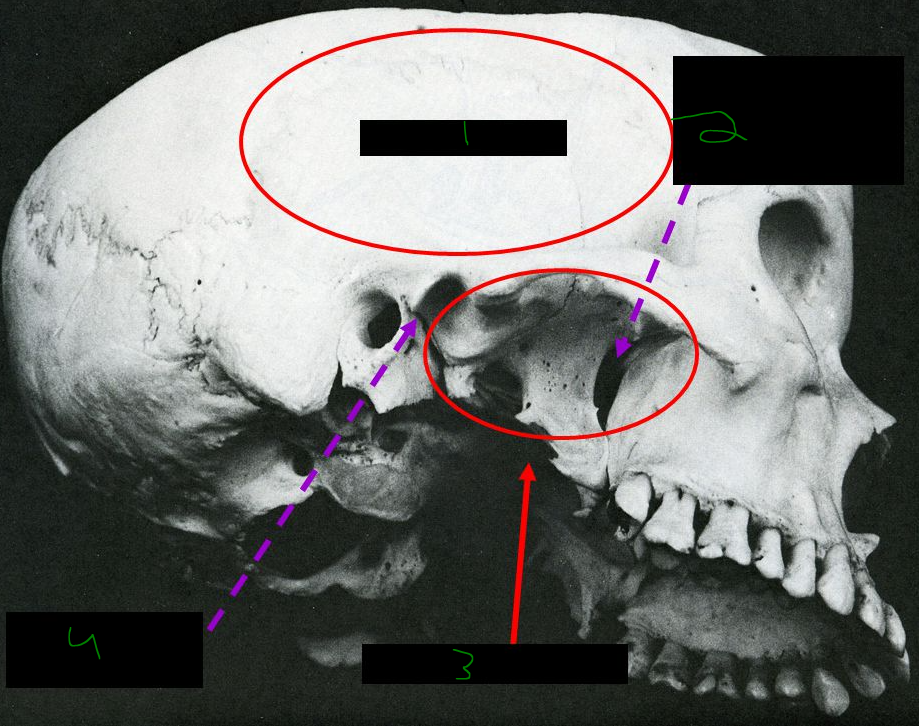 What is 1? | back 323 temporal fossa |
front 324 What is 2? | back 324 pterygomaxillary fissue leading to pterygopalatine fossa |
front 325 What is 3? | back 325 infratemporal fossa |
front 326 What is 4? | back 326 petrotympanic fissure |
front 327 what fissure leads to the pterygopalatine fossa? | back 327 pterygomaxillary fissure |
front 328 The nerve to the lateral pterygoid muscle branches from the ______ trunk of the mandibular nerve (V3), while the nerve to the medial pterygoid branches directly from V3 just distal to the ______ ______, along with the ______ branch. | back 328 anterior, foramen ovale, meningeal |
front 329 In the infratemporal fossa, the chorda tympani from CN ______ joins the ______ nerve (V3), and the lesser petrosal nerve from CN ______ carries preganglionic parasympathetics to the otic ganglion. | back 329 VII, lingual, IX |
front 330 Otic ganglion is small or large? | back 330 small |
front 331 otic ganglion is located _______ to mandibular n. V3 | back 331 medial |
front 332 where do all branches of the mandibular nerve (V3) originate? _______ _______ | back 332 infratemporal fossa |