Instructions for Side by Side Printing
- Print the notecards
- Fold each page in half along the solid vertical line
- Cut out the notecards by cutting along each horizontal dotted line
- Optional: Glue, tape or staple the ends of each notecard together
Anatomy JV Exam 3: Autonomics of Head
front 1 what is the synaptic relay site for the sympathetics of the head? ____ ____ ____ | back 1 superior cervical ganglion |
front 2 where do the preganglionic sympathetics arise from? neurons in the ____ ____ of ____ travel to ____ ____ ____ | back 2 neurons in the lateral horn of T1 travel to superior cervical ganglion |
front 3 Preganglionic sympathetic fibers supplying the head arise from neurons in the ______ ______ of spinal cord segment ______ and ascend the ______ ______ to reach the superior cervical ganglion. | back 3 lateral horn, T1, sympathetic trunk |
front 4 Postganglionic sympathetic fibers from the superior cervical ganglion travel via the ______ ______ nerve, forming a plexus around the ______ ______ artery, and use its ______ to reach target structures in the face and head. | back 4 internal carotid, internal carotid, branches |
front 5 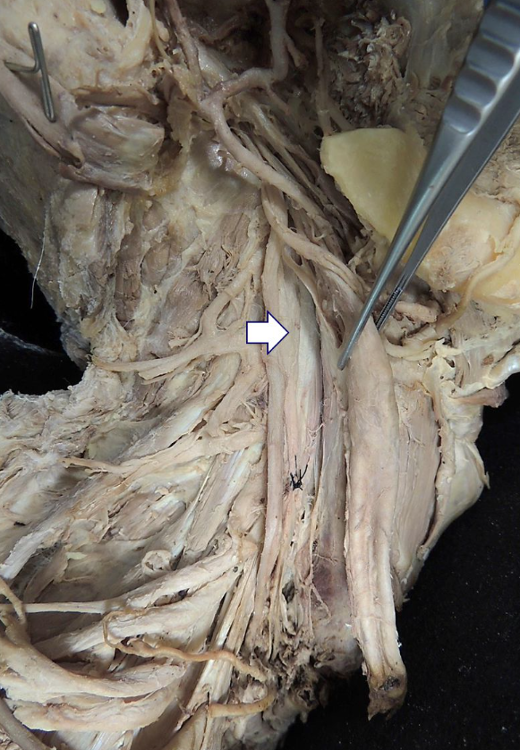 What is this? | back 5 superior cervical ganglion |
front 6 Horner's syndrome can result from damage to the sympathetic pathway at the ______ ______ communicantes, the ______ ______ ganglion, or along the ______ or ______ sympathetic fibers. | back 6 T1 white, superior cervical, preganglionic, postganglionic |
front 7 Horner's syndrome is characterized by ______ (small pupil), ______ (drooping upper eyelid), ______ (lack of sweating on affected side), and flushing of the ______ and ______ due to vasodilation. | back 7 miosis, ptosis, anhidrosis, face, neck |
front 8 Cranial nerves that carry general visceral efferent fibers for parasympathetic innervation of the head include cranial nerves ______, ______, and ______. | back 8 III, VII, IX |
front 9 1) oculomotor (III) - ______ ______ nucleus 2) facial (VII) - ______ ______ nucleus 3) glossopharyngeal (IX) - ______ ______ nucleus | back 9 edinger-westphal superior salivatory inferior salivatory |
front 10 The Edinger-Westphal nucleus is located in the ______ ______ within the ______ region of the brainstem. | back 10 oculomotor complex, mesencephalon |
front 11 Parasympathetic axons from the Edinger-Westphal nucleus travel in the ______ nerve and synapse in the ______ ganglion. | back 11 oculomotor, ciliary |
front 12 The superior salivatory nucleus is the visceral efferent nucleus of cranial nerve ______ and gives rise to parasympathetic fibers. | back 12 VII |
front 13 Axons from the superior salivatory nucleus travel in the ______ ______ nerve to synapse in the ______ ganglion and in the ______ ______ to synapse in the ______ ganglion. | back 13 greater petrosal, pterygopalatine, chorda tympani, submandibular |
front 14 The inferior salivatory nucleus is associated with cranial nerve ______ and gives rise to ______ fibers. | back 14 IX, parasympathetic |
front 15 Preganglionic fibers from the inferior salivatory nucleus travel through the ______ ______, enter the ______ ______ nerve, and synapse in the ______ ganglion. | back 15 tympanic plexus, lesser petrosal, otic |
front 16 Parasympathetic ganglia associated with the trigeminal nerve include the ______, ______, ______, and ______ ganglia. | back 16 ciliary, pterygopalatine, otic, submandibular |
front 17 The ciliary ganglion is associated with the ______ branch of the trigeminal nerve, specifically the ______ nerve. | back 17 V1, nasociliary |
front 18 The pterygopalatine ganglion is associated with the ______ branch of the trigeminal nerve. | back 18 V2 |
front 19 The otic ganglion is associated with the ______ branch of the trigeminal nerve. | back 19 V3 |
front 20 The submandibular ganglion is associated with the ______ nerve, a branch of ______. | back 20 lingual, V3 |
front 21 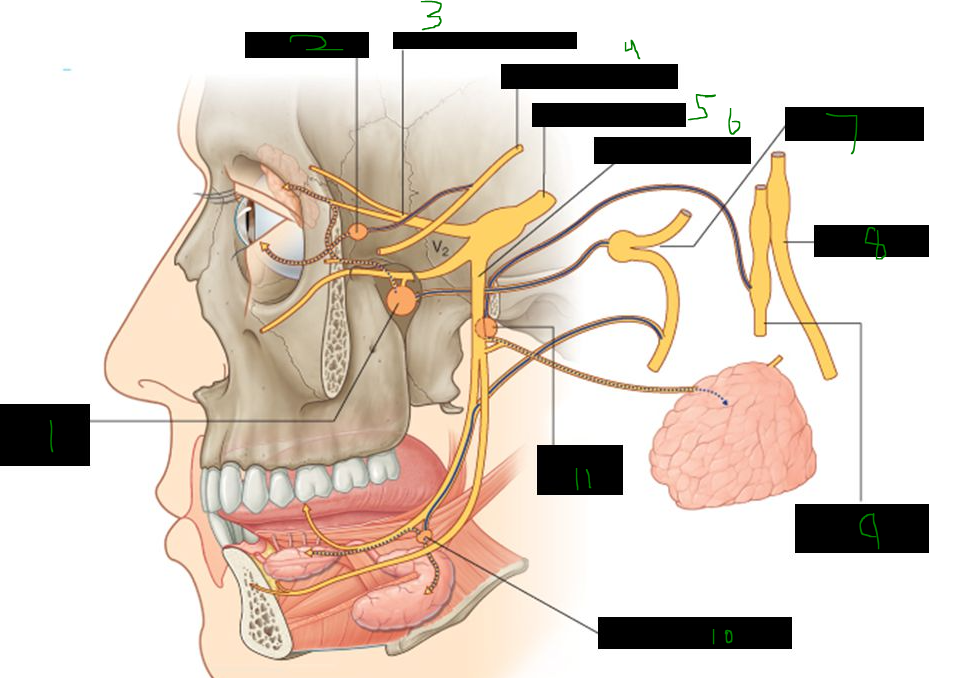 What is 1? | back 21 pterygopalatine ganglion |
front 22 What is 2? | back 22 ciliary ganglion |
front 23 What is 3? | back 23 opthalmic nerve (v1) |
front 24 What is 4? | back 24 oculomotor nerve (3) |
front 25 What is 5? | back 25 trigeminal nerve (5) |
front 26 What is 6? | back 26 mandibular nerve (v3) |
front 27 What is 7? | back 27 facial nerve (7) |
front 28 What is 8? | back 28 vagus nerve (10) |
front 29 What is 9? | back 29 glossopharyngeal neve (9) |
front 30 What is 10? | back 30 submandibular ganglion |
front 31 What is 11? | back 31 otic ganglion |
front 32 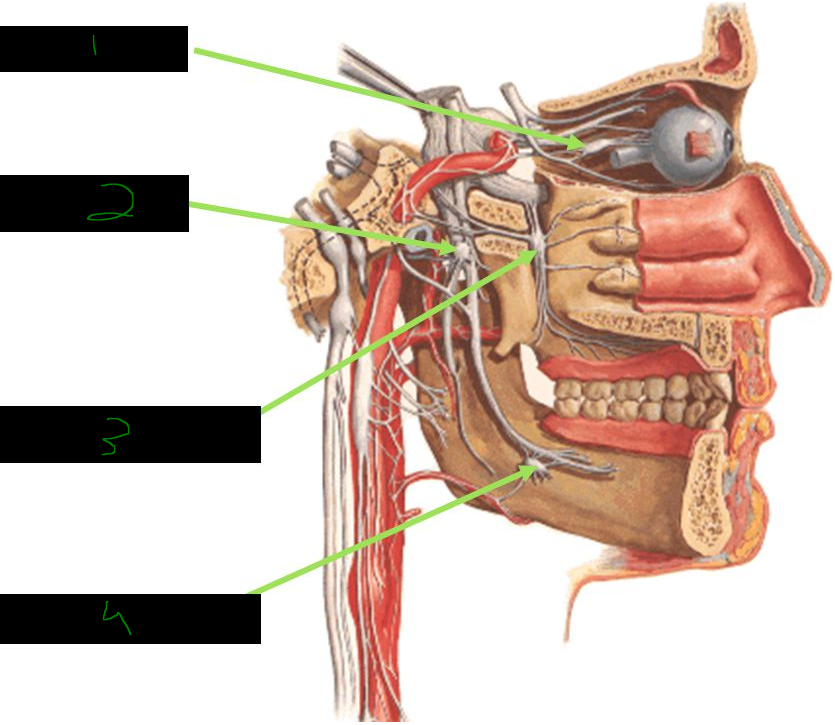 What is 1? | back 32 ciliary ganglion |
front 33 What is 2? | back 33 otic ganglion |
front 34 What is 3? | back 34 pterygopalatine ganglion |
front 35 What is 4? | back 35 submandibular ganglion |
front 36 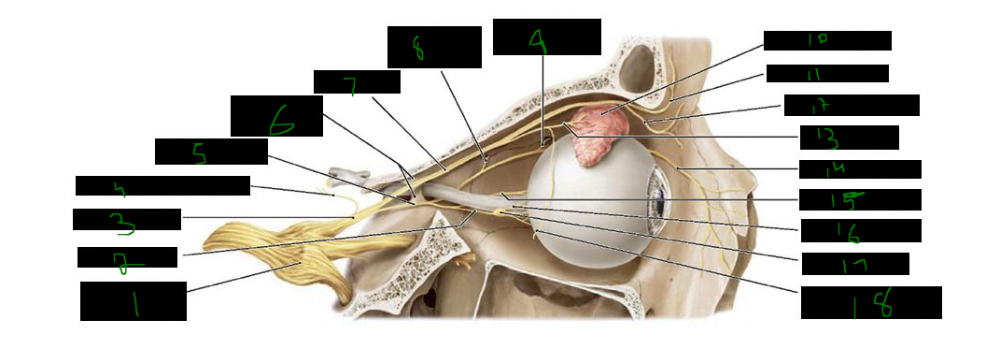 What is 1? | back 36 trigeminal ganglion |
front 37 What is 2? | back 37 nasociliary root |
front 38 What is 3? | back 38 opthalmic nerve |
front 39 What is 4? | back 39 recurrent meningeal branch |
front 40 What is 5? | back 40 nasociliary nerve |
front 41 What is 6? | back 41 superior orbital fissure |
front 42 What is 7? | back 42 frontal nerve |
front 43 What is 8? | back 43 posterior ethmoidal nerve |
front 44 What is 9? | back 44 anterior ethmoidal nerve |
front 45 What is 10? | back 45 lacrimal gland |
front 46 What is 11? | back 46 supraorbital nerve |
front 47 What is 12? | back 47 supratrochlear nerve |
front 48 What is 13? | back 48 lacrimal nerve |
front 49 What is 14? | back 49 infratrochlear nerve |
front 50 What is 15? | back 50 long ciliary nerves |
front 51 What is 16? | back 51 short ciliary nerves |
front 52 What is 17? | back 52 ciliary ganglion |
front 53 What is 18? | back 53 communicating branch to zygomatic nerve |
front 54 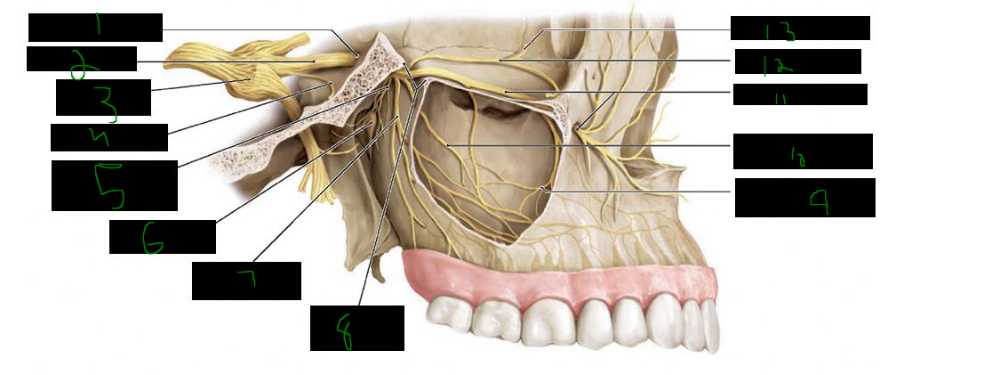 What is 1? | back 54 foramen rotundum |
front 55 What is 2? | back 55 maxillary nerve |
front 56 What is 3? | back 56 trigeminal nerve |
front 57 What is 4? | back 57 meningeal branch |
front 58 What is 5? | back 58 ganglionic branches of pterygopalatine ganglion |
front 59 What is 6? | back 59 pterygopalatine ganglion |
front 60 What is 7? | back 60 posterior superior alveolar nerves |
front 61 What is 8? | back 61 inferior orbital fissure |
front 62 What is 9? | back 62 anterior superior alveolar branches |
front 63 What is 10? | back 63 middle superior alveolar branches |
front 64 What is 11? | back 64 infraorbital nerve |
front 65 What is 12? | back 65 zygomatic nerve |
front 66 What is 13? | back 66 communicating branches |
front 67 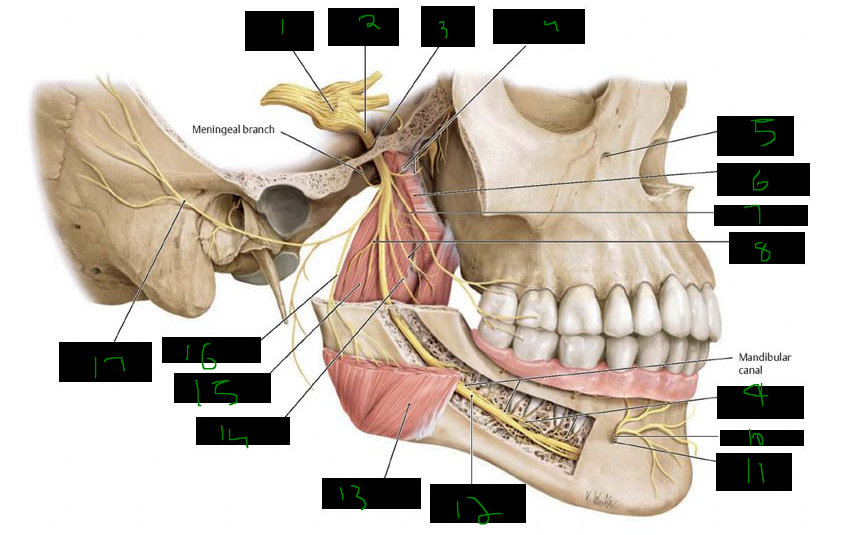 What is 1? | back 67 trigeminal ganglion |
front 68 What is 2? | back 68 mandibular division |
front 69 What is 3? | back 69 foramen ovale |
front 70 What is 4? | back 70 deep temporal nerves |
front 71 What is 5? | back 71 infraorbital foramen |
front 72 What is 6? | back 72 lateral pterygopalatine muscle |
front 73 What is 7? | back 73 buccal nerve |
front 74 What is 8? | back 74 pterygopalatine nerves |
front 75 What is 9? | back 75 inferior dental branches |
front 76 What is 10? | back 76 mental nerves |
front 77 What is 11? | back 77 mental foramen |
front 78 What is 12? | back 78 inferior alveolar nerve |
front 79 What is 13? | back 79 masseter muscle |
front 80 What is 14? | back 80 lingual nerve |
front 81 What is 15? | back 81 medial pterygoid muscle |
front 82 What is 16? | back 82 masseteric nerve |
front 83 What is 17? | back 83 auriculotemporal nerve |
front 84 The ciliary ganglion is the parasympathetic ganglion of cranial nerve ______ and is associated with the ______ branch of the trigeminal nerve. | back 84 III, nasociliary |
front 85 Preganglionic parasympathetic fibers from the ______ -______ nucleus synapse in the ______ ganglion before reaching the eye. | back 85 Edinger, Westphal, ciliary |
front 86 Postganglionic ______ and ______ axons pass through the ciliary ganglion without ______. | back 86 sympathetics, sensory, synapsing |
front 87 In the pupillary reflex, afferent axons originate from the ______ and terminate in the ______ area and ______ ______ of the midbrain. | back 87 retina, pretectal, superior colliculus |
front 88 Efferent parasympathetic fibers involved in the pupillary reflex originate in the ______ -______ nucleus, travel with cranial nerve ______, and synapse in the ______ ganglion. | back 88 Edinger, Westphal, III, ciliary |
front 89 In the pupillary light reflex, shining a ______ in one ______ causes that pupil to ______ as part of a normal response. | back 89 light, eye, constrict |
front 90 The pupillary light reflex evaluates the functional integrity of the ______ nervous system, specifically the ______ innervation of the ______. | back 90 parasympathetic, parasympathetic, pupil |
front 91 The consensual light reflex causes the ______ pupil to ______ slightly when light is shone in the ______ eye. | back 91 contralateral, constrict, opposite |
front 92 what is the consensual reflex? when light is shined in eye, ______ pupil will ______ to a ______ degree | back 92 contralateral, constrict, lesser |
front 93 The accommodation reflex occurs when a person focuses on a ______ object, causing both ______ to ______. | back 93 near, pupils, constrict |
front 94 During the accommodation reflex, the ______ muscles ______ to allow the lens to become ______ for near vision. | back 94 ciliary, contract, thicker |
front 95 Fixed and dilated pupils may indicate damage to the ______, specifically affecting the ______-______ nucleus, which prevents ______ constriction. | back 95 brainstem, Edinger, Westphal, parasympathetic |
front 96 In the absence of parasympathetic input, the unopposed action of the ______ ______ muscle—innervated by the ______ nervous system—leads to dilation. | back 96 dilator pupillae, sympathetic |
front 97 A complete injury to the parasympathetic pathway can cause a large, fixed pupil known as a ______ ______. | back 97 blown pupil |
front 98 For near vision, ______ muscles ______ under ______ innervation, reducing tension on the zonule fibers. | back 98 ciliary, contract, parasympathetic |
front 99 When viewing close objects, reduced zonule fiber tension allows the ______ to return to its ______ state and become more ______. | back 99 lens, normal, thick |
front 100 In close vision, the pupils also ______ to improve focus, a response mediated by the ______ nervous system. | back 100 constrict, parasympathetic |
front 101 For distant vision, the ______ muscles ______ due to the absence of ______ stimulation. | back 101 ciliary, relax, parasympathetic |
front 102 Relaxation of ciliary muscles increases tension on the ______ ______, causing the lens to become ______ and more suited for ______ vision. | back 102 zonule fibers, flat, distant |
front 103 Presbyopia is an age-related condition, typically occurring after age ______, in which the ______ loses its ______. | back 103 40, lens, flexibility |
front 104 In presbyopia, the lens cannot ______ when tension on the ______ ______ is released by ______ of the ciliary muscles. | back 104 thicken, zonule fibers, contraction |
front 105 Because the lens can no longer thicken properly, individuals with presbyopia cannot ______ on ______ objects. | back 105 focus, near |
front 106 what is the largest of the parasympathetic ganglia? ______ ______ | back 106 pterygopalatine ganglion |
front 107 The pterygopalatine ganglion contains cell bodies of ______ neurons that receive ______ input via the ______ ______ nerve. | back 107 postganglionic, preganglionic, greater petrosal |
front 108 The greater petrosal nerve joins the ______ ______ nerve to form the ______ of the pterygoid canal. | back 108 deep petrosal, nerve |
front 109 Postganglionic fibers from the pterygopalatine ganglion travel with branches of the ______ division of the ______ nerve. | back 109 maxillary, trigeminal |
front 110 Postganglionic fibers from the pterygopalatine ganglion travel with branches of the ______ division of the ______ nerve, also known as ______. | back 110 maxillary, trigeminal, V2 |
front 111 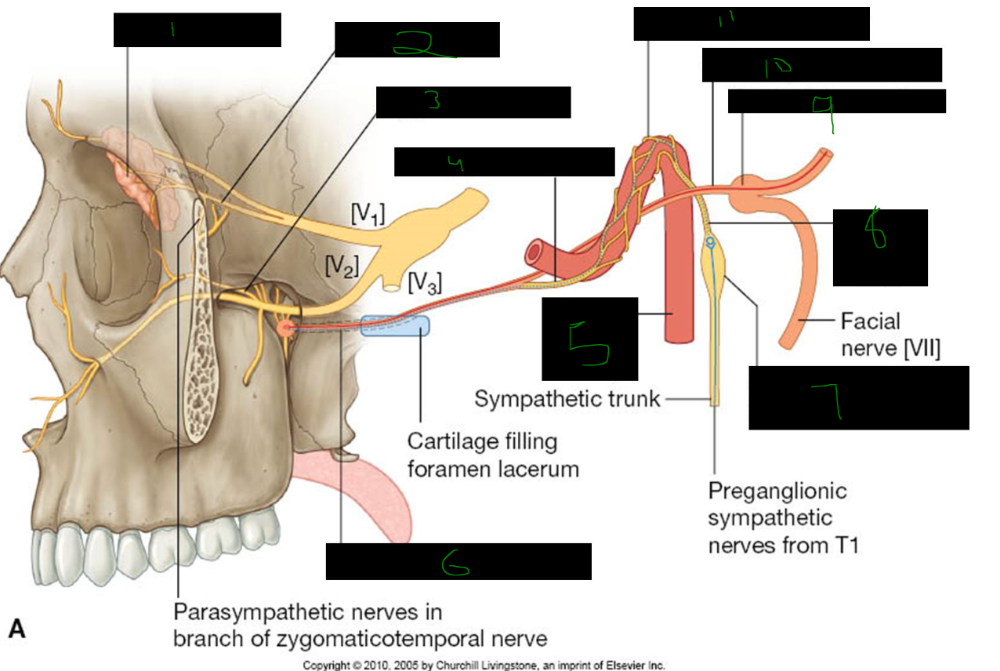 What is 1? | back 111 lacrimal gland |
front 112 What is 2? | back 112 lacrimal nerve |
front 113 What is 3? | back 113 zygomatic nerve |
front 114 What is 4? | back 114 deep petrosal nerve |
front 115 What is 5? | back 115 internal carotid artery |
front 116 What is 6? | back 116 nerve of pterygoid canal |
front 117 What is 7? | back 117 superior cervical sympathetic ganglion |
front 118 What is 8? | back 118 internal carotid nerve |
front 119 What is 9? | back 119 geniculate ganglion |
front 120 What is 10? | back 120 greater petrosal nerve |
front 121 What is 11? | back 121 internal carotid plexus |
front 122 The nerve of the pterygoid canal, also called the ______ nerve, is formed by the union of the ______ petrosal and ______ petrosal nerves. | back 122 Vidian, greater, deep |
front 123 The greater petrosal nerve contributes ______ ______ fibers to the nerve of the pterygoid canal. | back 123 preganglionic parasympathetic |
front 124 The deep petrosal nerve contributes ______ ______ fibers to the nerve of the pterygoid canal. | back 124 postganglionic sympathetic |
front 125 what axons are found within nervus intermedius? -______ -______ ______ | back 125 -sensory -preganglionic parasympathetics |
front 126 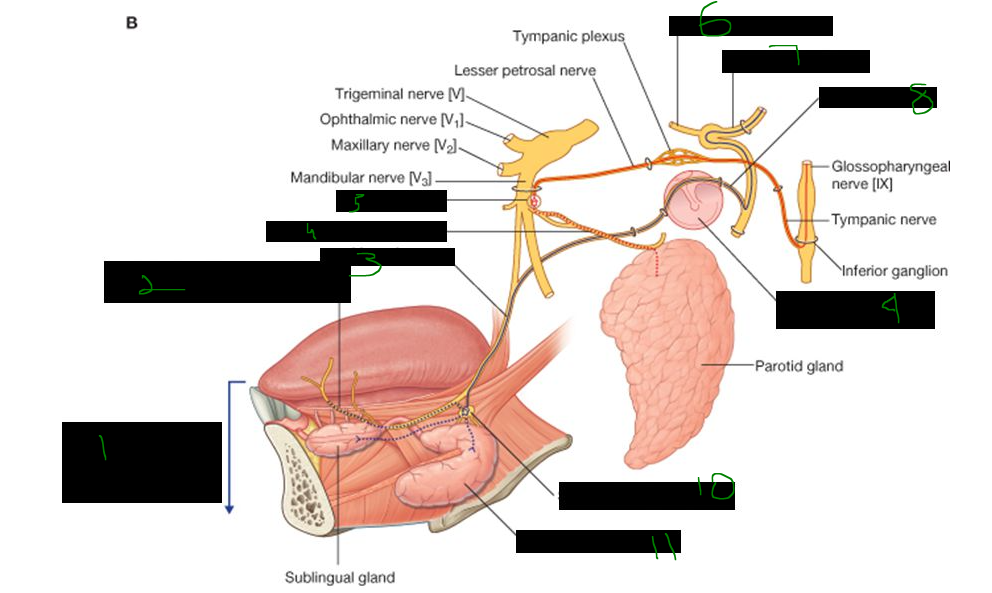 What is 1? | back 126 chorda tympani carries parasympathetic innervation to all glands below the oral fissure |
front 127 What is 2? | back 127 chorda tympani (carries taste from the anterior 2/3 of the tongue) |
front 128 What is 3? | back 128 lingual nerve |
front 129 What is 4? | back 129 auriculotemporal neve |
front 130 What is 5? | back 130 otic ganglion |
front 131 What is 6? | back 131 greater petrosal nerve |
front 132 What is 7? | back 132 facial nerve (7) |
front 133 What is 8? | back 133 chorda tympani |
front 134 What is 9? | back 134 tympanic membrane |
front 135 What is 10? | back 135 submandibular ganglion |
front 136 What is 11? | back 136 submandibular gland |
front 137 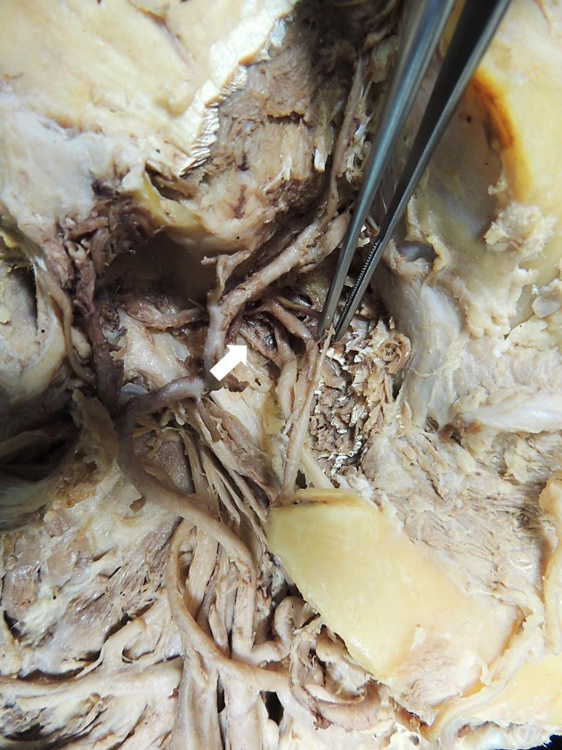 What is this? | back 137 chorda tympani joining lingual nerve |
front 138 The otic ganglion is located in the ______ ______, medial to cranial nerve ______, and deep to the ______ ______. | back 138 infratemporal fossa, V3, foramen ovale |
front 139 The otic ganglion contains ______ ______ fibers that arrive via the ______ ______ nerve, which originates from the ______ ______ on the medial wall of the middle ear. | back 139 preganglionic parasympathetic, lesser petrosal, tympanic plexus |
front 140 The lesser petrosal nerve arises from the ______ ______ on the medial wall of the ______ ______ cavity. | back 140 tympanic plexus, middle ear |
front 141 After arising, the lesser petrosal nerve travels along the floor of the ______ ______ fossa and exits the cranium via the ______ ______. | back 141 middle cranial, foramen ovale |
front 142 The lesser petrosal nerve carries ______ ______ fibers and enters the ______ ganglion to synapse. | back 142 preganglionic parasympathetic, otic |
front 143 Preganglionic parasympathetic axons in the glossopharyngeal nerve arise from the ______ ______ nucleus and travel to the ______ ______ via the ______ branch of CN IX. | back 143 inferior salivatory, tympanic plexus, tympanic |
front 144 Axons leave the tympanic plexus through the ______ ______ nerve, which carries them to the ______ ganglion. | back 144 lesser petrosal, otic |
front 145 The ciliary ganglion lies in the back of the ______, just ______ to the ______ nerve, positioned between it and the ______ ______ muscle. | back 145 orbit, lateral, optic, lateral rectus |
front 146 Postganglionic fibers from the otic ganglion travel to the ______ gland via the ______ branch of cranial nerve ______. | back 146 parotid, auriculotemporal, V3 |
front 147 where is the pterygopalatine ganglion located? lies within the ______ ______ | back 147 pterygopalatine fossa |
front 148 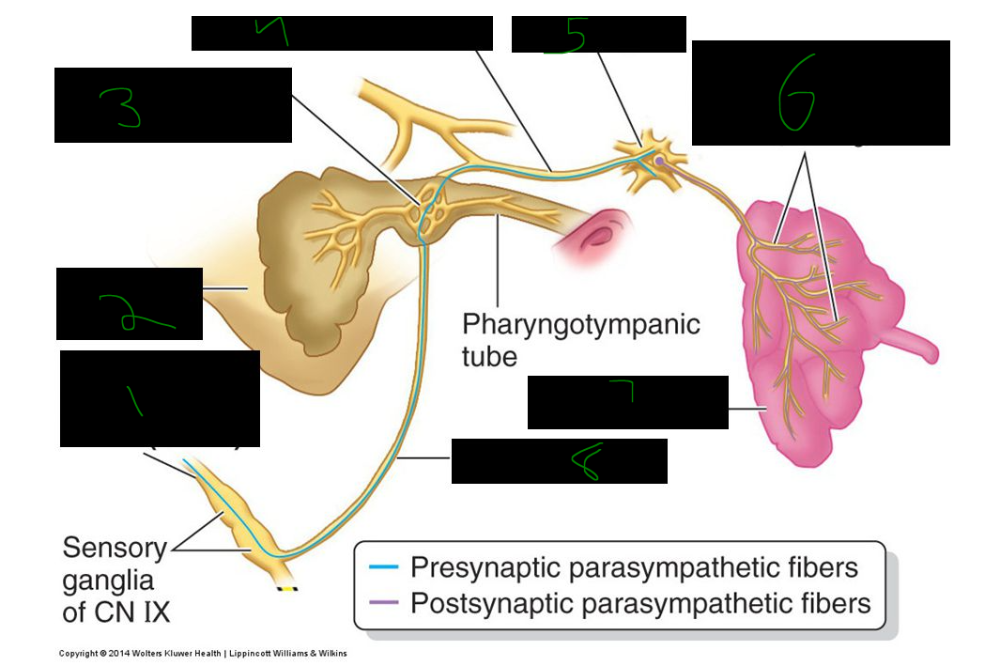 What is 1? | back 148 glossopharyngeal nerve (CN IX) |
front 149 What is 2? | back 149 mastoid process |
front 150 What is 3? | back 150 tympanic plexus in tympanic cavity |
front 151 What is 4? | back 151 lesser petrosal nerve |
front 152 What is 5? | back 152 otic ganglion |
front 153 What is 6? | back 153 parotid branches of auriculotemporal nerve (CN V3) |
front 154 What is 7? | back 154 parotid gland |
front 155 What is 8? | back 155 tympanic nerve |
front 156 Axons reach the lacrimal nerve from the maxillary division of V via a communicating branch off the ______ nerve, which is a branch of the ______ nerve. | back 156 zygomaticotemporal, zygomatic |
front 157 The submandibular ganglion lies medial to the ______ and is suspended from the ______ nerve, a branch of the mandibular division of cranial nerve ______. | back 157 mandible, lingual, V3 |