Instructions for Side by Side Printing
- Print the notecards
- Fold each page in half along the solid vertical line
- Cut out the notecards by cutting along each horizontal dotted line
- Optional: Glue, tape or staple the ends of each notecard together
BMED 4280 FINAL iRATs (ALL, 1-10)
front 1 During repolarization of an action potential... | back 1 sodium channels get deactivated |
front 2 Features of action potentials are all of the following EXCEPT: answer choices: The nerve action potential has a short duration (about 1 msec) Nerve action potentials are elicited in an all-or-nothing fashion Nerve cells code the intensity of information by the frequency of action potentials. A change in potential that increases the polarized state of a membrane | back 2 A change in potential that increases the polarized state of a membrane |
front 3 The absolute refractory period... | back 3 is a period of time after the initiation of one action potential when it is impossible to initiate a second action potential no matter how much the cell is depolarized. |
front 4 During depolarization of an action potential... | back 4 sodium channels get activated |
front 5 The membrane potential will never reach its ideal value (the sodium equilibrium potential) because... | back 5 contined K+ permeability |
front 6 A major difference between the changes in the K+ channels and the changes in the Na+ channels is that... | back 6 the K+ channels are slower to activate or open |
front 7 Allows one neuron to relay information to its neighbor. Long chains of these can be used to propagate information through the nervous system. | back 7 feedforward excitation |
front 8 Tetrodotoxin (TTX)... | back 8 blocks the voltage-dependent changes in Na+ permeability, but has no effect on the voltage-dependent changes in K+ permeability |
front 9 During hyperpolarization of actional potential... | back 9 both sodium and potassium channels are activated |
front 10 During resting state of an action potential... | back 10 both sodium and potassium channels are deactivated |
front 11 T/F: The second part of the calcium hypothesis for chemical synaptic transmission involves the consequences of the Ca2+ influx. The opening of the Ca2+ channel allows for calcium to flow down its concentration gradient from the outside to the inside of the synaptic terminal. This influx leads to an increase in the concentration of the Ca2+ in the presynaptic terminal, which by interacting with proteins associated with synaptic vesicles leads to the release of the chemical transmitter substance. | back 11 True |
front 12 Exocytosis involves the following processes in the order of happening: | back 12 mobilization, docking, fusion, release |
front 13 The amplitude of the endplate potential is about 50 mV, but only about 30 mV is needed to reach threshold. The extra 20 mV is called the... | back 13 safety factor |
front 14 Which of the following is needed for neurotransmitter release at the synaptic cleft? | back 14 Ca |
front 15 ___ is a distinct separation between the presynaptic and postsynaptic membrane | back 15 synaptic cleft |
front 16 T/F: Presynaptic density is darkly staining material of postsynaptic cell adjacent to the synapse. Receptors, ion channels, and other signaling molecules are likely bound to this material. | back 16 False |
front 17 Neuroglia differ from neurons in several general ways in that they... | back 17 retain the ability to divide |
front 18 Synapses can be identified by the presence of the following components except: A presynaptic complement of membrane-bound synaptic vesicles exists Many mitochondria are present synaptic cleft Na-K pump | back 18 Na+-K+ pump |
front 19 T/F: When neurons interact with muscle fibers, the region of functional contact is called the neuromuscular junction or motor endplate | back 19 True |
front 20 Each neuron has only one axon and it is usually straighter and smoother than the dendritic profiles. Axons also contain bundles of ........ and ...... and scattered ...... | back 20 microtubules, neurofilaments, and neurofilaments (Note: I think she meant to put microfilaments/actin filaments) |
front 21 T/F: Microglia, in contrast to the other types of glial cells, originate from embryonic mesoderm | back 21 True |
front 22 ___ cells have only one cell process and are primarily found in invertebrates | back 22 unipolar |
front 23 The following glial cell wraps a myelin sheath around axons of the central nervous system | back 23 oligodendrocyte |
front 24 T/F: Synapse is the junction that allows signals to pass from a nerve cell to another cell or from one nerve cell to a muscle cell. The synaptic cleft is the gap between the membrane of the pre- and postsynaptic cell. In a chemical synapse the signal is carried by a diffusable neurotransmitter. The cleft between the presynaptic cell and the postsynaptic cells is 20 to 40 nm wide and may appear clear or striated. Recent studies have indicated that the cleft is not an empty space per se, but is filled with carbohydrate-containing material. | back 24 True |
front 25 The cone-shaped region of the cell body where the axon originates is termed the... | back 25 axon hillock |
front 26 T/F: Exocytosis of neurotransmitters into the synaptic cleft occurs when fusion takes place. This step is Ca2+-stimulated. A vesicle protein called syntaxin binds Ca2+ to initiate fusion | back 26 False |
front 27 Tetanus toxin... | back 27 Clostridial neurotoxin with zinc-dependent protease activity; Cleaves synaptic vesicle proteins in the CNS and thereby blocks release of neurotransmitters. |
front 28 T/F: Because of the tetanus, there will be spatial and temporal summation of the EPSPs produced by the multiple afferent synapses on the common postsynaptic cell. Consequently, the membrane potential of the postsynaptic neuron will become very depolarized. | back 28 True |
front 29 Axosomatic (synapses) | back 29 synapses that are made onto the soma or cell body of a neuron |
front 30 VAMPs are... | back 30 synaptic vesicles |
front 31 Dynein | back 31 Transport proteins move retrogradely and slower than kinesin (fast anterograde protein transport) |
front 32 There are two fundamental differences between the process of synaptic transmission at the sensorimotor synapse in the spinal cord and the process of synaptic transmission at the neuromuscular junction... | back 32 First, the transmitter substance released by the sensory neuron is not ACh but rather glutamate Second, the amplitude of the synaptic potential in a spinal motor neuron, as a result of an action potential in a 1A afferent fiber, is only about 1 mV |
front 33 Vinblastine prevent axoplasmic transport through | back 33 disruption of the microtubules |
front 34 A very enduring form of synaptic plasticity is called | back 34 long-term potentiation (LTP) |
front 35 tetrodotoxin (TTX) | back 35 Fish toxin that blocks the pore of voltage-dependent Na+ channels |
front 36 ___ receptors produce generator potentials and action potential discharges that follow the time-varying waveform of pressure changes produced by a vibrating stimulus | back 36 The rapidly-adapting receptors |
front 37 MATCH THE RECEPTOR AND SENSATION: muscle spindle | back 37 muscle stretch |
front 38 MATCH THE RECEPTOR AND SENSATION: golgi tendon organ | back 38 muscle tension |
front 39 MATCH THE RECEPTOR AND SENSATION: joint: pacinian | back 39 joint movement |
front 40 MATCH THE RECEPTOR AND SENSATION: joint: golgi organ | back 40 joint torque |
front 41 MATCH THE RECEPTOR AND ADAPTATION: muscle spindle | back 41 rapid initial transient and slow sustained |
front 42 MATCH THE RECEPTOR AND ADAPTATION: muscle: golgi tendon organ | back 42 slow |
front 43 MATCH THE RECEPTOR AND ADAPTATION: joint: pacinian | back 43 rapid |
front 44 MATCH THE RECEPTOR AND ADAPTATION: free nerve ending | back 44 depends on information carried |
front 45 MATCH THE RECEPTOR AND THE SIGNAL: muscle spindle | back 45 muscle length and velocity |
front 46 MATCH THE RECEPTOR AND THE SIGNAL: muscle: golgi tendon organ | back 46 muscle contraction |
front 47 MATCH THE RECEPTOR AND THE SIGNAL: joint: pacinian | back 47 direction and velocity |
front 48 MATCH THE RECEPTOR AND THE SIGNAL: joint: ruffini | back 48 pressure and angle |
front 49 The somatosensory systems process information about, and represent, several modalities of somatic sensation: | back 49 pain, temperature, touch, proprioception |
front 50 MATCH THE RECEPTOR AND ITS TYPE: meissner corpuscle | back 50 encapsulated and layered |
front 51 MATCH THE RECEPTOR AND ITS TYPE: Ruffini corpuscle | back 51 encapsulated collagen |
front 52 MATCH THE RECEPTOR AND ITS TYPE: free nerve ending | back 52 unencapsulated |
front 53 MATCH THE RECEPTOR AND ITS TYPE: merkel complex | back 53 specialized epithelial cell |
front 54 The encapsulated cutaneous receptors include | back 54 meissner corpuscles, pacinian corpuscles, and ruffini corpuscles |
front 55 MATCH THE SENSATION TO THE RECEPTOR: meissner corpuscle | back 55 touch: flutter and movement |
front 56 MATCH THE SENSATION TO THE RECEPTOR: pacinian corpuscle | back 56 touch: vibration |
front 57 MATCH THE SENSATION TO THE RECEPTOR: ruffini corpuscle | back 57 touch: skin stretch |
front 58 MATCH THE SENSATION TO THE RECEPTOR: merkel complex | back 58 touch: pressure, form |
front 59 Peripheral somatosensory neurons | back 59 The cell bodies of the first-order (1°) somatosensory afferent neurons are located in posterior root or cranial root ganglia |
front 60 Propioceptive stimuli | back 60 are internal forces that are generated by the position or movement of a body part |
front 61 These fibers are myelinated, have a fast conduction velocity | back 61 A-delta fibers |
front 62 learning to respond to sudden pain and psychosomatic pain is the following type of response and pain | back 62 somatic pain, behavioral response |
front 63 This pathway is responsible for the immediate awareness of a painful sensation and for awareness of the exact location of the painful stimulus. | back 63 Neospinothalamic pathway |
front 64 Neospinothalamic tract decussate in | back 64 the anterior white commissure |
front 65 T/F: many of the visceral nociceptors are silent | back 65 True |
front 66 Skin nociceptors may be divided into four categories based on function, all of the following except... | back 66 unimodal nociceptors |
front 67 Factors that Activate Nociceptors are all of the following except... | back 67 acetylcholine (ACh) |
front 68 An increased painful sensation in response to additional noxious stimuli... | back 68 hyperalgesia |
front 69 Development of inflammatory arthritis can be caused by the liberation of the following peptides... | back 69 substance P (SP) and calcitonin gene-related peptide (CGRP) |
front 70 Pain caused by inflammation, burned skin, etc., is carried by the C fibers | back 70 burning pain or soreness pain |
front 71 T/F: Visual acuity is the ability to detect and recognize small objects visually depends on the refractory (focusing) power of the eye's lens system and the cytoarchitecture of the retina | back 71 True |
front 72 The process of producing a single image from the two disparate monocular images is called... | back 72 binocular fusion |
front 73 Bitemporal heminopia is caused by a lesion at the... | back 73 optic chiasm |
front 74 What is the main function of Photoreceptors? | back 74 capture light and convert it to electrical signals |
front 75 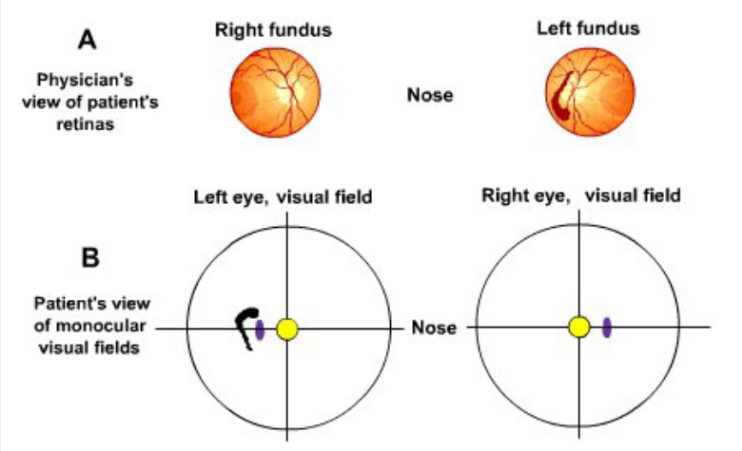 Symptoms: The patient is having his semiannual physical examination. As he is diabetic, the physician examines his retinas and performs a confrontation test of his visual fields. An abnormality is detected in his left fundus (Figure 15.12) but the confrontational field test detects nothing. Perimetry testing is requested. Perimetry Test Results: The results indicate the right eye's visual field is normal and that there is a peripheral scotoma (i.e., loss of vision that does not follow the boundaries of the visual field quadrants) in the left eye's temporal hemifield (Figure 15.13). The patient has all of the following EXCEPT: answer choices: retinal damage in the left eye damage located in the nasal half of the left retina damage related to the patient's diabetes - diabetic retinopathy damage related to the patient's glaucoma | back 75 damage related to the patient's glaucoma |
front 76 Vision in the peripheral visual field | back 76 is more sensitive to dim light |
front 77 T/F: light passes the eye and reaches the photoreceptors directly without passing through any other cell | back 77 False |
front 78 Right homonomous hemianopia is cause by a lesion at the | back 78 left occipital cortex |
front 79 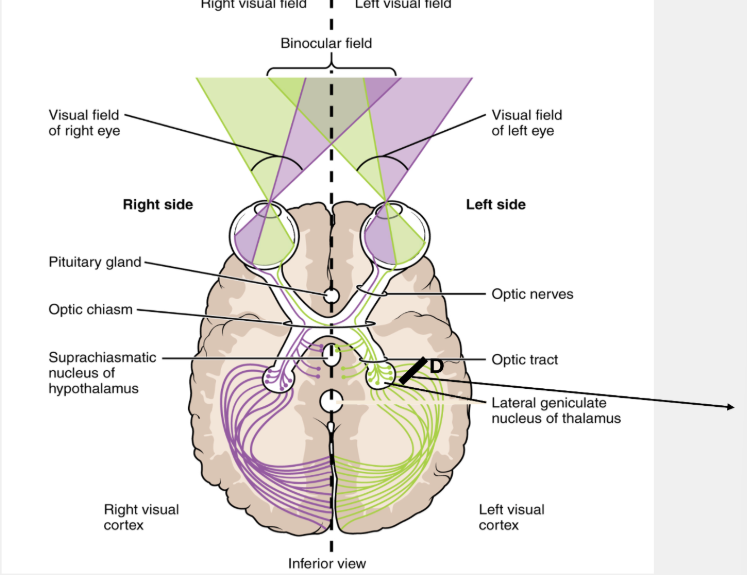 The following lesion in D causes which of the following | back 79 left superior quadrantanopia |
front 80 The axons in the optic tract terminate in the following nuclei within the brain except | back 80 the infraachiasmatic nucleus of the hypothalamus |
front 81 The striatum is composed of the | back 81 caudate and putamen |
front 82 The net effect of the indirect pathway of processing signals in the basal ganglia is... | back 82 inhibitory |
front 83 The loss of ......... neurons in Parkinson’s disease causes the poverty of movement that characterizes this disease, as the balance between direct pathway and indirect pathway is tipped in favor of the ....... pathway, with a subsequent pathological global ............ of motor cortex areas. | back 83 dopaminergic, indirect, inhibition |
front 84 The lenticular nucleus is composed of.... | back 84 the putamen and the globus pallidus |
front 85 The primary fissure separates the corpus cerebelli into a ................ | back 85 posterior lobe and an anterior lobe |
front 86 The corpus striatum is composed of all of the following except... | back 86 substantia nigra |
front 87 The cerebellum is involved in the following functions except... | back 87 sensory learning |
front 88 The net effect of the direct pathway of processing signals in the basal ganglia is... | back 88 excitatory |
front 89 The following disease is characterized by slowness or absence of movement (bradykinesia or akinesia), rigidity, and a resting tremor (especially in the hands and fingers) | back 89 Parkinson’s disease |
front 90 The substantia nigra is composed of... | back 90 the pars compacta and the pars reticulata |
front 91 Information flows into and through the hippocampus by three principal pathways except... | back 91 the indirect pathway |
front 92 PET scans have shown an increase in blood flow during panic attack to the... | back 92 parahippocampal gyri |
front 93 hippocampal formation typically refers to all of the following except... | back 93 cingulate cortex |
front 94 Major Output Pathways of the Amygdala are all of the following except... | back 94 directly to the hypothalamus |
front 95 The postcommissural fornix projects to which structure? | back 95 mamillary bodies |
front 96 Which structure is NOT part of the Papez circuit? | back 96 Ventral nucleus of the thalamus |
front 97 ___ is the integrative center for emotions, emotional behavior, and motivation | back 97 amygdala |
front 98 The limbic system includes all of the following except... | back 98 occipital and parietal lobes |
front 99 Retrograde amnesia refers to | back 99 loss of old memory |
front 100 T/F: The process by which an initially labile memory is transformed into a more enduring form is called consolidation | back 100 True |
front 101 Emotional responses to classical conditioning is controled by | back 101 amygdala |
front 102 Declarative memory examples are... | back 102 facts and events |
front 103 Explicit memory take place in | back 103 medial temporal lobe |
front 104 Nondeclarative memory includes all the following except | back 104 facts |
front 105 Short term memories can involve all of the following processes EXCEPT: | back 105 regulation of gene expression |
front 106 Simple classical conditioning is | back 106 implicit memory |
front 107 Anterograde amnesia refers to | back 107 inability to form new memory |
front 108 Skills and habits are stored in | back 108 striatum |