Instructions for Side by Side Printing
- Print the notecards
- Fold each page in half along the solid vertical line
- Cut out the notecards by cutting along each horizontal dotted line
- Optional: Glue, tape or staple the ends of each notecard together
Limbic System Hippocampus & Amygdala
front 1 Limbic means border. What is this border in between? | back 1 neocortex and the subcortical structures (diencephalon) |
front 2 limbic system includes the | back 2 hippocampal formation amygdala septal nuclei cingulate cortex entorhinal cortex perirhinal cortex parahippocampal cortex |
front 3 hippocampal formation typically refers to the | back 3 dentate gyrus, the hippocampus proper and the subicular cortex |
front 4 hippocampal formation is located in the | back 4 temporal lobe of each cerebral cortex |
front 5 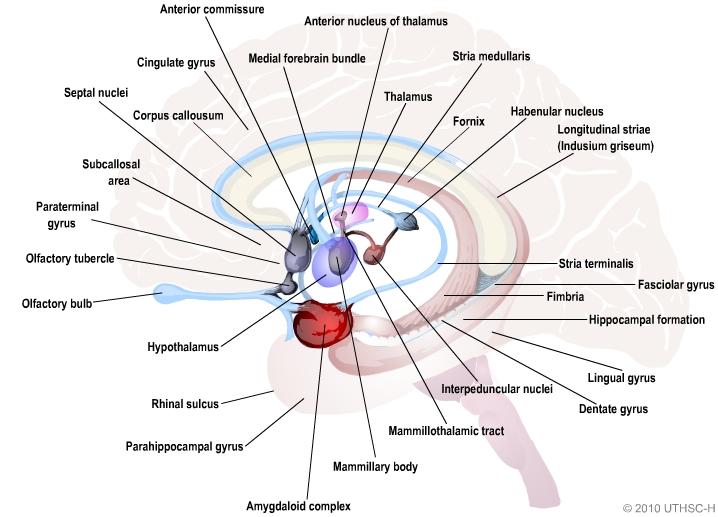 | back 5 septal nuclei |
front 6 Two major pathways into and out of the hippocampus are the | back 6 fornix and entorhinal cortex |
front 7 The precommissural branch of the fornix connects to the | back 7 septal, preoptic, ventral striatum, orbital cortex and anterior cingulate cortex |
front 8 The postcommissural branch of the fornix connects to the | back 8 anterior nucleus of the thalamus and the mammillary bodies of the hypothalamus |
front 9 The mammillary bodies are destroyed in _________ as the result of alcoholism and thiamine deficiency | back 9 Korsakoff’s syndrome |
front 10 Patients with Korsakoff’s syndrome have profound difficulty forming _____ _______ because the mammillothalamic tract also goes to the anterior thalamic nucleus, the hippocampus can affect the thalamus indirectly as well as directly. | back 10 new memories |
front 11 The anterior thalamic nuclei in turn connect to the _______. It projects back to the entorhinal cortex of parahippocampal gyrus, completing a “great” loop called the _______. | back 11 cingulate cortex Papez circuit |
front 12 The Papez circuit is involved in | back 12 learning and memory, emotion, and social behavior |
front 13 The input paths are just the | back 13 reverse of the output paths |
front 14 The _________ is a major source of inputs to the hippocampus | back 14 entorhinal cortex |
front 15 The ____ cortex, ______ lobe cortex, ______, _____ cortex, and ______ bulb all have inputs to the hippocampus via the entorhinal cortex | back 15 cingulate temporal amygdala orbital olfactory |
front 16 Information flows into and through the hippocampus by three principal pathways: 1. The ______ pathway from the entorhinal cortex to granule cells of the dentate gyrus 2. The ______ fiber pathway from the granule cell of the dentate gyrus to the pyramidal cells of the CA3 region of the hippocampus 3. The _____ collateral pathway from the
CA3 region of the hippocampus to
the | back 16 perforant mossy Schaffer |
front 17 Amygdala is the integrative center for | back 17 emotions, emotional behavior, and motivation |
front 18 major pathways communicate | back 18 bidirectionally and contain both efferent and afferent fibers |
front 19 The amygdala receives inputs from all senses as well as ______ | back 19 visceral inputs |
front 20 Visceral inputs come from the | back 20 hypothalamus, septal area, orbital cortex, and parabrachial nucleus. |
front 21 Auditory, visual and somatosensory | back 21 temporal and anterior cingulate cortices |
front 22 Major Output Pathways of the Amygdala | back 22 1. Ventral amygdalofugal pathway |
front 23 Ventral amygdalofugal pathway This pathway continues to the | back 23 anterior olfactory nucleus anterior perforated substance piriform cortex orbitofrontal cortex anterior cingulate cortex ventral striatum |
front 24 The ventral amygdalofugal pathway is important because it is a link whereby | back 24 motivation and drives can influence responses & is a link where responses are learned |
front 25 Stimulation of the amygdala causes | back 25 intense emotion, such as aggression or fear. |
front 26 Destructive lesions of the amygdala cause | back 26 tameness in animals, and a placid calmness in humans characterized as a flatness of affect. |
front 27 did not become conditioned to colors followed by the loud horn. But when asked how many colors were presented and which were followed by the horn, their recall was correct. | back 27 amygdala patients |
front 28 showed learning and conditioning to the colors followed by the horn, but could not recall which they were | back 28 hippocampal patients |
front 29 no conditioning and had no explicit | back 29 lesions in both amygdala & hippocampal |