Instructions for Side by Side Printing
- Print the notecards
- Fold each page in half along the solid vertical line
- Cut out the notecards by cutting along each horizontal dotted line
- Optional: Glue, tape or staple the ends of each notecard together
GIS test two, digital images
front 1 Digital images are a recording of __________ received by a sensor. | back 1 photons |
front 2 What is the difference between the possible values given by analogue vs digital instruments? | back 2 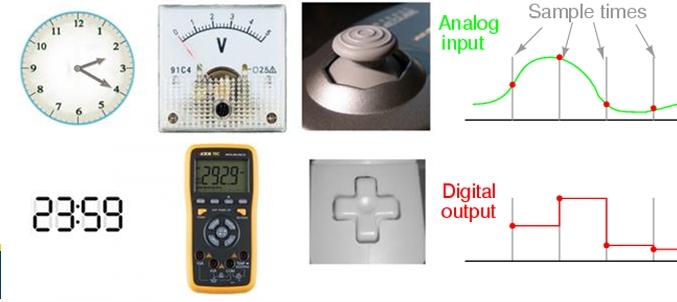 Analogue: infinite number of possible values Digital: discrete number of possible values (no in between) |
front 3 What is a charge-coupled device (CCD)? | back 3 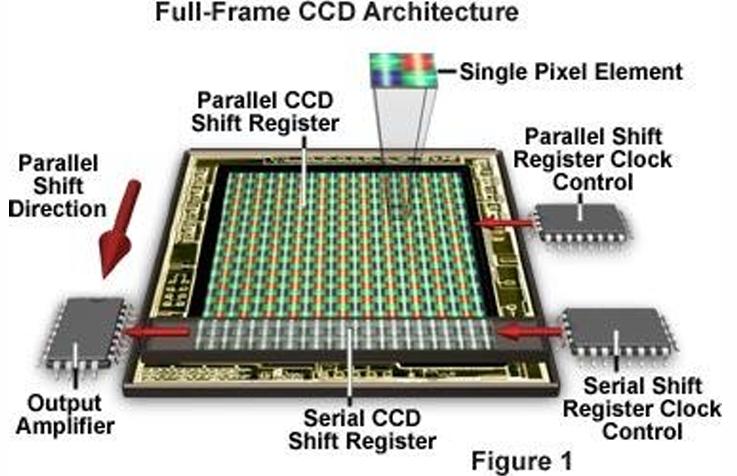 An array of silicon atoms (a grid) whose bonds can be broken by absorbing light (photons) of various wavelengths. |
front 4 What is an Instantaneous field of view (IFOV)? | back 4 A sensor's angular cone of visibility |
front 5 Define spatial resolution. | back 5 The smallest unit of area the sensor can collect |
front 6 What are Digital Numbers (DN)? What are they also referred to as? | back 6 The energy measured in a single pixel according |
front 7 DN is measure ___________, not reflection. | back 7 radiance |
front 8 A low DN value means ___________ radience. | back 8 little |
front 9 What is Radiometric Resolution? | back 9 A sensor’s ability to determine fine differences in energy measurements AKA Sensitivity of a sensor to differences in signal strength |
front 10 What is a Bit? | back 10 short for ‘Binary Digit’, Basic unit of information used in computing and digital communications |
front 11 What values can a bit have? What is the expression for how many possible combinations of bit values there are? | back 11 only one of two values, most commonly either 0 or 1 2n (n = number of bits), therefore 2 bits would have 4 (22) values |
front 12 The __________ of a radiometric resolution corresponds to the number of bits used for coding numbers in a binary format. | back 12 range |
front 13 Most commonly sensors will have _____ bit data but more advanced sensors have _____ bit data | back 13 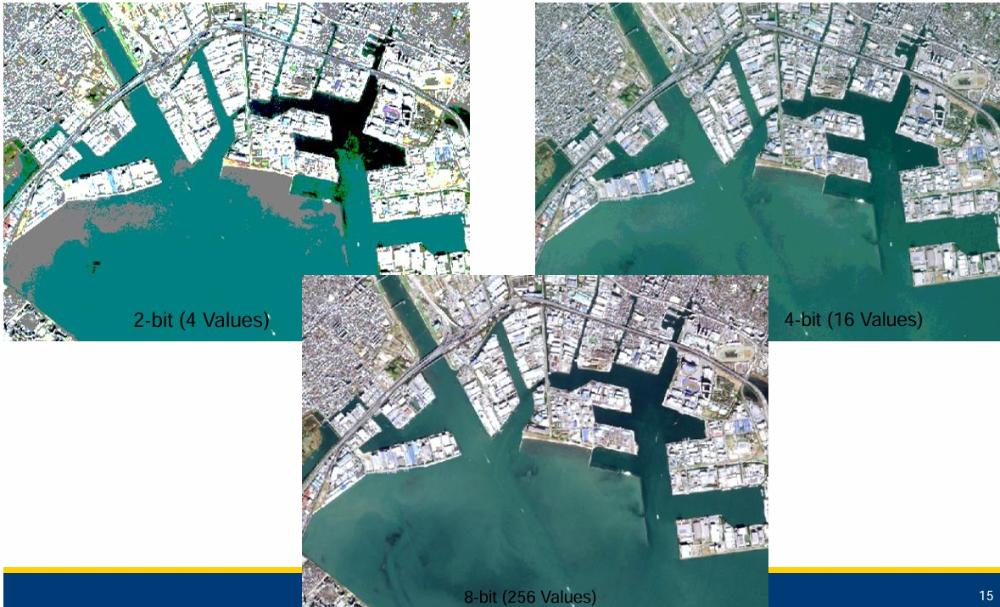 8, 12 |
front 14 The bands of colour used to render digital images are (discrete/continuous). | back 14 Discrete |
front 15 Why don't digital images have colour? What does this mean for the initial display of digital numbers? | back 15 Colour is used for interpretation, greyscale presentation |
front 16 A _____________ sensor measures the visible spectrum as one band. This results in a ___________-and-___________ | back 16 Panchromatic, black-and-white |
front 17 A ____________ ____________ is an image formed by displaying the DNs of one band as red, a second band as green, and a third as blue. | back 17 colour composite |
front 18 How is True colour composite different from a colour composite? | back 18 True colour matches red, green and blue to DN values that are red, green and blue respectively in real life. It is a type of colour composite. |
front 19 An image where the distribution of the band | back 19 A False colour composite |
front 20 What is the standard for which bands are represented by RGB in a false colour composite? | back 20 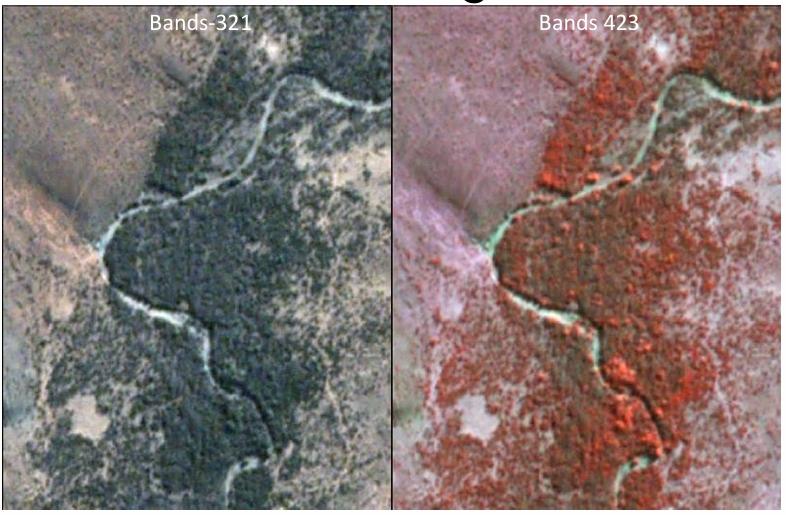 • NIR represented by red |
front 21 What is the spectral resolution of an sensor? | back 21 The number and width of bands measured by a |
front 22 A multispectral sensor will have ___-10 ___________ bands while a hyperspectral sensor will have hundreds of ___________ bands. | back 22 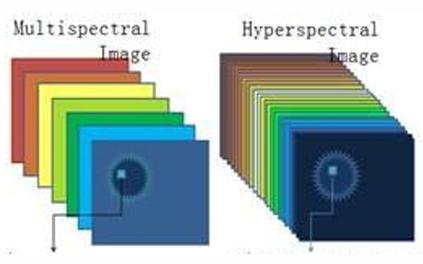 3, wider, narrow |