Instructions for Side by Side Printing
- Print the notecards
- Fold each page in half along the solid vertical line
- Cut out the notecards by cutting along each horizontal dotted line
- Optional: Glue, tape or staple the ends of each notecard together
Exam 2 BICH: TCA CYCLE
front 1 TCA cycle is a central pathway for___ ____ from several metabolic pathways when acetyl CoA can be generated | back 1 -recovering energy |
front 2 Acetyl CoA is oxidized in the TCA cycle, where intermediates are | back 2 utilized in a circular pathway |
front 3 Glycolysis occurs in the cytoplam and doesnt require energy. Meanwhile, the TCA cycle occurs in the | back 3 mitochondria |
front 4 The TCA cycle allows for the oxidation of pyruvate to CO2 under_____conditions, and yields about ______ATP | back 4 -aerobic -36 |
front 5 Do the electrons from glucose oxidation feed into the electron transport pathway, driving synthesis of ATP? | back 5 YES |
front 6 What is Acetyl CoA oxidized to? | back 6 CO2 |
front 7 Electrons stored as NADH and FADH2 are delivered to a________ to
the | back 7 -membrane-associated electron-transport chain |
front 8 Electron transfer is coupled | back 8 -oxidative phosphorylation. |
front 9 How many electrons are removed when a complete oxidation of glucose to CO2 occurs? | back 9 -24 electrons |
front 10 How many total electrons are in PDHC? | back 10 -4 electrons total in 2 pyr-> acetyl-CoA |
front 11 How many total electrons are in TCA cycle? | back 11 -8 electrons for each acetyl CoA (16 total) |
front 12 These electrons are stored as ___ and ___ used to fuel oxidative phosphorylation. | back 12 -NADH -FADH2 |
front 13 Flavin coenzymes can exist in three oxidation states | back 13 FAD, FMN, and riboflavin |
front 14 The three oxidation states allows for flavin coenzymes to participate in | back 14 one-electron or two-electron transfer reactions. |
front 15 Catalyze many reactions in biological systems and work with many electron donors and acceptors | back 15 Flavoproteins |
front 16 FADH2 can transfer either __ or __ e- at a time | back 16 -1 -2 |
front 17 FADH, FAD, FADH2 are made form the vitamin | back 17 riboflavin |
front 18 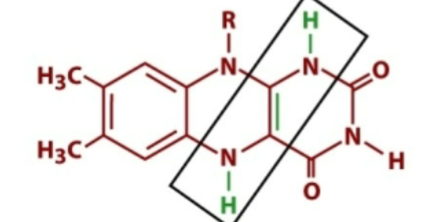 What structure is this? | back 18 FADH2 |
front 19 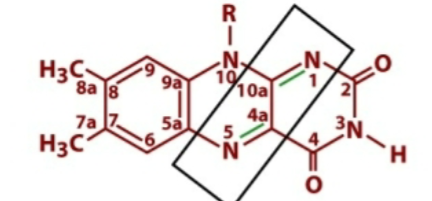 What structure is this? | back 19 FAD |
front 20 What is the source of acetyl CoA? | back 20 pyruvate |
front 21 The reaction that converts pyruvate to acetyl CoA is catalyzed by the | back 21 -pyruvate dehydrogenase complex (PDC or PDHC) |
front 22 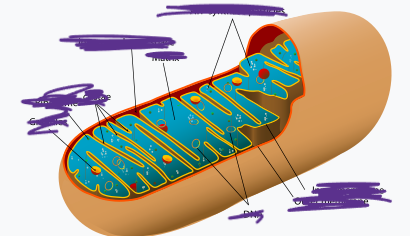 | back 22 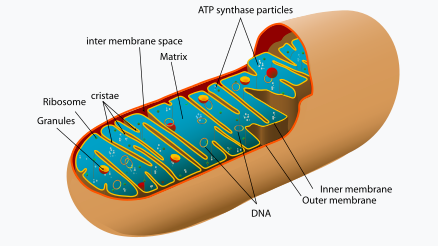 |
front 23 permeable to anything smaller than 5 kD | back 23 Outer membrane |
front 24 permeable only to O2, H2O, and CO2 | back 24 Inner membrane |
front 25 How does pyruvate make its way into the mitochondrial matrix? | back 25 -it travels through a channel in the outer membrane and an H+/pyruvate symporter in the inner membrane |
front 26 From pyruvate to Acetyl CoA: | back 26 oxidation by NAD+ and formation of a thioester |
front 27 What is the function of CoA? | back 27 -a carrier of acetyl and other acyl groups |
front 28 What is the reaction of a pyruvate DH complex? | back 28  |
front 29 What three enzymes is pyruvate dehydrogenase made of? | back 29 _pyruvate dehydrogenase(E1) -Dihydrolipoyl transacetylase (E2) -Dihydrolipoyl dehydrogenase (E3) |
front 30 What are the 5 cofactors of pyruvate dehydrogenase? | back 30 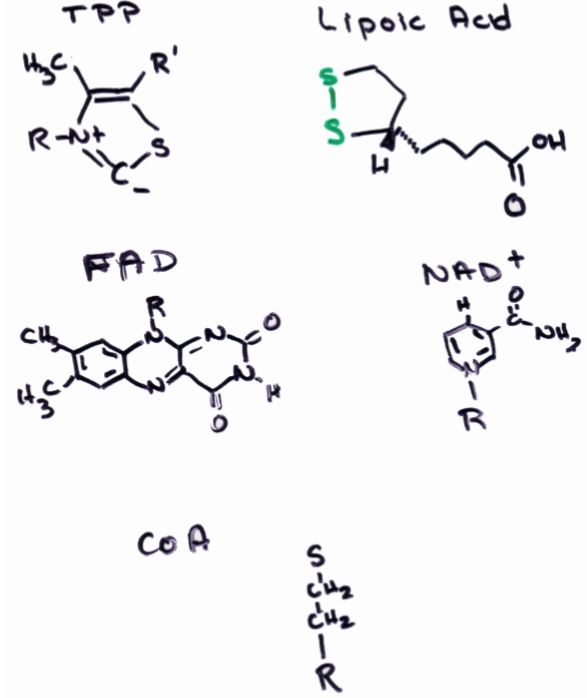 -TPP -NAD -FAD -Lipoic Acid -CoA |
front 31 Pyruvate conversion to Acetly CoA | back 31 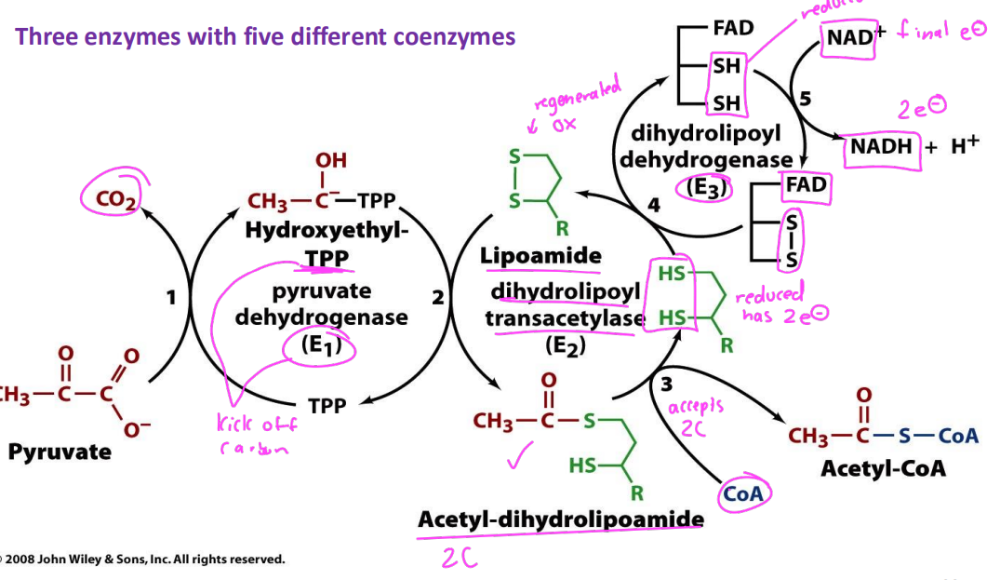 |
front 32 What is the purpose of TPP cofactor? | back 32 facilitates decarboxylation |
front 33 What is the purpose of lipoic acid? | back 33 -bound to a lysyl residue to form lipoamide that is reduced to from dihydrolipoamide -serves as a swinging arm to transfer intermediates from E1, E2, E3 |
front 34 Arsenic poisoning is a toxic compound that binds to | back 34 sulfhydryl compounds |
front 35 The inactivation of lipoamide-containing compounds such as pyruvate dehydrogenase and alpha-ketoglutarate dehydrogenase__- | back 35 halts respiration |
front 36 Arsenic compounds are more toxic to______ and was used to treat ___,___,___ | back 36 -microorganisms -syphilis, bacteria, and parasitic diseases |
front 37 TPP( vitamin B1/thiamine) deficiency results in | back 37 pain, paralysis, wasting, and heart failure |
front 38 TPP being used in pyruvate DH | back 38 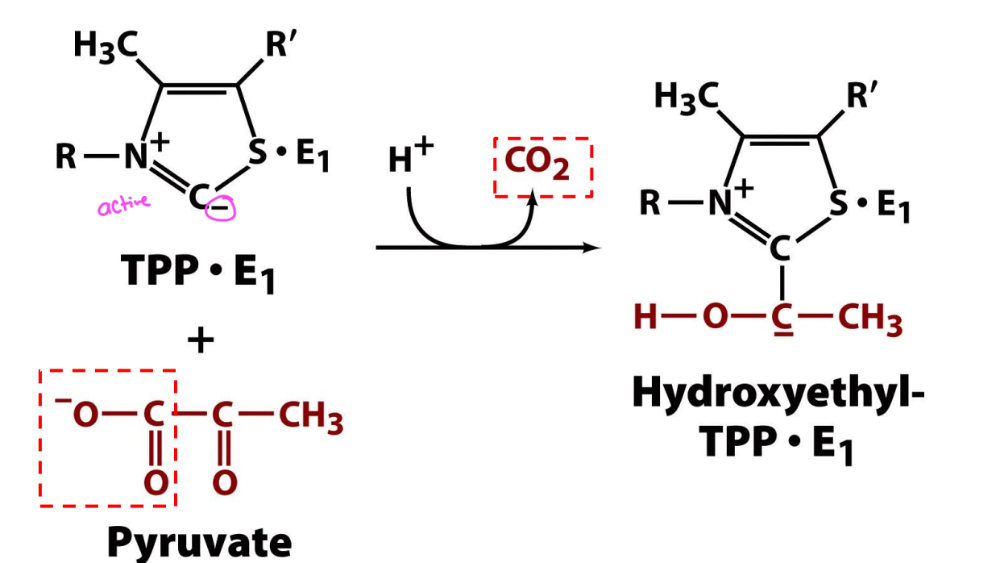 |
front 39 In pyruvate decarboxylase, hydrooxyethyl-TPP is | back 39 cleaved to release acetaldehyde +TPP |
front 40 In pyruvate DH reaction, hydroxyethyl-TPP transfers H3C-(C=O)- to_____ and ____occurs producing dihydrolipoate | back 40 -lipoic acid -oxidation |
front 41 T or F: Humans can make lipoic acid (it is a vitamin) | back 41 false |
front 42 The nucleophilic attack by CoA at carbonyl carbon results in transfer of acetyl group to CoA generating | back 42 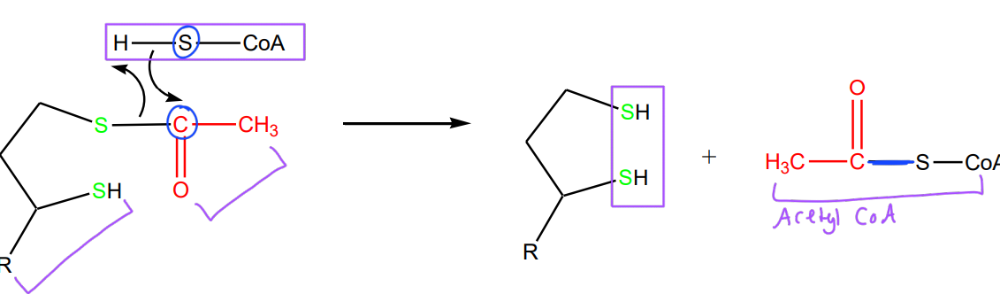 acetyl CoA |
front 43 When the acetyl group is transferred to CoA, FAD and NAD+ are used to | back 43 reclose (oxidize) S-S of lipoic acid |
front 44 E2 is a proper | back 44 oxidation state |
front 45 PDHC mechanism | back 45 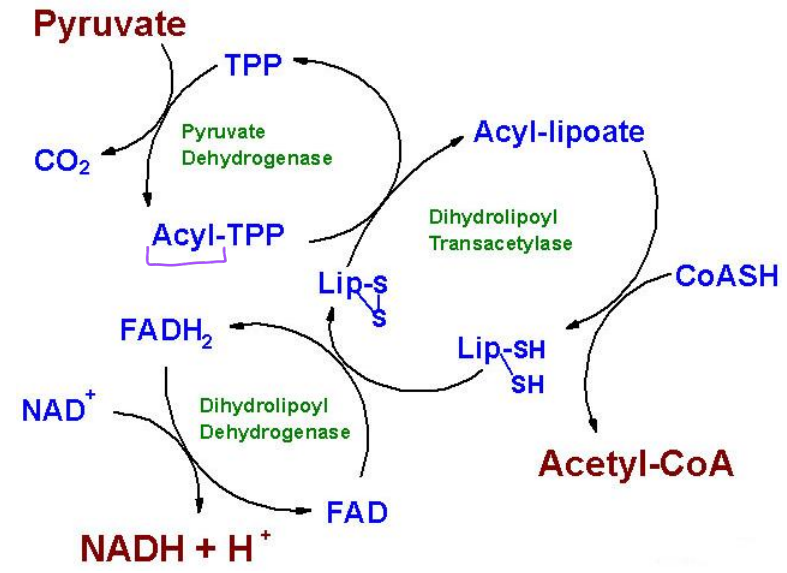 |
front 46 KNOW THIS TABLE | back 46 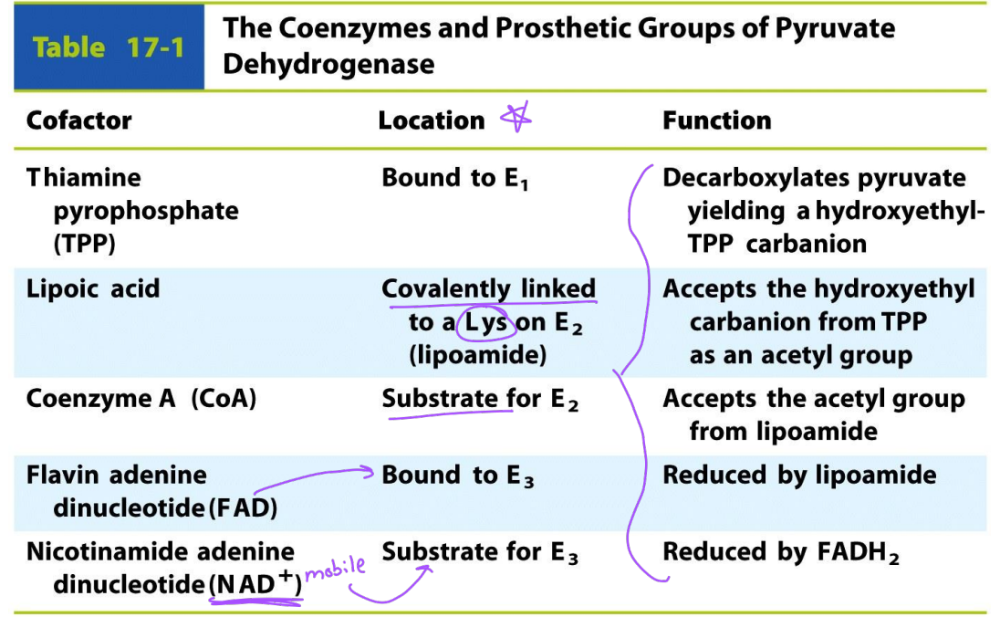 |
front 47 Thiamine is a vitamin in B1 and can be found in | back 47 nuts, meats, and whole grains |
front 48 Lipoic acid is made from fatty acid precursors in animals and can be found in | back 48 spinach, broccoli, yeast, rice bran, red organic meat |
front 49 CoA biosynthesis requires cysteine pantothenate and ATP and is | back 49 lesser known than vit. B5 because all foods are a source of B5 |
front 50 FAD/FMN is synthesized from_____ and can be found in_____- | back 50 -riboflavin -eggs, organ meats, low-fat milk, cereals, bread, and grain products |
front 51 NAD+ biosynthesized from____, but relies on salvage pathways that use______ | back 51 -tryptophan -niacin |
front 52 A long lasting drop or rise of ΔΨmvs normal levels may | back 52 induce unwanted loss of cell viability and be a cause of various pathologies |
front 53 ΔΨmvs drives inward transport of____ and outward transport of _____ | back 53 -cations -anions |
front 54 ΔΨmvs is an important factor in selection of | back 54 non-functional mitochondria |
front 55 1. Entry of new carbon units into the TCA cycle is from pyruvate or oxidation of fatty acids 2. Transfer of the 2-C acetyl CoA to 4C OAA yields citrate 3. A dehydration-rearrangement yields isocitrate 4. two successive decarboxylation produce alpha-KG and then succinyl CoA 5. Multiple rearrangements to regenerate OAA | back 55 The chemical logic of the TCA cycle |
front 56 reaction where 2C unit of acetyl CoA is introduced into the TCA cycle by addition to the 4C unit OAA to from citrate | back 56 1. Citrate synthase |
front 57 The Cα of the acetyl group in acetyl-CoA is acidic and can be deprotonated to form a | back 57 carbanion |
front 58 The carbanion is a strong ______that can attack the α-carbonyl of ______ | back 58 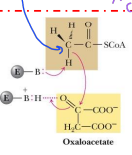 -nucleophile -oxaloacetate |
front 59 Due to citrates poor oxidation, the enzyme___ catalyzes an isomerization reaction | back 59 2. aconitase |
front 60 Aconitase uses an_____ to achieve stereospecificity | back 60 iron-sulfur cluster |
front 61 Is a hydride removal followed by a decarboxylation and is a link to the electron transport pathway because it makes NADH | back 61 3. Isocitrate dehydrogenase |
front 62 Isocitrate dehydrogenase produces the 1st NADH and the CO2 released came from the | back 62 end of OXAL |
front 63 α-ketoglutarate dehydrogenase catalyzes the_________of the TCA cycle | back 63 2nd oxidative decarboxylation |
front 64 Enzyme is nearly identical to pyruvate dehydrogenase and the 2nd NADH is produced | back 64 4. α-ketoglutarate dehydrogenase |
front 65 Uses 5 coenzymes: TPP, CoASH, lipoic acid, NAD+, and FAD | back 65 α-ketoglutarate dehydrogenase |
front 66 α-Ketoglutarate dehydrogenase is a very __, _____ reaction | back 66 -exergonic -irreversible |
front 67 The 60 subunits are made up of: | back 67 -pyruvate dehydrogenase: 24(E1) -dihydrolipoyl transacetylase: 24(E2) -dihydrolipoyl dehydrogenase:12(E3) |
front 68 Harvest "high energy" thioester bond to make GTP. Since succinate is symmetric, we can no longer distinguish which carbons came from acetyl coA | back 68 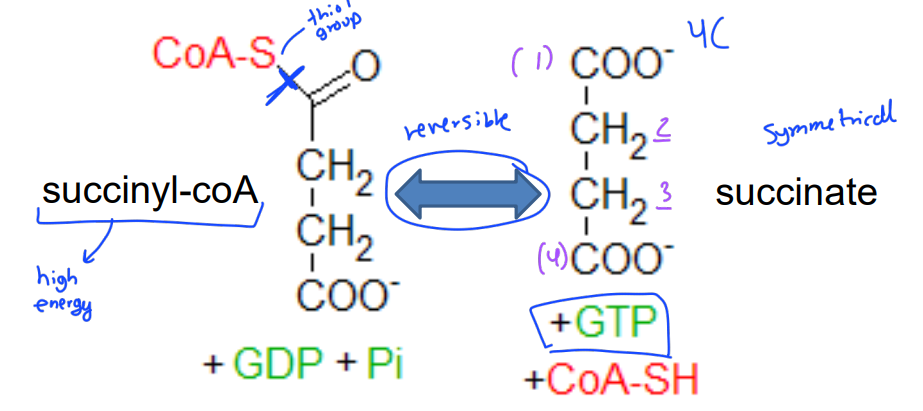 5. Succinyl-CoA synthetase |
front 69 It is considered to be the substrate-level phosphorylation | back 69 Succinyl-CoA synthetase reaction |
front 70 During Succinyl-CoA synthetase the mechanism involves formation of a ________to produce_____ | back 70 -phosphohistidine -succinate |
front 71 A____is made after succinyl-CoA synthetase | back 71 nucleoside triphosphate |
front 72 It is near equilibrium. DH->FADH2 rather than NADH | back 72 6. Succinate dehydrogenase |
front 73 (Δℰo‘= ℰo‘ (acceptor) - ℰo‘(donor)) | back 73 Remember this!! |
front 74 Reduction potential | back 74 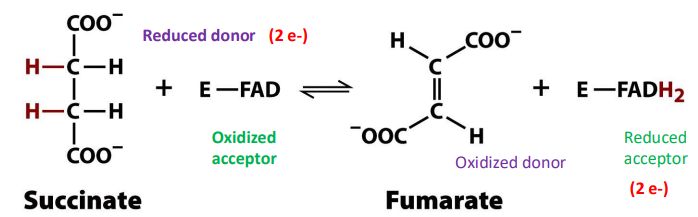 |
front 75 Practice this math question | back 75 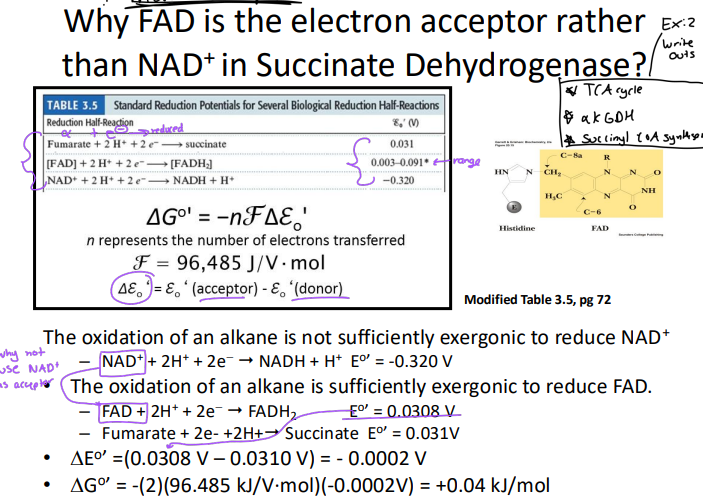 |
front 76 Succinate dehydrogenase contains three types of Fe-S centers: | back 76 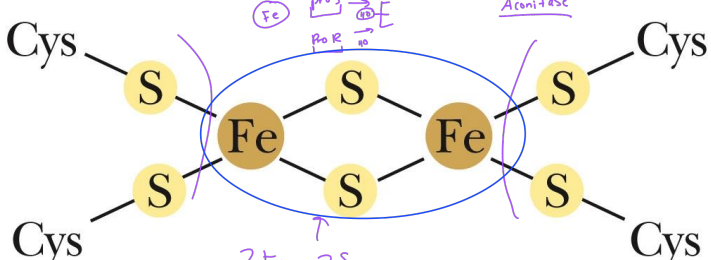 a 4Fe-4S center, a 3Fe-4S, and a 2Fe-2S center |
front 77 Succinate DH involves hydride removal by ____. This enzyme is part of the electron transport pathways in the inner _____ | back 77 -FAD -mitochondrial membrane |
front 78 The electrons transferred from succinate to FAD(to form FADH2) are passed to____in electron transport pathway | back 78 ubiquinone |
front 79 Fumarase converts fumarate->malate by | back 79 adding water |
front 80 Fumarase causes the | back 80 hydration across the double bond |
front 81 Malate DH _____malate-> OAA | back 81 reversibly oxidizes |
front 82 The carbon that gets oxidized received an OH group in the previous reaction. Is NAD+-dependent oxidation | back 82 8. Malate oxidation |
front 83 The carbon atoms of Acetyl-CoA have diff. fates | back 83 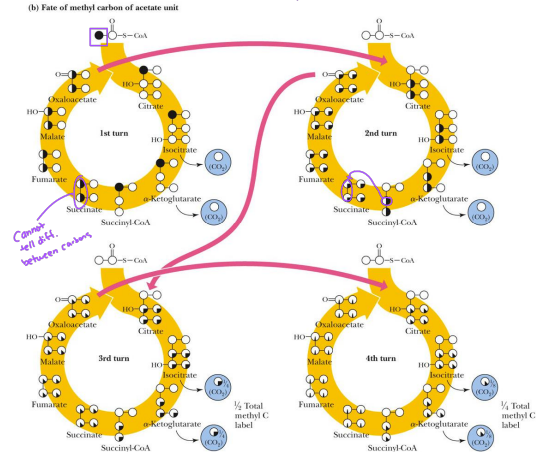 |
front 84 Electrons stored as NADH and FADH2 are delivered to a membrane associated ETC to the final electron acceptor O2. Electron transfer is coupled to a proton gradient across the membrane to drive the synthesis of ATP in a process known as | back 84 oxidative phosphorylation |