Instructions for Side by Side Printing
- Print the notecards
- Fold each page in half along the solid vertical line
- Cut out the notecards by cutting along each horizontal dotted line
- Optional: Glue, tape or staple the ends of each notecard together
Principles of Eco (Lec 5)
front 1 Large organisms heat and cool less quickly than | back 1 smaller organisms |
front 2 Heat content is a function of Heat exchange is a function of | back 2 volume surface area |
front 3 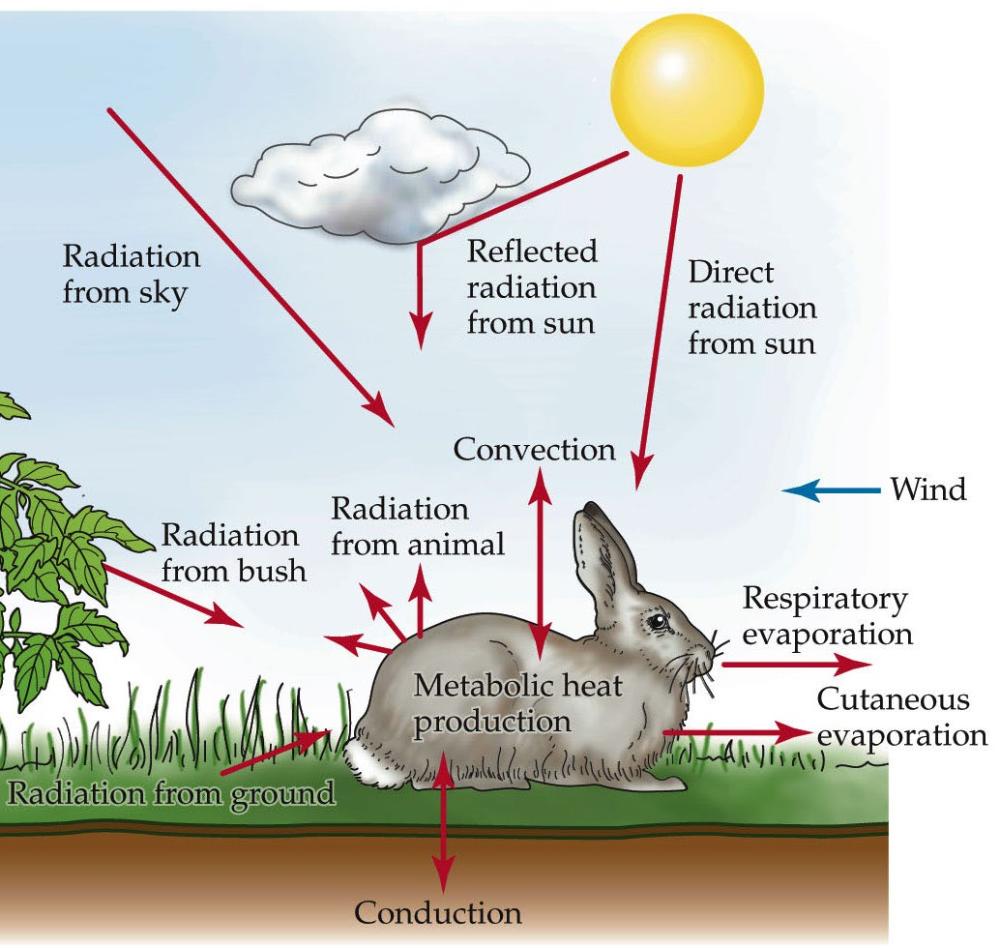 Temp. of organisms is determined by exchanges of | back 3 thermal energy(heat) with the external environment *heat produced by metabolims |
front 4 Heat Balance Equation: Generalized Equation | back 4 H= SR + IRin - IRout +/- Hconv +/- Hcond - Hevap + Hmet |
front 5 Plant Balance Equation: | back 5 H= SR + IRin - IRout +/- Hconv +/- Hcond - Hevap |
front 6 Organisms influence their temp. by modifying gains and losses via | back 6 1. Acute responses occurs within individual plants 2. Phenotypic acclimatization within individual plants 3. Evolutionary adaptation occurs across generations |
front 7 Plants can alter | back 7 - evapotranspirational water loss - leaf surface reflective properties - leaf orientation to the sun - leaf surface roughness |
front 8 Thermal Adaptation | back 8 no data |
front 9 Thermal Acclimatization Plants used: Brittlebush | back 9 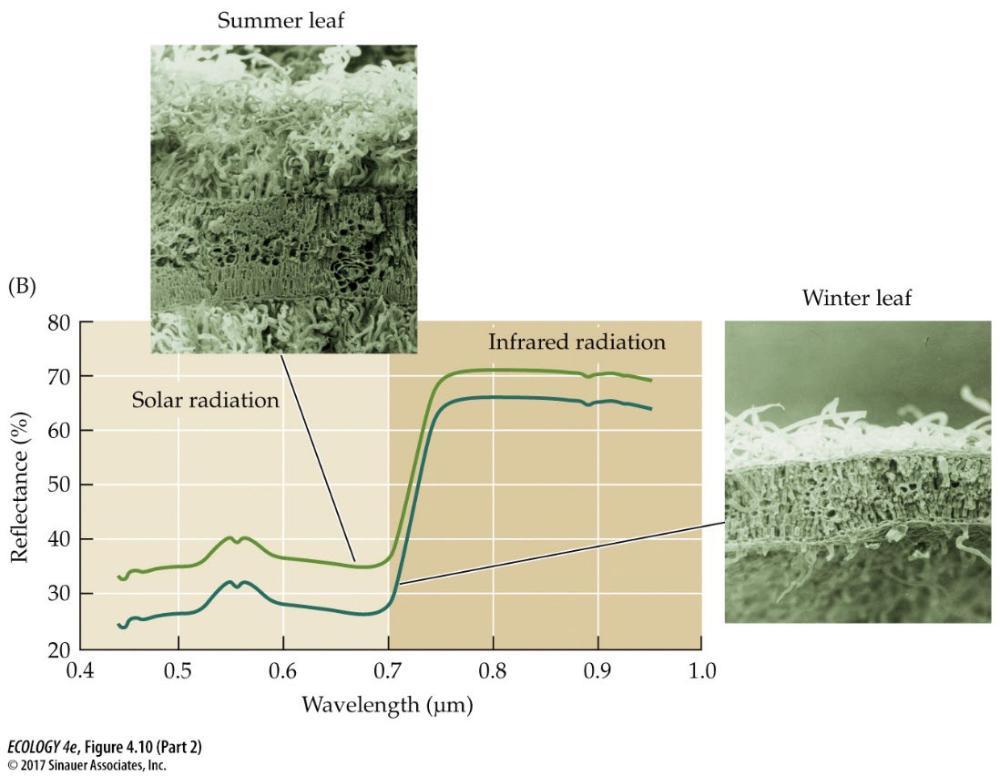 |
front 10 Endothermy *sources of heat | back 10 organism to maintain a stable body temperature through metabolic processes. * predominant source of heat |
front 11 Ectothermy *sources of heat | back 11 regulate their body temperature using external sources, such as sunlight or ambient temperature * outside env is their heat |
front 12 Homeothermy *body temp | back 12 maintain a stable internal body temperature, even when the external temperature varies to sustain: heat must be lost in the same rate it is gained |
front 13 Poikilothermy *body temp | back 13 organism that cannot regulate its body temperature except by behavioral means such as basking or burrowing. |
front 14 Most Fish: Generalized Equation | back 14 H= - Hconv +/- Hcond |
front 15 Terrestrial Ectotherms | back 15 H= SR + IRin - IRout +/- Hconv +/- Hcond - Hevap Hmet dropped due to not producing heat fast enough |
front 16 Terrestrial Endotherms | back 16 H= SR + IRin - IRout +/- Hconv +/- Hcond - Hevap + Hmet |
front 17 Endotherms can maintain high and constant body temps but | back 17 Endothermic homeothermy has a high energetic price |
front 18 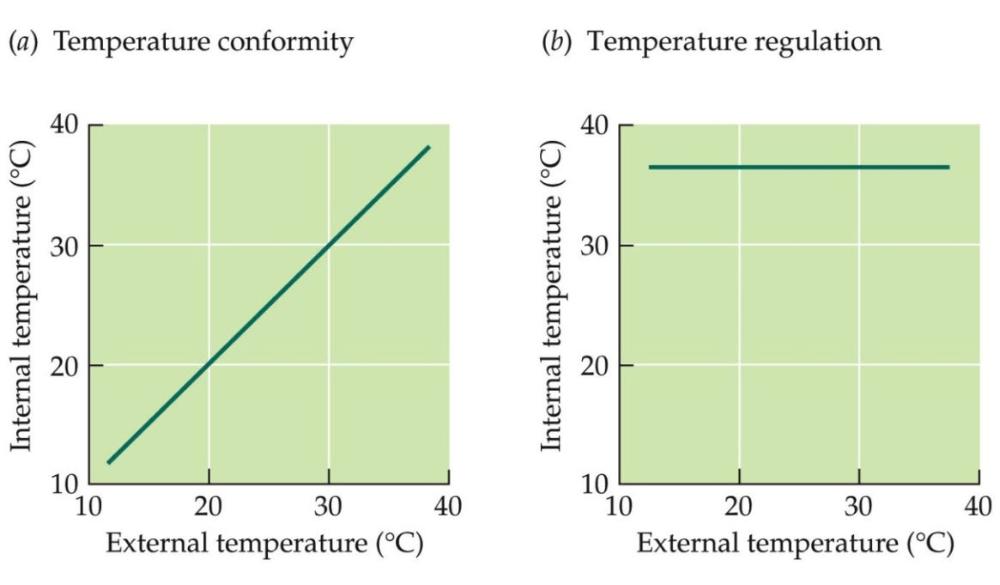 Temp regulation and thermal ecology are inseparable from energy metabolism | back 18 no data |
front 19 Ectotherms can not use what to thermoregulate? | back 19 metabolism |
front 20 Endo and ectothermy are not | back 20 strict alternatives |
front 21 Skipjack tuna use muscle activity and heat exchange to | back 21 maintain a body temp 14 C |
front 22 Terrestrial ectotherms can move between heat sources and heat sinks using Ex. Lizards | back 22 behavioral thermoregulation |
front 23 Insects have a high concentration of glycerol, a chemical that *similar to antifreeze proteins that fishes have as well | back 23 lowers the freezing point of body fluids |
front 24 Wood frogs (Rana Sylvatica) and some other species of frogs tolerate | back 24 tolerate freezing |
front 25 Metabolic rate depends on | back 25 external temp & S/V ratio |
front 26 Heat loss is faster in the | back 26 cold * endothermy is non-sustainable due to this and may enter torpor under cold conditions |
front 27 Benefits of enedothermy | back 27 _ independence from env temp - range expansion to high latitude and alitude - high capacity to sustain physical activity |
front 28 Characteristics of Endothermy | back 28 - Thermoneutral zone _ Low critical temp |
front 29 Thermoneutral zone | back 29 a constant basal metabolic rate can be maintained |
front 30 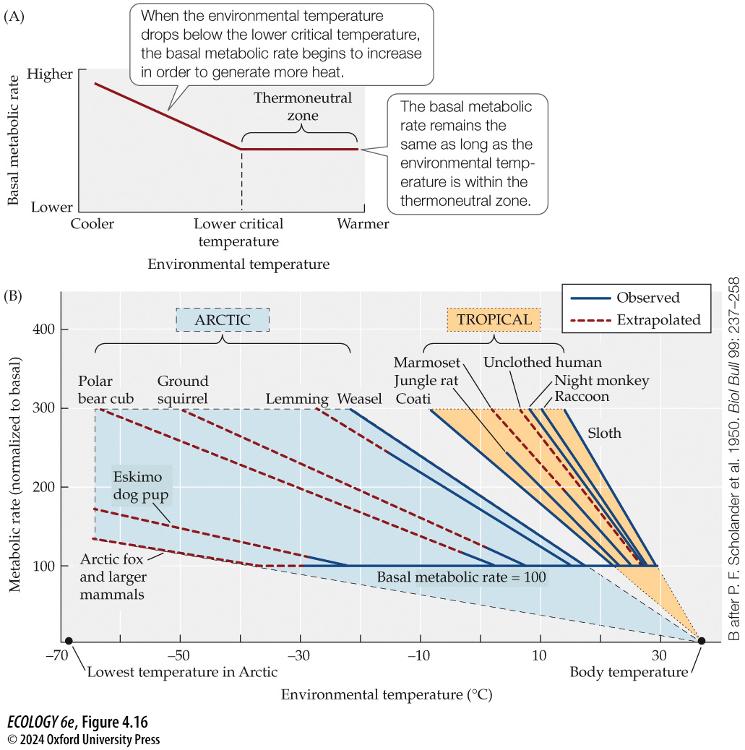 Lower critical temp * lower in Arctic mammals than tropical mammals | back 30 heat loss > metabolic production; body temp drops and heat increases |
front 31 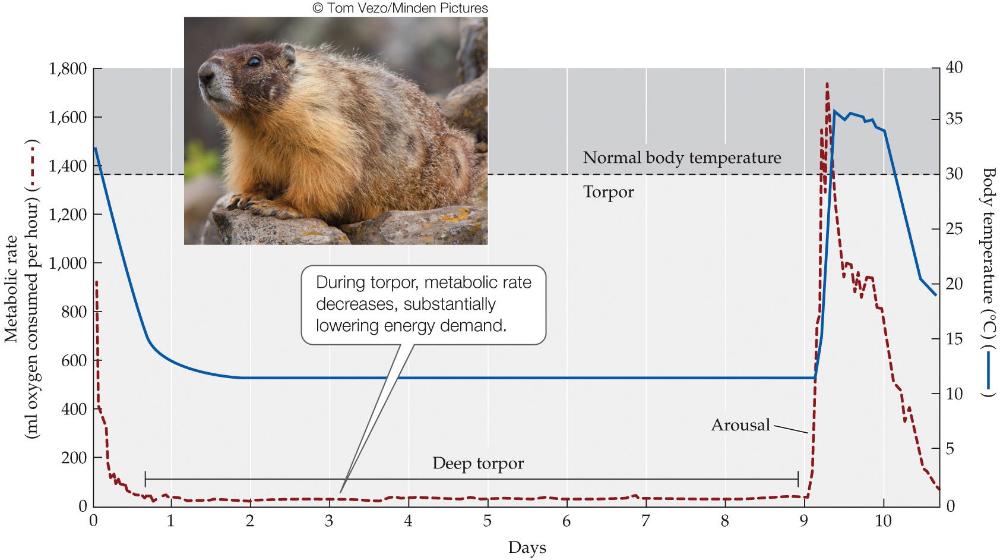 Torpor * long periods are possible for animals that can store enough energy * also related to hiberation | back 31 state of physical or mental inactivity; lethargy. |
front 32 Small endothemrs undego daily torpor to | back 32 survive cold nights |