Instructions for Side by Side Printing
- Print the notecards
- Fold each page in half along the solid vertical line
- Cut out the notecards by cutting along each horizontal dotted line
- Optional: Glue, tape or staple the ends of each notecard together
ch 10 plus some of ch 9
front 1 The processes are vital for all life forms | back 1 transport |
front 2 Cells must be able to _____ nutrients and _____waste | back 2 import, export |
front 3 All cells maintain__________of various metabolites across the plasma membrane and other intracellular membranes | back 3 concentration gradients |
front 4 Many transport processes involve the movement of | back 4 polar or ions across the hydrophobic interior of a membrane |
front 5 Transport proteins are | back 5 integral membrane proteins |
front 6 Uniport moves | back 6 1 solute downward |
front 7 Symport moves | back 7 2 solutes downward |
front 8 Antiport moves 2 solutes | back 8 in opposite directions (one goes up and other goes down) |
front 9 What are the four modes of membrane transport? | back 9 1. Passive diffusion (-ΔG) (favored) 2. Facilitated diffusion (-ΔG) (favored) 3. Active transport (+ΔG) (opposed) 4. Secondary active transport (+ΔG) (opposed) |
front 10 Passive diffusion doesn't require proteins and means the transportation of species | back 10 moving down its concentration gradient from high to low concentrations |
front 11 Passive diffusion of uncharged species move across the membrane depending on | back 11 the concentration on the two sides |
front 12 Passive diffusion of a charged species also depends on the concentration and | back 12 the charge of the particle |
front 13 allow transport of charged molecules such as protons across the bilayer down its concentration | back 13 Hydrophobic ionophores |
front 14 The proteins "facilitate" transport, increasing the rate of transport | back 14 facilitated diffusion |
front 15 Two important distinguishing features of facilitated diffusion | back 15 1. solute flows only in the favored direction 2. Transport displays saturation kinetics: there is an upper limit to how solutes can influence the rate of transport |
front 16 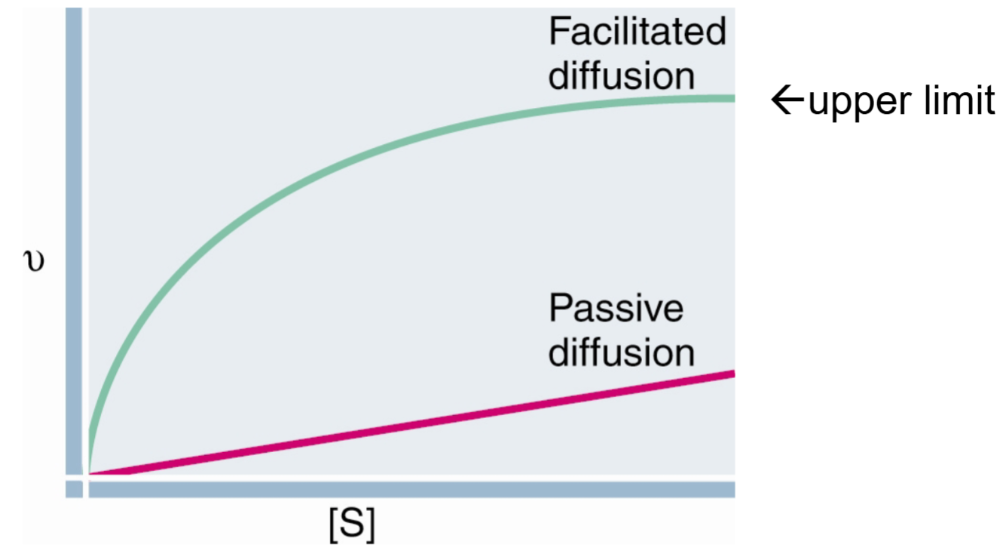 | back 16 Facilitated diffusion displays saturation |
front 17 Single channels can be formed from | back 17 dimers, trimers, tetramers, or pentamers of protein subunits |
front 18 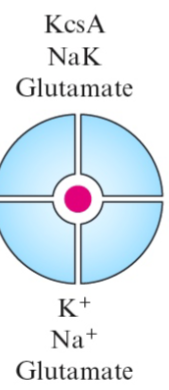 Multimeric assemblies in which each subunit | back 18 has its own pore as known |
front 19 Potassium channels combine | back 19 high selectivity with high conduction rates |
front 20 Active transport is used to transport | back 20 against the thermodynamic potential of solutes |
front 21 Active transport directly uses | back 21 ATP (hydrolysis) |
front 22 Another way to refer to the sodium-potassium pump | back 22 Na,K-ATPase |
front 23 Na,K-ATP maintains intracellular Na+ ____ and K+______ and it is crucial for organs ____ and_____ | back 23 low, high brain, neural tissue |
front 24 Drives Na+ out and K+ in | back 24 ATP hydrolysis |
front 25 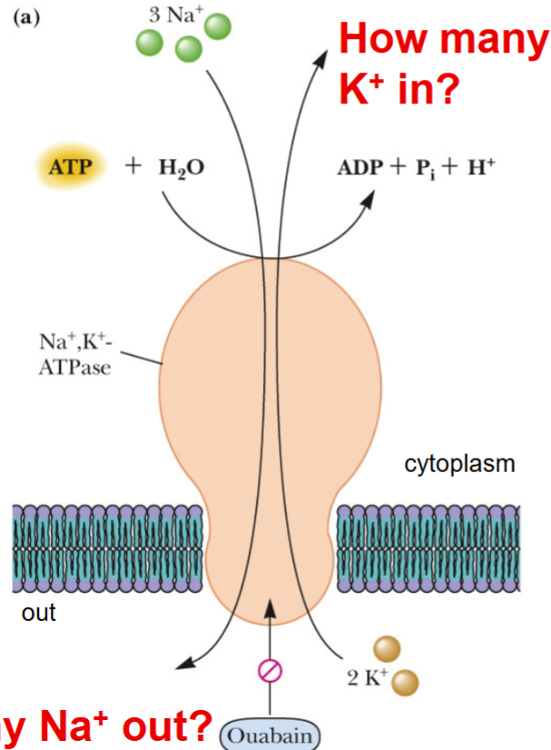 how much ATP is used? How many K+ goes from high to low? How many Na+ goes from low to high concentration? | back 25 - 1 ATP - 2 K+ - 3 Na+ |
front 26 Inhibit by binding to outside part of the transporter | back 26 cardiac glycosides(ouabain) |
front 27 Secondary active transport is not directly driven by | back 27 ATP |
front 28 In secondary active transport, the gradient of H+, Na+ and other cations and anions previously established by ATPase | back 28 can be used for secondary active transport against their concentration gradient |
front 29 Many of these are symports with the ion and the transported | back 29 amino acids or sugar moving in the same direction |
front 30 AcrB is an example of | back 30 secondary transport system |
front 31 AcrB is a major multi-drug resistance transporter in | back 31 E.coli |
front 32 As protons flow spontaneously inward through AcrB in the E.coli inner membrane, | back 32 drug molecules are driven outward |
front 33 Both lipids and proteins of the membrane exhibit | back 33 lateral and transverse asymmetry |
front 34 Proteins can associate and cluster in the plane of the membrane -They are not uniformly distributed | back 34 Lateral asymmetry of proteins |
front 35 Lipids can cluster in the plane of the membrane-they are not uniformly distributed | back 35 lateral asymmetry of lipds |
front 36 Mark Bretscher shows that N-terminus of glycophorin is extracellular whereas C-terminus is intracellular | back 36 Transverse asymmetry of proteins |
front 37 In most cell membranes, including those of intracellular organelles, the composition of the outer monolayer is quite different from that of the inner monolayer | back 37 transverse asymmetry of lipids |
front 38 Dynamic means | back 38 motion |
front 39 Lipids and proteins undergo lots of movements in the membrane and these motions | back 39 support a variety of cell functions |
front 40 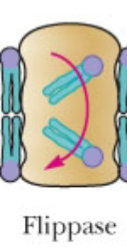 Move PS from the outer leaflet to the inner leaflet | back 40 ATP dependent flipase (flip in) |
front 41 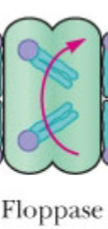 Moves lipids including cholesterol, PC, and sphingomyelin from the inner leaflet to the outer leaflet of the membrane | back 41 ATP dependent flopase (flop out) |
front 42 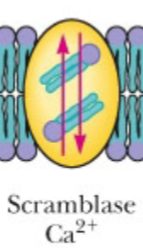 Randomize lipids across the membrane and thereby degrade membrane lipid asymmetry | back 42 Scramblases ( Ca^2+ activated but ATP dependent) |
front 43 At low tempertures , bilayer lipids are highly ordered, forming a gel, with acyl chains extended,nearly | back 43 perpendicular to the membrane plane |
front 44 So, solid ordered state | back 44 the lipid chains are tightly packed and undergo relatively little motion |
front 45 Characteristics of So, solid ordered state, | back 45 1. lipid chains are in their fully extended conformation 2. surface area per liquid is minimal 3. bilayer thickness is maximal |
front 46 At higher temperatures, acyl chains undergo much more motion and acyl chain C-C bonds result in bending of the acyl chains | back 46 Ld, liquid- disordered state |
front 47 Characteristics of Ld, liquid- disordered state | back 47 1. surface area per lipid increases 2. lipid chains are more likely to be bent at any one time 3. bilayer thickness decrease by 10-15% |
front 48 Transition from gel phase to liquid crystalline is a true | back 48 phase transition |
front 49 The temperature at which this occurs is the transition temperature | back 49 Melting temp. Tm |
front 50 If Tm is increasing, | back 50 the chain length would increase |
front 51 -lipids can influence curvature - integral membrane proteins with conical shapes can induce curvature - scaffolding proteins can influence membrane shape in many ways | back 51 Membrane remodeling and curvature |
front 52 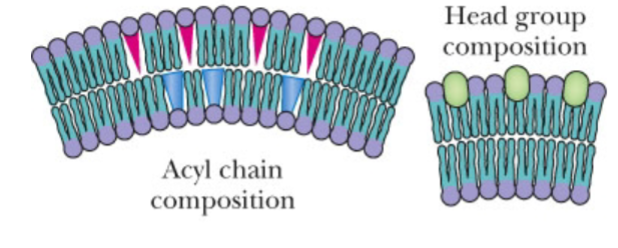 What type of bending is this? | back 52 lipid composition |
front 53 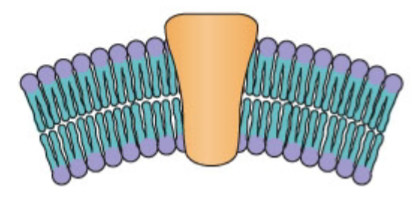 What type of bending is this? | back 53 membrane proteins |
front 54 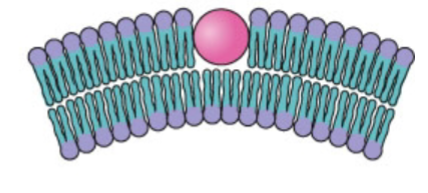 What type of bending is this? | back 54 amphipathic helix insertion |
front 55 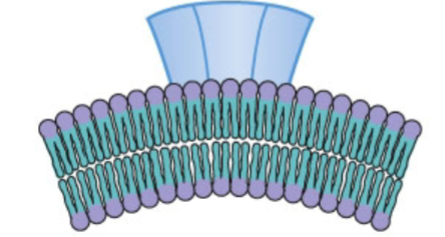 What type of bending is this? | back 55 scaffolding |
front 56 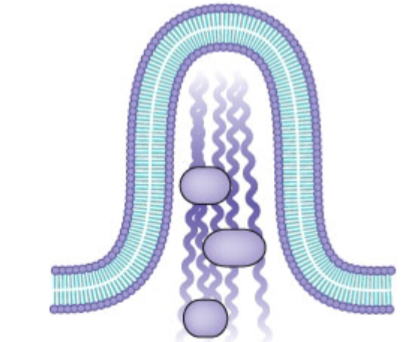 What type of bending is this? | back 56 cytoskeleton |
front 57 Membranes fusion requires proteins that _____opposite membranes and ____ them together | back 57 pierce, pull |