Instructions for Side by Side Printing
- Print the notecards
- Fold each page in half along the solid vertical line
- Cut out the notecards by cutting along each horizontal dotted line
- Optional: Glue, tape or staple the ends of each notecard together
OChem Lab Final
front 1 Alkane | back 1 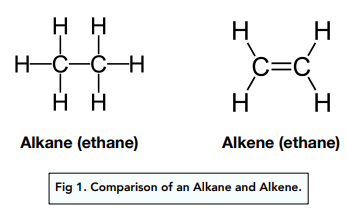 |
front 2 Alkene | back 2 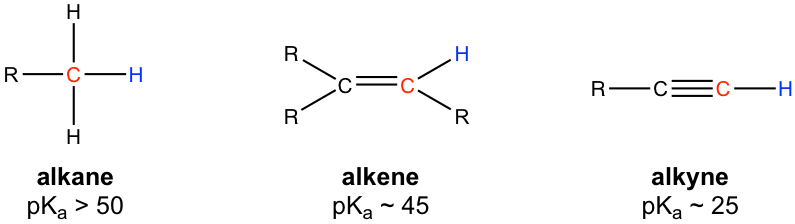 |
front 3 Alkyne | back 3 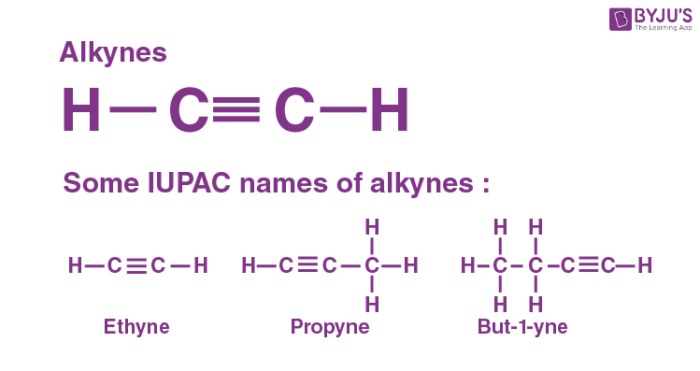 |
front 4 Is ethyne a hydrocarbon? | back 4 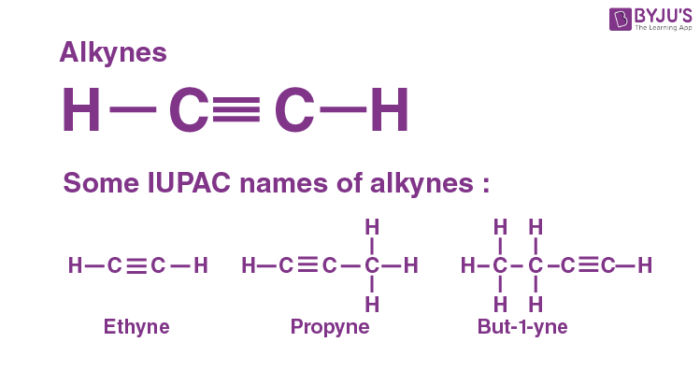 Yes, it is an unsaturated hydrocarbon (triple bond). |
front 5 What is the common name of ethyne? | back 5 Acetylene |
front 6 Are hydrocarbons soluble or insoluble in water? | back 6 Hydrocarbons are insoluble in water because they are nonpolar and water is polar. |
front 7 Will hydrocarbon be in the top or bottom layer? | back 7 They will be the top layer because they are less dense than water. |
front 8 Saturated hydrocarbon | back 8 - Molecules contain only single bonds. - Alkanes. |
front 9 Unsaturated hydrocarbon | back 9 - Have double or triple bonds. - Alkenes and alkynes. |
front 10 Write down the balanced equation for calcium carbide (CaC2) reacting with water to give off ethyne when reacted with water. | back 10 CaC2 + 2H2O -> Ca(OH)2 + C2H2 |
front 11 How many grams of ethyne (molar mass = 26.0 g/mol) would be given off if the limiting reagent in the reaction is calcium carbide (molar mass = 64.1 g/mol) and you start with 2.00 grams of it? | back 11 The equation of the reaction is; CaC2(s) + 2H2O (l) ------> Ca(OH)2(aq) + C2H2(g) We have been told that CaC2 is the limiting reactant. Number of moles of CaC2 = 2g/ 64 g/mol = 0.03 mol If 1 mole of CaC2 yields 1 mole of acetylene 0.03 moles of CaC2 yields 0.03 moles of acetylene Mass of acetylene = number of moles * molar mass Molar mass of acetylene = 26 g/mol Mass of acetylene = 0.03 moles * 26 g/mol Mass of acetylene = 0.78 g of acetylene. |
front 12 Aromatic hydrocarbon | back 12 Cyclic, planar compounds that resemble benzene in electronic configuration and behavior. |
front 13 By which test can you identify if a compound is saturated or unsaturated? | back 13 Bromine test |
front 14 What is a drying agent? | back 14 - A chemical used to remove water from an organic compound that is in solution. - Calcium chloride (CaCl2), Calcium oxide (CaO) |
front 15 A hydrocarbon is saturated if ___ are present. ___ are saturated hydrocarbons. A hydrocarbon is unsaturated if ___ are present. ___ are unsaturated hydrocarbons. | back 15 - only single bonds - Alkanes - any multiple bonds - Alkenes |
front 16 In general, when a hydrocarbon is added to water, the hydrocarbon will ___ the water because hydrocarbons are ___ than water. | back 16 - float above - less dense |
front 17 In general, when hydrocarbons like oil are added to water, the two liquids ___ because hydrocarbons are ___ and water is ___. | back 17 - do not mix - non-polar - polar |
front 18 The bromine test shows the presence of ___. A positive bromine test appears as ___. A negative bromine test appears as ___. | back 18 - alkenes - a colorless solution - an orange solution |
front 19 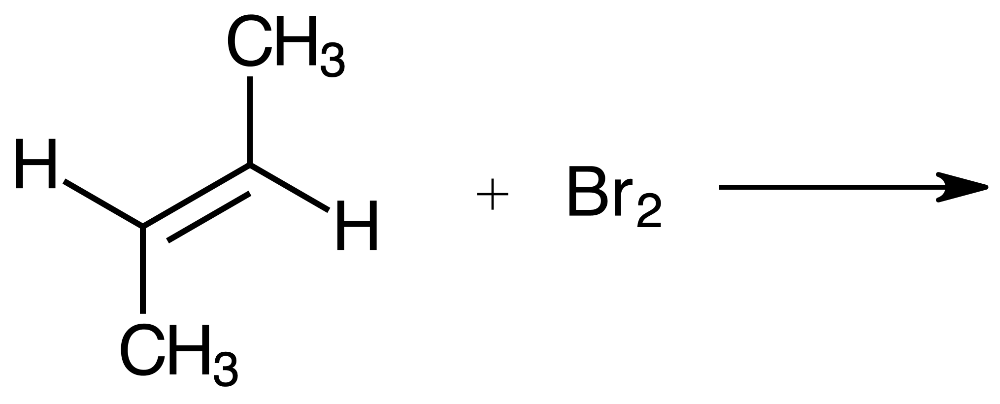 Consider the reaction of bromine with the pictured alkene. Which structure shows the correct bonding for the product? | back 19 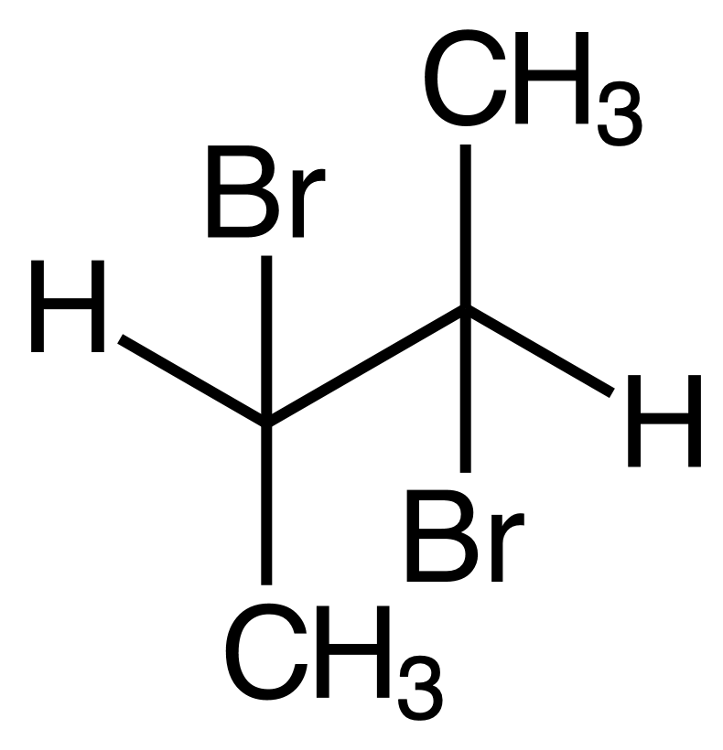 |
front 20 Baeyer's test, also known as the permanganate test, shows the presence of ___. A positive Baeyer's test appears as ___. A negative Baeyer's test appears as ___. | back 20 - alkenes - a brown precipitate - a purple solution |
front 21 The biggest concern of working with hydrocarbons in lab is that many of them are ___. Therefore, hydrocarbons should be handled ___ to contain any associated vapors with that hazard. | back 21 - flammable - in the hood |
front 22 What is a nucleophile? | back 22 Substances that tend to donate electron pairs to electrophiles in order to form chemical bonds with them. |
front 23 What is an electrophile? | back 23 A molecule that is electron deficient and can accept a pair of electrons to make a covalent bond. |
front 24 What do you mean by "back-side" attack in substitution reaction? | back 24 - The nucleophile attacks the electrophilic center on the side that is opposite to the leaving group. When a backside occurs, the stereochemistry of the product doesn't stay the same. - SN2 reaction |
front 25 Protic solvent | back 25 - Protic solvents have an O-H or N-H bonds and can hydrogen-bond with themselves. - Water (H2O), Ammonia (NH3), Ethanol (C2H6O) |
front 26 Aprotic solvent | back 26 - Solvents in which no hydrogen bonding takes place or they neither donate nor accept the proton (hydrogen). - Ex: Acetone (C3H6O), Dichloromethane (CH2Cl2) |
front 27 SN1 reaction | back 27 - A nucleophilic substitution reaction where the rate-determining step is unimolecular. - Commonly occurs with carbonyl compounds as well as benzene. - Solely dependent on substrate concentration, as carbocation formation has a high activation energy barrier, and overcoming this barrier takes time. |
front 28 SN2 reaction | back 28 - Reaction occurs only when the occupied lone pair orbital of the nucleophile donates electrons to the unfilled antibonding orbital between the carbon center and leaving group. - Depends on substrate concentration and nucleophile concentration. - Commonly occurs with alkyl halides and also benzoins. |
front 29 Solvent for SN1 reaction | back 29 - Polar protic - H2O, ROH |
front 30 Solvent for SN2 reaction | back 30 - Polar aprotic - Acetone |
front 31 What is a carbocation? | back 31 A molecule in which a carbon atom has a positive charge and three bonds. |
front 32 How many different types of carbocations are possible? | back 32 - Three different types: primary, secondary, tertiary. |
front 33 Stability of carbocation | back 33 tertiary > secondary > primary |
front 34 Which one best describes the mechanism of Nerolin synthesis? | back 34 SN2 |
front 35 A primary alkyl halide would prefer to undergo ___. | back 35 SN2 |
front 36 A tertiary alkyl halide would prefer to undergo ___. | back 36 SN1 |
front 37 Know which reagent has been used as a nucleophile, electrophile, and base in Nerolin synthesis. | back 37 - Nucleophile: 2-naphtoxide - Electrophile: iodoethane? - Base: potassium hydroxide |
front 38 What is the color of bromothymol blue indicator in acidic and basic condition? | back 38 - Acidic: yellow - Basic: blue |
front 39 SN1 reaction rate depends on | back 39 Substrate only (unimolecular) |
front 40 SN2 reaction rate depends on | back 40 Substrate and nucleophile (bimolecular) |
front 41 SN1 Energy barrier | back 41 Carbocation stability |
front 42 SN2 Energy barrier | back 42 Steric hindrance |
front 43 SN1 Alkyl halide structure (electrophile) | back 43 3° > 2° > 1° |
front 44 SN2 Alkyl halide structure (electrophile) | back 44 1° > 2° > 3° |
front 45 SN1 Nucleophile | back 45 Weak (generally neutral) |
front 46 SN2 Nucleophile | back 46 Strong (generally negatively charged) |
front 47 SN1 Solvent | back 47 Polar protic (ex: water, alcohols which stabilize the resulting (charged) carbocation that results from loss of the leaving group. These also tend to be the nucleophiles for these reactions as well). |
front 48 SN2 Solvent | back 48 Polar aprotic (ex: DMSO, acetone, acetonitrile, or DMG that are polar enough to dissolve the substrate and nucleophile but do not participate in hydrogen bonding with the nucleophile). |
front 49 SN1 Stereochemistry | back 49 Mix of retention and inversion |
front 50 SN2 Stereochemistry | back 50 Inversion only |
front 51 When it is time to end a reflux, first ___ and then turn off the heat. ___ until the system has cooled. | back 51 - lower the heat source - Leave the condenser water on |
front 52 Many reflux procedures involve a required length of time for the reflux to occur. When should you start timing the reflux for the procedure? | back 52 When the reflux ring stabilizes the condenser |
front 53 If crystal growth does not start on its own after the solution in the flask returns to room temperature, identify the best ways to promote this process. | back 53 - Scratch the bottom of flask gently with a stirring rod. - Add a bit of solid as a seed crystal. |
front 54 When working in the fume hood, it is important to make an effort to minimize ___. Only keep items in the hood if they are being used for ___. Do not ___ chemicals in the fume hood unless instructed to do so. | back 54 - clutter - the current experiment - store |
front 55 When working in a fume hood, what is the best position of the hood sash? | back 55 As low as possible, no more than halfway up. |
front 56 An SN2 reaction is a type of ___ in which the nucleophile attacks the electrophile ___ a leaving group leaves. The rate of the reaction depends on the concentration of ___. | back 56 - substitution reaction - at the same time - both reactants |
front 57 Consider the SN2 reaction of an alcohol with an alkyl halide in the presence of base. The ___ should be added to the alcohol first to ___ the alcohol and allow it to attack the ___. | back 57 - base - deprotonate - alkyl halide |
front 58 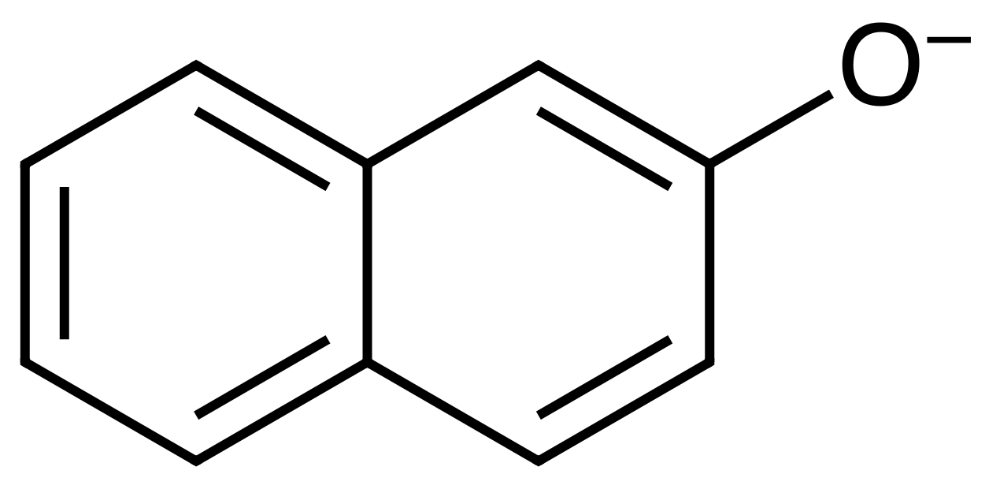 | back 58 Nucleophile |
front 59 KOH | back 59 Base |
front 60 I- | back 60 Leaving group |
front 61 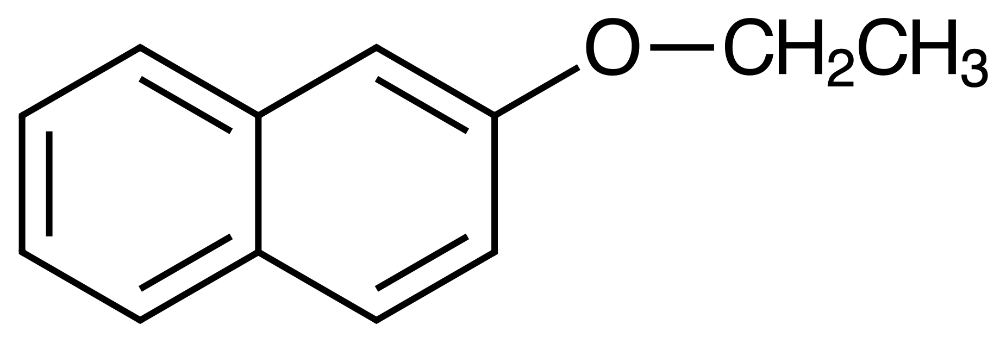 | back 61 Product |
front 62 I-CH2CH3 | back 62 Electrophile |
front 63 Why is potassium hydroxide preferred over sodium hydroxide in organic reactions? | back 63 Potassium hydroxide is more soluble in organic alcohols. |
front 64 The term SN1 describes a reaction that is a ___ involving ___. | back 64 - nucleophilic substitution - one molecule in the rate-determining step |
front 65 The reaction rate is constant regardless of the amount of reactant in solution. | back 65 Zero order |
front 66 An increase in the concentration of the reactant in solution causes the reaction rate to increase exponentially. | back 66 Second order |
front 67 The reaction rate increases in direct propotion to the concentration of the reactant in solution. | back 67 First order |
front 68 Bromothymol blue is an indicator that appears ___ in basic conditions and ___ yellow in acidic conditions. | back 68 - blue - yellow |
front 69 First order reaction | back 69 ln[reactant] vs time |
front 70 Zero order reaction | back 70 [reactant] vs time |
front 71 Second order reaction | back 71 1/[reactant] vs time |
front 72 Suppose you are performing a titration. At the beginning of the titration, you read the titrant volume as 2.59 mL. After running the titration and reaching the endpoint, you read the titrant volume as 26.97 mL. What volume, in mL, of titrant was required for the titration? | back 72 24.38 |
front 73 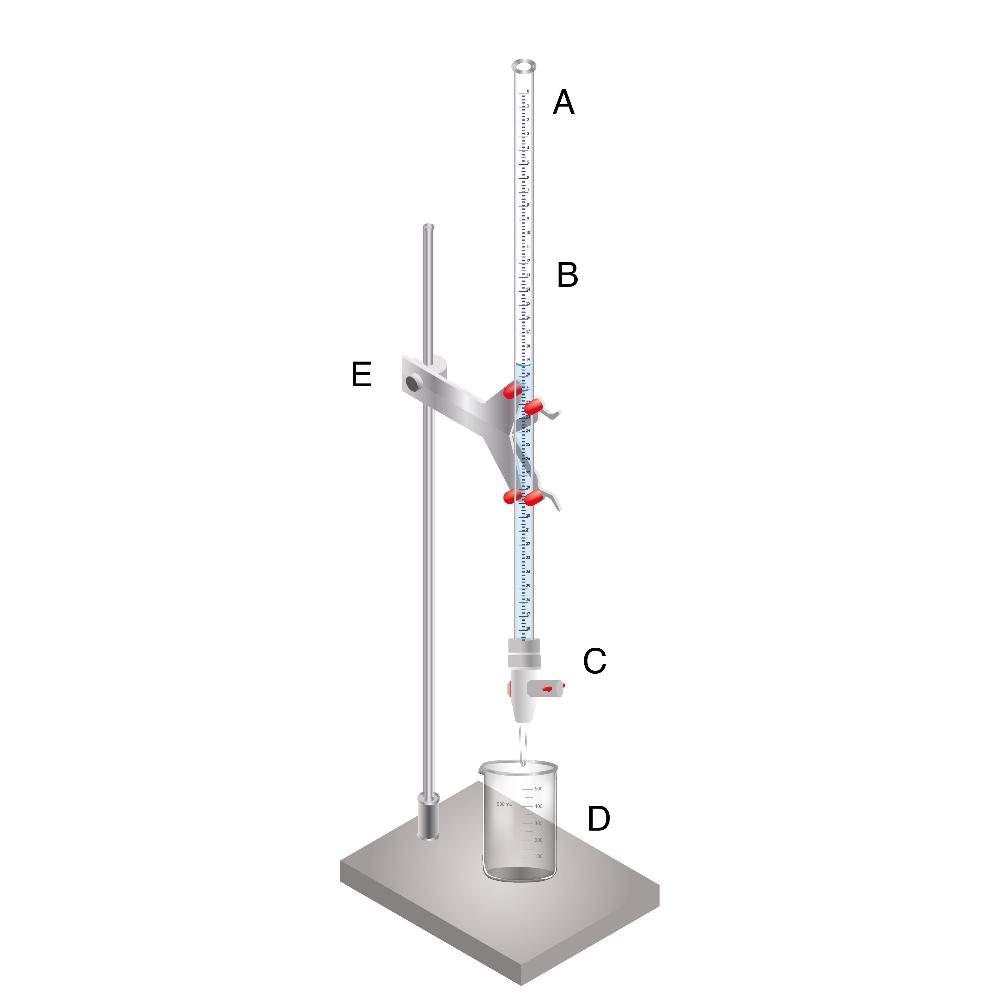 | back 73 A = 0.00 mark B = barrel C = stopcock D = collection flask E = buret clamp |
front 74 Which changes can be made to a chemical reaction in order to increase the rate constant? | back 74 - Increase the temperature - Add a catalyst |
front 75 What is the slowest step of an E1 reaction? How does this relate to an SN1 reaction? | back 75 - Carbocation formation - The energy barrier for SN1 reaction is carbocation stability. |
front 76 Why can more than one product sometimes be formed during an E1 reaction? | back 76 Because of the formation of different carbocation intermediates and different reaction pathways. The stability of the carbocation intermediate and steric hindrance can influence the major and minor products. |
front 77 Which functional group shows a positive bromine test? What will be the color change for the reaction? | back 77 - Alkene, aldehyde - Yellow to neutral |
front 78 What will be the color change if you test unsaturation with KMnO4? | back 78 Purple to brown |
front 79 Know the mechanism for an acid-catalyzed dehydration of alcohol. | back 79 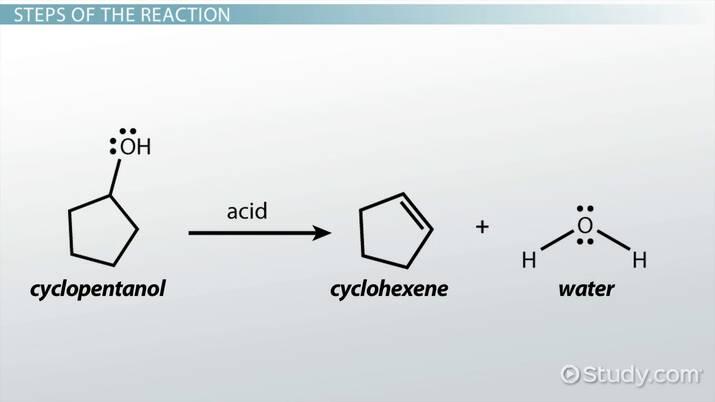 |
front 80 Describe the complete role of the acid catalyst in the dehydration of an alcohol. | back 80 The acid protonates the hydroxyl group and then the conjugate base deprotonates an adjacent carbon. |
front 81 What is the end product of dehydration of cyclohexanol. | back 81 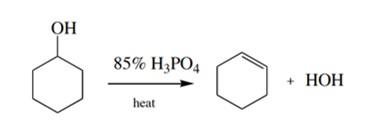 Alkene cyclohexene. |
front 82 Which of the following best describes the mechanism of dehydration of an alcohol? | back 82 E1 |
front 83 Be able to identify the parts of the reflux set-up. | back 83 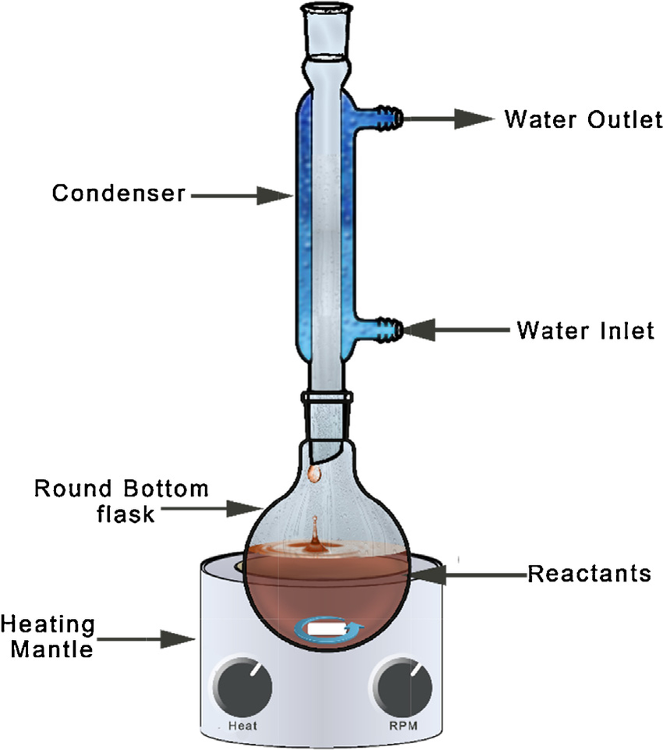 |
front 84 What was the dehydrating agent you have used in dehydration of cyclohexanol reaction? | back 84 Phosphoric acid???? |
front 85 Which statement is not true of nucleophilic substitution reactions? | back 85 Rates of both SN1 and SN2 increase with higher concentration of the nucleophile. |
front 86 Which one of the following alkyl halides will undergo SN1 most readily? | back 86 (CH3)3C-I |
front 87 Which of the following statements is not correct about SN2 reaction of alkyl halides? | back 87 SN2 mechanism is predominant in tertiary alkyl halide |
front 88 Which of the following cannot react as a nucleophile? | back 88 (CH3)4N+ |
front 89 The dehydration of a secondary alcohol, like cyclohexanol, is a mechanism that occurs in ___. First, the alcohol is protonated to ___, creating ___ intermediate. Then, a ___ is removed, moving the electrons from that bond to make a ___ bond. | back 89 - two steps - leave as a water molecule - a cation - hydrogen ion - carbon-carbon double |
front 90 How can a catalyst be recognized in a mechanism? | back 90 The catalyst is used and then regenerated in a later step. |
front 91 In the presence of acid and heat, ___ will undergo a more effective dehydration reaction because it is a ___ alcohol and the ___ in the intermediate of the mechanism will be more stable. | back 91 - cyclohexanol - secondary - cation |
front 92 If the dehydration of an alcohol is successful, what changes would be seen in the IR spectrum for the product compared to the starting material? | back 92 - The disappearance of an O-H band from the starting material - The addition of a C-C double bond band in the product - The disappearance of a C-O band from the starting material |
front 93 Why does the dehydration of an alcohol more often use concentrated sulfuric acid, H2SO4, as the acid catalyst rather than dilute hydrochloric acid, HCl? | back 93 - The additional water solvent from a dilute solution could reverse the dehydration reaction - The presence of the chloride ion could result in a competing substitution reaction |
front 94 When performing the acid-catalyzed dehydration of an alcohol, the yield of product can be increased by ___ during the reaction. Dehydration is ___, and removing the product from ___ reduces the ___ reaction. | back 94 - distilling off the product - reversible - the reaction flask - hydration |
front 95 What are the concerns presented by overheating a distillation to a dry flask? | back 95 - The empty glassware might heat quickly, igniting vapors from the distillation - The remaining solid residue might contain explosive peroxides |
front 96 Where should the tip of the thermometer be placed in a microscale distillation set-up? | back 96 At or slightly below the side arm of the distillation head. |