Instructions for Side by Side Printing
- Print the notecards
- Fold each page in half along the solid vertical line
- Cut out the notecards by cutting along each horizontal dotted line
- Optional: Glue, tape or staple the ends of each notecard together
A&P II Chapter 15 Attendance Quiz 1 - Unit test 1
front 1 Bitter taste is elicited by ________. | back 1 alkaloids |
front 2 Which of the following is true about gustatory receptors? | back 2 Complete adaptation occurs in about one to five minutes. |
front 3 The blind spot of the eye is where ________. | back 3 the optic nerve leaves the eye |
front 4 Which of the follow types of neurons are replaced throughout adult life? | back 4 olfactory receptor cells |
front 5 The first "way station" in the visual pathway from the eye, after there has been partialcrossover of the fibers in the optic chiasma, is the ________. | back 5 lateral geniculate body of the thalamus |
front 6 Seventy percent of all sensory receptors are located in the ________. | back 6 eye |
front 7 Dark adaptation ________. | back 7 involves accumulation of rhodopsin |
front 8 What prevents the eyelids from sticking together when the eyes close? | back 8 tarsal gland secretions |
front 9 Select the correct statement about olfaction. | back 9 Some of the sensation of olfaction is actually one of pain. |
front 10 Taste buds are not found ________. | back 10 in filiform papillae |
front 11 Damage to the medial rectus muscles would probably affect ________. | back 11 convergence |
front 12 An essential part of the maculae involved in static equilibrium is (are) the ________. | back 12 otoliths |
front 13 Which pairing of terms is incorrectly related? | back 13 frequency of sound waves: loudness of the sound |
front 14 The first vestiges of eyes in the embryo are called ________. | back 14 optic vesicles |
front 15 The tarsal plate of the eyelid ________. | back 15 is connected to the levator palpebrae |
front 16 The receptor membranes of gustatory cells are ________. | back 16 gustatory hairs |
front 17 The eye muscle that elevates and turns the eye laterally is the ________. | back 17 inferior oblique |
front 18 Which of the following taste sensations is incorrectly matched to the chemicals that produce it? | back 18 umamitriglycerides and fatty acids |
front 19 Which of the following is not a characteristic of olfactory receptor cells? | back 19 They are unipolar neurons. |
front 20 Which of the following is true about photoreceptors? | back 20 Rods absorb light throughout the visual spectrum but confer only gray tone vision. |
front 21 As sound levels increase in the spiral organ (of Corti), ________. | back 21 outer hair cells stiffen the basilar membrane |
front 22 Information from balance receptors goes directly to the ________. | back 22 brain stem reflex centers |
front 23 Most newborns ________. | back 23 often use only one eye at a time |
front 24 Which statement about malnutrition-induced night blindness is most accurate? | back 24 Vitamin supplements can reverse degenerative changes. |
front 25 What is the main function of the rods in the eye? | back 25 vision in dim light |
front 26 Tinnitus, vertigo, and gradual hearing loss typify the disorder called ________. | back 26 Ménière's syndrome |
front 27 There are three layers of neurons in the retina. The axons of which of these neuron layers form the optic nerves? | back 27 ganglion cells |
front 28 Select the correct statement about equilibrium. | back 28 Cristae respond to angular acceleration and deceleration. |
front 29 Visual processing in the thalamus does not contribute significantly to ________. | back 29 night vision |
front 30 What is a modiolus? | back 30 a bone pillar in the center of the cochlea |
front 31 Visual inputs to the ________ serve to synchronize biorhythms with natural light and dark. | back 31 suprachiasmatic nucleus |
front 32 The only special sense not fully functional at birth is the sense of ________. | back 32 vision |
front 33 Light passes through the following structures in which order? | back 33 cornea, aqueous humor, lens, vitreous humor |
front 34 The oval window is connected directly to which passageway? | back 34 scala vestibuli |
front 35 Which statement about sound localization is not true? | back 35 It requires processing at the cortical level. |
front 36 Farsightedness is more properly called __________. | back 36 hyperopia |
front 37 Conscious perception of vision probably reflects activity in the ____________. | back 37 occipital lobe of the cortex |
front 38 Visible light fits between ____________. | back 38 UV and infrared |
front 39 Which of the following is not a possible cause of conduction deafness? | back 39 cochlear nerve degeneration |
front 40 Olfactory cells and taste buds are normally stimulated by ______________. | back 40 substances in solution |
front 41 Nerve fibers from the medial aspect of each eye ____________. | back 41 cross over to the opposite side at the chiasma |
front 42 The receptor for static equilibrium is the ___________. | back 42 macula |
front 43 The cells of the retina in which action potentials are generated are the ____________. | back 43 ganglion cells |
front 44 Which of the following structures is not part of the eternal ear? | back 44 pharyngotympanic tube |
front 45 Ceruminous glands are _________. | back 45 modified apocrine sweat glands |
front 46 Ordinarily, it is not possible to transplant tissues from one person to another, yet corneas can be transplanted without tissue rejection. This is because the cornea: | back 46 Has no blood supply |
front 47 Receptors for hearing are located in the __________. | back 47 Cochlea |
front 48 Another name for the primary visual cortex is ___________. | back 48 Striate cortex |
front 49 In the visual pathways to the brain, the optic radiations project to the _____________. | back 49 Primary visual cortex |
front 50 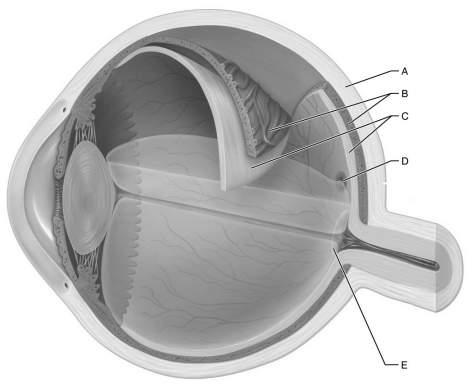 Consists of a pigmented layer and a neural layer. | back 50 C |
front 51 Fluid blockages cause glaucoma. | back 51 D |
front 52 The only tissue in the body that can be transplanted from one person to another with little or no rejection. | back 52 B |
front 53 Blood vessels supply nutrition to all eye layers. | back 53 B |
front 54 Lacks photoreceptors; where optic nerve exits the eye. | back 54 E |
front 55 Acts as a reflexively activated diaphragm to vary pupil size. | back 55 C |
front 56 Holds the retina firmly against the pigmented layer. | back 56 E |
front 57 Contains only cones; provides detailed colored vision. | back 57 D |
front 58 Controls lens shape. | back 58 A |
front 59 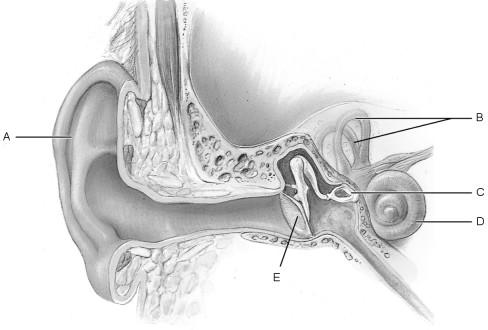 Tympanic membrane. | back 59 E |
front 60 Houses organ of Corti. | back 60 D |
front 61 Cochlea. | back 61 D |
front 62 Semicircular canals. | back 62 B |
front 63 Pinna. | back 63 A |
front 64 Balance organ. | back 64 B |
front 65 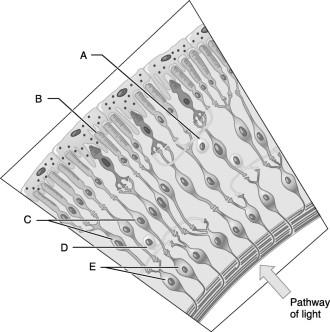 Horizontal cell. | back 65 A |
front 66 Ganglion cells. | back 66 E |
front 67 Amacrine cell. | back 67 D |
front 68 Bipolar cells. | back 68 C |