Instructions for Side by Side Printing
- Print the notecards
- Fold each page in half along the solid vertical line
- Cut out the notecards by cutting along each horizontal dotted line
- Optional: Glue, tape or staple the ends of each notecard together
Final Practice
front 1 A homogeneous mixture is also called a ____________. A) solution B) pure substance C) heterogeneous mixture D) liquid | back 1 A) solution |
front 2 Italian dressing contains olive oil and vinegar, which will separate out from each other if left to sit. This makes the dressing a: A) heterogeneous mixture B) Homogeneous mixture C) Both (A) and (B) D) None of the above+ | back 2 A) heterogeneous mixture |
front 3  Which of the following states of matter is pictured below? | back 3 A) solid |
front 4 Which one of the following is an example of an element? A) brass B) nickel C) bronze D) sterling silver | back 4 B) nickel |
front 5 Which one of the following is an example of a homogenous mixture? A) coffee B) salt C) concrete D) iron | back 5 A) coffee |
front 6 Which one of the following is an example of a heterogenous mixture? A) coffee B) water C) sand D) tap water | back 6 C) sand |
front 7 Which one of the following would be a chemical property of a sample of neon gas? A) It is a gas at room temperature. B) It is inert. C) It is colorless. D) It boils at -246 °C.+ | back 7 B) It is inert. |
front 8 Which one of the following would be a physical property of glucose? A) It is used by the body to generate energy. B) When combined with sulfuric acid it forms carbon. C) In its pure form, it is a white powder. D) It can be fermented to form ethanol.+ | back 8 C) In its pure form, it is a white powder. |
front 9 Which of the following is the first step in the scientific method? A) Hypothesis Formation B) Analysis of Results C) Background Research D) Observation E) Experimentation | back 9 D) Observation |
front 10 Which hypothesis in this list is NOT testable by science? A) The earth is a flat disc. B) Carbon dioxide is a greenhouse gas. C) The boiling point of water increases with increasing elevation. D) The conductivity of saltwater increases with increasing concentration. E) No man is immortal.+ | back 10 E) No man is immortal. |
front 11 If you go mini-golfing, in which of these scenarios are you precise but not accurate? A) You hit all holes in one. B) You take six strokes at each hole. C) It always takes you a long time to get your shots in D) All of your shots are off, but they all go to the same place.+ | back 11 D) All of your shots are off, but they all go to the same place. |
front 12 Which of the following is a physical change? A) An alkaline battery is discharged. B) A lithium-ion battery is recharged. C) Water is boiled in a microwave. D) A car battery is jump-started. E) A pinch of salt is dissolved in water. | back 12 C) Water is boiled in a microwave. |
front 13 The process of fermentation is example of A) a chemical change B) a mixture C) a physical change D) an intensive property | back 13 A) a chemical change |
front 14 Which of the following metric prefixes corresponds to 10³? A) centi- B) kilo- C) mega- D) micro- E) milli- | back 14 B) kilo- |
front 15 Which of the following metric prefixes corresponds to 10⁶? A) centi- B) kilo- C) mega- D) micro- E) milli- | back 15 C) mega- |
front 16 Which of the following metric prefixes corresponds to 10⁻³? A) centi- B) kilo- C) mega- D) micro- E) milli-+ | back 16 E) milli- |
front 17 Which of the following metric prefixes corresponds to 10⁻⁶? A) centi- B) kilo- C) mega- D) micro- E) milli- | back 17 D) micro- |
front 18 How many milliliters are in a liter? | back 18 1000 mL |
front 19 Which of the following quantities is equivalent to 3.7 cm? A) 3.7×10⁻³ m B) 3.7×10⁻⁵ km C) 3.7×10⁻² mm D) 3.7×10⁵ μm E) 3.7×10² mm | back 19 B) 3.7×10⁻⁵ km |
front 20 Which of the following represents an exact quantity? A) There are 2.54 cm in an inch. B) A man is 5 feet 10 inches tall. C) A man weighs 200 lb. D) It takes 15 minutes to drive to the grocery store. E) There are 80 grams of sugar in a serving of soda. | back 20 A) There are 2.54 cm in an inch. |
front 21 Which one of the following is the largest mass? A) 7.6 × 10⁴ mg B) 7.6 × 10 ng C) 7.6 × 10⁻² kg D) 7.6 × 10⁸ μg | back 21 D) 7.6 × 10⁸ μg |
front 22 Which one of the following is the smallest volume? A) 310 mL B) 0.031 dL C) 3.1 L D) 31000 μL | back 22 B) 0.031 dL |
front 23 You have a 100 gram sample of each of the following metals. Which sample has the smallest volume? A) Aluminum, d = 2.7 g/cm³ B) Gold, d = 19.3 g/cm³ C) Iron, d = 7.86 g/cm³ D) Magnesium, d = 1.74 g/cm³ E) Silver, d = 10.5 g/cm³ | back 23 B) Gold, d = 19.3 g/cm³ |
front 24 The density of water is approximately 1 g/cm³. Which of these substances will sink in water? A) Liquid hydrogen, d = 0.070 g/cm³ B) Lithium, d = 0.535 g/cm³ C) Potassium, d = 0.860 g/cm³ D) Polymer resin, d = 1.03 g/cm³+ | back 24 D) Polymer resin, d = 1.03 g/cm³ |
front 25 You have a sample of each of the following five metals, with the mass and density of each sample given. Which sample has the smallest volume? A) Aluminum, mass = 138 g, d = 2.7 g/cm³ B) Copper, mass = 225 g, d = 8.92 g/cm³ C) Iron, mass = 235 g, d = 7.86 g/cm³ D) Magnesium, mass = 105 g, d = 1.74 g/cm³ E) Silver, mass = 215 g, d = 10.5 g/cm³ | back 25 E) Silver, mass = 215 g, d = 10.5 g/cm³ |
front 26 A chemist has a block of aluminum metal (density is 2.7 g/mL). They drop the metal into a graduated cylinder containing water, and find the volume change is 1.5 mL. What is the mass of the block, in grams? | back 26 4.1 g |
front 27 Which one of the following would have the largest mass?A) a cube of tin (d = 5.75 g/cm³) that is 1.80 cm on each side.B) 30.0 mL of water (d = 1.00 g/mL).C) a 24.5 g sample of copper (d = 8.98 g/cm³).D) 4.50 cm³ of silver (d = 10.5 g/cm³). | back 27 4.1 g |
front 28 Which one of the following would have the largest mass? A) a cube of tin (d = 5.75 g/cm³) that is 1.80 cm on each side. B) 30.0 mL of water (d = 1.00 g/mL). C) a 24.5 g sample of copper (d = 8.98 g/cm³). ) 4.50 cm³ of silver (d = 10.5 g/cm³). | back 28 D) 4.50 cm³ of silver (d = 10.5 g/cm³). |
front 29 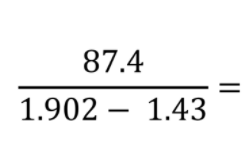 the answer to the calculation below with the correct number of significant figures is A) 190 B) 185 C) 185.2 D) 200 | back 29 A) 190 |
front 30 Which of the following numbers contains four significant figures? A) 1561.0 B) 0.053 C) 0.761 D) 3.101 E) 1400 | back 30 D) 3.101 |
front 31 How many significant figures does the number 23.070 have? | back 31 5 |
front 32 The number 0.01060 has ___ significant figures. | back 32 4 |
front 33 The number 4.0 × 10⁵ has ___ significant figures. | back 33 2 |
front 34 The number 6.11 × 10⁻² when taken out of scientific notation would be A) 0.00611 B) 0.0611 C) 611 D) 6110 | back 34 B) 0.0611 |
front 35 The number 875000 written in scientific notation would be A) 8.75 × 10⁵ B) 8.75 × 10⁻⁴ C) 8.75 × 10⁴ D) 8.75 × 10⁻⁵ | back 35 A) 8.75 × 10⁵ |
front 36 Jamel is to receive Cleocin 275 mg IV for 6.00 hr. The concentration of the solution is 5.00 mg/mL. What is the volume of the solution in milliliters that will need to be delivered? | back 36 55.0 mL |
front 37 Convert 5.32 × 10⁻⁷s to micro seconds. Use only the metric system. | back 37 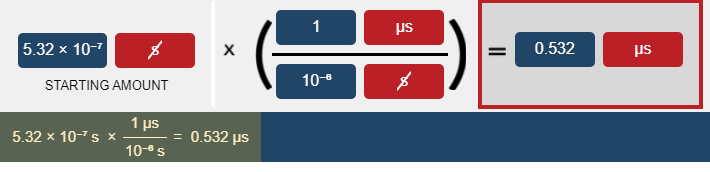 55.0 mL |
front 38 Convert 0.0134 L to milliliters. Use only the metric system. | back 38 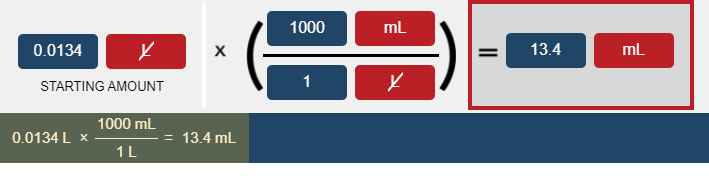 13.4 mL. |
front 39 Convert 2.87 kg to grams. Use only the metric system. | back 39 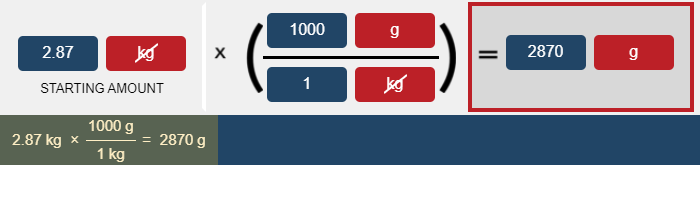 2870 g. |
front 40 A person loses 2.70 lb in two weeks. How many grams did they lose? | back 40 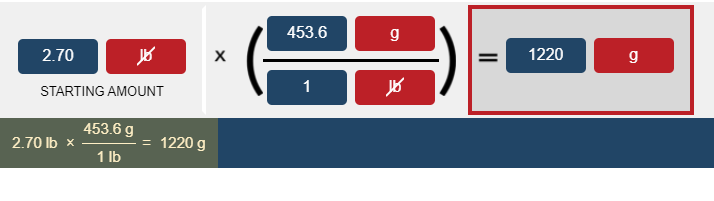 1220 g |
front 41 A race car has a maximum speed of 0.104km/s. What is this speed in miles per hour? | back 41 233 mi / hr. |
front 42 Convert -32.1 °C to K. | back 42 241.1 K |
front 43 Convert -115.1 °C to °F.-175.18 | back 43 -175.2 °F |
front 44 Convert 15.0 inches to meters. (2.54 cm = 1 inch) | back 44 0.381 m |
front 45 Rutherford's gold foil experiment determined that A) neutrons are in the nucleus. B) electrons have a negative charge. C) most of the space in an atom is empty except for a concentrated area called the nucleus. D) protons and neutrons have about the same mass. E) neutrons have no charge. | back 45 C) most of the space in an atom is empty except for a concentrated area called the nucleus. |
front 46 Which has a greater mass? A) Electron B) Proton C) They have equal masses D) Not enough information | back 46 B) Proton |
front 47 Which particle(s) may be found in the nucleus of an atom? A) Proton and electron B) Proton and neutron C) Proton only D) Neutron only E) Neutron and electron | back 47 B) Proton and neutron |
front 48 What is the element symbol for aluminum? A) Au B) Am C) Al D) A E) An | back 48 C) Al |
front 49 What is the element symbol for fluorine? A) Fl B) Fu C) Fi D) F E) Fe | back 49 D) F |
front 50 What is the element symbol for gold?A) Au B) Am C) Al D) A E) An | back 50 A) Au |
front 51 The element symbol for lead is __. A) La B) Le C) Sb D) Lu E) Pb | back 51 E) Pb |
front 52 The symbol Hg represents the element _____ A) hydrogen B) mercury C) helium D) holmium E) seaborgium | back 52 B) mercury |
front 53 What element has the symbol Pb? A) praseodymium B) potassium C) lead D) phosphorus E) polonium | back 53 C) lead |
front 54 Which element has the symbol Sn? A) tin B) scandium C) samarium D) lead E) antimony | back 54 A) tin |
front 55 Which of the following sets of elements and symbols is paired incorrectly? A) iron, Fe B) sodium, S C) tin, Sn D) potassium, K E) copper, Cu | back 55 B) sodium, S |
front 56 A mass spectrometer measures neon to have two masses: 20 and 22 atomic mass units. These are: A) Isotopes B) Ions C) Compounds D) None of the above | back 56 A) Isotopes |
front 57 How many protons are in an atom of Co? | back 57 27 |
front 58 What does the mass number of an atom represent? A) number of neutrons in the atom B) number of protons in the atom C) atomic mass of the element D) total number of electrons and neutrons in the atom E) total number of protons and neutrons in the atom | back 58 E) total number of protons and neutrons in the atom |
front 59 An unknown element X has the following isotopes: ⁵²X (90.00% abundant), ⁴⁹X (8.00% abundant), ⁵⁰X (2.00% abundant). What is the average atomic mass in amu of X? | back 59 51.7 amu |
front 60 There are two naturally occurring isotopes of europium, ¹⁵¹Eu (151.0 amu) and ¹⁵³Eu (153.0 amu). If the atomic mass of Eu is 151.96, what is the approximate natural abundance of ¹⁵¹Eu? A) 20% B) 40% C) 50% D) 60% E) 80% | back 60 C) 50% |
front 61 What is the atomic symbol for the element in Group 5A (15) and the fifth period? A) As B) Sb C) Sn D) Te E) Bi | back 61 B) Sb |
front 62 Which of the following elements is NOT a metal? A) arsenic B) indium C) iridium D) lithium E) lutetium | back 62 A) arsenic |
front 63 Which of the following numbered groups on the periodic table represents the noble gases? A) Group 1 B) Group 2 C) Group 16 D) Group 17 E) Group 18 | back 63 E) Group 18 |
front 64 Determine the number of protons (p) and electrons (e) in N³⁻. A) 10 p, 7 e B) 7 p, 10 e C) 7 p, 7 e D) 7 p, 9 e E) 10 p, 10 e | back 64 B) 7 p, 10 e |
front 65 Which of the following represents a species with 16 protons and 18 electrons? A) Ar B) S C) S²⁻ D) Si⁴⁻ E) S²⁺ | back 65 C) S²⁻ |
front 66 Which of the following is most likely to make a -3 ion? A) Al B) P C) Be D) Se E) Bi | back 66 B) P |
front 67 Predict the chemical formula for the ionic compound formed by Al³⁺ and C₂H₃O₂⁻ | back 67 Al(C₂H₃O₂)₃ |
front 68 Predict the chemical formula for the ionic compound formed by NH₄⁺ and PO₄³⁻ | back 68 (NH₄)₃PO₄ |
front 69 Predict the chemical formula for the ionic compound formed by the elements K and S | back 69 K₂S |
front 70 Classify the following compounds as ionic or covalent: KCl, CrCl₃, Cl₂O. A) Ionic, covalent, covalent. B) Ionic, ionic, covalent. C) Covalent, covalent, ionic. D) Ionic, covalent, ionic. | back 70 B) Ionic, ionic, covalent. |
front 71 Which of the following is best classified as an ionic compound? A) S₄N₄ B) SO₃ C) ZnS D) S₂F₁₀ | back 71 C) ZnS |
front 72 Which of the following compounds does NOT exhibit covalent bonding?A) CO₂ B) CO C) CoCl₂ D) HCOOH E) Na₂CO₃ | back 72 C) CoCl₂ |
front 73 What is the correct IUPAC name for CaS? | back 73 calcium sulfide |
front 74 What is the correct IUPAC name for Mg₃P₂? | back 74 magnesium phosphide |
front 75 What is the correct IUPAC name for Cr₂O₃? | back 75 chromium(III) oxide |
front 76 What is the correct IUPAC name for Cu₂S? | back 76 copper(I) sulfide |
front 77 What is the correct IUPAC name for Mg₃(PO₄)₂? | back 77 magnesium phosphate |
front 78 What is the correct IUPAC name for CuSO₃? | back 78 copper(II) sulfite |
front 79 What is the correct IUPAC name for Sn(CO₃)₂? | back 79 tin(IV) carbonate |
front 80 What is the correct IUPAC name for S₂F₈? | back 80 disulfur octafluoride |
front 81 What is the correct IUPAC name for SeF₂? | back 81 selenium difluoride |
front 82 What is the correct IUPAC name for NI₃? | back 82 nitrogen triiodide |
front 83 Write the chemical formula for the carbonate ion | back 83 CO₃²⁻ |
front 84 Write the chemical formula for the hydrogen phosphate ion | back 84 HPO₄²⁻ |
front 85 Write the chemical formula for the hydroxide ion | back 85 OH⁻ |
front 86 Write the chemical formula for the nitrate ion | back 86 NO₃⁻ |
front 87 Write the chemical formula for the sulfate ion | back 87 SO₄²⁻ |
front 88 Write the chemical formula for aluminum fluoride | back 88 AlF₃ |
front 89 Write the chemical formula for cobalt(II) oxide | back 89 CoO |
front 90 Write the chemical formula for bromine pentachloride | back 90 BrCl₅ |
front 91 Write the chemical formula for diphosphorus pentabromide | back 91 P₂Br₅ |
front 92 What is the correct formula for barium phosphate? A) BaPO₄ B) Ba₂PO₄ C) Ba₂(PO₄)₃ D) Ba₃(PO₄)₂ | back 92 D) Ba₃(PO₄)₂ |
front 93 What is the correct formula for calcium oxide? A) CaO₂ B) CaO C) Ca₂O D) Ca₂O₃ | back 93 B) CaO |
front 94 Which has the correct name-formula combination? A) Barium oxide - BaO B) Lithium nitride - LiN C) Aluminum sulfide - AlS D) Rubidium phosphide - RbP | back 94 A) Barium oxide - BaO |
front 95 What is the value of Avogadro's number? | back 95 6.022 × 10²³ |
front 96 Determine the mass in grams of 3.00 × 10²¹ atoms of arsenic. (The mass of one mole of arsenic is 74.92 g.) | back 96 0.373 g |
front 97 Determine the number of atoms in 51.0 grams of sodium, Na. (The mass of one mole of sodium is 22.99 g.) | back 97 1.34 × 10²⁴ atoms |
front 98 Determine the molar mass of Cr₃(PO₄)₂. | back 98 345.94 g/mol |
front 99 How many atoms of zirconium are in 0.3521mol of ZrSiO₄? | back 99 2.120 × 10²³ atoms Zr. |
front 100 Determine the mass in grams of 1.6 × 10⁻³mol glucose, C₆H₁₂O₆ | back 100 0.29 g C₆H₁₂O₆. |
front 101 How many atoms are in 1.2 mol of carbon? | back 101 7.2 × 10²³ atoms |
front 102 Which of the following represents the generic form of a single-displacement reaction? A) A + BX → AX + B B) AB → A + B C) AX + BY → AY + BX D) A + B → AB | back 102 A) A + BX → AX + B |
front 103 Which of the following represents the generic form of a double-displacement reaction? A) A + B → AB B) A + BX → AX + B C) AX + BY → AY + BX D) AB → A + B | back 103 C) AX + BY → AY + BX |
front 104 What type of reaction is represented by the following equation: C₄H₈(g) + 6O₂(g) → 4CO₂(g) + 4H₂O(g) A) acid-base B) decomposition C) precipitation D) redox (oxidation-reduction) | back 104 D) redox (oxidation-reduction) |
front 105 Balance the following chemical equation (if necessary): BF₃(s)+3Li₂SO₃(s)→LiF(s)+3B₂(SO₃)₃(s) | back 105 2 BF₃(s) + 3 Li₂SO₃(s) → 6 LiF(s) + B₂(SO₃)₃(s) |
front 106 Balance the following chemical equation (if necessary): C₆H₆(l)+O₂(g)→H₂O(g)+CO₂(g) | back 106 2 C₆H₆(l) + 15 O₂(g) → 6 H₂O(g) + 12 CO₂(g) |
front 107 Write a balanced chemical equation based on the following description: aqueous silver nitrate reacts with aqueous nickel(II) chloride to produce solid silver chloride and aqueous nickel(II) nitrate | back 107 2 AgNO₃(aq) + NiCl₂(aq) → 2 AgCl(s) + Ni(NO₃)₂(aq) |
front 108 Write a balanced chemical equation based on the following description: liquid C₇H₈O is burned with oxygen gas to produce gaseous carbon dioxide and water vapor | back 108 2 C₇H₈O(l) + 17 O₂(g) → 14 CO₂(g) + 8 H₂O(g) |
front 109 How many moles of H₂SO₄ are required to completely react with 7.20 mol of Al according to the balanced chemical reaction: 2Al(s)+3H₂SO₄(aq)→Al₂(SO₄)₃(aq)+3H₂(g) | back 109 10.8 mol H₂SO₄. |
front 110 How many moles of MnO₃ are produced when 4.30kg of oxygen gas completely reacts according to the balanced chemical reaction: 2Mn(s)+3O₂(g)→2MnO₃(s) | back 110 89.6 mol MnO₃. |
front 111 How many moles of ammonia would be required to react exactly with 0.470 moles of copper(II) oxide in the following chemical reaction? 2 NH₃(g) + 3 CuO(s) → 3 Cu(s) + N₂(g) + 3 H₂O(g) | back 111 0.313 mol |
front 112 How many grams of NO will be produced from 80.0 g of NO₂ reacted with excess water in the following chemical reaction? 3 NO₂(g) + H₂O(l) → 2 HNO₃(g) + NO(g) A) 17.4 g B) 157 g C) 52.2 g D) 40.9 g | back 112 A) 17.4 g |
front 113 If 8.00 moles of NH₃ of and 10.00 moles of O₂ react in the following reaction, how many moles of which reactant will be left over? 4 NH₃ (g) + 5 O₂ (g) → 4 NO (g) + 6 H₂O (g) A) 2.00 mol O₂ B) 2.00 mol NH₃ C) 8.00 mol NO D) no moles will be left over of either reactant because both are limiting. | back 113 D) no moles will be left over of either reactant because both are limiting |
front 114 If 33.6 g of NO and 26.9 g of O₂ react together, what is the mass in grams of NO₂ that can be formed via the reaction below? 2 NO (g) + O₂ (g) → 2 NO₂ (g) | back 114 51.5 g |
front 115 How many moles of NO₂ would be produced from 4.5 mol of O₂ in the reaction below assuming the reaction has a 57.0% yield? 2 NO (g) + O₂ (g) → 2 NO₂ (g) | back 115 5.1 mol |
front 116 If 50.9 g of aspirin (C₉H₈O₄) are produced from 79.8 g of C₇H₆O₃, what is the percent yield from the reaction below? C₇H₆O₃ (s) + C₄H₆O₃ (s) → C₉H₈O₄ (s) + HC₂H₃O₂ (aq). | back 116 48.9 % |
front 117 In the following reaction, which element in what species is oxidized? C₂H₄ (g) + 3 O₂ (g) → 2 CO₂ (g) + 2 H₂O (g) A) C in C₂H₄ B) H in C₂H₄ C) O in O₂ D) This is not an oxidation/reduction type of reaction. | back 117 A) C in C₂H₄ |
front 118 In the following reaction, which element in what species is reduced? Zn (s) + 2 HCl (aq) → ZnCl₂ (aq) + H₂ (g) A) Zn B) H in HCl C) Cl in HCl D) This is not an oxidation/reduction type of reaction. | back 118 B) H in HCl |
front 119 Convert 2.70 atm to torr | back 119 2050 torr |
front 120 Convert 532 torr to kPa. Remember that multiple steps may be required in the conversion. | back 120 70.9 kPa. |
front 121 The pressure in Denver, Colorado averages about 632mm Hg. How many atmospheres is this? | back 121 0.832 atm. |
front 122 Convert 750.0 torr to atm. | back 122 0.9868 atm |
front 123 How many atm is 23.4 psi? | back 123 1.59 atm |
front 124 If a sealed, rigid container's pressure is doubled, what will happen to temperature? A) The temperature will decrease by a factor of 2 B) The temperature will decrease by a factor of 4 C) The temperature will increase by a factor of 2 D) The temperature will increase by a factor of 4 E) The temperature will remain the same | back 124 C) The temperature will increase by a factor of 2 |
front 125 The gas in a 250.0 mL piston experiences a change in pressure from 1.00 atm to 2.80 atm. What is the new volume (in mL) assuming the moles of gas and temperature are held constant? | back 125 89.3 mL |
front 126 One way to measure temperature in some applications is to monitor the gas pressure in a rigid, closed container. What is the temperature (in °C) of such a vessel, calibrated to read 1.00 atm at STP, if the pressure reads 1.25 atm? | back 126 68.29 °C |
front 127 A weather balloon calibrated at 0.00 °C to have a volume of 20.0 L has what volume in L at -40.0 °C assuming pressure is held constant? | back 127 17.1 L |
front 128 A sample of 2.00 mol of gas in a 10.00 L container is at 45.0 °C. What is the pressure (in atm) of the gas? | back 128 5.22 atm |
front 129 15.0 L of an ideal gas at 298 K and 3.36 atm are heated to 383 K with a new pressure of 6.00 atm. What is the new volume in liters? | back 129 10.8 L |
front 130 Which one of the following is NOT a statement of the Kinetic Molecular Theory? A) Gas particles will be attracted to one another. B) The volume available to the gas particles is equal to the volume of the container. C) The measured pressure is from collisions of the gas particles with the walls of the container. D) The average kinetic energy is proportional to the temperature of the system. | back 130 A) Gas particles will be attracted to one another. |
front 131 Convert 23.4 kJ to calories | back 131 5590 cal. |
front 132 How many J are there in 30.0 kcal? (1 cal = 4.184 J) | back 132 1.26 × 10⁵ J OR 125520 J |
front 133 Which of the following represents an example of kinetic energy? A) a ball at the top of a hill. B) A ball rolling down a hill. C) A ball at the bottom of a hill. | back 133 B) A ball rolling down a hill. |
front 134 An exothermic reaction causes the surroundings to A) warm up B) become acidic C) condense D) decrease in temperature E) release CO₂ | back 134 A) warm up |
front 135 Which one of the following processes is endothermic? A) Boiling a liquid. B) Freezing a solid. C) Condensation of a gas into a liquid. D) Condensation of a gas into a solid. | back 135 A) Boiling a liquid. |
front 136 Which one of the equations below is an endothermic reaction? A) SrO (s) + CO₂ (g) → SrCO₃ (s)∆H° = -234 kJ/mol B) H₂ (g) + F₂ (g) → 2 HF (g) ∆H° = -79.2 kJ/mol C) H₂ (g) + C (s) + N₂ (g) → 2 HCN (g) ∆H° = 270.3 kJ/mol D) 2 K (s) + 2 H₂O (l) → 2 KOH (aq) + H₂ (g) ∆H° = -393.1 kJ/mol | back 136 C) H₂ (g) + C (s) + N₂ (g) → 2 HCN (g) ∆H° = 270.3 kJ/mol |
front 137 Which one of the equations below is an exothermic reaction? A) CO₂ (g) → C (s) + O₂ (g) ∆H° = 394 kJ/mol B) CaO (s) + H₂O (l) → Ca(OH)₂ (aq) ∆H° = -64 kJ/mol C) C (s) + 2 F₂ (g) → CF₄ (g) ∆H° = 141.3 kJ/mol D) N₂ (g) + O₂ (g) → 2 NO (g) ∆H° = 180.6 kJ/mol | back 137 B) CaO (s) + H₂O (l) → Ca(OH)₂ (aq) ∆H° = -64 kJ/mol |
front 138 How much heat (in kJ) will be absorbed by a 50.3 g piece of aluminum (specific heat = 0.930 J/g・°C) as it changes temperature from 23.0°C to 67.0°C? | back 138 2.06 kJ |
front 139 What is the specific heat of a 75.01 g piece of an unknown metal that exhibits a 45.2°C temperature change upon absorbing 1870 J of heat? | back 139 0.552 J/g・°C |
front 140 In a multi-electron atom, which orbital will have the highest energy?A) 4s B) 4p C) 4d D) 4f E) All are equal | back 140 D) 4f |
front 141 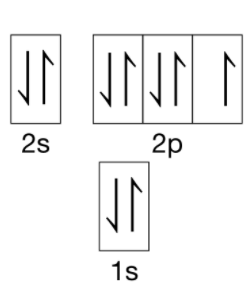 What element is designated by the orbital diagram below? A) N B) O C) F D) Ne E) Cl | back 141 C) F |
front 142 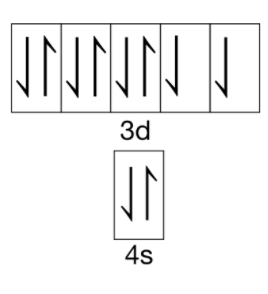 What element is designated by the orbital diagram below? (Note that core electrons are not shown.) A) Co B) Ni C) Fe D) Cu E) Zn | back 142 B) Ni |
front 143 The ground state electron configuration of a Se atom is A) 1s²2s²2p⁶3s²3p⁶4s²4p⁴ B) 1s²2s²2p⁶3s²3p⁶4s²4d¹⁰4p⁴ C) 1s²2s²2p⁶3s²3p⁶4s²3d¹⁰4p⁴ D) 1s²2s²2p⁶3s²3p⁴ E) 1s²2s²2p⁶3s²3p⁶4s²3d¹⁰4p³ | back 143 C) 1s²2s²2p⁶3s²3p⁶4s²3d¹⁰4p⁴ |
front 144 Which element has the electron configuration 1s²2s²2p⁶3s²3p⁶4s²3d¹⁰4p²? A) Si B) Ge C) Sn D) Ga E) As | back 144 B) Ge |
front 145 What is the noble gas electron configuration of Ca? A) [Ne]4s² B) [Ne]3s² C) [Ar]4s¹ D) [Ar]4s² E) 4s² | back 145 D) [Ar]4s² |
front 146 Which element has the ground state electron configuration [Kr]5s²4d¹⁰5p³? A) Te B) Pb C) Sb D) Bi E) Sn | back 146 C) Sb |
front 147 Elements that are most similar in their properties are found _____ A) in the same period. B) in the same group. C) have the same electron configurations. D) to occur randomly throughout the table. E) diametrically opposite each other on the periodic table. | back 147 B) in the same group. |
front 148 Which element resides in the third period under group 4A (14) of the periodic table? A) Ge B) Si C) Al D) Sc E) P | back 148 B) Si |
front 149 Which of the following groups of elements tend to form cations? A) Metals B) Metalloids C) Nonmetals D) Noble gases E) Radioactive elements | back 149 A) Metals |
front 150 Which of the following atom(s) below has/have five valence electrons? A) C B) N C) O D) F E) All of the above | back 150 B) N |
front 151 Which of the following atom(s) below has/have five valence electrons? A) C B) N C) O D) F E) All of the above | back 151 B) N |
front 152 Which periodic trend quantifies the amount of energy required to remove an electron from a neutral, gaseous atom? A) Atomic Radius B) Ionization Energy C) Ionic Radius D) Electron Affinity E) Electronegativity | back 152 B) Ionization Energy |
front 153 Which of the following transition metals would be expected to have the smallest atomic radius? A) Yttrium (Y) B) Zirconium (Zr) C) Niobium (Nb) D) Technetium (Tc) E) Ruthenium (Ru) | back 153 E) Ruthenium (Ru) |
front 154 Rank the following atoms in order of increasing first ionization energies (i.e., lowest to highest): Rb, F, Mg, B, N. A) F < N < B < Mg < Rb B) Rb < Mg < F < N < B C) Mg < Rb < F < N < B D) Rb < Mg < B < N < FE) Rb > B > N > F > Mg | back 154 D) Rb < Mg < B < N < F |
front 155 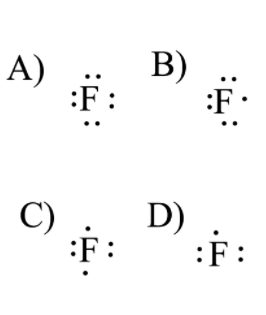 Which of the following is the correct Lewis symbol for a neutral atom of F?A) see problem image B) see problem image C) see problem image D) see problem image | back 155 B) see problem image |
front 156 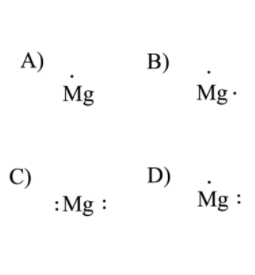 Which of the following is the correct Lewis symbol for a neutral atom of Mg? A) see problem image B) see problem image C) see problem image D) see problem image | back 156 B) see problem image |
front 157 Which of the following is an example of an ionic bond? A) K - F B) C - H C) Kr - H D) C - F | back 157 A) K - F |
front 158 Which of the following is an example of a covalent bond? A) K - Cl B) Al - Cl C) H - Cl D) Al - Al | back 158 C) H - Cl |
front 159 Which one of the following is the most electronegative atom? A) C B) N C) O D) F | back 159 D) F |
front 160 Which one of the following statements is FALSE? A) Ionic bonding results from the transfer of electrons from one atom to another B) Dipole moments result from the unequal distribution of electrons in a molecule C) The electrons in a polar bond are found nearer to the more electronegative element D) A molecule with very polar bonds can be nonpolar E) Linear molecules cannot have a net dipole moment | back 160 E) Linear molecules cannot have a net dipole moment |
front 161 Which of the following bonds is a nonpolar covalent bond? A) H - F B) N - F C) F - Cl D) F - F | back 161 D) F - F |
front 162 Based on their positions in the periodic table, which of the following bonds is the most polar? A) O - F B) C - F C) B - F D) F - F | back 162 C) B - F |
front 163 Which of the following is the strongest type of bond? A) a single bond B) a double bond C) a triple bond | back 163 C) a triple bond |
front 164 Draw the Lewis structure of CS₂ and then determine the number of nonbonding electron pairs on the central atom. | back 164 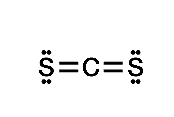 A) 0 |
front 165 Draw the Lewis structure of PF₃ and then determine the number of nonbonding electron pairs on the central atom. A) 0 B) 1 C) 2 D) 4 E) 6 | back 165 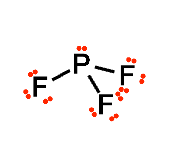 B) 1 |
front 166 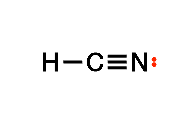 Determine the number of valence electrons in HCN and then draw the corresponding Lewis structure. A) 13 B) 12 C) 10 D) 9 E) 7 | back 166 C) 10 |
front 167 The Lewis structure for acetic acid (CH₃COOH) shown below is incorrect. Starting from this structure, complete the correct structure. | back 167 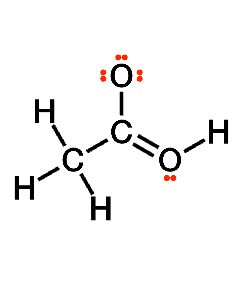 |
front 168 Determine the number of valence electrons in ethanol (C₂H₅OH) and then draw the corresponding Lewis structure. A) 24 B) 22 C) 17 D) 20 E) 23 | back 168 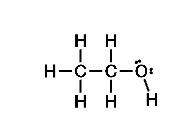 D) 20 |
front 169 What is the correct molecular geometry of NH₃ according to Valence Shell Electron Pair Repulsion Theory? A) trigonal planar B) trigonal pyramidal (pyramidal) C) bent D) tetrahedral | back 169 B) trigonal pyramidal (pyramidal) |
front 170 Draw the Lewis structure of CBr₄ and then determine its electron domain and molecular geometries. A) trigonal / planar B) linear / trigonal pyramidal C) tetrahedral / tetrahedral D) planar / trigonalE) planar / tetrahedral+ | back 170 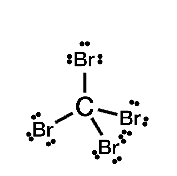 C) tetrahedral / tetrahedral |
front 171 Draw the Lewis structure of H₂CS and then determine its electron domain and molecular geometries. A) planar / tetrahedral B) trigonal planar / linear C) trigonal / trigonal planar D) trigonal planar / trigonal planar E) planar / planar | back 171 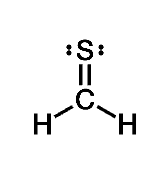 D) trigonal planar / trigonal planar |
front 172 Which of the following bonds is the most polar? A) P - S B) C - Cl C) F - F D) Rb - Br E) All bonds have equal polarity. | back 172 D) Rb - Br |
front 173 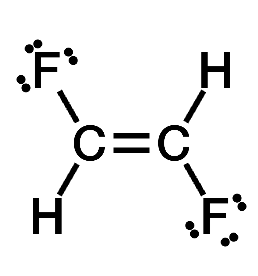 A Lewis structure for a different isomer C₂H₂F₂ is shown below. Based on this structure, determine if the molecule is polar or nonpolar. A) Nonpolar B) Polar | back 173 A) Nonpolar |
front 174 Draw the Lewis structure of carbon dioxide (CO₂) and then determine if the molecule is polar or nonpolar. A) Nonpolar B) Polar | back 174 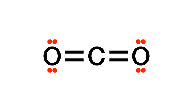 A) Nonpolar |
front 175 The predominant intermolecular force between molecules of I₂ is _____ A) ionic bonds. B) dipole-dipole interactions. C) ion-dipole interactions. D) dispersion forces. E) covalent bonds. | back 175 D) dispersion forces. |
front 176 Which of the following would exhibit hydrogen bonding in a pure substance? A) HCl B) CH₃CH₃ C) CF₂H₂ D) CH₃CH₂OH E) CH₃OCH₃ | back 176 D) CH₃CH₂OH |
front 177 Which of the following exhibits dipole-dipole intermolecular forces in a pure substance? A) BF₃ B) CO₂ C) NH₃ D) Br₂ E) CF₄ | back 177 C) NH₃ |
front 178 Which of the following represents the intermolecular forces present in CO₂? A) dispersion only B) dipole-dipole only C) hydrogen bonding only D) dispersion and dipole-dipole E) dispersion and hydrogen bonding | back 178 A) dispersion only |
front 179 Ammonia and hydrogen fluoride both have unusually high boiling points due to _____ A) dispersion forces. B) dipole-dipole interactions. C) hydrogen bonding. D) ion-dipole interactions. E) low molar masses. | back 179 C) hydrogen bonding. |
front 180 Which of the following phase changes is endothermic? A) Sublimation B) Deposition C) Freezing D) Condensation | back 180 A) Sublimation |
front 181 Which of the following has the greatest mass? A) α particle B) neutron C) proton D) β⁻ particle E) neutrino | back 181 A) α particle |
front 182 The equation below is best described as ___________. ²³⁵₉₂U → ²³⁵₉₃Np + ⁰₋₁e A) alpha decay. B) beta decay. C) gamma emission. D) positron emission. | back 182 B) beta decay. |
front 183 Which of the following symbols represents an alpha particle? A) ⁰₊₁e B) ⁰₋₁e C) ⁴₂He D) γ | back 183 C) ⁴₂He |
front 184 What is the product of alpha emission from uranium-238? A) ²³⁴U B) ²³²Th C) ²³⁴Th D) ²³⁷Np E) ²³¹Pa | back 184 C) ²³⁴Th |
front 185 Complete the following nuclear decay process: ²³⁵₉₂U → ⁴₂He + ___ A) ²³⁹₉₄Pu B) ²³¹₉₄Pu C) ²³¹₉₂U D) ²³¹₉₀Th E) ²³⁹₉₀Th | back 185 D) ²³¹₉₀Th |
front 186 ²³⁵U undergoes fission by one neutron to produce ¹³³Sb, three neutrons, and what other nuclide? A) ¹⁰⁰Zr B) ¹⁰⁰Nb C) ¹⁰¹Nb D) ¹⁰⁰Mo E) ¹⁰²Mo | back 186 B) ¹⁰⁰Nb |
front 187 When two He atoms undergo fusion in a star, the resulting element is: A) H B) Li C) Be D) He E) All of the above | back 187 C) Be |
front 188 Assuming only one product forms, what nuclide is produced from the fusion reaction between ³H and ⁴He?A) ⁷He B) ⁷N C) ⁷Li D) ³N E) ³Li | back 188 C) ⁷Li |
front 189 The process that powers stars is A) fission B) fusion C) neutron emission D) gamma ray emission E) alpha particle emission | back 189 B) fusion |