Instructions for Side by Side Printing
- Print the notecards
- Fold each page in half along the solid vertical line
- Cut out the notecards by cutting along each horizontal dotted line
- Optional: Glue, tape or staple the ends of each notecard together
Chapter 3: Alignment and Occlusion of the Dentition
front 1 The major opposing forces that influence tooth position originate from the (...). | back 1 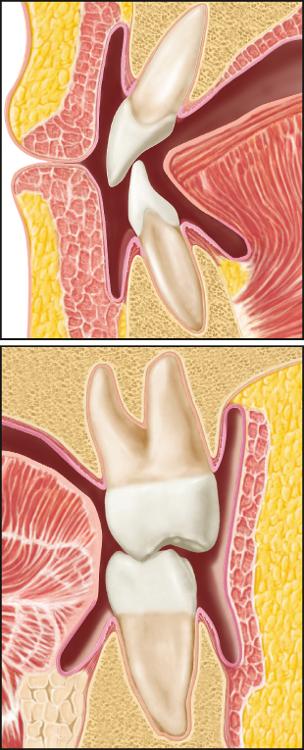 surrounding musculature |
front 2 If the tongue is either unusually active or large, it can displace the neutral space (...), resulting in (...) of the anterior teeth which presents clinically as (...). | back 2 labially; labial flaring; anterior openbite |
front 3 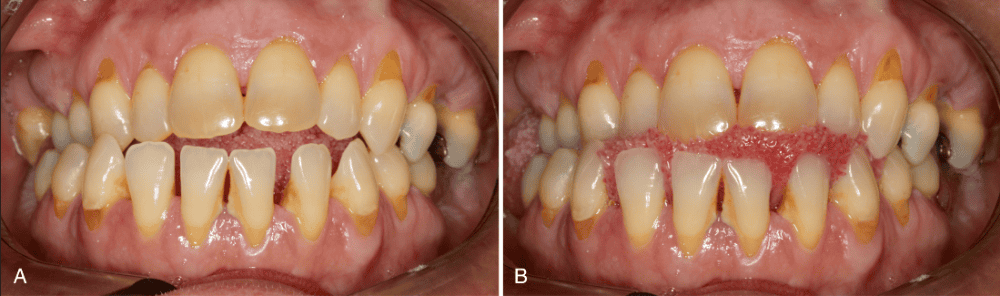 This patient presents with labial flaring of the anterior teeth due to excessive labially directed forces produced by the tongue when swallowing.
| back 3 (c) The statement is true, but the reason is false. The anterior teeth are displaced labially by the constant resting or posturing position of the tongue, not the actual activity of swallowing; the tongue thrusting forward during a swallow is more likely associated with the patient’s attempt to seal the mouth, which is necessary for efficient swallowing. |
front 4 The tooth position in the oral cavity where the labiolingual and buccolingual forces are equal. | back 4 neutral space |
front 5 (...) between adjacent teeth helps maintain the teeth in normal alignment. | back 5 proximal contact |
front 6 If proximal contact is lost, the adjacent tooth will (...) to restore it. | back 6 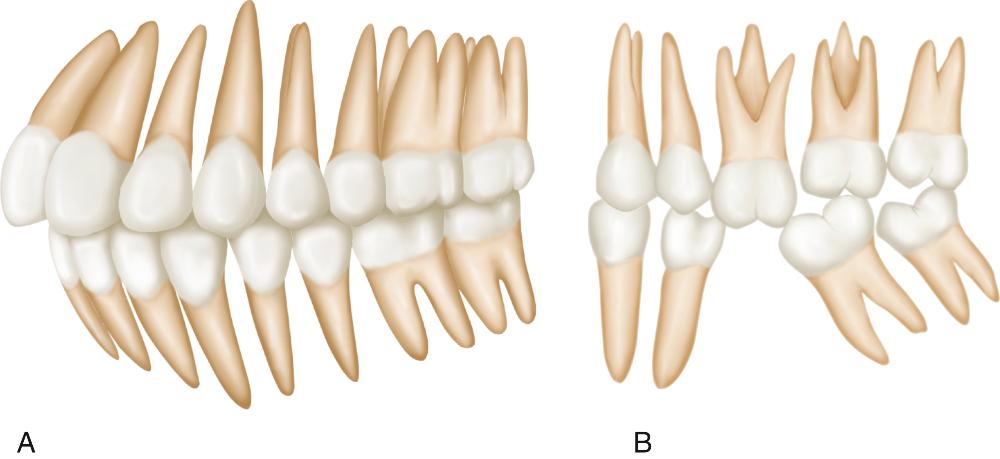 drift mesially |
front 7 Another important factor that helps to stabilize tooth alignment is (...), which prevents the extrusion or supereruption of teeth. | back 7 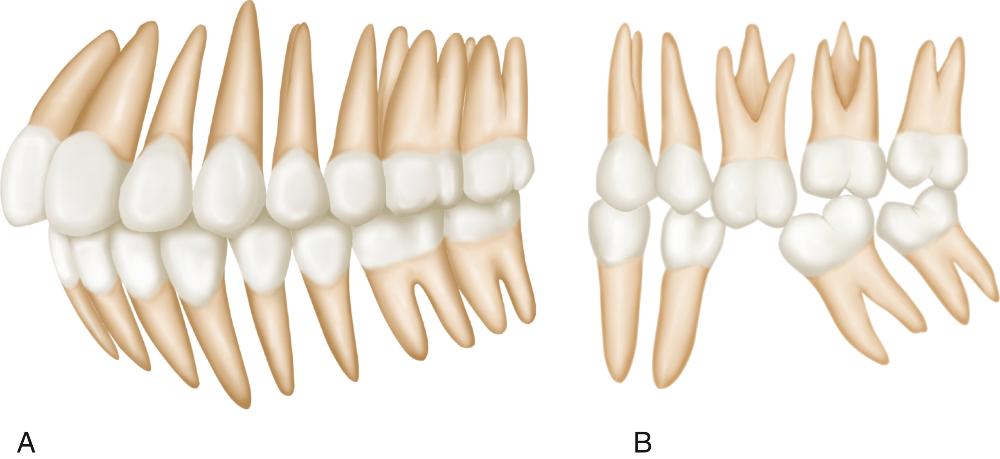 occlusal contact |
front 8 If occlusal contact is lost, the opposing tooth will (...) to restore it. | back 8 super erupt |
front 9 Refers to the relationship of the teeth to each other within the dental arch. | back 9 intraarch tooth alignment |
front 10 The plane that would be established if a line were drawn through all the buccal cusp tips, lingual cusp tips, and incisal edges of the mandibular teeth. | back 10 plane of occlusion |
front 11 The occlusal planes of the dental arches are curved in a manner that permits (...) during function. | back 11 maximum utilization of tooth contacts |
front 12 When examining the arches from the lateral view, the mesiodistal axial relationship can be seen. In the mandibular arch both the anterior and the posterior teeth are inclined (...). | back 12 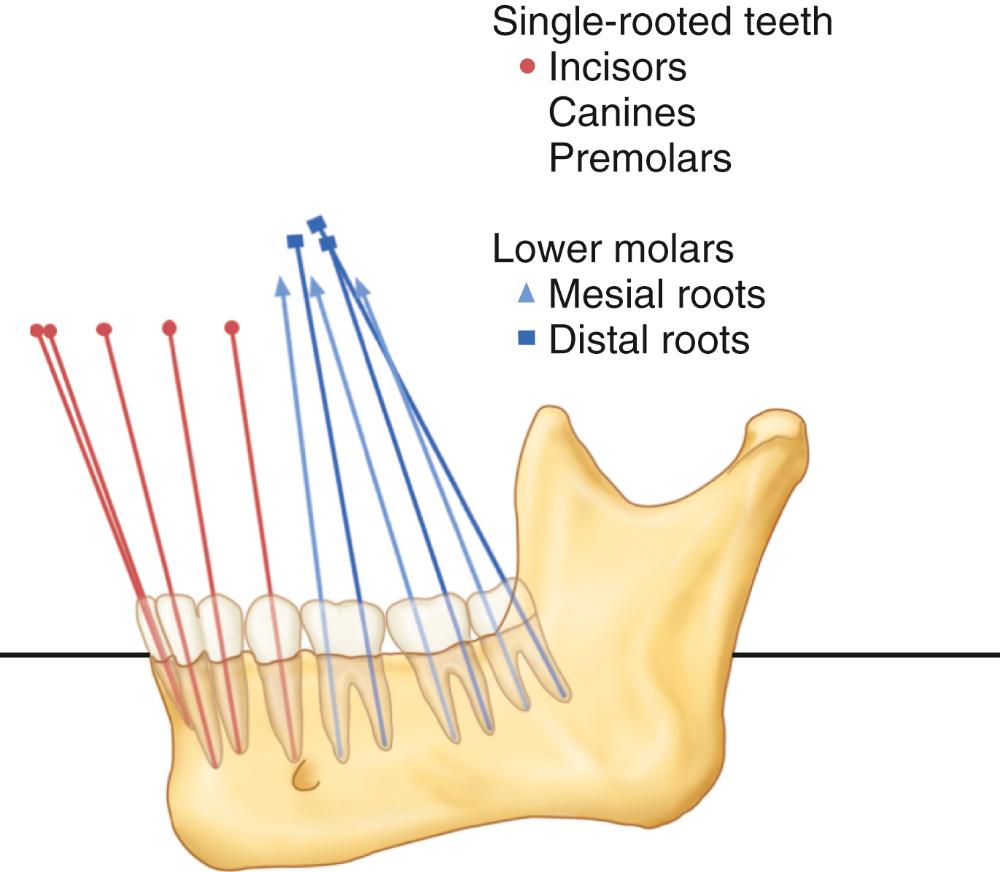 mesially |
front 13 When examining the arches from the lateral view, the mesiodistal axial relationship can be seen. In the maxillary arch, the anterior teeth are inclined (...), while the most posterior molars are inclined (...). | back 13 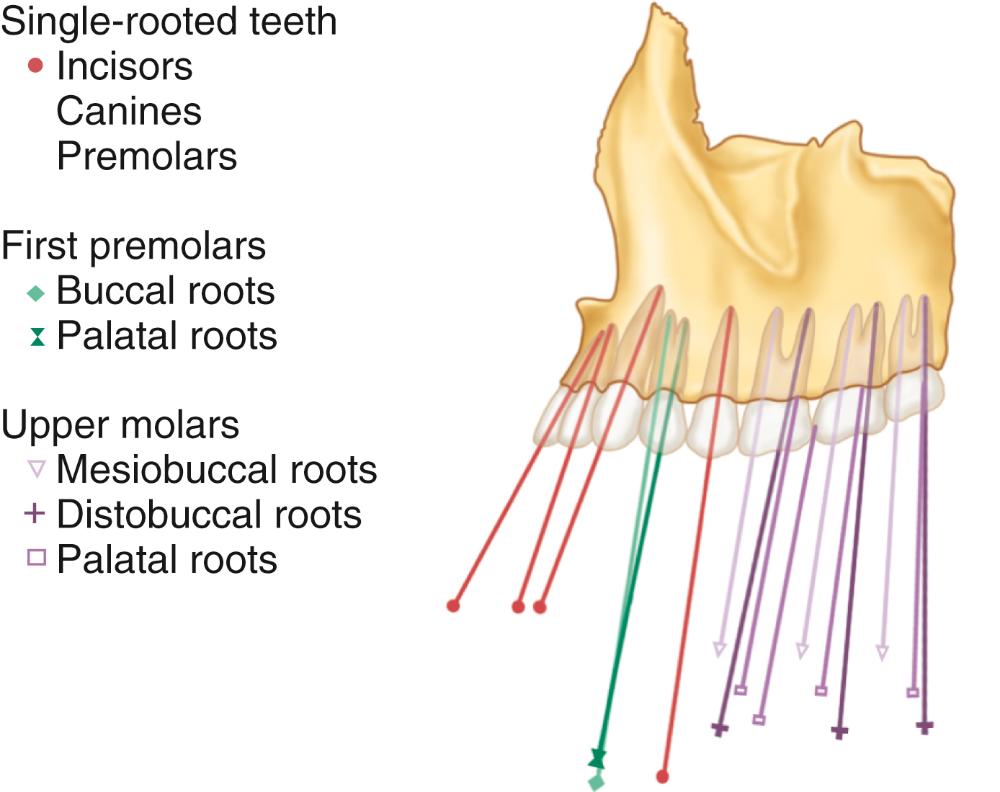 mesially; distally |
front 14 The curved line following the plane of occlusion from the lateral view, which is convex for the maxillary arch and concave for the mandibular arch. | back 14 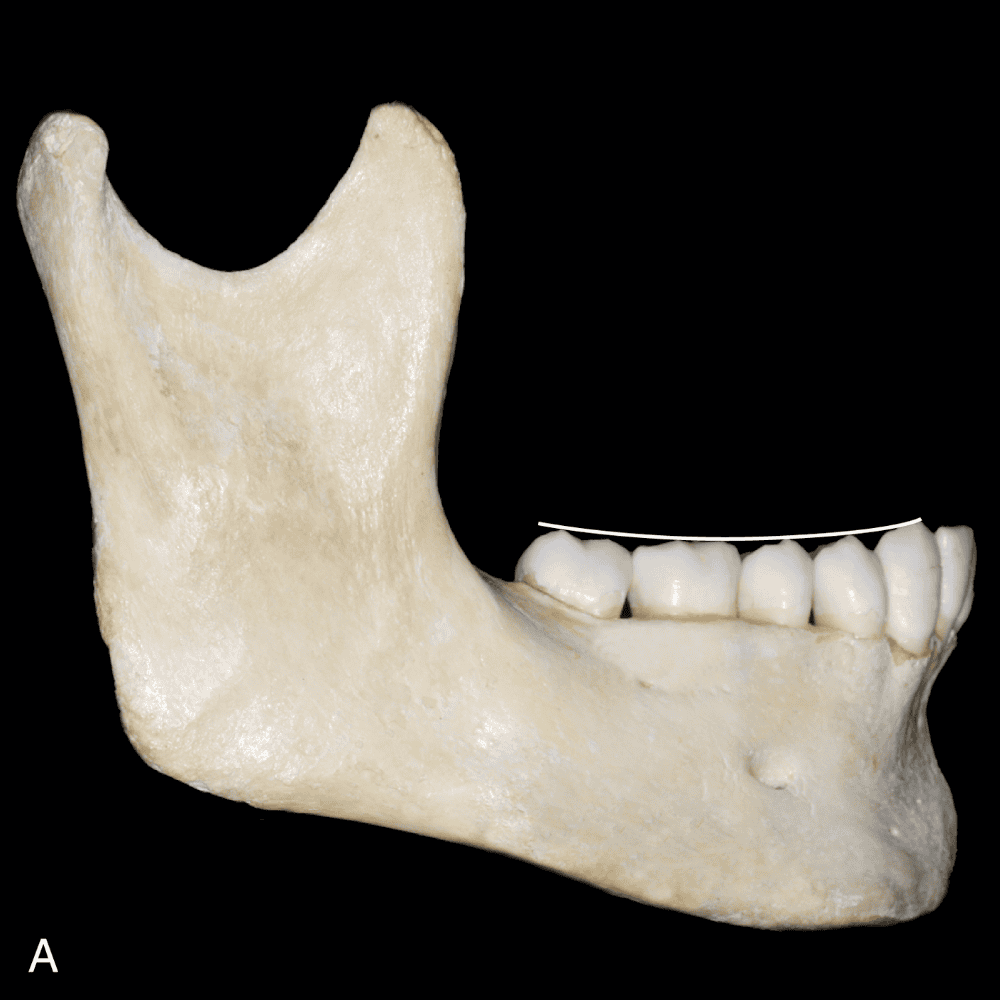 curve of Spee |
front 15 When observing the dental arches from the frontal view, the buccolingual axial relationship can be seen. In the maxillary arch, the posterior teeth have a slight (...) inclination. | back 15 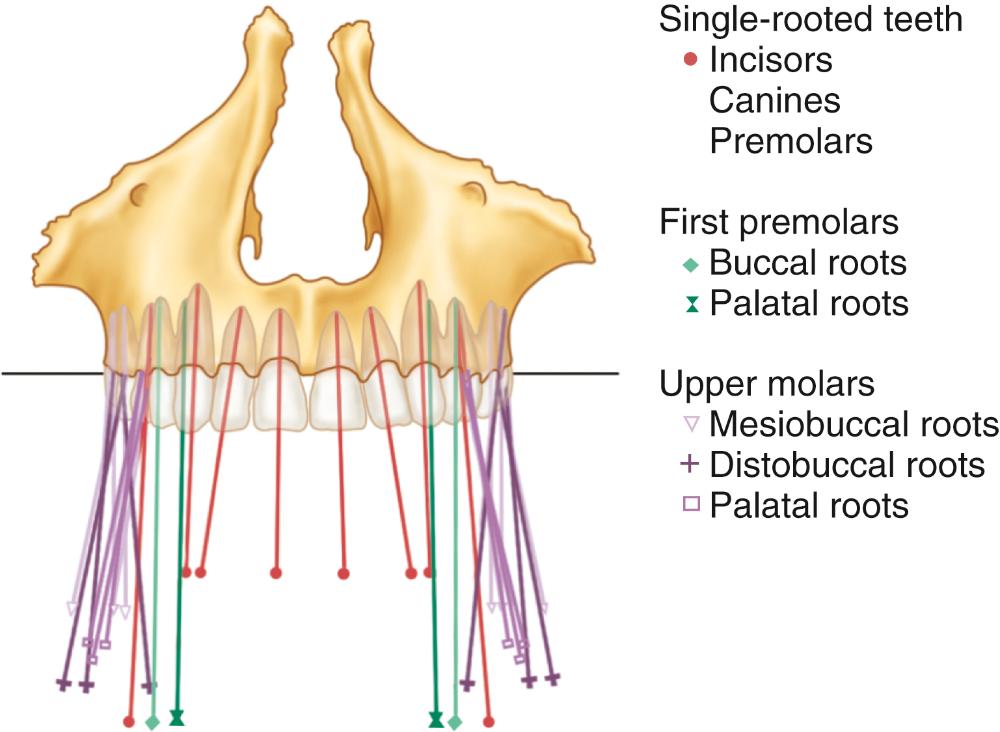 buccal |
front 16 When observing the dental arches from the frontal view, the buccolingual axial relationship can be seen. In the mandibular arch, the posterior teeth have a slight (...) inclination. | back 16 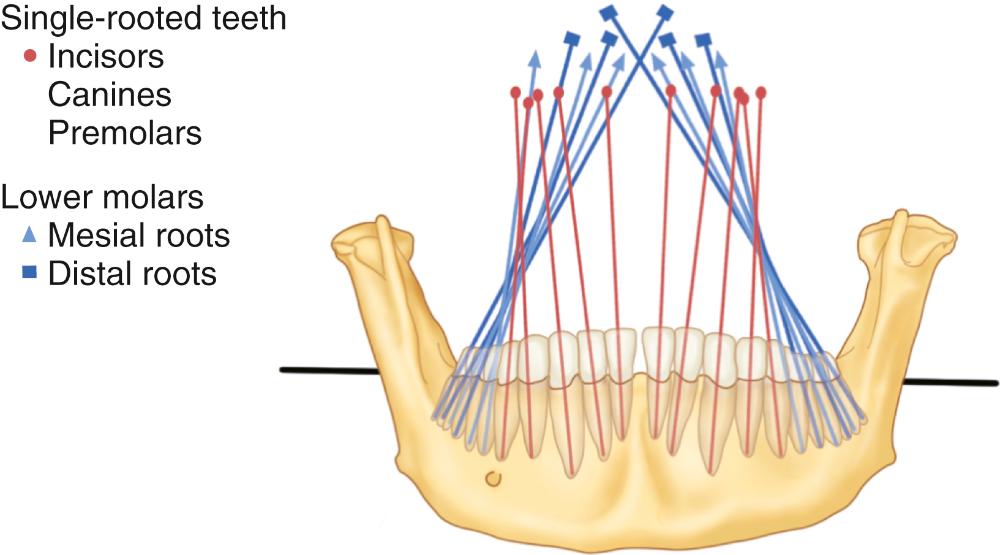 lingual |
front 17 The curved line following the plane of occlusion from the frontal view, which is convex for the maxillary arch and concave for the mandibular arch. | back 17 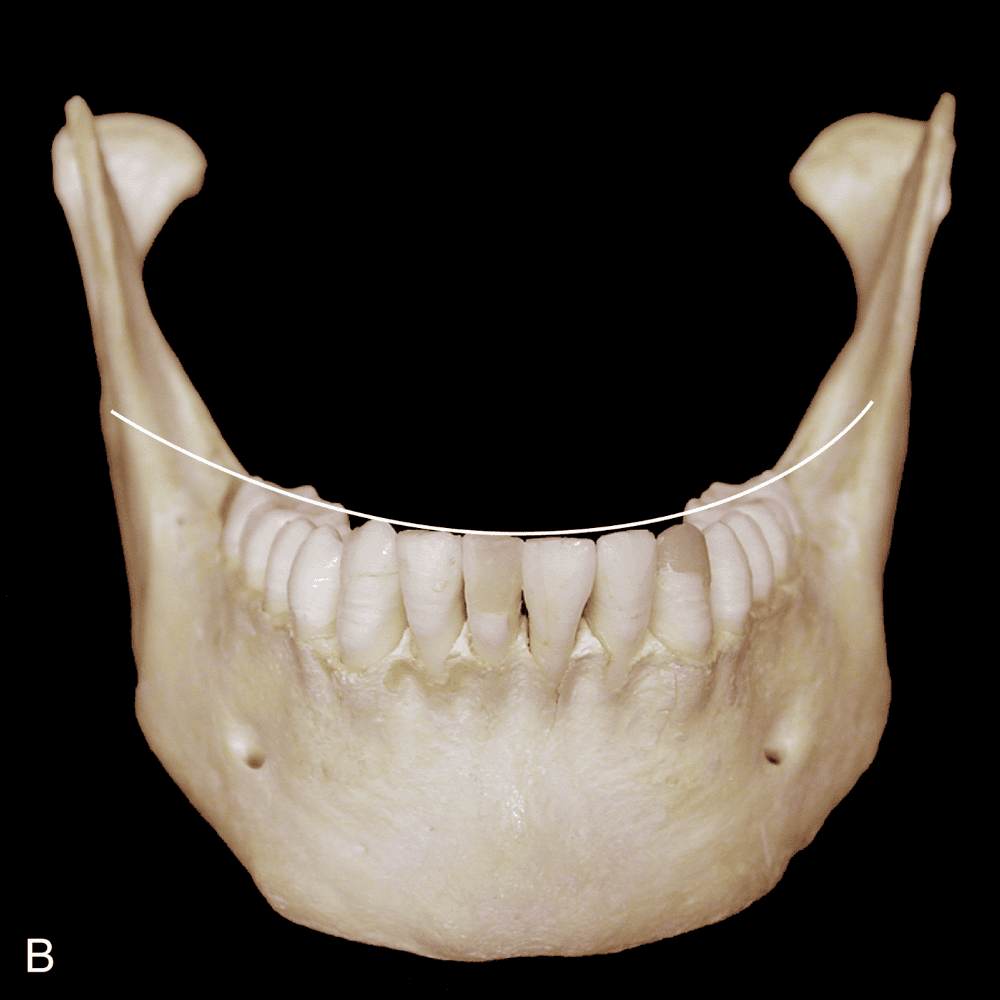 curve of Wilson |
front 18 Bonwill, one of the first to describe the dental arches, noted that an equilateral triangle with 4-inch sides existed between the (...) and the (...). | back 18 centers of the condyles; mesial contact areas of the mandibular central incisors |
front 19 In 1932, Monson utilized Bonwill’s triangle and proposed a theory that a sphere existed with a radius of 4 inches whose center was an equal distance from the (...) and from the (...). | back 19 occlusal surfaces of the posterior teeth; centers of the condyles |
front 20 The area of the tooth between the buccal and lingual cusp tips of the posterior teeth, where the major forces of mastication are applied. | back 20 occlusal table |
front 21 The occlusal table represents approximately (...)% of the total buccolingual dimension of the posterior tooth and is positioned over the (...). | back 21 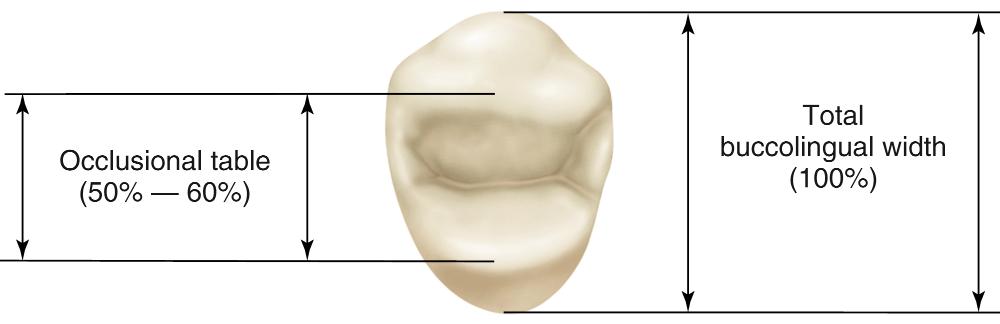 50% to 60%; long axis of the root structure |
front 22 The occlusal table is considered the (...) of the tooth, since it falls between the cusp tips. Likewise, the occlusal area outside the cusp tips is called the (...). | back 22 inner aspect; outer aspects |
front 23 The inner aspects of the tooth that extend from the cusp tips to the central fossa areas are called the (...), while the outer aspects of the tooth that extend from the cusp tips to height of the contour are called the (...). | back 23 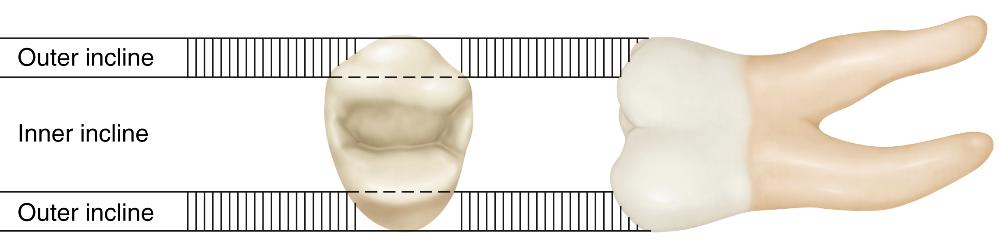 inner inclines; outer inclines |
front 24 Tooth inclines are also identified with respect to the surface toward which they are directed. (...) inclines are those that face the mesial portion of the tooth, while (...) inclines are those that face the distal portion. | back 24 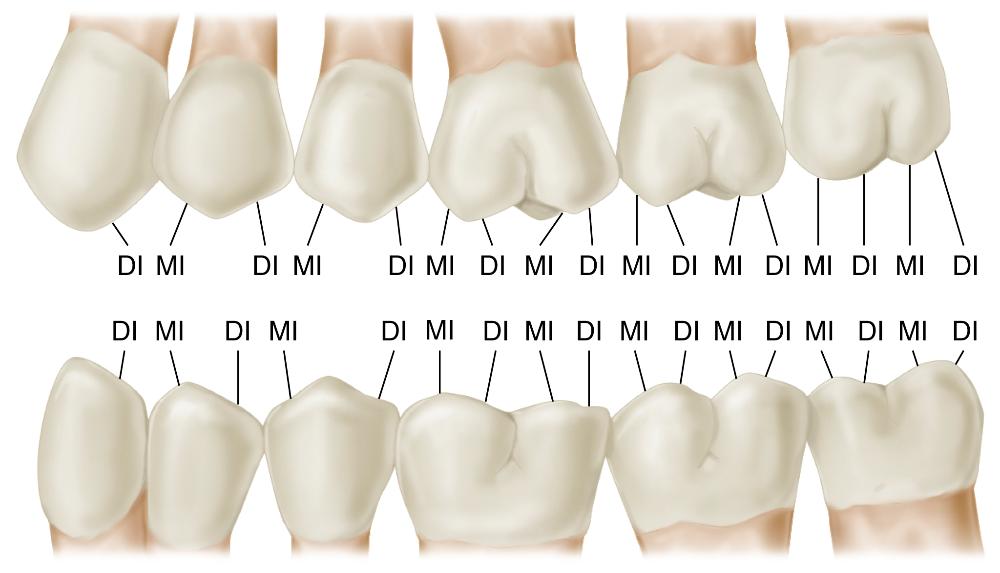 mesial; distal |
front 25 Refers to the relationship of the teeth in one arch to those in the other. | back 25 interarch tooth alignment |
front 26 The distance of a line that begins at the distal surface of the third molar, extends mesially through all of the proximal contact areas around the entire arch, and ends at the distal surface of the opposite. | back 26 arch length |
front 27 Both arches have approximately the same length, with the (...) arch being only slightly smaller, as a result of the narrower mesiodistal distance of the incisors. | back 27 mandibular |
front 28 The distance across the arch. | back 28 arch width |
front 29 The width of the (...) arch is slightly less than that of the (...) arch; thus when the arches occlude, each maxillary tooth is positioned more (...) than the occluding mandibular tooth. | back 29 mandibular; maxillary; facially |
front 30 In the normal occlusal relationship of the posterior teeth, the mandibular (...) cusps to occlude along the central fossa areas of the maxillary teeth. Likewise, the maxillary (...) cusps occlude along the central fossa areas of the mandibular teeth | back 30 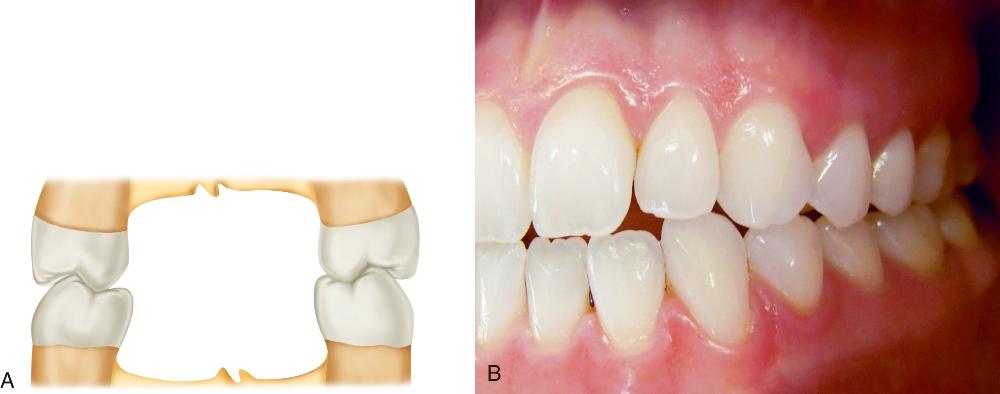 buccal; lingual |
front 31 Occasionally, because of discrepancies in skeletal arch size or eruption patterns, the teeth occlude in such a manner that the maxillary buccal cusps contact in the central fossa area of the mandibular teeth. This relationship is referred to as (...). | back 31 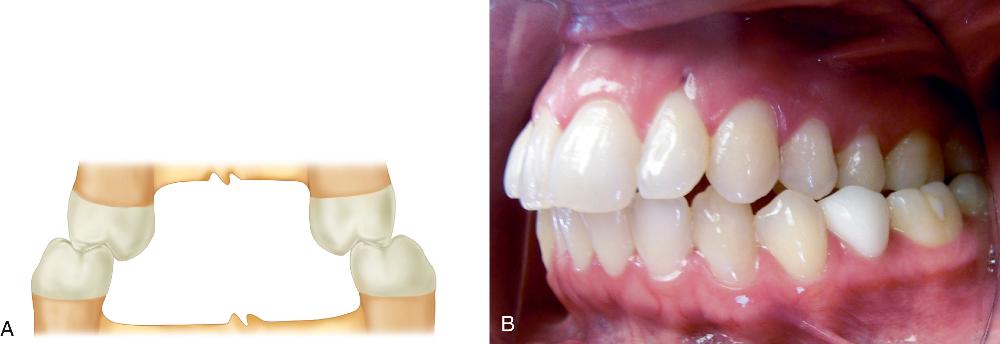 cross-bite |
front 32 The buccal cusps of the mandibular posterior teeth and the lingual cusps of the maxillary posterior teeth are called the (...). cusps. | back 32 centric (or supporting) |
front 33 The centric cusps are responsible for maintaining the (...). These cusps also play a major role in (...) since contact occurs on both the inner and the outer aspects. | back 33 vertical dimension of occlusion (VDO); mastication |
front 34 The centric cusps are broad and rounded. When viewed from the occlusal, their tips are located approximately (...) the distance into the total buccolingual width of the tooth. | back 34 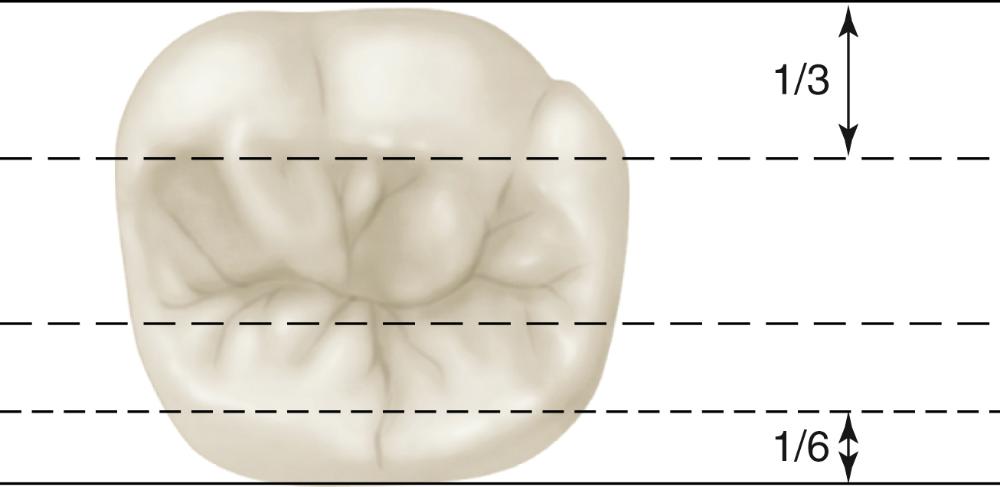 one-third |
front 35 The buccal cusps of the maxillary posterior teeth and the lingual cusps of the mandibular posterior teeth are called the (...) cusps. | back 35 noncentric (or guiding) |
front 36 The noncentric cusps are relatively sharp, with definite tips located approximately (...) the distance into the total buccolingual width of the tooth. | back 36 one-sixth |
front 37 The small area of the centric cusp (about 1 mm) that functions against the inner incline of the noncentric cusp is called the (...). | back 37 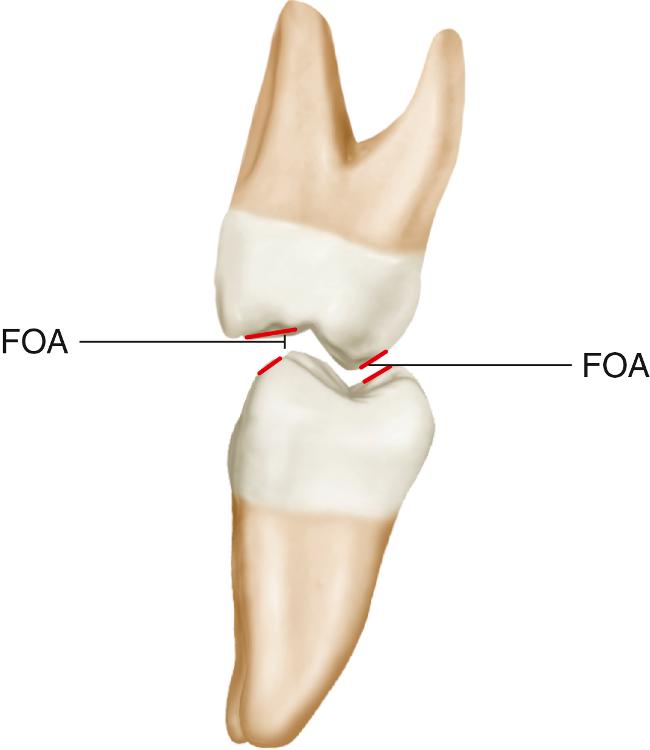 functional outer aspect |
front 38 Since the contact between the noncentric cusps and the functional outer aspect assists in cutting food during mastication, the noncentric cusps have also been called the (...) cusps. | back 38 shearing |
front 39 The major role of the noncentric cusps is to minimize (...), to maintain the bolus of food on the occlusal table for mastication, and to guide the mandible into (...). | back 39 tissue impingement; maximum intercuspal position (MICP) |
front 40 The relationship of the teeth in full occlusion, so that tight definite occlusal relationship results. | back 40 maximum intercuspal position (MICP) |
front 41 An imaginary line that extends through all the buccal cusp tips of the mandibular posterior teeth. | back 41 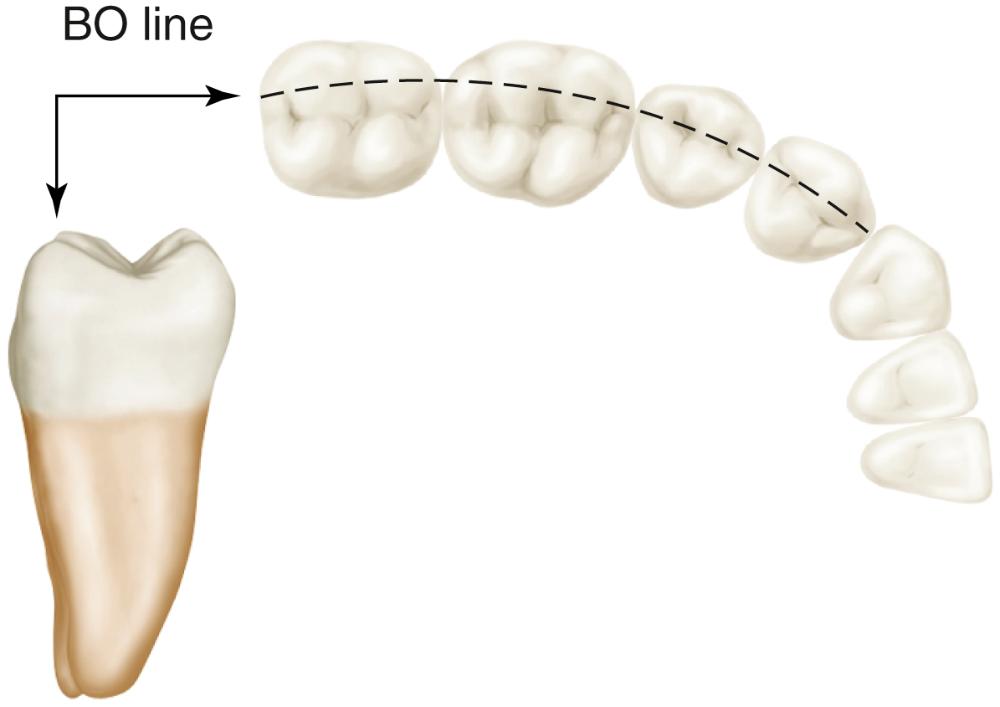 buccoocclusal (B-O) line |
front 42 An imaginary line that extends through all the lingual cusp tips of the maxillary posterior teeth. | back 42 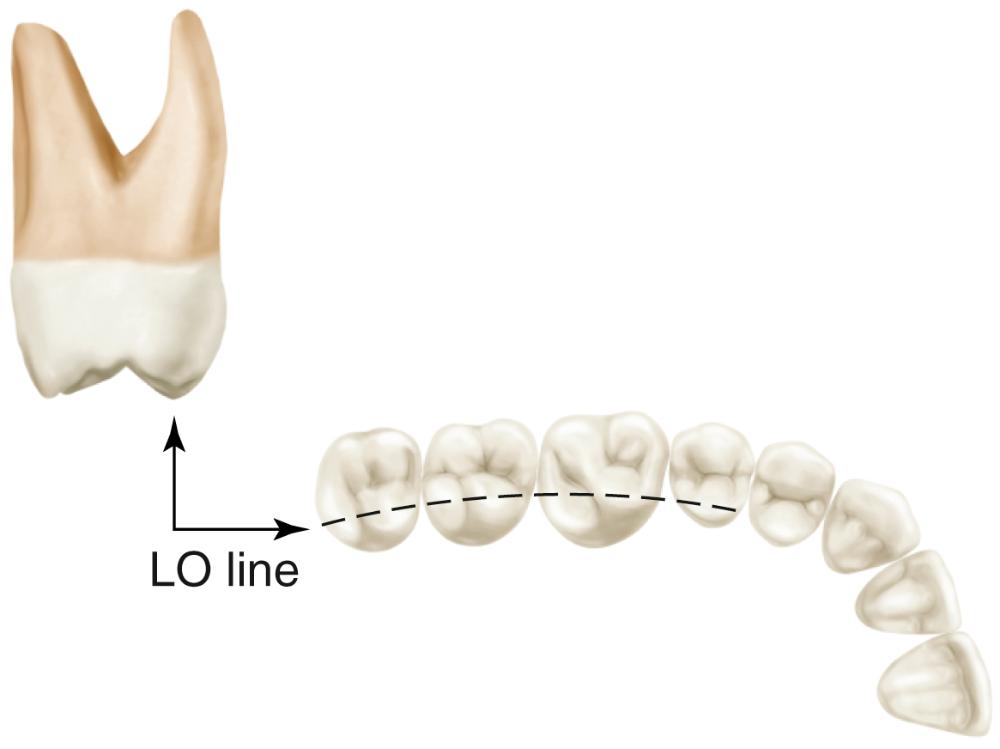 linguoocclusal (L-O) line |
front 43 An imaginary line that extends through the central developmental grooves of the maxillary and mandibular posterior teeth. | back 43 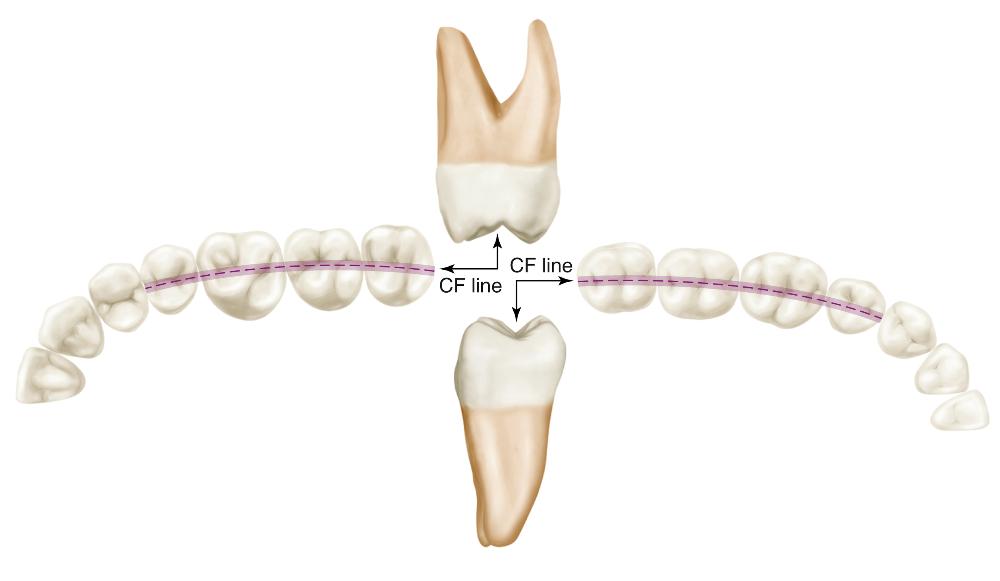 central fossa (C-F) line |
front 44 The proximal contact areas are generally located slightly (...) to the C-F line. This allows for a greater (...) embrasure area and a smaller (...) embrasure area, which provides a spillway for food and improves the efficiency of mastication. | back 44 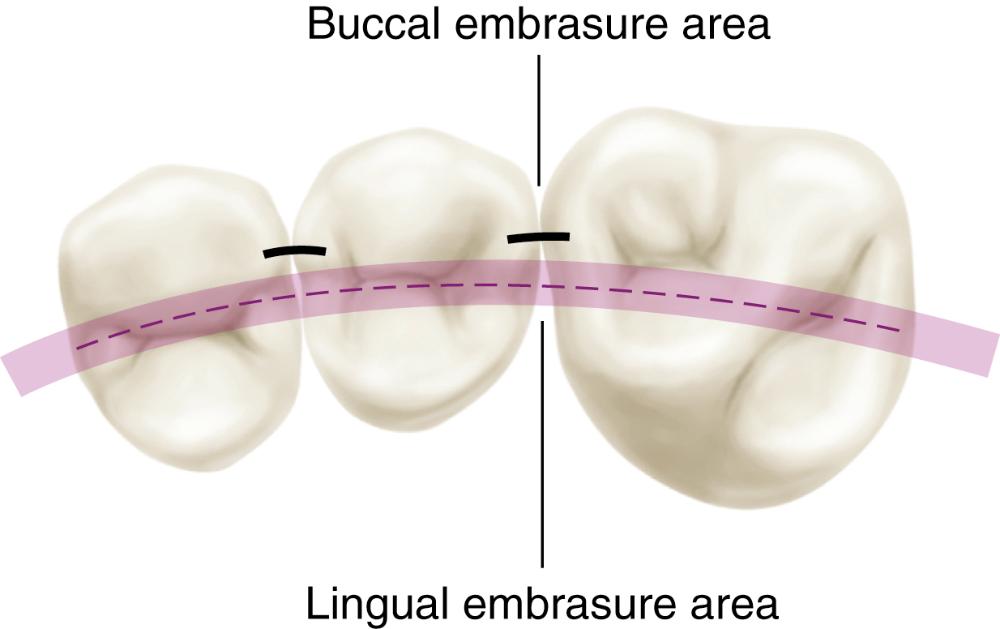 buccal; lingual; buccal |
front 45 The (...) line of the mandibular teeth occludes with the C-F line of the maxillary teeth. | back 45 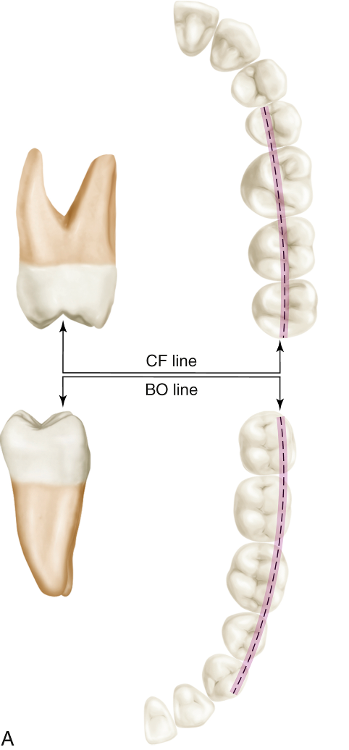 B-O |
front 46 The (...) line of the maxillary teeth occludes with the C-F line of the mandibular teeth. | back 46 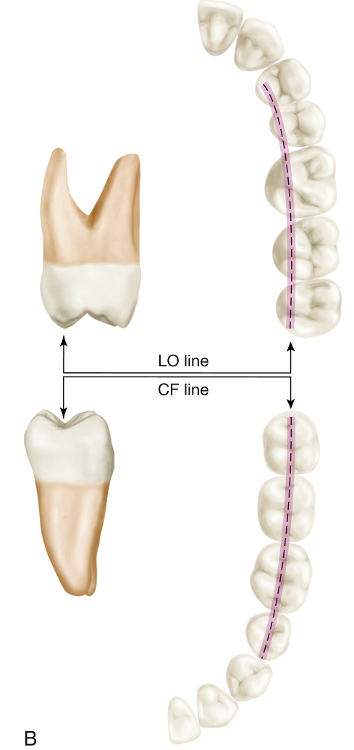 L-O |
front 47 Occlusal contacts occur when the centric cusps contact the opposing central fossa line. Viewed from the facial, these cusps typically contact in one of which two areas? | back 47 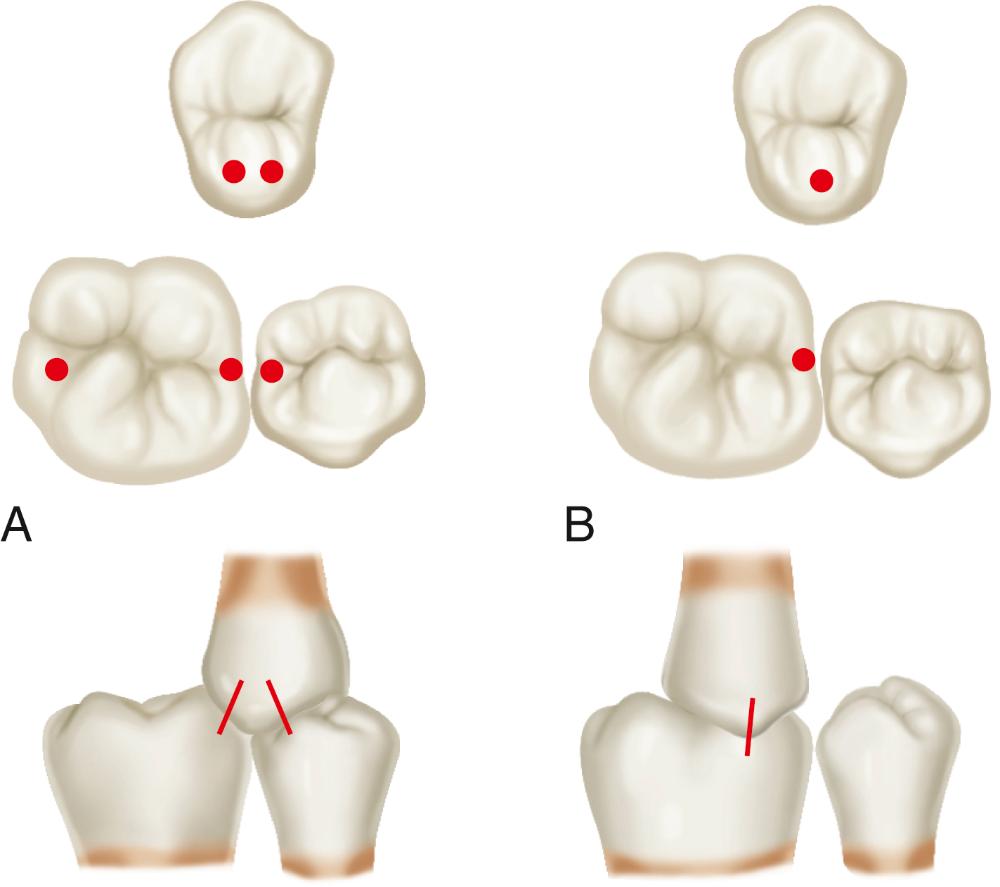 (1) central fossa area or (2) marginal ridge and embrasure area |
front 48 When the normal interarch tooth relationship is viewed from the lateral, it can be seen that each tooth occludes with two opposing teeth, except for the (...) and the (...), which occlude with only one opposing tooth. | back 48 mandibular central incisors; maxillary third molars |
front 49 Throughout the arch, any given tooth is found to occlude with its (...) in the opposing arch plus (...), which helps distribute occlusal forces. | back 49 namesake; an adjacent tooth |
front 50 In the normal relationship, the mandibular teeth are positioned slightly (...) to their counterparts. This is true of both the posterior and the anterior teeth. | back 50 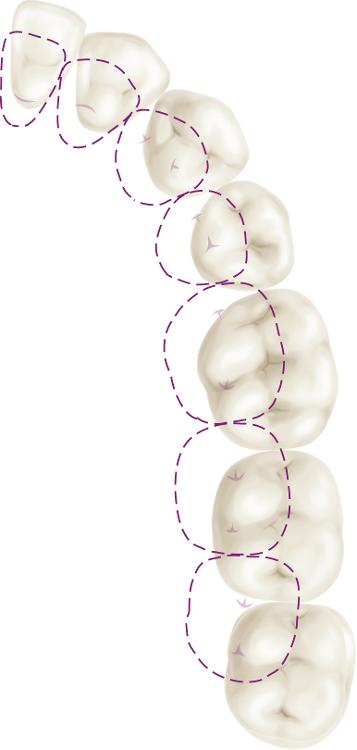 mesiolingual |
front 51 In examining the occlusal relationships of the posterior teeth, much attention is centered around the first molar. The mandibular first molar is normally situated slightly (...) to the maxillary first molar. | back 51 mesial |
front 52 The variation in molar relationship was first described by (...) and is therefore called an (...) molar relationship. | back 52 Angle; Angle Class I, II, or III |
front 53 In an Angle Class I molar relationship:
| back 53 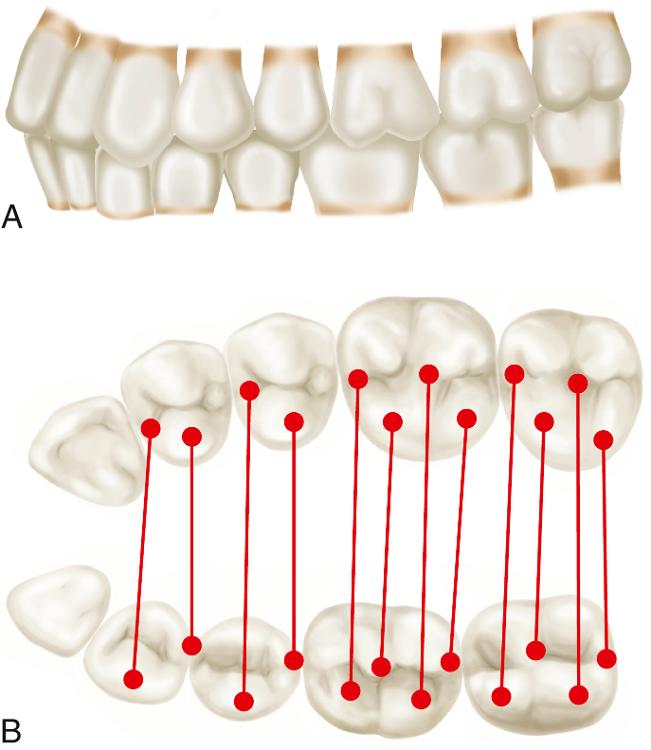
|
front 54 In an Angle Class II molar relationship:
| back 54 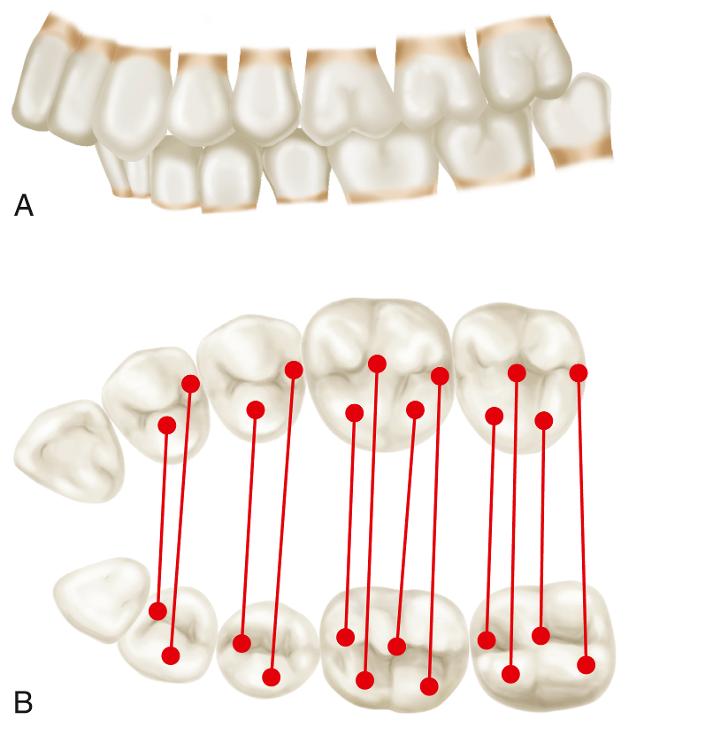
|
front 55 When compared to the Class I relationship, each occlusal contact pair in a Class II relationship is situated to (...) by approximately the mesiodistal width of (...). | back 55 distally; a premolar |
front 56 In an Angle Class III molar relationship:
| back 56 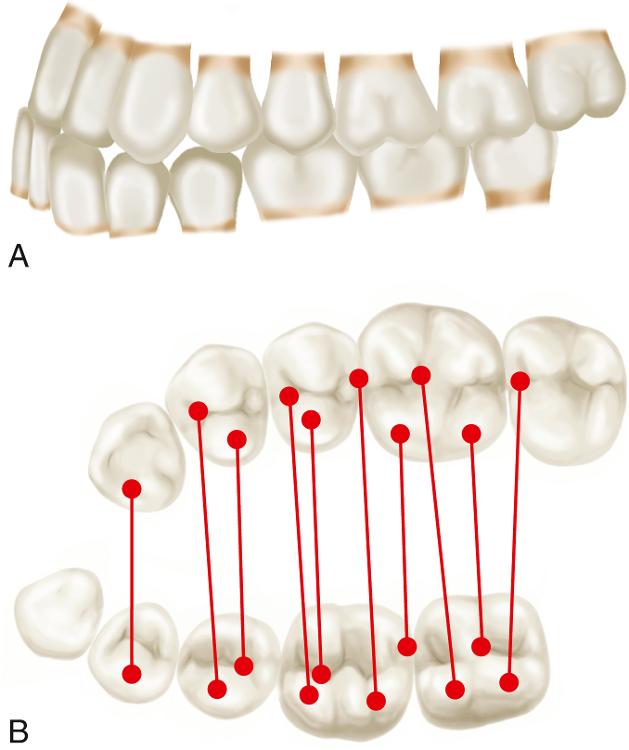
|
front 57 When compared to the Class I relationship, each occlusal contact pair in a Class III relationship is situated to (...) by approximately the mesiodistal width of (...). | back 57 mesially; a premolar |
front 58 What is the most commonly found molar relationship? | back 58 Class I |
front 59 A Class II or III (...) describes a condition that is not Class I, yet is not extreme enough to satisfy the description of Class II or III. | back 59 tendency |
front 60 Like the maxillary posterior teeth, the maxillary anterior teeth are normally positioned labial to the mandibular anterior teeth. Unlike the posterior teeth, both maxillary and mandibular anteriors are inclined to the (...). | back 60 labial by 12 to 28° from a vertical reference line |
front 61 Although a great amount of variation occurs, the normal relationship will find the (...) of the mandibular incisors contacting the (...) of the maxillary incisors. | back 61 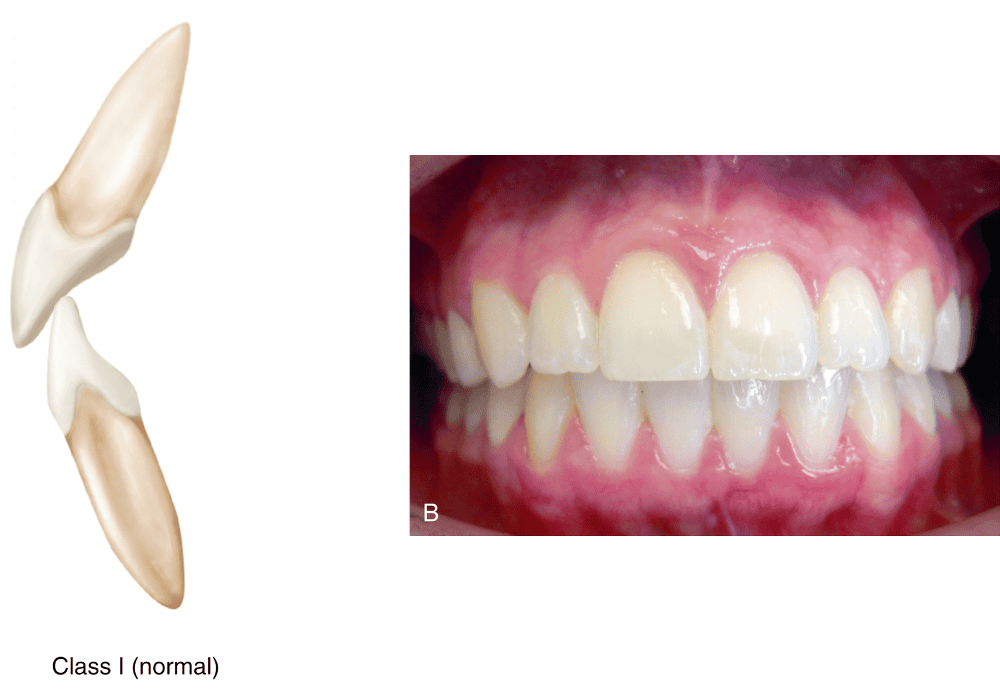 incisal edges; lingual surfaces |
front 62 Anterior contacts commonly occur in the lingual fossae of the maxillary incisors approximately (...) mm gingival to the incisal edges. | back 62 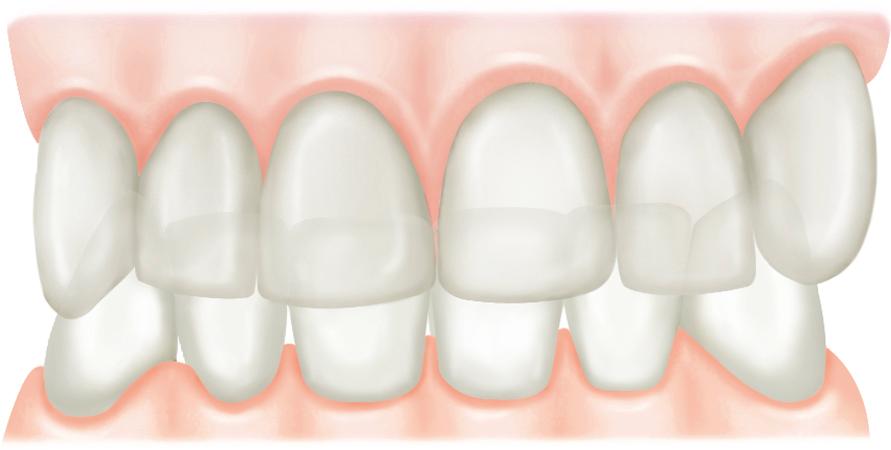 4 mm (i.e. 3 to 5 mm of the mandibular incisors are hidden) |
front 63 The anterior tooth contacts that provide guidance of the mandible through the various lateral movements are called (...). | back 63 anterior guidance |
front 64 The distance between the labial incisal edge of the maxillary incisor and the labial surface of the mandibular incisor in the intercuspal position. | back 64 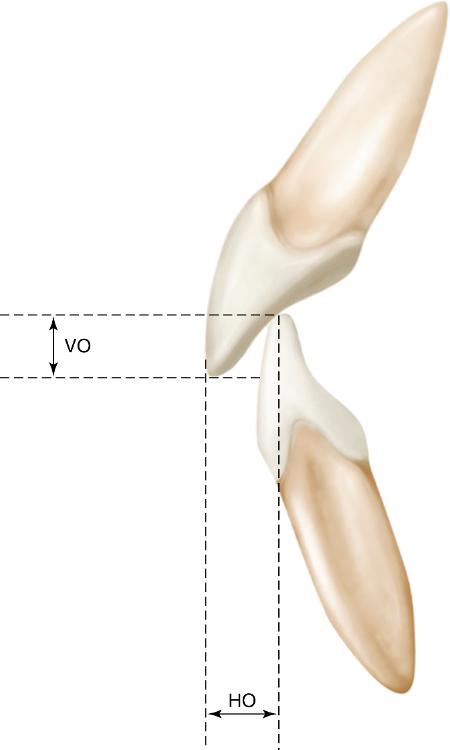 horizontal overlap (sometimes called overjet) |
front 65 The distance between the incisal edges of the opposing anterior teeth, which is approximately 3 to 5 mm in normal occlusion. | back 65 vertical overlap (sometimes called overbite) |
front 66 When a person has an underdeveloped mandible (Class II molar relationship), the mandibular anterior teeth often contact at the gingival third of the lingual surfaces of the maxillary teeth. This anterior relationship is termed a (...). | back 66 deep-bite (or deep overbite) |
front 67 If in an anterior Class II relationship the maxillary central and laterals are at a normal labial inclination, it is considered to be (...), | back 67 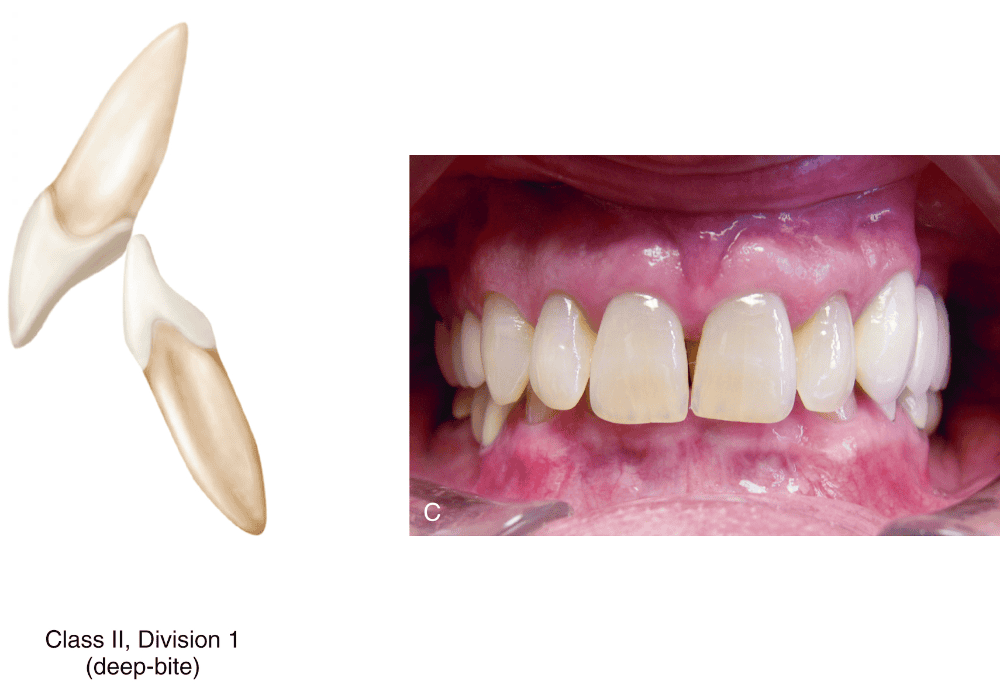 Class II, division 1 |
front 68 If in an anterior Class II relationship the maxillary incisors are lingually inclined, the anterior relationship is termed (...). | back 68 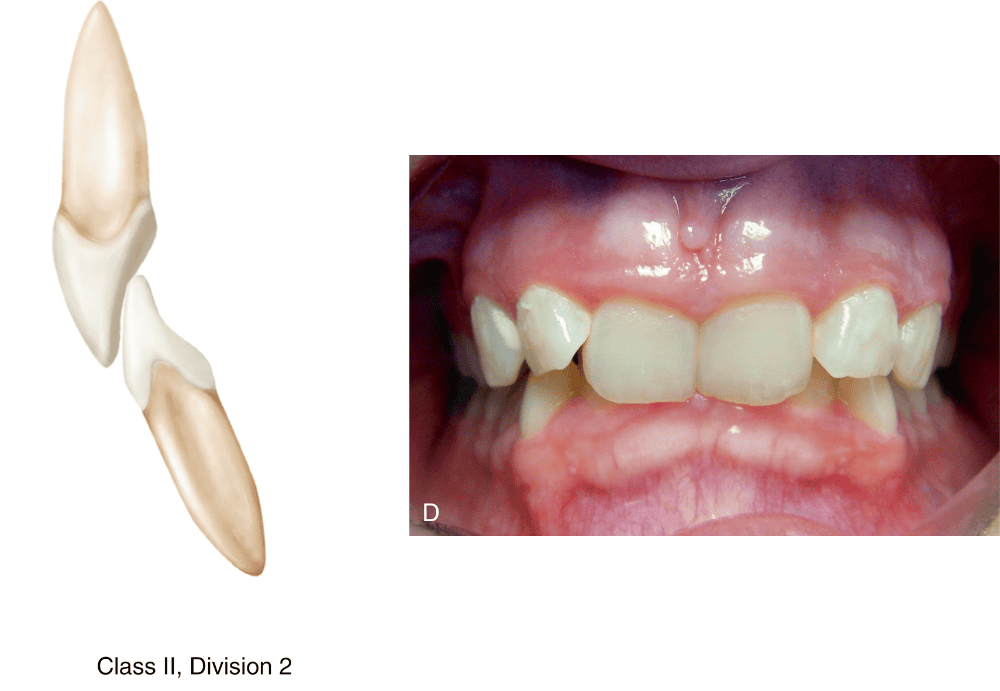 Class II, division 2 |
front 69 In people with pronounced mandibular growth, the mandibular anterior teeth are often positioned forward and contact with the incisal edges of the maxillary anterior teeth (molar Class III relationship). This is termed an (...) relationship. | back 69 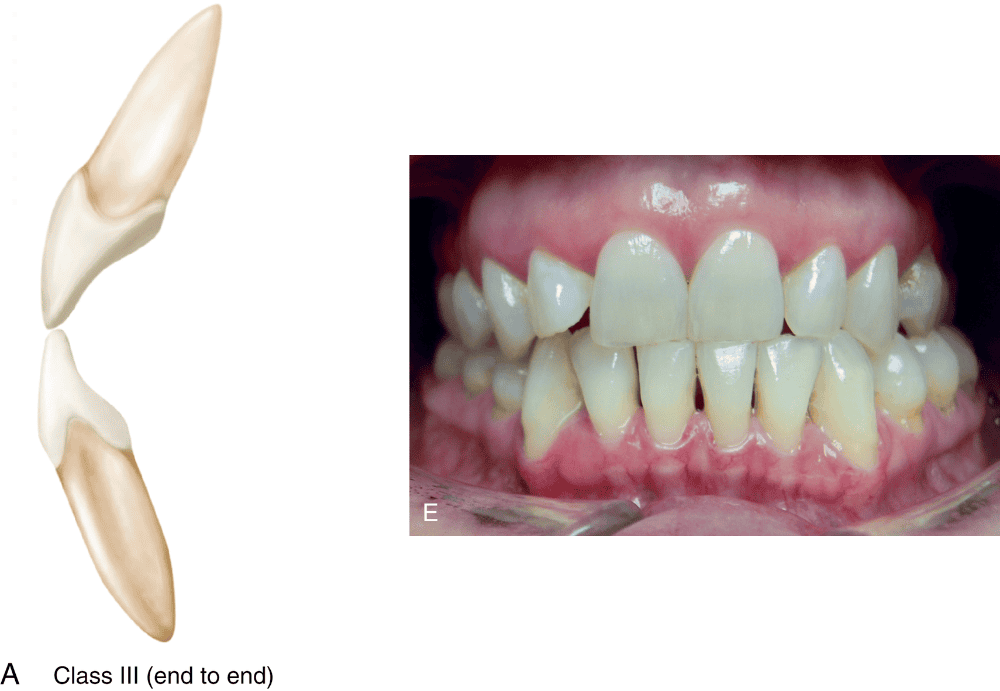 end-to-end (or edge-to-edge) |
front 70 In extreme cases of (...) occlusion, the mandibular anterior teeth can be positioned so far forward that no contact occurs in the intercuspal position. | back 70 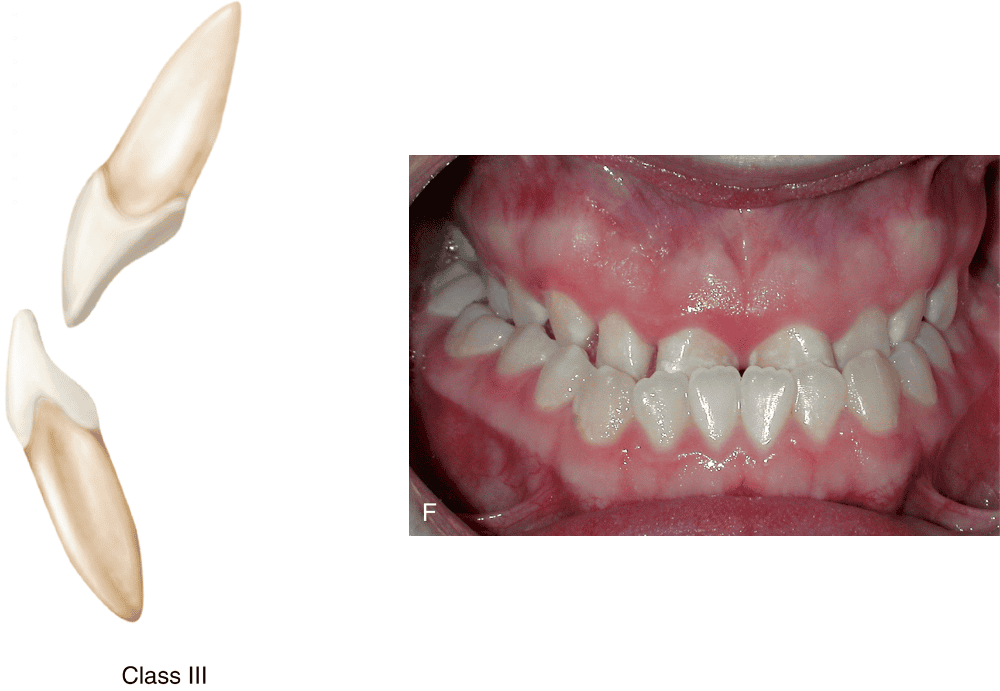 Class III |
front 71 When the posterior teeth in maximum intercuspation and the opposing anterior teeth do not overlap or even contact each other, there is negative vertical overlap. This anterior relationship is termed an (...). | back 71 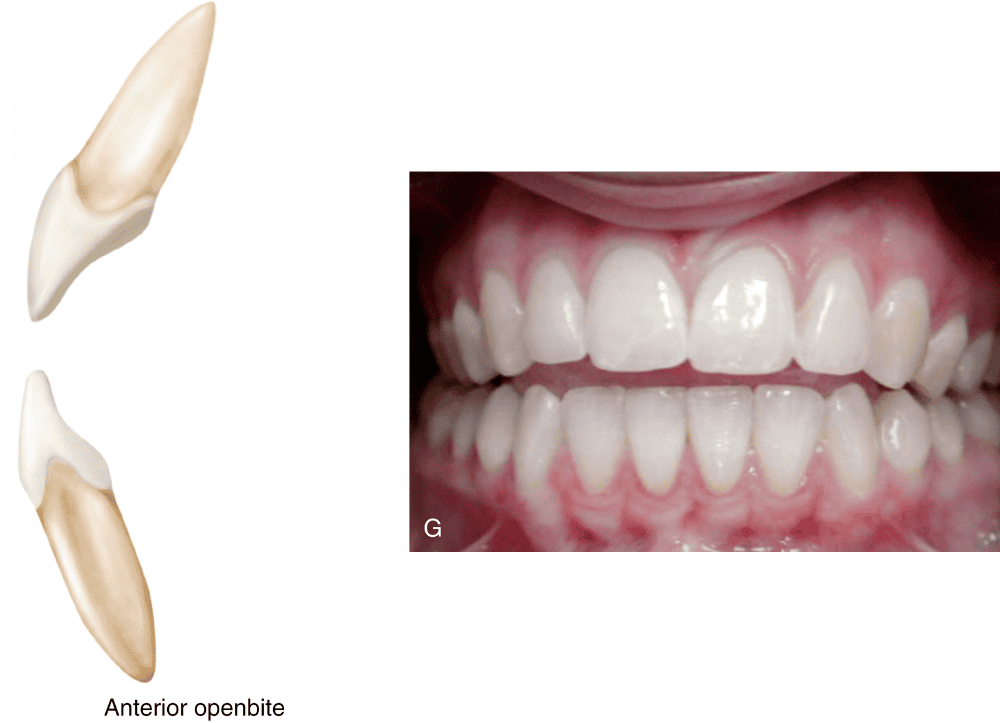 anterior openbite |
front 72 The temporomandibular joints and associated musculature permit the mandible to move in which three planes? | back 72 sagittal, horizontal, and frontal |
front 73 The term (...) has been used to describe any movement of the mandible from the intercuspal position that results in tooth contact. | back 73 eccentric |
front 74 What are the three basic eccentric movements of the mandible? | back 74 protrusive, laterotrusive, and retrusive |
front 75 A (...) mandibular movement occurs when the mandible moves forward from the intercuspal position. | back 75 protrusive |
front 76 Any area of a tooth that contacts an opposing tooth during protrusive movement is considered to be (...). | back 76 protrusive contact |
front 77 In a normal occlusal relationship, the predominant protrusive contacts occur on the anterior teeth, between the (...) of the mandibular incisors against the (...) of the maxillary incisors. | back 77 incisal and labial edges; lingual fossa areas and incisal edges |
front 78 The (...) of the teeth are the surfaces responsible for the characteristics of anterior guidance. | back 78 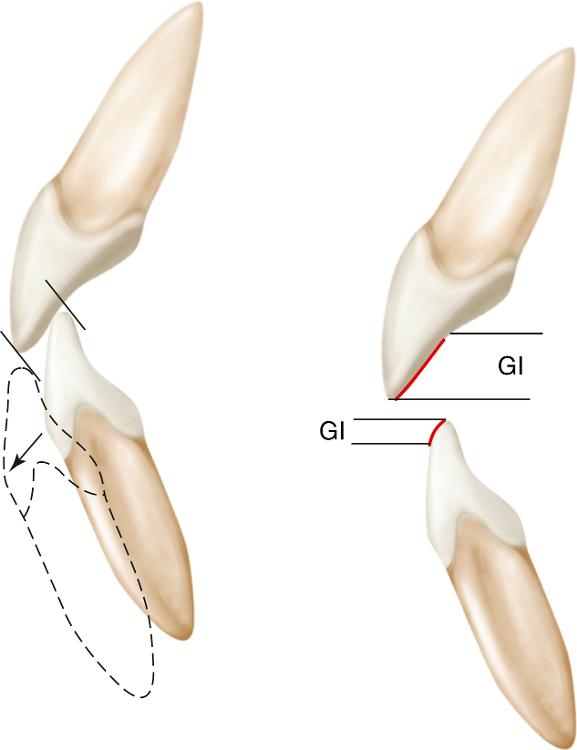 guiding inclines (GI) |
front 79 Posterior protrusive contacts can occur between the (...) of maxillary cusps and the (...) of mandibular cusps. | back 79 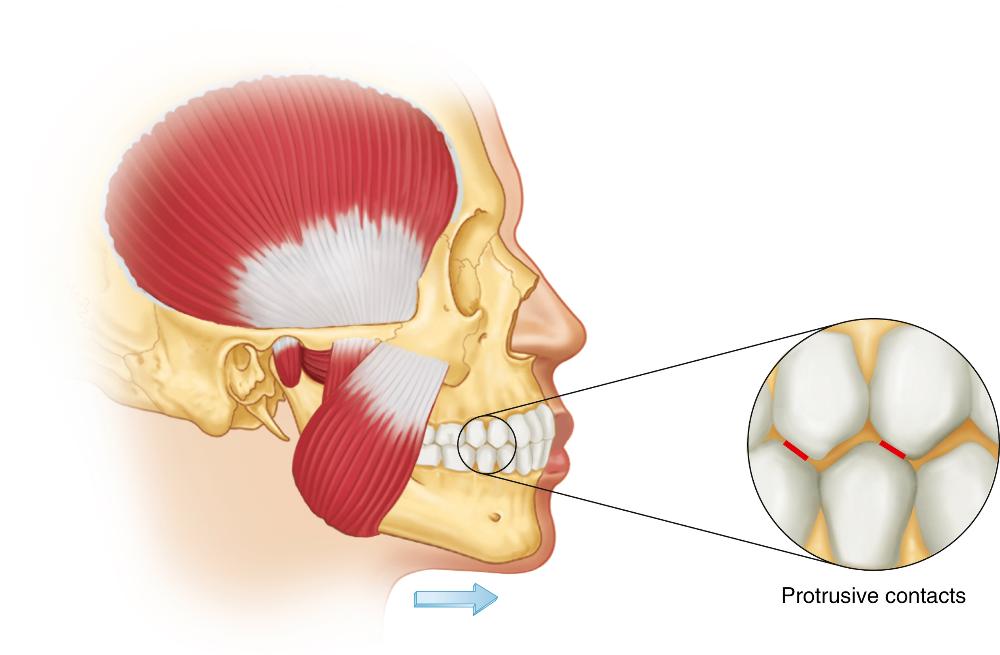 distal inclines; mesial inclines |
front 80 During (...) mandibular movement, the right and left mandibular posterior teeth move across their opposing teeth in different directions. | back 80 laterotrusive |
front 81 Any area of a tooth that contacts an opposing tooth on the working side during laterotrusive movement is considered to be (...). | back 81 laterotrusive (or working-side) contact |
front 82 Laterotrusive contacts can occur:
| back 82 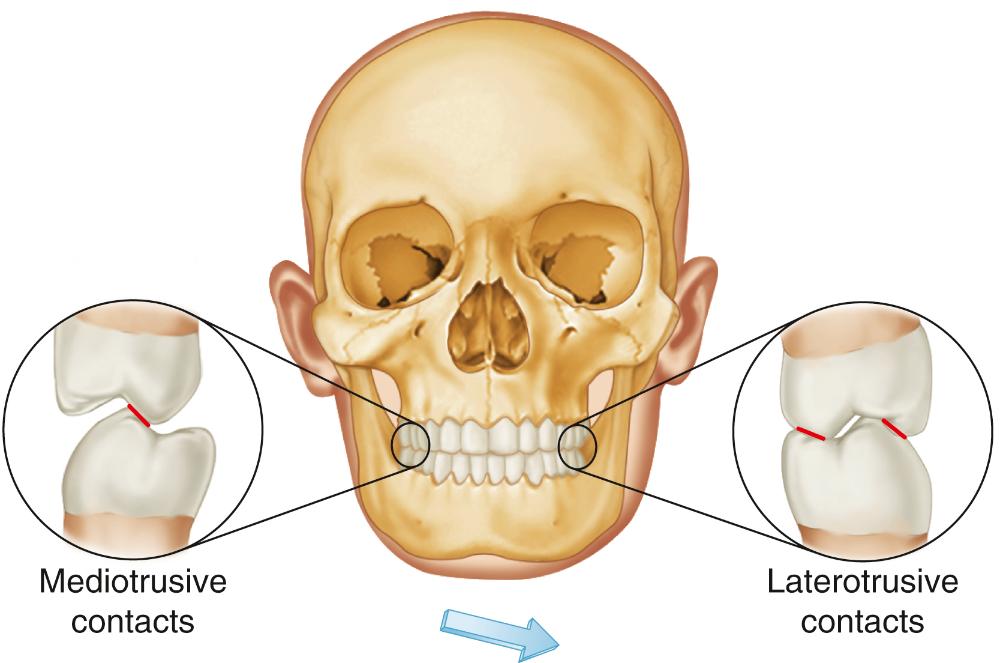 inner inclines ; outer inclines; outer inclines; inner inclines |
front 83 Any area of a tooth that contacts an opposing tooth on the non-working side during laterotrusive movement is considered to be (...). | back 83 mediotrusive (or non-working-side) contacts |
front 84 Mediotrusive contacts can only occur between the (...) of the maxillary lingual cusps and the (...) of the mandibular buccal cusps. | back 84 inner inclines; inner inclines |
front 85 In earlier literature, mediotrusive (non-working-side) contacts were also called (...). | back 85 balancing contacts |
front 86 A (...) movement occurs when the mandible moves posteriorly from the intercuspal position. | back 86 retrusive |
front 87 Compared to the other movements, retrusive movement is quite small (1 or 2 mm), because it is (...). | back 87 restricted by the ligamentous structures |
front 88 Posterior retrusive contacts can occur between the (...) of the maxillary cusps and the (...) of the mandibular cusps. | back 88 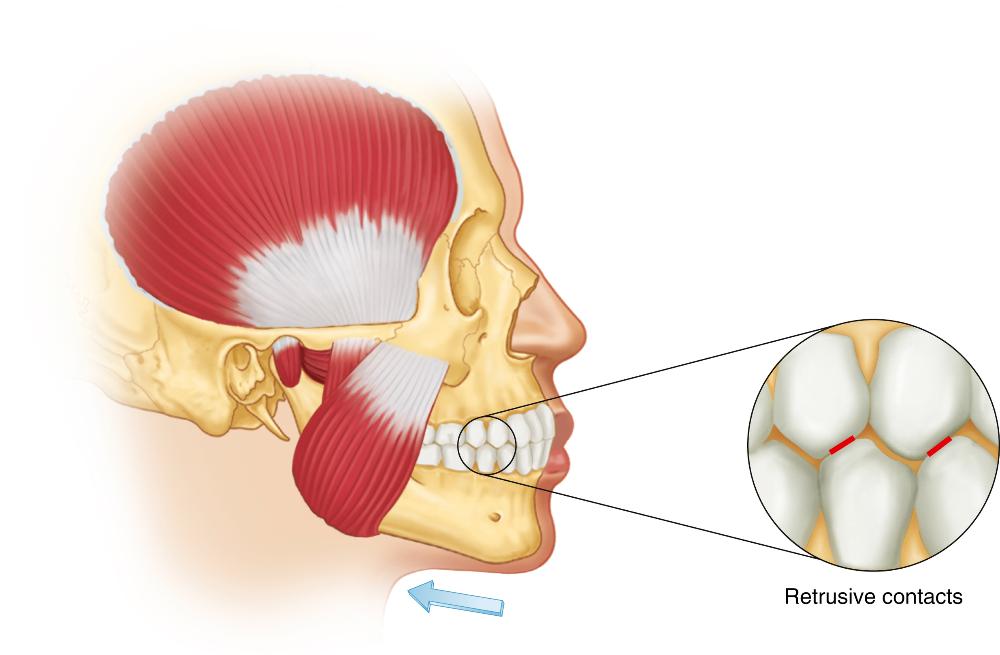 mesial inclines; distal inclines |
front 89 Each centric cusp can potentially provide eccentric contact with the opposing tooth on (...) of its inclines. Each noncentric cusps can contact an opposing tooth on (...) of its inclines. | back 89 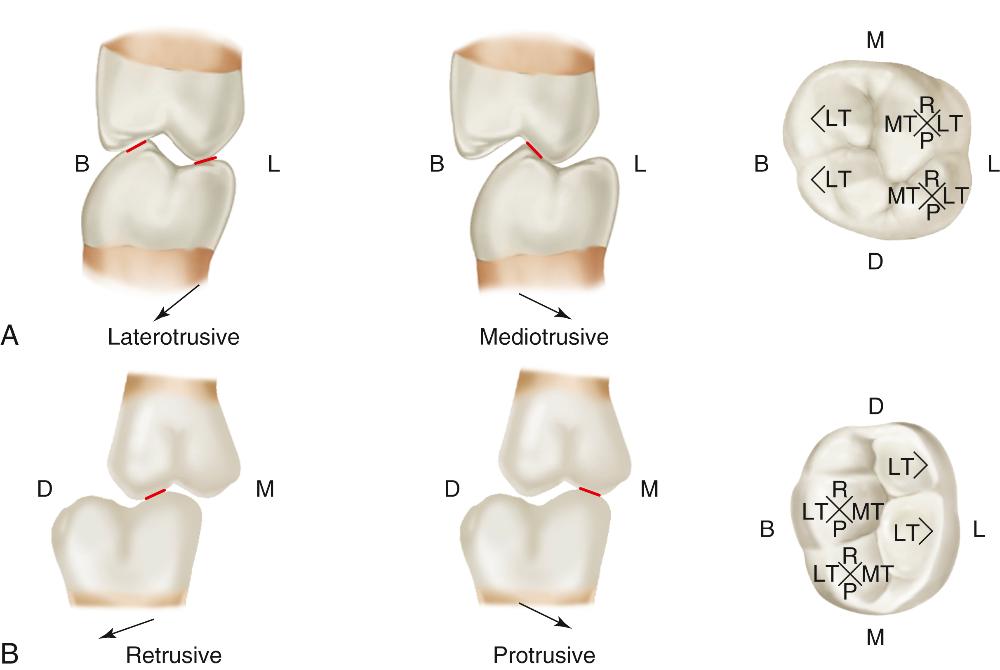 all four; only one (inner) |
front 90 In a normal occlusal relationship, the first anterior teeth from the midline to participate in laterotrusive movements are the (...). | back 90 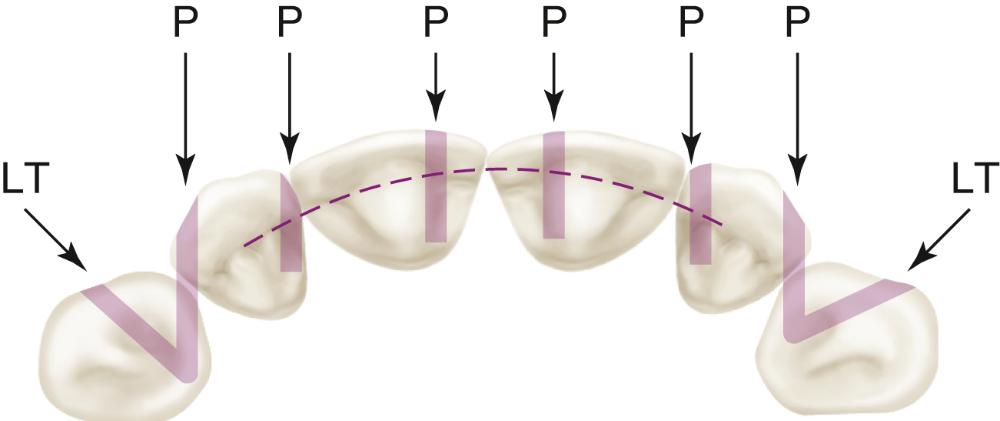 canines |