Print Options

Card layout: ?

← Back to notecard set|Easy Notecards home page

Instructions for Side by Side Printing
  1. Print the notecards
  2. Fold each page in half along the solid vertical line
  3. Cut out the notecards by cutting along each horizontal dotted line
  4. Optional: Glue, tape or staple the ends of each notecard together
  1. Verify Front of pages is selected for Viewing and print the front of the notecards
  2. Select Back of pages for Viewing and print the back of the notecards
    NOTE: Since the back of the pages are printed in reverse order (last page is printed first), keep the pages in the same order as they were after Step 1. Also, be sure to feed the pages in the same direction as you did in Step 1.
  3. Cut out the notecards by cutting along each horizontal and vertical dotted line
To print: Ctrl+PPrint as a list

50 notecards = 13 pages (4 cards per page)

Viewing:

A&P I - Joints

front 1

Joints (aka Articulartions)

back 1

Sites where 2 or more bones meet.

front 2

Functions of Joints

back 2

Functions of joints: give skeleton mobility and hold skeleton together

front 3

Classifications of Joints

back 3

2 classifications of Joints:

1. Structural: 3 types based on what material binds the joints and whether a cavity is present.

Fibrous (Connective Tissue)
Cartilaginous (Cartilage)
Synovial (Joint Cavity)

2. Functional classifications: 3 types based on movement joint allows

Synarthroses: immovable joints
Amphiarthroses: slightly movable joints
Diarthroses: freely movable joints (synovial joints)

front 4

Fibrous Joints

back 4

  • Bones joined by dense fibrous connective tissue
  • No joint cavity
  • Most are immovable (Depends on length of connective tissue fibers)
  • Three types of fibrous joints
    • Sutures
    • Syndesmoses
    • Gomphoses

front 5

Fibrous Joints: Sutures

back 5

Fibrous joint

  • Rigid, interlocking joints of skull
  • Allow for growth during youth (Contain short connective tissue fibers that allow for expansion)
  • In middle age, sutures ossify and fuse (Immovable joints join skull into one unit that protects brain)

front 6

Fibrous Joints: Syndesmoses

back 6

  • Bones connected by ligaments, bands of fibrous tissue
  • Fiber length varies, so movement varies
    • Short fibers offer little to no movement - ex: inferior tibiofibular joint, which is the tibia/fibula
  • Longer fibers offer a larger amount of movement
    • ex: interosseous membrane connecting radius and ulna

front 7

Fibrous Joints: Gomphoses

back 7

  • Peg-in-socket joints
  • Only examples are the teeth in alveolar sockets
  • Fibrous connection is the periodontal ligament
    • Holds tooth in socket

front 8

Cartilaginous Joints

back 8

  • Bones united by cartilage
  • Like fibrous joints, have no joint cavity
  • Not highly movable (slightly movable)
  • Two types:
    • Synchondroses
    • Symphyses

front 9

Cartilaginous Joints: Synchondroses

back 9

  • Bar or plate of hyaline cartilage unites bones
  • Almost all are synarthrotic (immovable)
    • Examples–Temporary epiphyseal plate joints§Become synostoses after plate closure
    • Cartilage of 1st rib with manubrium of sternum

front 10

Cartilaginous Joints: Symphyses

back 10

  • Fibrocartilage unites bone in symphysis joint
    • Hyaline cartilage also present as articular cartilage on bony surfaces
  • Symphyses are strong, amphiarthrotic (slightly movable) joints
  • Examples:
    • Intervertebral joints
    • Pubic symphysis

front 11

Synovial Joints

back 11

  • Bones separated by fluid-filled joint cavity
  • All are diarthrotic (freely movable)
  • Include almost all limb joints

front 12

Characteristics of synovial joints

back 12

  • Characteristics of synovial joints:
    • Have six general features
    • Have bursae and tendon sheaths associated with them
    • Stability is influenced by three factors
    • Allow several types of movements
    • Classified into six different types

front 13

General Structure of Synovial Joints:

back 13

Synovial joints have 6 general features:
1. Articular cartilage
2. Joint (synovial) cavity
3. Articular (joint) capsule
4. Synovial fluid
5. Different types of reinforcing ligaments
6. Nerves & blood vessels

front 14

General Structure of Synovial Joints: Articular Cartilage

back 14

1. Articular cartilage: consists of hyaline cartilage covering ends of bones (Prevents crushing of bone ends)

front 15

General Structure of Synovial Joints: Joint (Synovial) Cavity

back 15

2. Joint (synovial) cavity: small, fluid-filled potential space that is unique to synovial joints

front 16

General Structure of Synovial Joints: Articular (joint) capsule

back 16

3. Articular (joint) capsule: 2 layers thick
-External fibrous layer: dense regular CT
-Inner synovial membrane: loose CT that makes synovial fluid

front 17

General Structure of Synovial Joints: Synovial fluid

back 17

4. Synovial fluid: viscous, slippery filtrate of plasma & hyaluronic acid. Lubricates & nourishes articular cartilage. Contains phagocytic cells to remove microbes & debris.

front 18

General Structure of Synovial Joints:

Different Types of reinforcing ligaments

back 18

5. Different types of reinforcing ligaments
-Capsular: thickened part of fibrous layer
-Extracapsular: outside the capsule
-Intracapsular: deep to capsule; covered by synovial membrane

front 19

General Structure of Synovial Joints: Nerves & blood vessels

back 19

6. Nerves & blood vessels: Nerves detect pain; monitor joint position & stretch. Capillary beds supply filtrate for synovial fluid.

front 20

General Structure of Synovial Joints - other features

back 20

  • Other features of some synovial joints:
    • Fatty pads (For cushioning between fibrous layer of capsule and synovial membrane or bone)
    • Articular discs (menisci) (Meniscus for singular - seen in knee joint)
      • Fibrocartilage separates articular surfaces to improve “fit” of bone ends, stabilize joint, and reduce wear and tear

front 21

Bursae and Tendon Sheaths

back 21

  • Bags of synovial fluid that act as lubricating “ball bearing”
    • Not strictly part of synovial joints, but closely associated
  • Bursae: reduce friction where ligaments, muscles, skin, tendons, or bones rub together
  • Tendon sheaths: elongated bursae wrapped completely around tendons subjected to friction

front 22

Factors Influencing Stability of Synovial Joints

back 22

Three factors determine stability of joints to prevent dislocations:

  1. Shape of articular surface (minor role)
    1. Shallow surfaces less stable than ball-and-socket
  2. Ligament number and location (limited role)
    1. The more ligaments, the stronger the joint
  3. Muscle tone keeps tendons taut as they cross joints (most important)
    1. Extremely important in reinforcing shoulder and knee joints and arches of the foot

front 23

Movements Allowed by Synovial Joints

back 23

  • All muscles attach to bone or connective tissue at no fewer than two points
    • Origin: attachment to immovable bone (fixed point)
    • Insertion: attachment to movable bone (movable point)
  • Muscle contraction causes insertion to move toward origin
  • Movements occur along transverse, frontal, or sagittal planes

front 24

3 General Types of Movements Allowed by Synovial Joints

back 24

Three general types of movements

  1. Gliding
  2. Angular movements
  3. Rotation

front 25

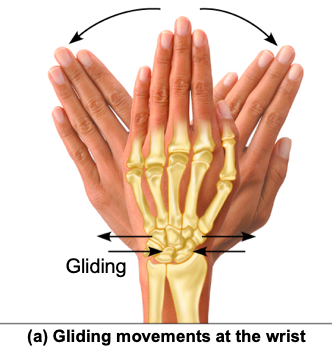
Synovial Joints: Gliding Movements

back 25

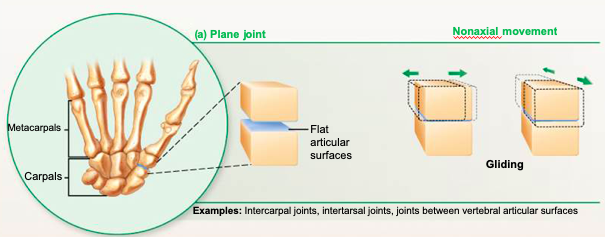
Gliding movements: One flat bone surface glides or slips over another similar surface.

Examples:
Intercarpal joints
Intertarsal joints
Between articular processes of vertebrae

front 26

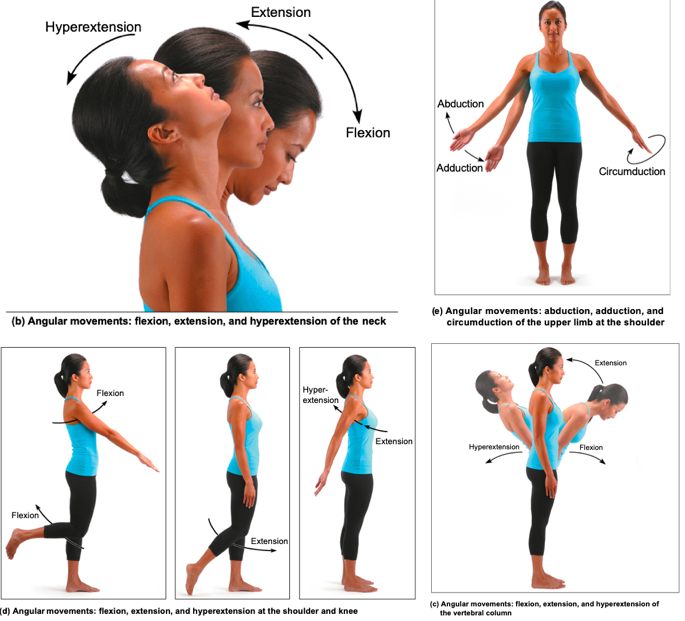
Synovial Joints: Angular Movements

back 26

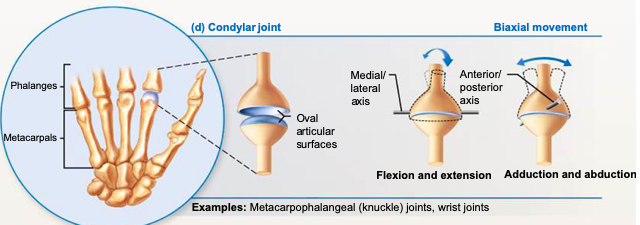
Angular movements: Increase or decrease angle between 2 bones. Movement along sagittal plane. Angular movements include:

  • Flexion: decreases the angle of the joint
  • Extension: increases the angle of the joint
    • Hyperextension: movement beyond the anatomical position
  • Abduction: movement along frontal plane, away from midline
  • Adduction: movement along frontal plane, toward midline
  • Circumduction
    • Involves flexion, abduction, extension, & adduction of limb
    • Limb describes cone in space

front 27

Synovial Joint - Angular Movements in Pictures

back 27

front 28

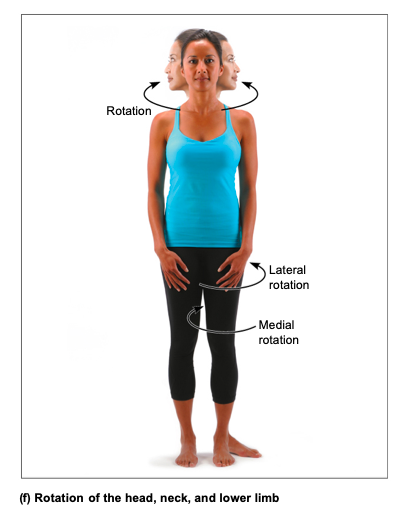
Synovial Joints: Rotations

back 28

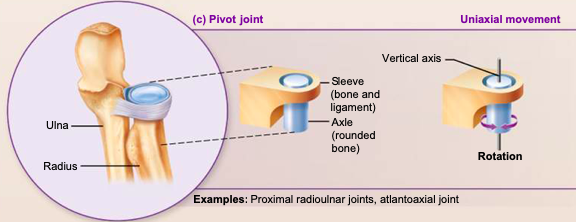
Rotation: turning of bone around its own long axis, toward midline or away from it

  • Medial: rotation toward midline
  • Lateral: rotation away from midline
  • Examples
    • Rotation between C1 and C2 vertebrae
    • Rotation of humerus and femur

front 29

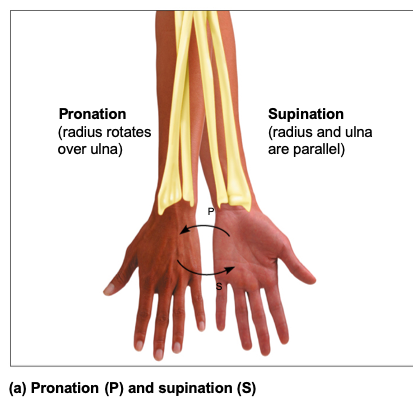
Synovial Joints, Special movements: Supination and pronation

back 29

Supination and pronation: rotation of radius and ulna

  • Supination: palms face anteriorly
    • Radius and ulna are parallel
  • Pronation: palms face posteriorly
    • Radius rotates over ulna

front 30

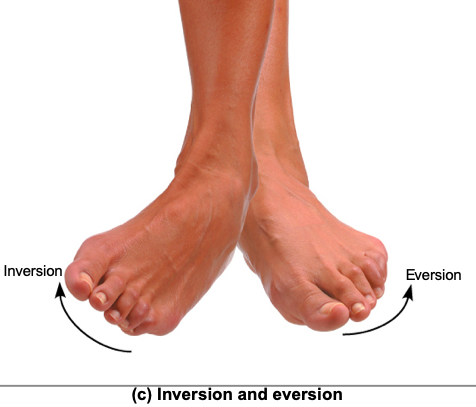
Synovial Joints, Special movements: Inversion and Eversion

back 30

  • Inversion and eversion of foot
    • Inversion: sole of foot faces medially
    • Eversion: sole of foot faces laterally

front 31

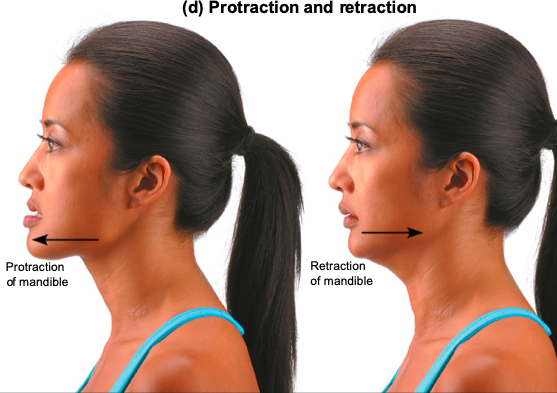
Synovial Joints, Special movements: Protraction and retraction

back 31

  • Protraction and retraction: movement in lateral plane
    • Protraction: mandible juts out
    • Retraction: mandible is pulled toward neck

front 32

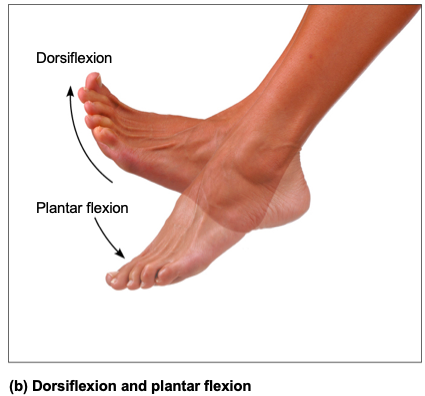
Synovial Joints, Special movements: Dorsiflexion and plantar flexion

back 32

Dorsiflexion and plantar flexion of foot

  • Dorsiflexion: bending foot toward shin
  • Plantar flexion: pointing toes

front 33

Synovial Joints, Special movements: Elevation and Depression of mandible

back 33

Elevation and depression of mandible:

Elevation: lifting body part superiorly
Example: shrugging shoulders

Depression: lowering body part
Example: opening jaw

front 34

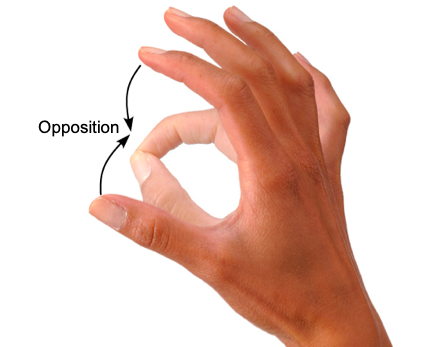
Synovial Joints, Special movements: Opposition

back 34

Opposition: movement of thumb
Example: touching thumb to tips of other fingers on same hand or any grasping movement

front 35

Six different types of synovial joints

back 35

Categories are based on shape of articular surface, as well as movement joint is capable of

  1. Plane
  2. Hinge
  3. Pivot
  4. Condylar
  5. Saddle
  6. Ball-and-socket

front 36

Synovial Plane Joint - diagram

back 36

front 37

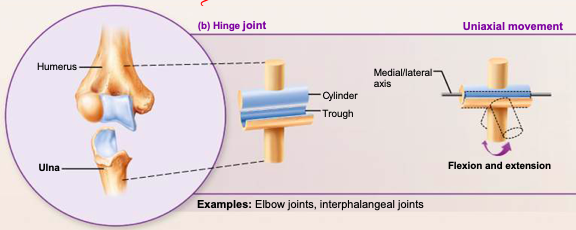
Synovial Hinge Joint - diagram

back 37

front 38

Synovial Pivot Joint - diagram

back 38

front 39

Synovial Condylar Joint - diagram

back 39

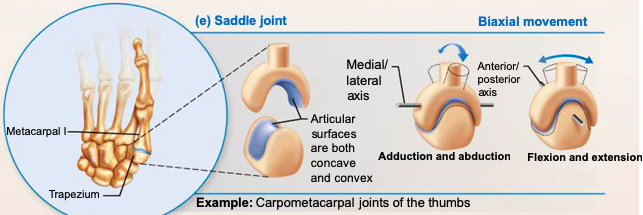
front 40

Synovial Saddle Joint - diagram

back 40

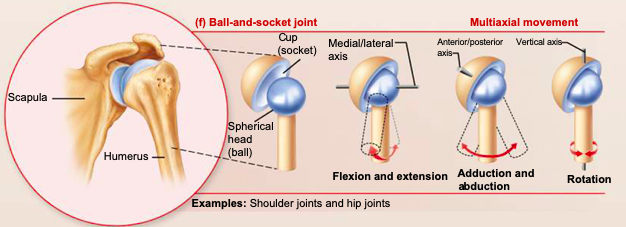
front 41

Synovial Ball-and-socket Joint: diagram

back 41

front 42

Knee Joint

back 42

  • Largest, most complex joint of body. Consists of joints surrounded by single cavity.
  • Joint capsule is thin and absent anteriorly
  • Anteriorly, quadriceps tendon gives rise to 3 broad ligaments that run from patella to tibia
  • Medial and lateral patellar retinacula that flank the patellar ligament
    • Doctors tap patellar ligament to test knee-jerk reflex
    • At least 12 bursae associated with knee joint

front 43

Knee Joint: Femoropatellar joint

back 43

Femoropatellar joint (femur & patella)

  • Plane joint
  • Allows gliding motion during knee flexion

front 44

Knee Joint: Lateral & Medial Joints

back 44

  1. Lateral joint and
  2. Medial joint
    • Lateral and medial joints together are called tibiofemoral joint (femur & tibia)
    • Joint between femoral condyles and lateral and medial menisci of tibia
    • Hinge joint that allows flexion, extension, and some rotation when knee partly flexed

front 45

Three ligaments that act to stabilize knee joint

back 45

Capsular, extracapsular, or intracapsular ligaments

front 46

Intracapsular ligaments

back 46

1 of 3 ligaments that act to stabilize knee joint

Intracapsular ligaments reside within capsule, but outside synovial cavity:
-Help to prevent anterior-posterior displacement
-Anterior cruciate ligament (ACL)
*Attaches to anterior tibia & prevents forward sliding of tibia and stops hyperextension of knee
-Posterior cruciate ligament (PCL)
*Attaches to posterior tibia & prevents backward sliding of tibia and forward sliding of femur

front 47

Capsular, extracapsular ligaments

back 47

2 of 3 ligaments that act to stabilize knee joint:

  • Capsular & extracapsular ligaments help prevent hyperextension of knee
    • Fibular & tibial collateral ligaments: prevent rotation when knee is extended
    • Oblique popliteal ligament: stabilizes posterior knee joint
    • Arcuate popliteal ligament: reinforces joint capsule posteriorly

front 48

Common Knee Injuries

back 48

Knee absorbs great amount of vertical force; however, it is vulnerable to horizontal blows

Common knee injuries involved the 3 C’s:
1. Collateral ligaments (tibia & fibula)
2. Cruciate ligaments (ant / posterior)
3. Cartilages (menisci) (medial & lateral)

–Lateral blows to extended knee can result in tears in tibial collateral ligament, medial meniscus, & anterior cruciate ligament

–Injuries affecting just ACL are common in runners who change direction, twisting ACL

–Surgery usually needed for repairs

front 49

Common Joint Injuries: Cartilage Tears

back 49

Cartilage tears:

  • Due to compression and shear stress
  • Fragments may cause joint to lock or bind
  • Cartilage rarely repairs itself
  • Repaired with arthroscopic surgery
  • Partial menisci removal renders joint less stable but mobile; complete removal leads to osteoarthritis
  • Meniscal transplant possible in younger patients
  • Perhaps meniscus grown from own stem cells in future

front 50

Common Joint Injuries: Sprains

back 50

Sprains

  • Reinforcing ligaments are stretched or torn
  • Common sites are ankle, knee, & lumbar region of back
  • Partial tears repair very slowly because of poor vascularization
  • 3 options if torn completely:
    • Ends of ligaments can be sewn together
    • Replaced with grafts
    • Just allow time and immobilization for healing