Instructions for Side by Side Printing
- Print the notecards
- Fold each page in half along the solid vertical line
- Cut out the notecards by cutting along each horizontal dotted line
- Optional: Glue, tape or staple the ends of each notecard together
Chapter 7 MC
front 1 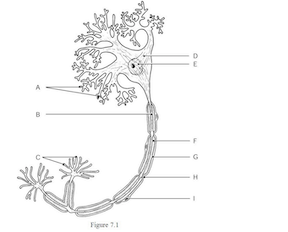 The neural processes that convey incoming messages toward the cell body are indicated by ________. A) Label H B) Label G C) Label A D) Label F E) Label B | back 1 C |
front 2 The metabolic center of the neuron is indicated by ________. A) Label D B) Label F C) Label A D) Label H E) Label I | back 2 A |
front 3 The axon terminals are indicated by ________. A) Label I B) Label G C) Label B D) Label A E) Label C | back 3 E |
front 4 The axon is indicated by ________. A) Label B B) Label F C) Label H D) Label I E) Label A | back 4 A |
front 5 The gaps between Schwann cells are indicated by ________. A) Label D B) Label H C) Label B D) Label F E) Label A | back 5 B |
front 6 The nucleus of the neuron is indicated by ________. A) Label E B) Label I C) Label A D) Label B E) Label F | back 6 A |
front 7 The nervous system is structurally subdivided into two systems: ________ nervous system and ________ nervous system. A) central; peripheral B) somatic; autonomic C) parasympathetic; sympathetic D) autonomic; sympathetic | back 7 A |
front 8 ____ cells form the myelin sheaths around nerve fibers in the PNS. A) Satellite B) Ependymal C) Schwann D) Nerve | back 8 C |
front 9 Support cells in the central nervous system are collectively called ________. A) myelin sheaths B) neuroglia C) oligodendrocytes D) microglia | back 9 B |
front 10 The part of the neuron that typically conducts nerve impulses away from the cell body is the ________. A) dendrite B) cell body C) synaptic cleft D) axon | back 10 D |
front 11 The gaps between Schwann cells found at regular intervals in peripheral system neurons are called ________. A) synaptic clefts B) axon terminals C) nodes of Ranvier D) myelin sheaths | back 11 C |
front 12 Sensory receptors located in muscles and tendons are termed ________. A) Meissner's corpuscles B) proprioceptors C) lamellar corpuscles D) association neurons | back 12 B |
front 13 Bundles of nerve fibers (neuron processes) running through the CNS are called ________, whereas in the PNS they are called ________. A) tracts; nerves B) gray matter; white matter C) axons; dendrites D) afferent neurons; efferent neurons | back 13 A |
front 14 The cell bodies of the ________ neurons are always located within the CNS. A) proprioceptor B) afferent C) motor D) sensory | back 14 C |
front 15 Myelinated fibers (tracts) form ________ matter while unmyelinated fibers form ________ matter. A) sensory; motor B) gray; white C) motor; sensory D) white; gray | back 15 D |
front 16 _______ connect sensory and motor neurons in neural pathways and their cell bodies are typically located in the central nervous system. A) Interneurons (association neurons) B) Afferent C) Efferent D) Proprioceptors | back 16 A |
front 17 During repolarization, ________ ions are pumped out of the cell. A) sodium B) potassium C) both sodium and potassium D) calcium | back 17 A |
front 18 ______ reflexes include the secretion of saliva, changes in the size of our pupils, and digestion involve the activities of smooth muscles. A) Somatic B) Voluntary C) Autonomic D) Sympathetic | back 18 C |
front 19 The thalamus, hypothalamus, and epithalamus collectively constitute the ________. A) cerebellum B) dicephalon (interbrain) C) brain stem D) cerebrum | back 19 B |
front 20 The brain dysfunction where blood supply to a region (or regions) of the brain is blocked and vital brain tissue dies, as by a blood clot or a ruptured blood vessel, is called ________. A) cerebrovascular accident (CVA), or stroke B) Parkinson's disease C) Huntington's disease D) multiple sclerosis | back 20 A |
front 21 The brain and spinal cord are protected and cushioned by three connective tissue membranes that are collectively called ________. A) ventricles B) arachnoid villi C) meninges D) sinuses | back 21 C |
front 22 Cerebrospinal fluid is formed from blood by clusters of capillaries in the brain known as ________. A) choroid plexuses B) arachnoid villi C) ventricles D) sinuses | back 22 A |
front 23 The primary somatic sensory cortex is located in the ________ lobe of the cerebrum. A) parietal B) frontal C) temporal D) occipital | back 23 A |
front 24 The blood-brain barrier is formed by ________ junctions that nearly seamlessly bind capillaries in the brain. A) gap B) intercalated C) desmosome D) tight | back 24 D |
front 25 One of the major functions of the pons is to control ________. A) breathing B) hunger C) thirst D) consciousness | back 25 A |
front 26 The fissure in the brain that separates the two cerebral hemispheres is called the ________. A) transverse fissure B) longitudinal fissure C) sagittal fissure D) tentorium cerebelli | back 26 B |
front 27 The hypothalamus regulates the ________. A) pineal gland B) pituitary gland C) pons D) thalamus | back 27 B |
front 28 The large fiber tract that allows communication between the two cerebral hemispheres is called the ________. A) corpus callosum B) fornix C) pons D) thalamus | back 28 A |
front 29 The portion of the diencephalon that acts as a relay station for sensory impulses traveling to the sensory cortex is the ________. A) pons B) pituitary gland C) thalamus D) hypothalamus | back 29 C |
front 30 The delicate innermost membrane, or meningeal layer, that clings to the surface of the brain and spinal cord is known as the ________ mater. A) dura B) arachnoid C) periosteal D) pia | back 30 D |
front 31 Hemiplegia and aphasia characterize those patients who have experienced a ________. A) concussion B) cerebrovascular accident (CVA), or stroke C) contusion D) cerebral edema | back 31 B |
front 32 There are ________ pairs of cranial nerves and ________ pairs of spinal nerves in the peripheral nervous system. A) 5; 7 B) 18; 34 C) 12; 31 D) 15; 25 | back 32 C |
front 33 _______ disease results from a degeneration of the dopamine-releasing neurons of the substantia nigra. A) Parkinson's B) Alzheimer's C) Huntington's D) Autoimmune | back 33 A |
front 34 The ________ is a connective tissue wrapping around fascicles of neuron fibers. A) epineurium B) endoneurium C) perineurium D) perimysium | back 34 C |
front 35 Sweat glands that produce perspiration when stimulated are innervated only by the ________ fibers. A) sympathetic B) parasympathetic C) somatic D) afferent | back 35 A |
front 36 The only pair of cranial nerves to extend to the thoracic and abdominal cavities is the ________ nerves. A) glossopharyngeal B) oculomotor C) vestibulocochlear D) vagus | back 36 D |
front 37 Cranial nerve III is known as the ________ nerve. A) optic B) olfactory C) oculomotor D) trochlear | back 37 C |
front 38 The number of neurons involved in transmission of impulses in the autonomic nervous system is ________. A) one B) two C) four D) eight | back 38 B |
front 39 One of the last areas of the CNS to mature is the ________, which regulates body temperature. A) hypothalamus B) thalamus C) cerebellum D) cerebrum | back 39 A |
front 40 The largest nerve in the body, the sciatic nerve, belongs to the ________ nerve plexus. A) lumbar B) sacral C) brachial D) cervical | back 40 B |
front 41 Each spinal nerve divides into a dorsal and a ventral ________. A) ramus B) tract C) ganglion D) plexus | back 41 A |
front 42 The ________ division of the autonomic nervous system is often called the "rest-and-digest" division. A) somatic B) sympathetic C) parasympathetic D) afferent | back 42 C |
front 43 The term central nervous system refers to the ________. A) autonomic and peripheral nervous systems B) brain, spinal cord, and cranial nerves C) brain and cranial nerves D) spinal cord and spinal nerves E) brain and spinal cord | back 43 E |
front 44 Fibers that carry information from the skin, joints, and skeletal muscles to the central nervous system are ________. A) motor B) visceral sensory C) somatic sensory D) interneurons (association neurons) E) parasympathetic | back 44 C |
front 45 Which of these neuroglial cells forms the myelin sheath in the central nervous system? A) astrocytes B) oligodendrocytes C) Schwann cells D) ependymal cells E) satellite cells | back 45 B |
front 46 The Schwann cell forms a myelin sheath around the ________. A) dendrites B) cell body C) nucleus D) axon E) nodes of Ranvier | back 46 D |
front 47 The neuron processes that normally receive incoming stimuli are called ________. A) axons B) dendrites C) neurolemmas D) Schwann cells E) satellite cells | back 47 B |
front 48 Unmyelinated nerve fibers are known as ________. A) white matter B) sensors C) myelin sheaths D) receptors E) gray matter | back 48 E |
front 49 The major role of the interneuron (association neuron) is to ________. A) carry information from the central nervous system to muscles and/or the viscera B) form a lipid-protein (lipoprotein) cell membrane on the outside of axons C) transmit nerve impulses from the skin and organs to the central nervous system D) connect motor and sensory neurons in their pathways E) detect the amount of stretch in skeletal muscles or tendons and their joints | back 49 D |
front 50 Neurons with several processes branching off the cell body, such as motor neurons and interneurons (association neurons), are structurally classified as ________. A) efferent B) multipolar C) afferent D) bipolar E) unipolar | back 50 B |
front 51 The two major functional properties of neurons are ________. A) cover and line body surfaces B) contraction and movements C) irritability and conductivity D) connect and protect E) lubricate and secrete | back 51 C |
front 52 Ganglia are collections of ________. A) nuclei B) dendrites C) cell bodies D) axons E) axon terminals | back 52 C |
front 53 Impulse conduction is fastest in neurons that are ________. A) myelinated B) unmyelinated C) sensory D) motor E) cerebral | back 53 A |
front 54 Bipolar neurons are commonly ________. A) motor neurons B) called neuroglia C) found in ganglia D) found in the eye and nose E) more abundant in adults than in children | back 54 D |
front 55 During the resting state, a neuron is ________. A) polarized with more sodium ions outside the cell and more potassium ions inside the cell B) propagating the action potential C) depolarizing and generating an action potential D) restoring the ionic conditions utilizing the sodium-potassium pump E) repolarizing as potassium ions diffuse out of the cell | back 55 A |
front 56 Immediately after an action potential is propagated, which one of the following ions rapidly diffuses out of the cell into the tissue fluid ________. A) sodium B) chloride C) calcium D) potassium E) magnesium | back 56 D |
front 57 An action potential is caused by an influx of these ions into the cell ________. A) potassium B) sodium C) calcium D) magnesium E) both potassium and sodium | back 57 B |
front 58 Nerve impulse transmissions occurring along myelinated neurons are called ________. A) saltatory conduction B) threshold C) graded potential D) sodium-potassium pump E) all-or-none response | back 58 A |
front 59 Neurons either conduct action potentials along the length of their axons, or they remain at rest. This statement best describes ________. A) a reflex arc B) the all-or-none response C) repolarization D) saltatory conduction E) graded potential | back 59 B |
front 60 Which one of the following is the correct sequence of events that correlates to the sequence of events of a nerve impulse? 1. the membrane becomes depolarized 2. sodium channels open and sodium ions diffuse inward 3. the membrane becomes repolarized 4. potassium channels open and potassium ions diffuse outward while sodium is actively transported out of the cell A) 3, 2, 4, 1 B) 2, 1, 4, 3 C) 2, 1, 3, 4 D) 1, 2, 4, 3 E) 4, 1, 3, 2 | back 60 B |
front 61 Which ion causes neurotransmitter vesicles to fuse with the axon's membrane during the conduction of a nerve impulse from one neuron to the next? A) chlorine B) sodium C) potassium D) calcium E) magnesium | back 61 D |
front 62 The gap between two communicating neurons is termed ________. A) synaptic cleft B) cell body C) effector D) Schwann cell E) node of Ranvier | back 62 A |
front 63 The substance that is released at axonal endings to propagate a nervous impulse is called ________. A) an ion B) nerve glue C) a neurotransmitter D) the sodium-potassium pump E) an action potential | back 63 C |
front 64 Which of the following is the correct sequence in a typical reflex arc? A) effector, sensory neuron, integration center, motor neuron, receptor B) receptor, sensory neuron, integration center, motor neuron, effector C) effector, motor neuron, integration center, sensory neuron, receptor D) receptor, motor neuron, integration center, sensory neuron, effector E) receptor, sensory neuron, motor neuron, integration center, effector | back 64 B |
front 65 Rick quickly pulled his hand away from the hot stove. This reflex is best known as a(n) ________. A) two-neuron reflex B) patellar reflex C) knee-jerk reflex D) withdrawal reflex E) autonomic reflex | back 65 D |
front 66 Which type of reflex involves skeletal muscles? A) parasympathetic B) sympathetic C) autonomic D) somatic E) visceral | back 66 D |
front 67 The sensory homunculus is located in the primary somatic sensory area in the ________. A) parietal lobe B) occipital lobe C) frontal lobe D) temporal lobe E) cerebellum | back 67 A |
front 68 A stroke in the primary motor area has caused Don to lose control over his skeletal muscles on the right side of his body. What lobe of his brain was damaged? A) occipital lobe B) temporal lobe C) frontal lobe D) parietal lobe E) pyramidal tract | back 68 C |
front 69 Sally has a brain injury; she knows what she wants to say but can't vocalize the words. The part of her brain that deals with the ability to speak is the ________. A) longitudinal fissure B) gyrus C) central sulcus D) Broca's area E) primary motor area | back 69 D |
front 70 The midbrain, pons, and medulla oblongata are housed in the ________. A) diencephalon B) hypothalamus C) brain stem D) pineal gland E) cerebellum | back 70 C |
front 71 What part of the brain stem houses reflex centers for vision and hearing? A) pons B) corpora quadrigemina C) fourth ventricle D) medulla oblongata E) reticular formation | back 71 B |
front 72 The hypothalamus is the "emotional-visceral" center of the brain and, thus, is an important part of the ________. A) posterior association area B) reticular activating system C) limbic system D) Broca's area E) anterior association area | back 72 C |
front 73 Cerebrospinal fluid circulates through all of the following EXCEPT ________. A) subarachnoid space B) corpus callosum C) cerebral aqueduct D) fourth ventricle E) lateral ventricles | back 73 B |
front 74 A special group of neurons in the brain stem that plays a role in consciousness and the awake/sleep cycles is the ________. A) thalamus B) reticular activating system (RAS) C) pineal gland D) limbic system E) cerebellum | back 74 B |
front 75 Control of temperature, endocrine activity, metabolism, and thirst are functions associated with the ________. A) medulla oblongata B) cerebellum C) hypothalamus D) thalamus E) cerebrum | back 75 C |
front 76 The vital centers for the control of visceral activities such as heart rate, breathing, blood pressure, swallowing, and vomiting are located in the ________. A) pons B) medulla oblongata C) midbrain D) cerebrum E) hypothalamus | back 76 B |
front 77 Loss of muscle coordination results from damage to the ________. A) cerebrum B) hypothalamus C) cerebellum D) thalamus E) midbrain | back 77 C |
front 78 Which one of the following represents the correct sequence from outermost to innermost layers of the meninges? A) pia mater, dura mater, arachnoid mater B) pia mater, arachnoid mater, dura mater C) arachnoid mater, dura mater, pia mater D) dura mater, pia mater, arachnoid mater E) dura mater, arachnoid mater, pia mater | back 78 E |
front 79 Cerebrospinal fluid is reabsorbed into venous blood in the dural sinuses via the ________. A) cerebral aqueduct B) hypothalamus C) arachnoid villus D) choroid plexus E) pons | back 79 C |
front 80 The cerebrospinal fluid ________. A) is secreted by the arachnoid villi B) enters the four ventricles after filling and circulating through the subarachnoid space C) is secreted mostly by the ependymal cells lining the brain ventricles D) is continually formed mostly by the choroid plexuses E) is identical in composition to whole blood | back 80 D |
front 81 The blood-brain barrier is effective against the passage of ________. A) water B) nutrients such as glucose C) alcohol D) anesthetics E) metabolic waste such as urea | back 81 E |
front 82 Which of the following brain dysfunctions is also known as a stroke? A) cerebrovascular accident (CVA) B) Alzheimer's disease C) aphasia D) cerebral edema E) Parkinson's disease | back 82 A |
front 83 The spinal cord terminates around vertebra ________. A) C7 B) T2 C) T9 D) L3 E) S4 | back 83 D |
front 84 Cell bodies of the sensory neurons of the spinal nerves are located in ________. A) the dorsal root ganglia of the spinal cord B) the ventral root ganglia of the spinal cord C) the thalamus D) the hypothalamus E) sympathetic ganglia | back 84 A |
front 85 Which one of the following is the correct sequence of nerves that exit the spinal cord, from superior to inferior? A) thoracic spinal nerves, cervical spinal nerves, lumbar spinal nerves, sacral spinal nerves B) cervical spinal nerves, lumbar spinal nerves, thoracic spinal nerves, sacral spinal nerves C) thoracic spinal nerves, cervical spinal nerves, sacral spinal nerves, lumbar spinal nerves D) cervical spinal nerves, thoracic spinal nerves, sacral spinal nerves, lumbar spinal nerves E) cervical spinal nerves, thoracic spinal nerves, lumbar spinal nerves, sacral spinal nerves | back 85 E |
front 86 Which one of the following is the correct sequence in connective tissue sheaths, going from outermost to innermost layer? A) epineurium, endoneurium, perineurium B) epineurium, perineurium, endoneurium C) perineurium, epineurium, endoneurium D) perineurium, endoneurium, epineurium E) endoneurium, epineurium, perineurium | back 86 B |
front 87 Each spinal nerve branches into a ventral and dorsal ________. A) root B) ganglion C) plexus D) ramus E) tract | back 87 D |
front 88 How many pairs of cranial nerves branch from the surface of the brain? A) three B) five C) seven D) twelve E) eighteen | back 88 D |
front 89 Which cranial nerves control eye movement? A) cranial nerve II, IV, V B) cranial nerve III, IV, VI C) cranial nerve V, VI, VIII D) cranial nerve VIII, X, XII E) cranial nerve IX, X, XI | back 89 B |
front 90 The ventral rami of the spinal nerves form complex networks of nerves known as a ________. A) ganglion B) reflex C) plexus D) tract E) fascicle | back 90 C |
front 91 Which cranial nerve descends into the thoracic and abdominal cavities to regulate heart rate and promote digestive activity? A) oculomotor B) vagus C) hypoglossal D) accessory E) glossopharyngeal | back 91 B |
front 92 Which nervous system subdivision is a chain of two motor neurons consisting of a preganglionic neuron and a postganglionic neuron? A) somatic B) central C) autonomic D) skeletal E) sensory | back 92 C |
front 93 Which of the following is NOT a major nerve of the brachial nerve plexus? A) radial B) axillary C) musculocutaneous D) median E) phrenic | back 93 E |
front 94 The sciatic nerve is the largest nerve in the body resulting from a combination of which two nerves? A) pudendal and femoral nerves B) femoral and tibial nerves C) pudendal and common peroneal nerves D) common fibular and tibial nerves E) pudendal and tibial nerves | back 94 D |
front 95 The sympathetic and parasympathetic nervous systems are subdivisions of the ________. A) central nervous system B) voluntary nervous system C) autonomic nervous system D) somatic nervous system E) peripheral nervous system | back 95 C |
front 96 In contrast to the somatic nervous system, the autonomic nervous system ________. A) has a chain of two motor neurons B) has a chain of two sensory neurons C) stimulates its effector cells D) has both sensory and motor fibers E) is a subdivision of the central nervous system | back 96 A |
front 97 Which of the following is favored by the parasympathetic nervous system? A) emergency B) exercise C) digestion D) embarrassment E) excitement | back 97 C |
front 98 Preparing the body for the "fight-or-flight" response during threatening situations is the role of the ________. A) sympathetic nervous system B) cerebrum C) parasympathetic nervous system D) somatic nervous system E) afferent nervous system | back 98 A |
front 99 Which of the following effects is characteristic of the parasympathetic nervous system? A) decreased activity of the digestive system B) stimulated sweat glands to produce perspiration C) decreased urine output D) increased metabolic rate E) decreased heart rate | back 99 E |
front 100 The effects of the sympathetic nervous system are essentially opposite of the ________. A) central nervous system B) parasympathetic nervous system C) autonomic nervous system D) motor division E) sensory division | back 100 B |
front 101 Sympathetic division fibers leave the spinal cord in the ________. A) craniosacral regions, and the postganglionic fibers secrete norepinephrine B) thoracolumbar region, and the postganglionic fibers secrete acetylcholine C) craniosacral region, and the postganglionic fibers secrete acetylcholine D) thoracolumbar region, and the postganglionic fibers secrete norepinephrine E) craniosacral region, and the preganglionic fibers secrete norepinephrine | back 101 D |
front 102 What congenital disorder results when the vertebrae fail to form completely around the spinal cord, typically in the lumbosacral region? A) cystic fibrosis B) anencephaly C) hydrocephaly D) cerebral palsy E) spina bifida | back 102 E |
front 103 Which one of the following statements about aging is most accurate? A) the brain reaches its maximum weight around the seventh decade of life B) synaptic connections are too fixed to permit a great deal of learning after the age of 35 C) despite some neuronal loss, an unlimited number of neural pathways are available and ready to be developed; therefore, additional learning can occur throughout life D) learning throughout the adult and aging years is supported primarily by glial proliferation E) increased efficiency of the sympathetic nervous system enhances the ability to learn | back 103 C |