Instructions for Side by Side Printing
- Print the notecards
- Fold each page in half along the solid vertical line
- Cut out the notecards by cutting along each horizontal dotted line
- Optional: Glue, tape or staple the ends of each notecard together
Anatomy Chapter 6 MC
front 1 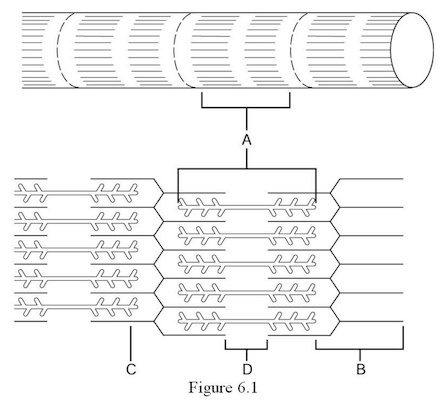 The I band within a skeletal muscle fiber is indicated by ________. A) Label A B) Label B C) Label C D) Label D | back 1 B |
front 2 The A band within a skeletal muscle fiber is indicated by ________. A) Label A B) Label B C) Label C D) Label D | back 2 A |
front 3 The H zone, located within the A band, lacks thin filaments and is represented by ________. A) Label A B) Label B C) Label C D) Label D | back 3 D |
front 4 The myofilament composed of actin is indicated by ________. A) Label A B) Label B C) Label C D) Label D | back 4 C |
front 5 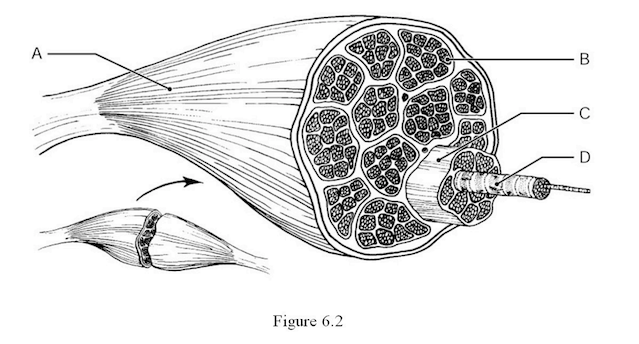 The epimysium is represented by ________. A) Label A B) Label B C) Label C D) Label D | back 5 A |
front 6 The perimysium wraps a fascicle of muscle cells and is represented by ________. A) Label A B) Label B C) Label C D) Label D | back 6 C |
front 7 The muscle fiber (cell) is indicated by ________. A) Label A B) Label B C) Label C D) Label D | back 7 D |
front 8 The endomysium that wraps individual muscle fibers is indicated by ________. A) Label A B) Label B C) Label C D) Label D | back 8 B |
front 9 Striated involuntary muscle tissue is classified as ________ muscle. A) skeletal B) cardiac C) smooth D) either smooth or skeletal | back 9 B |
front 10 The epimysium covering on the outside of the muscle can blend into cordlike ________ or sheetlike ________. A) tendons; aponeuroses B) ligaments; tendons C) fascia; ligaments D) aponeuroses; ligaments | back 10 A |
front 11 The ________ is an organelle that wraps and surrounds the myofibril and stores calcium. A) cross bridge B) sarcomere C) sarcolemma D) sarcoplasmic reticulum | back 11 D |
front 12 Muscle tissue has the ability to shorten when adequately stimulated, a characteristic known as ________. A) elasticity B) irritability C) contractility D) extensibility | back 12 C |
front 13 One neuron and all the skeletal muscles it stimulates is known as a ________. A) sarcoplasmic reticulum B) motor unit C) synaptic cleft D) neuromuscular junction | back 13 B |
front 14 The heads of the myosin myofilaments are called ________ when they link the thick and thin filaments together during skeletal muscle contraction. A) neuromuscular junctions B) synapses C) cross bridges D) motor units | back 14 C |
front 15 The gap between the motor neuron and the muscle fiber it supplies at the neuromuscular junction is called the ________. A) synaptic cleft B) motor unit C) cross bridge D) H zone | back 15 A |
front 16 When a skeletal muscle is fully contracted, the ________ are closer to the thick filaments. A) Z discs B) M lines C) cross bridges D) A bands | back 16 A |
front 17 Anaerobic glycolysis requires ________ to make ATP. A) creatine phosphate B) oxygen C) glucose D) both oxygen and glucose | back 17 B |
front 18 A smooth, sustained contraction is called ________. A) fused, or complete, tetanus B) a twitch C) unfused, or incomplete, tetanus D) summing of contractions | back 18 A |
front 19 Contractions in which muscles shorten and produce movement are known as ________. A) isotonic contractions B) twitches C) isometric contractions D) resistance exercises | back 19 C |
front 20 The point of muscle attachment to an immovable or less movable bone is known as the ________. A) innervation B) action C) insertion D) origin | back 20 D |
front 21 Muscles that perform opposite actions to one another are termed ________. A) synergists B) prime movers C) antagonists D) fixators | back 21 C |
front 22 The arrangement of fascicles in orbicularis oris is ________. A) circular B) convergent C) pennate D) fusiform | back 22 A |
front 23 The muscle that closes each eye is the ________. A) orbicularis oris B) frontalis C) orbicularis oculi D) zygomaticus | back 23 C |
front 24 The prime mover of arm abduction is the ________ muscle. A) trapezius B) deltoid C) latissimus dorsi D) quadratus lumborum | back 24 B |
front 25 The hamstring group is the prime mover of thigh ________ and knee ________. A) extension; flexion B) dorsiflexion; plantar flexion C) abduction; adduction D) rotation; circumduction | back 25 A |
front 26 An inherited disease that causes muscles to degenerate and atrophy is known as ________. A) torticollis B) muscular dystrophy C) cystic fibrosis D) myasthenia gravis | back 26 B |
front 27 Striated involuntary muscle tissue found in the heart is ________. A) smooth muscle B) skeletal muscle C) dense regular D) cardiac muscle E) dense irregular | back 27 D |
front 28 Endomysium covers ________. A) fascicles of muscle cells B) an entire muscle C) an individual muscle cell D) myofibrils E) smooth muscle only | back 28 C |
front 29 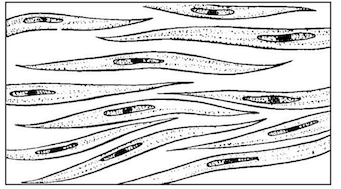 The type of muscle tissue pictured in Figure 6.3 is ________. A) skeletal muscle B) voluntary C) striated D) found only in the heart E) smooth muscle | back 29 E |
front 30 The plasma membrane of a skeletal muscle cell is called the ________. A) sarcolemma B) sarcomere C) myofilament D) sarcoplasm E) sarcoplasmic reticulum | back 30 A |
front 31 Smooth muscle cells are ________. A) multinucleate B) involuntary C) branched D) striated E) cylindrical | back 31 B |
front 32 Which type of muscle tissue contracts most quickly upon stimulation? A) skeletal B) visceral C) cardiac D) smooth E) tendons | back 32 A |
front 33 Which of the following is NOT a function of the muscular system? A) production of movement B) maintenance of posture C) stabilization of joints D) generation of heat E) hematopoiesis | back 33 E |
front 34 A sarcomere is ________. A) the nonfunctional unit of skeletal muscle B) the contractile unit between two Z discs C) the area between two intercalated discs D) the wavy lines on the cell, as seen in a microscope E) a compartment in a myofilament | back 34 B |
front 35 Which one of the following is composed of myosin protein? A) thick filaments B) thin filaments C) all myofilaments D) Z discs E) light bands | back 35 A |
front 36 Cross bridges are created when myosin heads bind to ________. A) thick filaments B) sarcomeres C) thin filaments D) sarcoplasmic reticula E) myosin filaments | back 36 C |
front 37 A motor neuron and all of the skeletal muscle fibers it stimulates are termed a ________. A) myofilament B) synaptic cleft C) motor unit D) neuromuscular junction E) neurotransmitter | back 37 C |
front 38 Why are calcium ions necessary for skeletal muscle contraction? A) calcium increases the action potential transmitted along the sarcolemma B) calcium releases the inhibition on Z discs C) calcium triggers the binding of myosin to actin D) calcium causes ATP binding to actin E) calcium binds to regulatory proteins on the myosin filaments, changing both their shape and their position on the thick filaments | back 38 C |
front 39 The mechanical force of contraction is generated by ________. A) shortening of the thick filaments B) shortening of the thin filaments C) a sliding of thin filaments past thick filaments D) the "accordian-like" folding of thin and thick filaments E) the temporary disappearance of thin filaments | back 39 C |
front 40 Acetylcholine is ________. A) an ion pump on the postsynaptic membrane B) a source of energy for muscle contraction C) a component of thick myofilaments D) an oxygen-binding protein E) a neurotransmitter that stimulates skeletal muscle | back 40 E |
front 41 The gap between the axon terminal of a motor neuron and the sarcolemma of a skeletal muscle cell is called the ________. A) motor unit B) sarcomere C) neuromuscular junction D) synaptic cleft E) cross bridge | back 41 D |
front 42 Neurotransmitters are released upon stimulation from a nerve impulse by the ________. A) myofibrils B) sarcoplasmic reticulum C) thick filaments D) axon terminals of the motor neuron E) sarcolemma of the muscle cell | back 42 D |
front 43 An elaborate and specialized network of membranes in skeletal muscle cells that function in calcium storage is the ________. A) sarcolemma B) mitochondria C) intermediate filament network D) myofibrillar network E) sarcoplasmic reticulum | back 43 E |
front 44 During skeletal muscle contraction, myosin heads attach to binding sites associated with ________. A) myosin filaments B) actin filaments C) Z discs D) thick filaments E) the H zone | back 44 B |
front 45 Which of the following can actually shorten during a muscle contraction? A) myosin filament B) A band C) actin filament D) sarcomere E) myofilamen | back 45 D |
front 46 In order to excite a muscle cell, acetycholine must ________. A) enter the muscle cell by endocytosis B) travel into the axon terminal of the nerve cell by endocytosis C) enter the muscle cell through protein channels D) bind to receptors in the sarcolemma of the muscle cell E) break down acetylcholinesterase in the synaptic cleft | back 46 D |
front 47 Which of these events must occur first to trigger the skeletal muscle to generate an action potential and contract? A) sodium ions rush into the cell B) acetylcholine (ACh) causes temporary permeability to sodium C) diffusion of potassium ions out of the cell D) operation of the sodium-potassium pump E) acetylcholinesterase (AchE) breaks down acetylcholine (ACh) | back 47 B |
front 48 A skeletal muscle twitch differs from a tetanic contraction in that ________. A) the tetanic contraction is considered abnormal, while the twitch is a normal muscle response B) the tetanic contraction is caused by a single stimulus, while the twitch is caused by very rapid multiple stimuli C) the muscle twitch is prolonged and continuous while a tetanic contraction is brief and "jerky" D) the muscle twitch occurs only in small muscles while a tetanic contraction occurs in large muscle groups E) the muscle twitch is a brief and "jerky" movement, while the tetanic contraction is prolonged and continuous | back 48 E |
front 49 Creatine phosphate (CP) functions within the muscle cells by ________. A) forming a temporary chemical compound with myosin B) forming a chemical compound with actin C) inducing a conformational change in the myofilaments D) storing energy that will be transferred to ADP to resynthesize ATP as needed E) storing energy that will be transferred to ATP to resynthesize ADP as needed | back 49 D |
front 50 The condition of skeletal muscle fatigue can be best explained by ________. A) the all-or-none law B) the inability to generate sufficient quantities of ATP due to feedback regulation of synthesis C) insufficient intracellular quantities of ATP due to excessive consumption D) a total lack of ATP E) inadequate numbers of mitochondria | back 50 C |
front 51 Which of the following is an example of an isometric contraction? A) shaking the head as to say "no" B) pushing against an immovable wall C) bending the elbow D) rotating the arm E) nodding the head as to say "yes" | back 51 B |
front 52 Anaerobic glycolysis occurs without ________. A) ATP B) oxygen C) lactic acid D) carbon dioxide E) glucose | back 52 B |
front 53 The least movable point of muscle attachment to a bone is termed its ________. A) bone marking B) function C) insertion D) action E) origin | back 53 E |
front 54 The movement opposite to abduction is ________. A) flexion B) rotation C) circumduction D) adduction E) supination | back 54 D |
front 55 Which of the following muscles closes the jaw? A) buccinator B) zygomaticus C) frontalis D) sternocleidomastoid E) both masseter and temporalis | back 55 E |
front 56 Sandra is playing the piano for her recital. Which muscle is NOT involved in the movement of her hands and/or fingers ________. A) flexor carpi radialis B) flexor carpi ulnaris C) extensor digitorum D) extensor digitorum longus E) extensor carpi radialis | back 56 D |
front 57 Which of these muscles is a synergist to masseter? A) sternocleidomastoid B) temporalis C) trapezius D) buccinator E) orbicularis oris | back 57 B |
front 58 Which muscle helps compress the abdominal contents during defecation or childbirth? A) internal intercostals B) deltoids C) trapezius D) iliopsoas E) rectus abdominis | back 58 E |
front 59 A muscle located on the ventral (anterior) side of the body is the ________. A) pectoralis major B) occipitalis C) gastrocnemius D) gluteus medius E) latissimus dorsi | back 59 A |
front 60 A nursing infant develops a powerful sucking muscle that adults also use for whistling or blowing a trumpet called the ________. A) platysma B) masseter C) zygomaticus D) buccinator E) temporalis | back 60 D |
front 61 What is the main function of the quadriceps group? A) arm flexion B) hand supination C) thigh abduction D) knee extension E) foot inversion | back 61 D |
front 62 A muscle group that works with and assists the action of a prime mover is a(n) ________. A) antagonist only B) fixator only C) synergist only D) antagonist and synergist E) antagonist and fixator | back 62 C |
front 63 Which muscle is an antagonist to gastrocnemius? A) sartorius B) tibialis anterior C) fibularis brevis D) fibularis longus E) soleus | back 63 B |
front 64 Which muscle group includes the biceps femoris, semimembranosus, and semitendinosus? A) abdominal muscles B) quadriceps group C) adductor group D) fibularis muscles E) hamstring group | back 64 E |
front 65 Paralysis of which of the following would make an individual unable to flex the hip ________. A) biceps femoris B) gastrocnemius C) tibialis anterior D) soleus E) iliopsoas | back 65 E |
front 66 Which one of the following muscles is involved in abduction of the arm at the shoulder joint? A) deltoid B) biceps brachii C) triceps brachii D) latissimus dorsi E) pectoralis major | back 66 A |
front 67 What is the origin of the deltoid muscle? A) proximal radius B) proximal humerus C) distal humerus D) olecranon process of ulna E) scapular spine and clavicle | back 67 E |
front 68 While doing "jumping jacks" during an exercise class, your arms and legs move laterally away from the midline of your body. This motion is called ________. A) extension B) flexion C) abduction D) adduction E) circumduction | back 68 C |
front 69 Which of the following muscles are antagonists? A) biceps brachii and triceps brachii B) bicpes femoris and biceps brachii C) vastus medialis and vastus lateralis D) masseter and temporalis E) gastrocnemius and soleus | back 69 A |
front 70 What condition results if muscles are not used, such as when immobilized in a cast for healing a broken bone? A) hypertrophy B) lordosis C) atrophy D) spina bifida E) scoliosis | back 70 C |
front 71 Which one of the following is NOT a criterion generally used in naming muscles? A) relative size of the muscle B) number of origins of the muscle C) shape of the muscle D) method of attachment of the muscle to bone E) action of the muscle | back 71 D |
front 72 T/F: Cardiac and skeletal muscle both possess striations. | back 72 TRUE |
front 73 T/F: All types of muscle have endomysium covering individual muscle cells | back 73 TRUE |
front 74 T/F: Bundles of muscle fibers are known as aponeuroses | back 74 FALSE |
front 75 T/F: The striations seen in skeletal muscle are actually alternating dark A and light I bands. | back 75 TRUE |
front 76 T/F: The sarcoplasmic reticulum wraps like a sleeve around the myofibril and stores and releases calcium. | back 76 TRUE |
front 77 T/F: A neuromuscular junction consists of one neuron and all the skeletal muscles it stimulates | back 77 FALSE |
front 78 T/F: The neurotransmitter used by the nervous system to activate skeletal muscle cells is acetylcholine. | back 78 TRUE |
front 79 T/F: Thick filaments are made of a protein called actin. | back 79 FALSE |
front 80 T/F: Aerobic respiration requires the use of oxygen to generate ATP. | back 80 TRUE |
front 81 T/F: The fastest mechanism for producing ATP is aerobic respiration. | back 81 FALSE |
front 82 T/F: Isometric contractions produce movement when filaments slide past one another and the muscle shortens. | back 82 FALSE |
front 83 T/F: Aerobic, or endurance, exercise involves jogging or biking | back 83 TRUE |
front 84 T/F: A muscle twitch results when the muscle is stimulated so rapidly that no evidence of relaxation is seen. | back 84 FALSE |
front 85 T/F: The effect of the neurotransmitter on the muscle cell membrane is to temporarily modify its permeability of ions such as Na+ and K+. | back 85 TRUE |
front 86 T/F: When a muscle fiber contracts, the I bands diminish in size, the H zones disappear, and the A bands move closer together but do not diminish in length | back 86 TRUE |
front 87 T/F: Abduction and adduction are antagonistic actions. | back 87 TRUE |
front 88 T/F: The deltoid is a prime mover of arm adduction | back 88 FALSE |
front 89 T/F: The deepest muscle of the abdominal wall is the transversus abdominis | back 89 TRUE |
front 90 T/F: The deltoid muscle is a common site for intramuscular injections | back 90 TRUE |
front 91 T/F: Plantar flexion at the ankle joint is accomplished by the tibialis anterior muscle. | back 91 FALSE |
front 92 T/F: The hamstring group inserts into the distal tibia. | back 92 FALSE |
front 93 T/F: Muscle development in babies occurs in a cephalic/caudal direction. | back 93 FALSE |
front 94 T/F: Supination and pronation refer to up and down movements of the foot at the ankle. | back 94 FALSE |