Instructions for Side by Side Printing
- Print the notecards
- Fold each page in half along the solid vertical line
- Cut out the notecards by cutting along each horizontal dotted line
- Optional: Glue, tape or staple the ends of each notecard together
TEST 5 , 24, 25, 32, 33
front 1 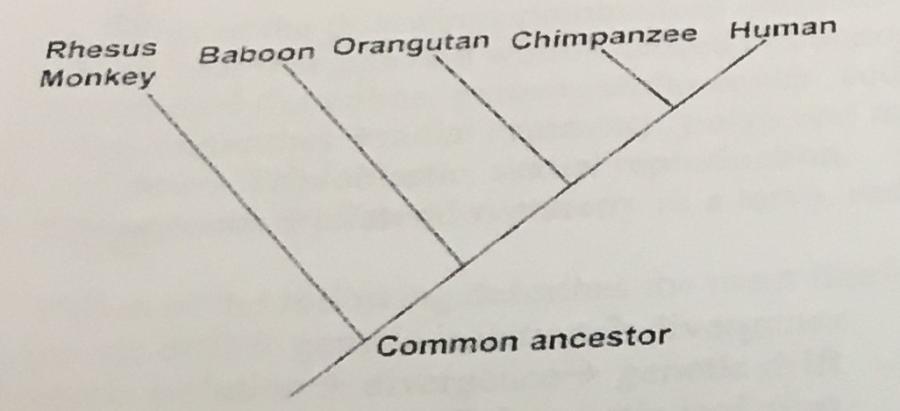 Based on the phylogenetic tree shown below, which statement best describes a relationship between the common ancestor and the organisms shown? A) Rhesus monkeys have exact same DNA as the common ancestor B) Chimpanzees were the first organisms to evolve from the common ancestor. C) The common ancestor is more closely related to humans than to baboons D) The common ancestor shares DNA with all the other organism E) All the organisms on the phylogenetic tree are equally related to the common ancestor | back 1 Answer: D |
front 2 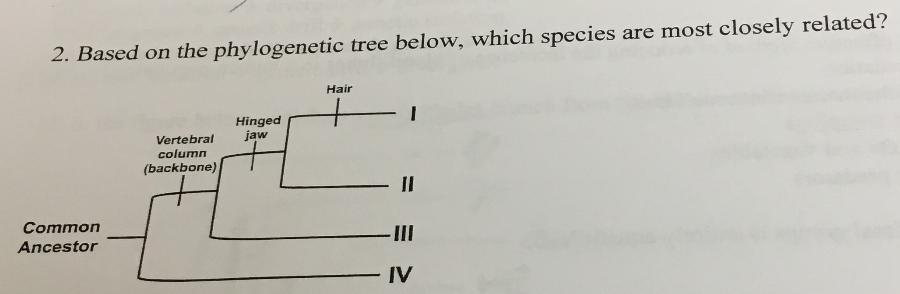 Based on the phylogenetic tree below, which species are most closely related? A) species II B) species I and IV C) species I and II D) species I and III E) species II and III | back 2 Answer: C |
front 3 What do animals as diverse as corals and monkeys have in common? A) body cavity between body wall and digestive system B) number of embryonic tissue layers C) type of body symmetry D) presence of hox genes E) degree of cephalization | back 3 Answer: D |
front 4 Approximately how far back in time does the fossil record extend? A) 3.5 million years B) 5.0 million years C) 3.5 billion years D) 5.0 billion years | back 4 Answer: C |
front 5 The largest unit within which gene flow can readily occur is a A) population B) species C) genus D) hybrid E) phylum | back 5 Answer: B |
front 6 What would be the most effective method of reducing the incidence of
blood flukes in a human population? | back 6 Answer: B |
front 7 Which of the following animal groups is entirely aquatic? | back 7 Answer: C |
front 8 Assuming chimps and gorillas are human's closest relatives removing humans from the great ape clade placing them in a different clade has the effect of making the phylogenetic tree of the great apes A) polyphyletic B) paraphyletic C) monophyletic D) conform with Linnaeus' view of great ape phylogeny | back 8 Answer: B |
front 9 You find a multi-legged animal in your garden and want to determine if it is a centipede or a millipede. You take the animal to a university where a myriapodologist quickly tells you that you have found a centipede. Which of the following traits may have allowed her to make this distinction? A) presence of body segments B) poisonous claws C) egg- laying D) molting E) two pairs of legs per body segment | back 9 Answer: B |
front 10 Macroevolution is ____ A) the same as microevolution, but includes the origin of new species B) evolution above the species level C) defined as the evolution of microscopic organisms into organisms that can be seen with the naked eye D) defined as a change in allele or gene frequency over the course of many generations E) indistinguishable from microevolution | back 10 Answer: B |
front 11 Which of the following combinations correctly matches a phylum to its description? A) nematode --> segmented worms, closed circulatory system B ) cnidaria --> flatworms, gastrovascular cavity, acoelomate C) platyheminthes --> radial symmetry, polyp and medusa body forms D) porifera --> triploblastic; sexual reproduction E) echinoderms --> bilateral symmetry as a larva, radial symmetry as adult | back 11 Answer: E |
front 12 Which of the following describes the most likely order of events in allopatric speciation? A) genetic drift --> genetic isolation--> divergence B) genetic isolation--> divergence--> genetic drift C) divergence--> genetic drift--> genetic isolation D) genetic isolation --> genetic drift--> divergence | back 12 Answer: D |
front 13 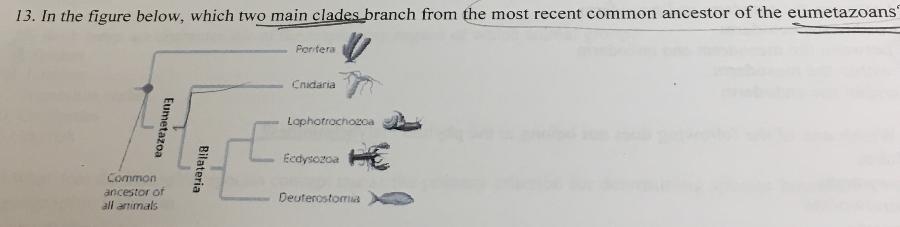 In the figure below, which two main clades branch from the most recent common ancestor of the eumetazoans A) Porifera and Cnidaria B) lophotrochozoa and ecdysozoa C) ecdyzoa and deuterosoia D) cnidaria and bilateria E) deuterostomia and bilateria | back 13 Answer: D |
front 14 Which phylum is characterized by animals that are assymetric and are diploblastic? A) Cnidaria B) Platyhelminthes C) Mollusca D) Nematoda E) Porifera | back 14 Answer: E |
front 15 Which of the following is true of the class, Hexapoda? A) All of them undergo complete metamorphosis B) They all have jointed appendages and a radula C) They have a chitinous exoskeleton D) Their bodies are divided into cephalothorax stomach | back 15 Answer: C |
front 16 During embryological development, the anus forms before the mouth in: A) snails B) vertebrates C) flatworms D) arthropods E) annelids | back 16 Answer: B |
front 17 If the half-life of carbon-14 is about 5,730 years, then a fossil that has 1/8 the normal proportion of carbon-14 to carbon-12 should be about how many years old? A) 2,800 B) 11,200 C) 17,190 D) 22,900 E) 28,650 | back 17 Answer: C |
front 18 The worms in ___ (phylum) occur in raw meats, have a pseudocoelom, an alimentary canal, and an outer covering that shed during molting A) Platyhelminthes B) Arthropoda C) Nematoda D) Annelida E) Mollusca | back 18 Answer: C |
front 19 During animal development, the true coelom develops? A) between the ectoderm and mesoderm B) within the ectoderm C) between the mesoderm and endoderm D)within the mesoderm E) within endoderm | back 19 Answer: D |
front 20 Which of the following does not belong to the phylum Platyhelminthes? A) flukes B) tapeworms C) roundworms D) planaria | back 20 Answer: C |
front 21 Cribrostatin is a substance that has the potential for use in cancer therapy as well as an antibiotic. This compound naturally found in animals belonging to which of the following phyla? A) Poriferan B) Cnidarian C) Myriapoda D) Echinodermata E) Mollusca | back 21 Answer: A |
front 22 Which of the following is not a characteristics of all animals? A) they are all multicellular B) they have tissues, organs and organ systems C) they are eukaryotes D) they are heterotrophic E) they ingest their food | back 22 Answer: B |
front 23 Which two scientists hypothesized that the early earth atmosphere was reducing? A) Miller and Urey B) Gould and Eldredge C) Oparin and Haldane D) Watson and Franklin E) Huxley and Mayr | back 23 Answer: C |
front 24 Which of the following is not a pancrustachean? A) crayfish B) spider C) butterfly D) lobster E) beetle | back 24 Answer: B |
front 25 He was the prominent 20th century biologist who formulated the biological species concept that based on the ability of organisms to interbreed A) Stephen Gould B) Charles Darwin C) Alfred Wallace D) Konrad Lorenz E) Ernst Mayr | back 25 Answer: E |
front 26 Ecdysozoans include all the following except: A) insect B) nematodes C) lobsters D) sea urchins E) scorpions | back 26 Answer: D |
front 27 Book lungs are characteristics of the respiratory organs of which animal group? A) spiders B) lobsters C) horseshoe crabs D) centipedes E) crayfish | back 27 Answer: A |
front 28 What does the biological species concept use as the primary criterion
for determining species boundaries? | back 28 Answer: C |
front 29 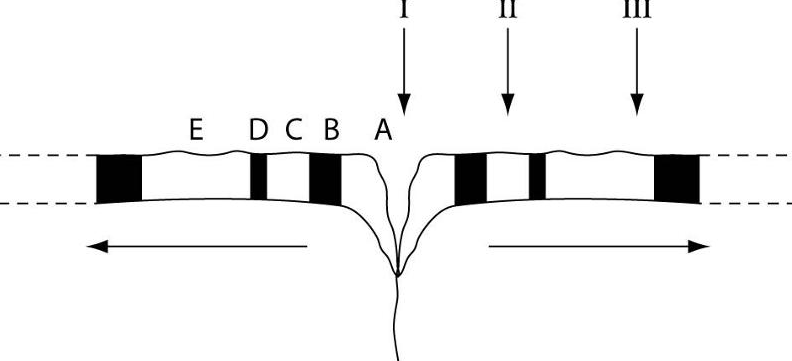 Assuming a continuous rate of sediment deposition, which section of seafloor crust should have the thickest layer of overlying sediment A) A B) B C) C D) D E) E | back 29 Answer: E |
front 30 The teacher and class were especially saddened when the colonial
hydrozoan died. They had watched it carefully, and the unfortunate
creature never even got to produce offspring by budding. Yet, everyone
was elated when Tommy (now recovered) noticed a small colonial
hydrozoan growing in a part of the tank far from the location of the
original colony. The teacher was apparently unaware that these
hydrozoans exhibit | back 30 Answer: E |
front 31 The larvae of some insects are merely small versions of the adult,
whereas the larvae of other insects look completely different from
adults, eat different foods, and may live in different habitats. Which
of the following most directly favors the evolution of the latter,
more radical, kind of metamorphosis? | back 31 Answer: B |
front 32 Which characteristic(s) is (are) shared by both cnidarians and
flatworms? | back 32 Answer: D |
front 33 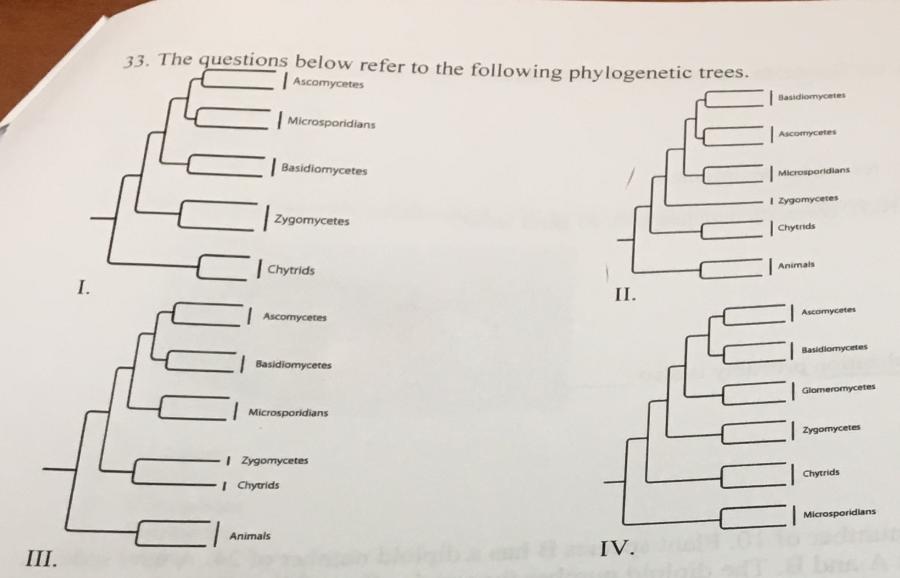 Which tree depicts the microsporidians as a sister group of the ascomycetes? A) I B) II C) III D) IV | back 33 Answer: A |
front 34 If you were using cladistics to build a phylogenetic tree of cats, which of the following would be the best outgroup? A) lion B) domestic cat C) dog D) leopard E) cheetah | back 34 Answer: C |
front 35 A character that evolved in a group after it had branched from a common ancestor is known as ____ A) Ancestral character B) analogous character C) Homologous character D) Derived character E) Exaptation | back 35 Answer: D |
front 36 More species have been extinct from this group than from any other animal group A) echinoderm B) mullusca C) arthropoda D) nematode E) myriapoda | back 36 Answer: B |
front 37 Whatever its ultimate cause(s), the Cambrian explosion ushered in ____ A) mass extinction B) evolutionary stasis C) adaptive radiation D) a large meteor impact E) animal migration from aquatic to terrestial environment | back 37 Answer: C |
front 38 Which tissue type or organism is not correctly matched with its germ layer? A) nervous --> mesoderm B) muscular --> mesoderm C) stomach --> endoderm D) skin --> ectoderm E) skeletal --> mesoderm | back 38 Answer: A |
front 39 An organism that exhibits cephalization probably is also ____ A) bilaterally symmetrical B) a coelomate C) segmented D) diploblastic E) asexual | back 39 Answer: A |
front 40 Plant species A has a diploid number of 12. Plant species B has a
diploid number of 16. A new species, C, arises as an allopolyploid
from A and B. The diploid number for species C would probably be
| back 40 Answer: D |
front 41 What do both nematodes and arthropods share in common? A) develop an anus from the blastopore (pore) formed in the gastrula stage B) they are suspension feeders C) they grow by shedding their exoskeleton D) they have ciliated larvae E) they have a closed circulatory system | back 41 Answer: C |
front 42 The largest clade in lophotrochozoan are the: A) bryozoans B) bivalves C) ectoprocta D) molluses E) platyhelminthes | back 42 Answer: D |
front 43 Three populations of the finches look very similar, but the males have courtship songs that sound different. What function would this difference in song likely serve if the populations came in contact? A) a temporal reproductive isolating mechanism B) a postzygotic isolating mechanism C) a behavioral reproductive isolating mechanism D) a gametic reproductive isolation mechanism E) habitat reproductive isolation | back 43 Answer: C |
front 44 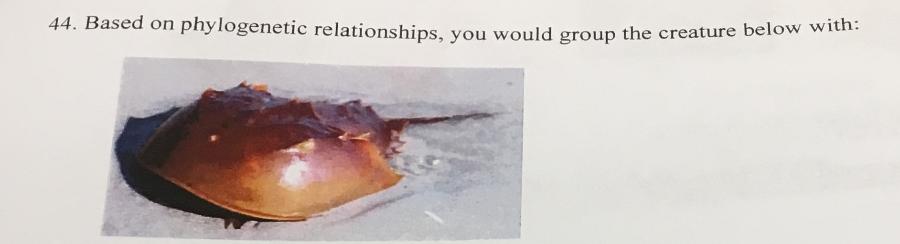 Based on phylogenetic relationships you would group the creature below with : A) Lobster B) Spider C) Centipedes D) Millipedes E) Insects | back 44 Answer: B |
front 45 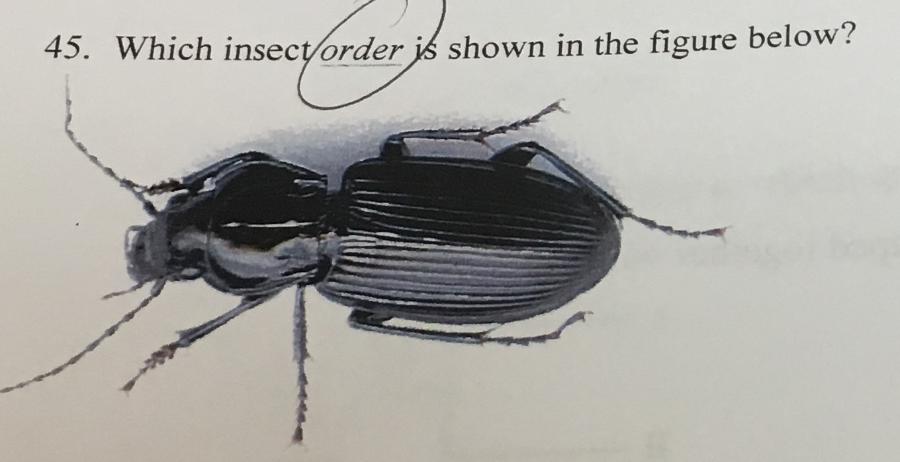 Which insect order is shown in the figure below? A) Diptera B) Coleoptera C) Lepidoptera D) Hymenoptera E) Orthoptera | back 45 Answer: B |
front 46 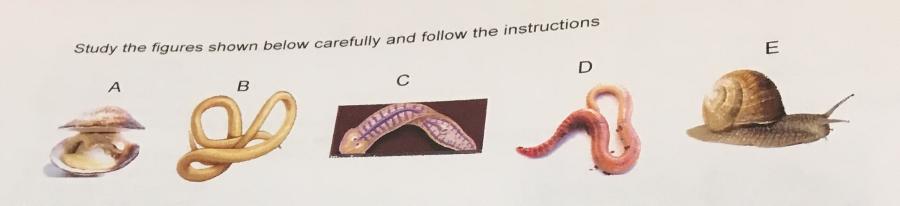 Which of the letter correspond to a gastropod mollusk? A) E B) D C) C D) B E) A | back 46 Answer: A |
front 47 Which letter shows an organism that has Tubellaria as one of its members? A) E B) D C) C D) B E) A | back 47 Answer: C |
front 48 Which letter indicates an organism that can be grouped together with the oyster? A) E B) D C) C D) B E) A | back 48 Answer: E |
front 49 Which letter shows an organism in the phylum Nematoda? A) E B) D C) C D) B E) A | back 49 Answer: D |
front 50 What is the common name of the organism shown in letter D above? A) Roundworm B) Pinworm C) Tapeworm D) Earthworm | back 50 Answer: D |