Biology Exam #2
A phospholipid consists of...
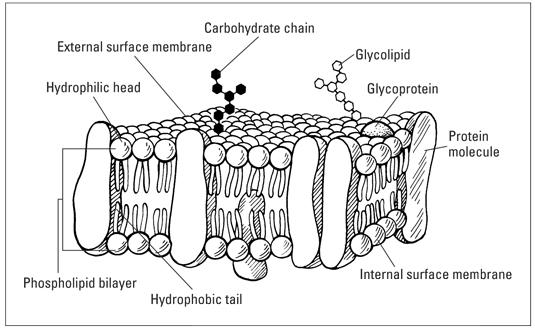
A head: glycerol + phosphate
Tails: 2 fatty acids
Hydrophilic
Water-loving
Hydrophobic
Water-fearing
What is the function of cholesterol?
To stiffen the cell membrane and make it more rigid
Integral Proteins
Embedded; span membrane
Peripheral Membrane
Loosely associated with the outer or inner surface
Carbohydrates
Sugars associated with the outside of the membrane; face extracellular environment
Cell-to-Cell Adhesion/recognition
Fluid Mosaic Model of Membrane Structure
Diffusion
Movement of substances from high to low
Down Concentration Gradient
What kinds of molecules can exit and enter cells by diffusion?
small, hydrophobic
EXAMPLE: gases/lipids
Osmosis
diffusion of H2O through a membrane from an area of low solute (high H2O) to an area of high solute (high H2O).
Tonicity
relative solute concentration of two solutes
Hypotonic:
Low solutes; cell will swell and explode
Hypertonic:
High solutes; cell will shrivel (CRENATION)
Isotonic:
Same solutes: cell will maintain a healthy shape
Plasmolysis
Cell membrane withdraws from the cell wall
Turgor Pressure
H20 pushing outward against cell wall (Hypotonic)
DO NOT BURST
Facilitated Diffusion
Passive transport aided by integral membrane proteins
Channel Proteins
integral membrane protein with a passageway for substances to pass (do not change shape)
EXAMPLE: substances that cannot penetrate the bilayer (charged atoms)
Carrier Proteins
Integral membrane proteins that can change shape
EXAMPLES: sugars; amino acids
Substance binds carrier; carrier changes shape; substance exposed to inside of the cell (continues to equilibrium
Active Transport:
Movement of a substance through a membrane from an area of LOW concentration to HIGH concentration (uphill)
Requires energy; requires integral membrane protein
1/3 of your energy is needed to run pumps!
Endocytosis:
uptake of molecules and particulate matter by forming new vesicles from the plasma membrane
Phagocytosis
"cell eating" LARGE particles
Extensions of the cytoplasm surround the particle to form a vesicle
Pinocytosis
"cell drinking" INVAGINATION
NO psuedopods; membrane pinches to form a vesicle
Receptor Mediated
Substance first binds to a membrane protein receptor
highly selective (LDL: Bad Cholesterol)
Exocytosis
move substances out; secretion of large molecules from the cell by the fusion of vesicles with the plasma membrane
secretory pathway
ACTIVE transport
Metabolism
total of all chemical reactions in a cell
Anabolic
building reactions (monomers to polymers)
require energy
Catabolic
break down (polymers to momomers)
release energy
Endergonic
requires energy (monkey climbing)
Exergonic
releases energy (monkey dropping coconut)
Energy Coupling
Cells couple energy releasing reactions to energy consuming reactions
ATP Hydrolysis
exergonic
release of energy with mechanical energy
Add water to cleave off last phosphate
How is ATP hydrolysis coupled to processes that require energy?
endergonic reactions
ATP------> ADP + P +Energy
Enzymes
catalysts; speed up reactions
ACTIVATION ENERGY
Active Site
Groove or fold in enzyme where substrate binds
Induced Fit
Both enzyme and substrate change their shape
What happens when substrate levels are high and all active sights are occupied
enzyme is saturated and rates level off (Plateau)
REDOX (Oxidation and Reduction Reactions
transfer of electrons from one reactant to another
Oxidation
during catabolism of bonds of food; electrons are released
Delivery to FEA
Fuel e- +Y------> product + Ye-
Y becomes reduced
Reduction
gained electron
Aerobic Respiration
Break down of bonds of our food and release electrons and put them on O2 (final electron acceptor)
Glucose Catabolism
C6H12O6 + 6O2-----------> CO2 + 6H2O + Energy
Glycolysis
Occurs in cytosol
Conversion of glucose to 2 pyruvates
e- are not directly added to oxygen
e- are added to NAD (intermediate electron acceptor) to make NADH
ATP produced by substrate level phosphorylation (2 ATP)
Products: 2 ATP, 2 Pyruvates, 2 NADH
Pyruvate Oxidation
Occurs in matrix of mitochondria
Conversion of 2 pyruvates to acetyl CoA (2)
electrons released from pyruvate during oxidation are added to NAD
No ATP is produced
Products are: 2 NADH, 2 Co2, 2 Acetyl CoA
Kreb's Cycle
Occurs in matrix of the mitochondria
Conversion of 2 acetyl CoA to CO2
Electrons are added to NAD and FAD
ATP is produced by substrate level phosphorylation
Electron Transport Chain
Occurs on CRISTAE: folds of inner membrane of mitochondria
series of electron carriers in the cristae; e- from NADH + FADH2 that were generated in the Kreb's cycle, pyruvate oxidation, and glycolysis are added to the e- carriers here
30-32 ATP
Oxidative Phosphorylation
how electron transport and energy release by the electron transport chain is coupled to ATP formation
Steps of Oxidative Phosphorylation/ETC
1.) electrons pass down the ETC to o2 to form water
2.) this causes H+ ions to be pumped from the matrix of the mitochondria to the intermembrane space. Hydrogen ions accumulate here.
3.) Chemiosmosis----> H+ move down their concentration gradient through ATP synthase, a protein complex in the inner membrane that acts as a "water wheel" or a molecular rotary engine. When it spins, this activates catalytic sites on ATP synthase that bind ADP and P to form ATP
Advantage of Fermentation
regenerate NAD that can be used in glycolysis for ATP production
Somatic Cell
body cell; all cells in body except for eggs and sperm
Karyotype
Picture of chromosomes
Diploid
2 sets of chromosomes (somatic cells)
Homologous chromosomes
same length, centromere position, and carry genes controlling the same traits
Haploid
One kind of chromosome (1 set)
Meiosis
Reduces Chromosome number; occurs in the gonads; starts with diploid germline cell
Prophase 1
Nuclear membrane and nucleolus disappear
centrioles separate and spindle fibers form
chromosomes condense
homologous chromosomes pair up (SYNAPSIS)
Crossing Over
Individual chromosomes that carry information from both parents
source of genetic variation
Chromatid breaks and exchanges with nonsister chromatid
Metaphase 1
Homologous pairs line up on the equator
Anaphase 1
homologous chromosomes separate
Telophase 1
nuclear membrane reforms
spindle fibers disappear
DNA uncoil
END OF MEIOSIS 1
2 haploid cells; reduction division
diploid into haploid
Interphase 2 (or interkinesis)
NO DNA REPLICATION
Prophase 2
Typical prophase events
Metaphase 2
chromosomes line up on the equator
Anaphase 2
Split centromeres and go to opposite poles
Telophase 2
Typical telophase events; cell splits by means of cytokinesis
END OF MEIOSIS 2
4 HAPLOID cells
Independent Assortment
Independent orientation of homologous chromosomes at equator in metaphase 1
Monohybrid Cross
Following of one trait (height)
True Breeding
Plants that produce offspring of the same variety when they self-pollinate
Gene
unit of heredity that is transferred or passed down from a parent to their offspring and determines some characteristics of that offspring
Allele
alternate versions of a gene on the same locus
Genotype
Genetic traits; set of genes in DNA responsible for a trait
Phenotype
Physical traits; physical expression of a gene
Homozygous/Heterozygous
Same: homo
Different: hetero
Dominant Allele
ALWAYS shows up in an organism; captial representation; "stronger" gene
Recessive allele
"hidden" when the dominant allele is present; "weaker" gene represented by a lowercase letter
P Generation
Parent Generation
F1 Generation
Generation resulting immediately from a cross of the P1 generation
F2 Generation
Offspring from the interbreeding of F1 generation
Test Cross
Used to determine if a group exhibiting a dominant trait is heterozygous or homozygous
Principle of Segregation
The two alleles for a heritable characteristic separate during the formation of gametes in meiosis and end up in different gametes at the end
DiHybrid Cross
heterozygous for 2 characteristics
Principle of Independent Assortment
Each pair of alleles segregates independently of each other pair of alleles during gamete formation if the genes are located on different chromosomes
Incomplete Dominance
Not all alleles are fully dominant or recessive
Heterozygous individual: phenotype is intermediate between the parents
Multiple Alleles
genes with more than two alleles in the population
example: blood type
Alleles and Antigens of Blood
IA ------> A antigen
IB-------> B antigen
i----------> no antigen
Pleiotropy
one gene has multiple affects on phenotype
example: sickle cell allele
Polygenic Inheritance
Many genes- One trait
Few phenotypes result from one gene
Examples: hair color; skin tone; height
Multi-Factorial
Traits that depend on multiple genes combined with environmental influences
Y Chromosome
SRY Gene (sex determining region on the Y chromosome) triggers the development of testes
Who is more likely to get a sex-linked disorder?
Males