Chapter 1
Another name for the midsagittal plane is
median.
coronal.
oblique
parasagittal.
None of the above
Median
The ________ cavity contains the heart and lungs.
lateral
abdominopelvic
thoracic
dorsal
Thoracic
An example of a tissue in the body is
a muscle cell.
the stomach.
epithelium.
a macromolecule
Epithelium
Which structure is not covered by visceral serosa?
ribs
lungs
uterus
stomach
None of the above
Ribs
An example of an organ is
a fat cell.
the cardiovascular system (but not the circulatory system).
epithelium.
the intestine.
the intestine
What point or structure in the body is located farthest laterally? (Hint: Questions always refer to the body in the anatomical position)
ear
tip of thumb
the coxal region
little toe
tip of thumb
Which organ system consists of vessels that do not carry blood, but pick up fluids (and some cells) that are leaked from the blood?
integumentary
lymphatic
endocrine
urinary
None of the above
lymphatic
Which organ is not found in the ventral body cavity?
heart
urinary bladder
liver
spinal cord
spinal cord
Which of the following pairs of organs/structures is located ipsilateral?
mouth : navel
cecum : sigmoid colon
descending colon : spleen
right lung : left lung
descending colon : spleen
The buccal region is the
waist.
calf of the leg.
underside of the foot.
cheeks.
cheeks
What is the function of serous membranes?
They reduce friction so that viscera move freely.
They contain gland cells that secrete mucus.
They act like wrapping paper to hold visceral organs together.
They halt the spread of infection.
All of the above
They reduce friction so that viscera move freely.
The extremities are the same as
the ears.
the fingers and toes.
all structures in the head.
the limbs.
the limbs
The axillary artery is found in the region of the
posterior surface of the knee.
vertebral column.
armpit.
long axis of any limb.
armpit
Which structure is located entirely within the right upper quadrant?
gallbladder
spleen
stomach
appendix
gallbladder
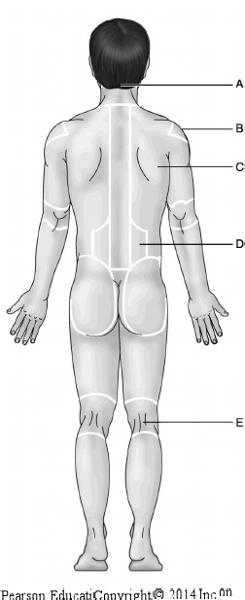
Which letter indicates the acromial region?
B
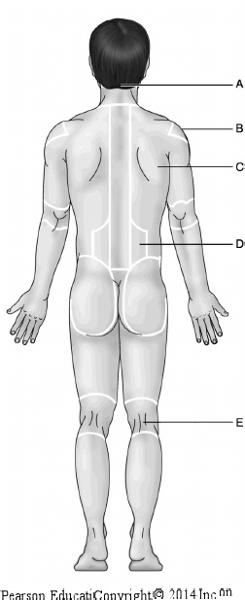
Which letter indicates the lumbar region?
D
The sternal region is ________ to the scapular region.
a. posterior
b. lateral
c. anterior
C. anterior
The thumb is ________ to the index finger
a. posterior
b. lateral
c. anterior
B. lateral
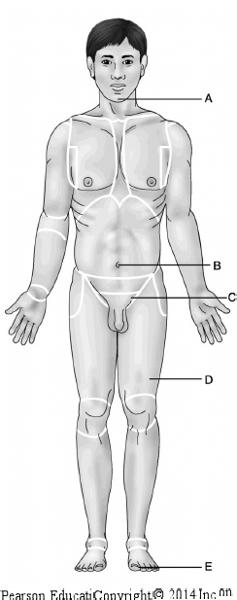
Which letter indicates the hallux?
E
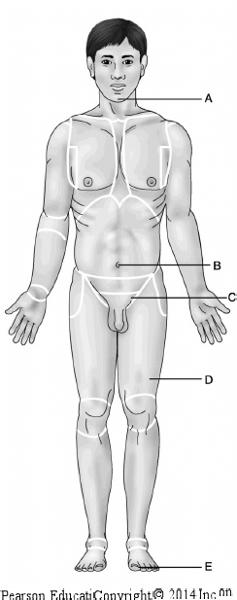
Which letter indicates the inguinal region?
C
Which statement concerning the anatomical position is FALSE?
A. The palms face anteriorly.
B. The knees, elbows, and neck are straight (not bent).
C. The person is lying down, as straight as possible
D. The toes point anteriorly, but the fingers point inferiorly.
C. The person is lying down, as straight as possible
The popliteal region is
A. in the cervical region
B. the side of the leg
C. the inferior part of the gluteal region
D. the posterior surface of the knee
D. the posterior surface of the knee
Which structure is not present in the mediastinum?
A. Trachea
B. Lung
C. Heart
D. Esophagus
E. None of the above
B. Lung
The _____ body cavity contains the brain.
A. ventral
B. serous
C. Lateral
D. Dorsal
D. dorsal
The brain is _____ to the skull.
A. Superior
B. Lateral
C. Anterior
D. Proximal
E. Deep
E. Deep
The Knee is _____ to the foot.
A. superior
B. lateral
C. anterior
D. proximal
E. Deep
D. Proximal
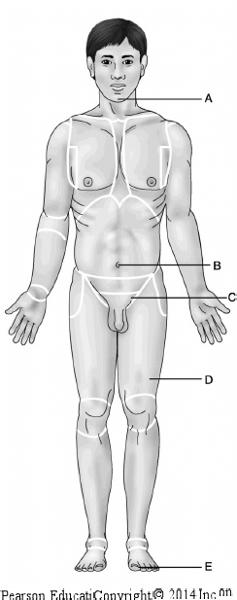
Which letter indicates the mental region?
A