18
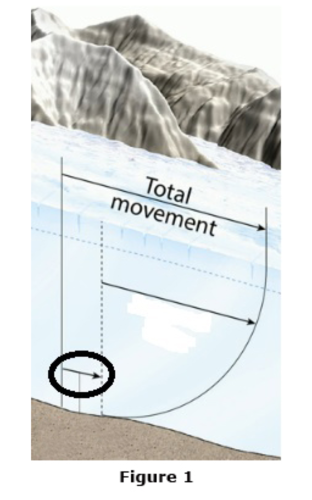
basal sliding
Which type of glacial movement will be responsible for the greatest amount of glacial flow?
internal flow
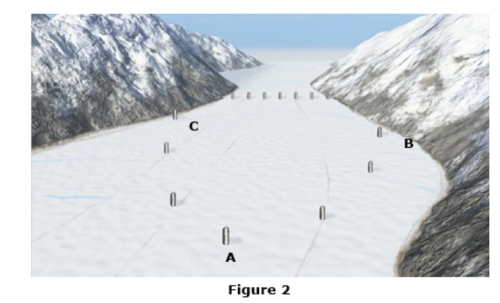
Explain why post A has moved farther than posts B and C.
Ice in the center of a glacier has the least friction with the surrounding bedrock and can flow faster.
Which part of a glacier will see the build-up of ice and snow over the course of a full year?
Zone of Accumulation
How does a glacier lose ice through sublimation?
Ice changes from solid to gas.
Which of the following budget scenarios describes a glacial advance?
More ice and snow accumulates than melts each year.
During a glacial retreat, a glacier will flow _____ while the terminus moves _____.
forward; backward
A __________ is defined as a chain of glacial lakes where each lake flows into the next.
pater noster lake
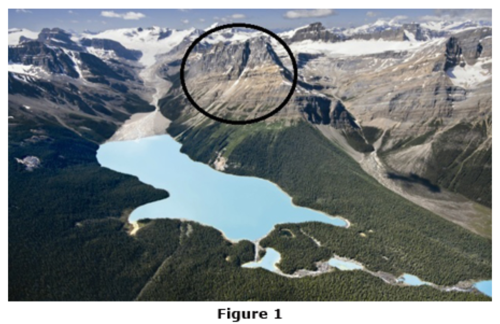
arête
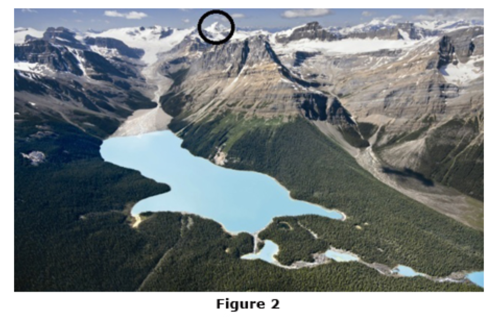
horn
What is the best way to describe the shape of a glacial valley?
U-shaped
Which two regions currently contain the world's last remaining ice sheets?
Antarctica and Greenland
When was the last time North America had major ice sheets?
18,000 years ago
Which landform marks the furthest extent of an advancing glacier?
terminal moraine
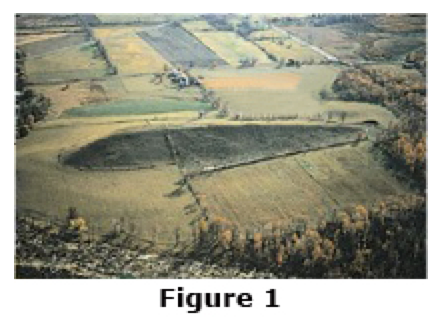
What glacial landform is visible in Figure 1?
drumlin
What feature is responsible for creating eskers?
streams that flowed below, in, or on the glacier
Which orbital effect describes how the shape of Earth's orbit around the Sun will change over time?
eccentricity
What is the critical latitude for incoming solar radiation, which could affect the formation of ice sheets?
65° N
How many years does one complete cycle of precession take?
26,000 years
What effect will an increased angle of tilt have on the Earth's climate?
warmer summers and colder winters
Which of the following scenarios will have the greatest chance of triggering an ice age?
eccentricity, obliquity, and precession overlapping to provide the least amount of solar radiation