Advanced Accounting: Chapter 3 Quiz
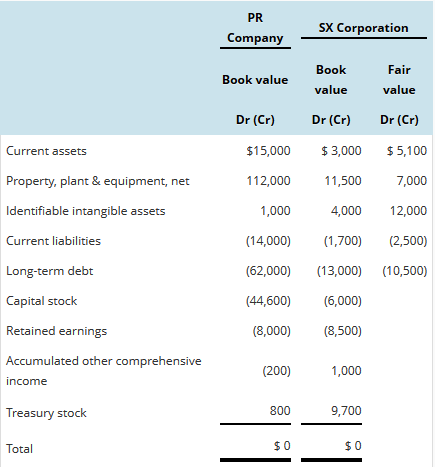
PR Company pays $15,000 in cash and issues stock with a fair value of $45,000 to acquire all of SX Corporation's stock. SX will be a subsidiary of PR. Balance sheet accounts just prior to the acquisition are as follows, in trial balance format:
(look at image)
PR's consultants find these items that are not reported on SX's balance sheet:
---------------------------------------------------------------
Fair Value
Potential contracts w/ new customers $5,000
Advanced production technology $6,000
Future cost savings $1,500
Customer lists $3,000
---------------------------------------------------------------
Outside consultants are paid $300 in cash, and registration fees to issue PR's new stock are $500. Total acquisition cost reported by PR (the debit to Investment on PR's books) is

$60,000
$15,000 + $45,000 = $60,000
PR Company pays $20,000 in cash and issues stock with a fair value of $50,000 to acquire all of SX Corporation's stock. SX will be a subsidiary of PR.
Total acquisition cost reported by PR (the debit to Investment on PR's books) is
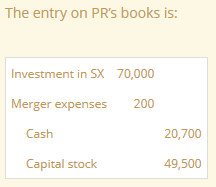
$70,000
PR Company pays $5,000 in cash and issues stock with a fair value of $30,000 to acquire all of SX Corporation's stock. SX will be a subsidiary of PR.
Total acquisition cost reported by PR (the debit to Investment on PR's books) is
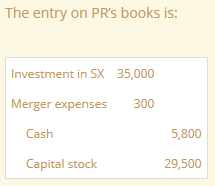
$35,000
PR Company pays $10,000 in cash and issues stock with a fair value of $40,000 to acquire all of SX Corporation's stock. SX will be a subsidiary of PR.
Total acquisition cost reported by PR (the debit to Investment on PR's books) is
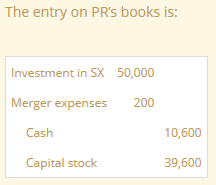
$50,000
PR Company pays $10,000 in cash and issues stock with a fair value of $40,000 to acquire all of SX Corporation’s stock. SX will be a subsidiary of PR.
Total acquisition cost reported by PR (the debit to Investment on PR's books) is
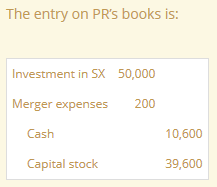
$50,000