Exercise 25 Special Senses: Hearing and Equilibrium
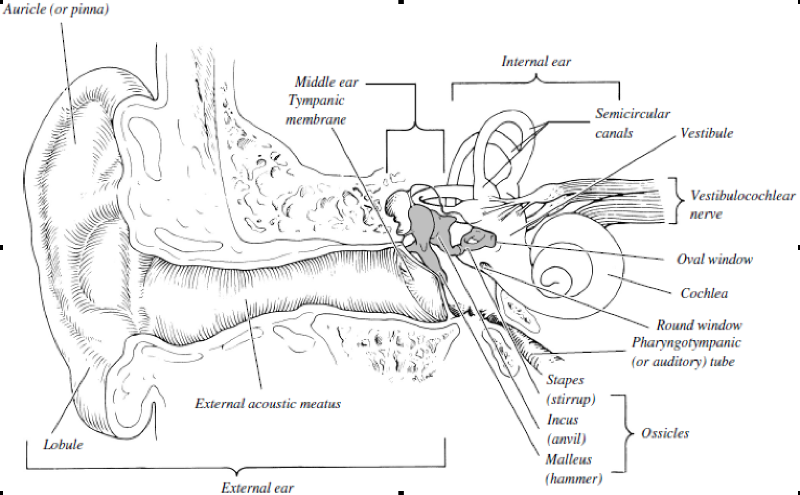
Auricle (pinna)
External acoustic meatus
Tympanic membrane
structures composing the external ear
Semicircular canals
Cochlea
Vestibule
structures composing the internal ear
Incus (anvil)
Malleus (hammer)
Stapes (stirrup)
collectively called the ossicles
Pharyngotympanic (auditory) tube
- involved in equalizing the pressure in the middle ear with atmospheric pressure
- passage between the throat and the tympanic cavity
Tympanic membrane
vibrates at the same frequency as sound waves hitting it; transmits the vibrations to the ossicles
Semicircular canals
Vestibule
contain receptors for the sense of balance
Oval window
transmits the vibratory motion of the stirrup to the fluid in the scala vestibuli of the internal ear
Round window
acts as a pressure relief valve for the increased fluid pressure in the scala tympani; bulges into the tympanic cavity
Endolymph
fluid contained within the membranous labyrinth
Perilymph
fluid contained within the bony labyrinth and bathing the membranous labyrinth
Saccule, Utricle
- sacs found within the vestibule
- sites of the maculae
Cochlear duct
contains the spiral organ
Semicircular ducts
positioned in all spatial planes
Basilar membrane
hair cells of the spiral organ rest on this membrane
Tectorial membrane
gelatinous membrane overlying the hair cells of the spiral organ
Ampulla
contains the crista ampullaris
Otoliths, Saccule, Utricle, Vestibular nerve
function in static equilibrium
Ampulla, Ampullary cupula, Semicircular ducts, Vestibular nerve
function in dynamic equilibrium
Cochlear nerve
carries auditory information to the brain
Ampullary cupula
gelatinous cap overlying hair cells of the crista ampullaris
Otoliths
grains of calcium carbonate in the maculae
Trace the pathway through which vibrations are transmitted to stimulate the hair cells in the spiral organ.
Tympanic membrane > malleus > incus > stapes > oval window > perilymph > cochlear duct > endolymph > basilar membrane with hair cells
Describe how sounds of different frequency (pitch) are differentiated in the cochlea.
The frequency determined by the length and tension of the basilar membrane fibers. High pitch sounds = oval window. low pitch = basilar membrane near apex of cochlea.
Explain the role of the endolymph of the semicircular canals in activating the receptors during angular motion.
When angular motion occurs in one direction, the endolymph in a semicircular canal lags behind, pushing the cupula in a direction opposite to that of the angular motion. Depending on the ear, this depolarizes or hyperpolarizes the hair cells, resulting in enhanced or reduced impulses to the brain.
Explain the role of the otoliths in perception of static equilibrium (head position).
When the head moves, otoliths move in response to variation in gravitational pull. As the deflect different hair cells, they hyper polarize or depolarize hair cells and modify the rate of impulse transmission along vestibular nerve.
Conduction deafness
- can result from the fusion of the ossicles
- can result from impacted cerumen or a perforated eardrum
Sensorineural deafness
- can result from a lesion on the cochlear nerve
- sound heard in one ear but not in the other during bone and air conduction
- can result from a blood clot in the primary auditory cortex
Conduction deafness and Sensorineural deafness
- can result from otitis media
The Rinne test evaluates an individual's ability to hear sounds conducted by air or bone. Which is more indicative of normal hearing?
Air-conducted sound
Nsytagmus
involuntary rolling of the eyes in any direction or the trailing of the eyes slowly in one direction, followed by rapid eye movement in the opposite direction
Vertigo
sensation of dizziness and rotational movement when such movement is not occurring or has ceased
The Barany test investigated the effect that rotatory acceleration had on the semicircular canals. Explain why the subject still had the sensation of rotation immediately after being stopped.
subject has vertigo
What is the usual reason for conduction the Romberg test?
to determine if impulses are being transmitted up the spinal cord to the brain properly
Wast he degree of sway greater with the eyes open or closed? why?
closed; you lose visual reference points
Normal balance, or equilibrium, depends on input from a number of sensory receptors. Name them.
vestibular receptors, visual receptors, somatic receptors
What effect does alcohol consumption have on balance and equilibrium? Explain.
alcohol depresses the neurons and enhances the inhibition of coordination and causes a loss of equilibrium reflexes